Nakamoto joins the corporate BTC reserve race
TechFlow Selected TechFlow Selected
Nakamoto joins the corporate BTC reserve race
The battle among Bitcoin reserve giants is no longer just about companies racing to accumulate BTC.
 Navigating Web3 tides with focused insights
Author: Token Dispatch, Thejaswini M A, Nameet Potnis, Prathik Desai
Translation: Block unicorn

Introduction
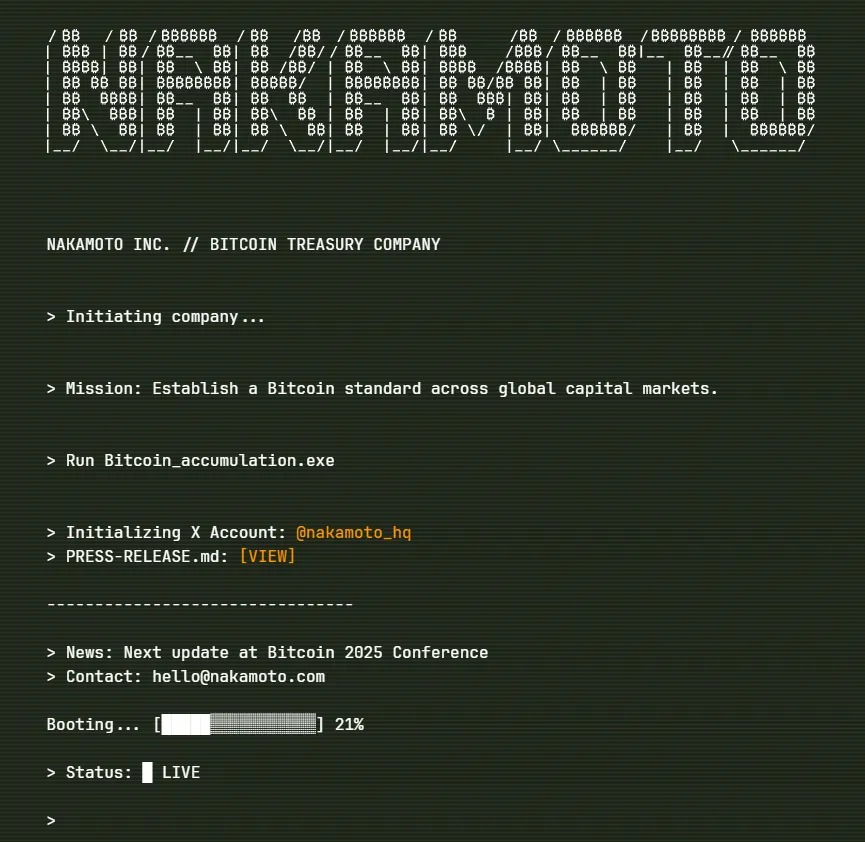
This is the text description on Nakamoto's typewriter-style website about the latest corporate Bitcoin reserve challenger in the cryptocurrency space.
Just two weeks after another company led by giants (such as Tether, Cantor, and SoftBank) launched a pure Bitcoin firm challenging Michael Saylor’s Strategy, Nakamoto Holdings entered the scene with $710 million in capital reserves and a strategy that would make Satoshi proud.
In today's article on corporate Bitcoin reserves, we'll tell you:
-
How Nakamoto's launch intensified the corporate BTC reserve race
-
Why Bernstein's $330 billion prediction has everyone excited
-
Why corporate Bitcoin reserves have suddenly become the hottest topic in crypto
-
How a hotel company now holds more Bitcoin than the sixth-largest national holder
Nakamoto's Bitcoin Strategy
Nakamoto Holdings, founded by David Bailey, CEO of Bitcoin Magazine, announced a merger with healthcare provider KindlyMD, transforming a company treating opioid addiction into Bitcoin’s newest corporate reserve contender.
Why the name Nakamoto?
"The financial institutions that defined chapters of history were named after their founders: Medici, Rothschild, Morgan, Goldman Sachs. Today, we place our bet on Satoshi," said Bailey.
Mission? "To establish the Bitcoin standard in global capital markets."
That’s the text from Nakamoto’s sleek website.
The move comes just two weeks after Jack Mallers’ Twenty One Capital unveiled its $4 billion corporate Bitcoin reserve initiative.
If you thought Mallers’ pure-play corporate Bitcoin bet was groundbreaking, wait until you hear about Bailey’s plan. He is building what he calls the “first publicly traded Bitcoin conglomerate.”
Bailey’s financing strategy includes a fully committed $510 million private investment in public equity (PIPE) offering and $200 million in convertible notes.
The PIPE attracted over 200 investors across six continents, including Adam Back, Balaji Srinivasan, Eric Semler (CEO of Semler Scientific), and Simon Grover (CEO of Metaplanet), signaling strong backing for the venture.
How is this different from Saylor’s Strategy or Mallers’ Twenty One?
"Nakamoto’s vision is to bring Bitcoin to the center of global capital markets—packaged into stocks, bonds, preferred shares, and new hybrid structures that every investor can understand and own. Our mission is simple: list these instruments on every major exchange worldwide," Bailey explained the approach.
Intensifying Corporate Reserve Race
As Nakamoto made its grand entrance, Strategy (formerly MicroStrategy) had just another ordinary Monday—purchasing another $1.34 billion worth of 13,390 BTC.
Strategy’s corporate Bitcoin holdings now reach an astonishing 568,840 BTC, roughly 2.8% of Bitcoin’s total supply.
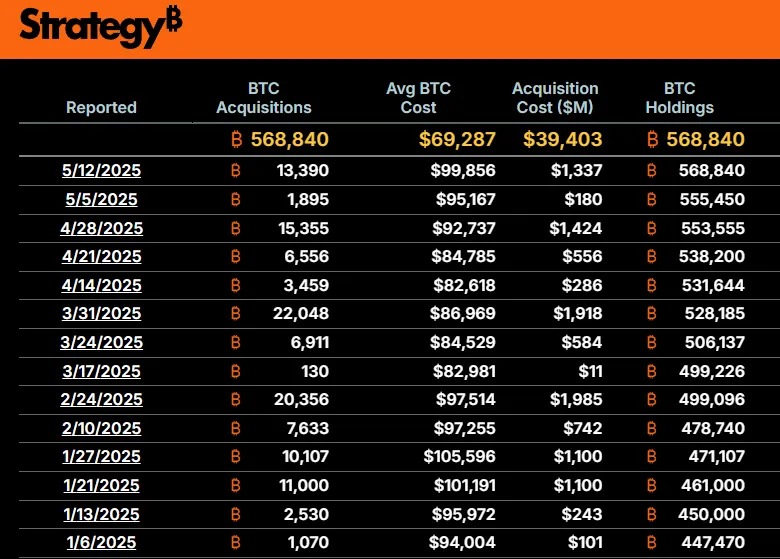
It has added 122,440 BTC in 2025 alone—more than most companies hold in their entire reserves.
Jack Mallers’ project positioned itself as a purer play than Strategy, but now faces competition from Bailey’s broader “Bitcoin company ecosystem” approach.
Even Coinbase revealed it purchased $153 million worth of crypto assets, primarily Bitcoin, last quarter.
"Over the past 12 years, there were definitely moments when we thought, wow, maybe we should put 80% of our balance sheet into crypto—especially Bitcoin," Armstrong told Bloomberg. "We made prudent risk choices."
Today, the race has evolved beyond simple Bitcoin accumulation into a battle over corporate identity.
Who can most convincingly reposition themselves as a “Bitcoin company”? Strategy transformed from a software firm, Twenty One brought in traditional finance players, and now Nakamoto is merging with a healthcare provider. The common thread? An insatiable appetite for Bitcoin.
That hunger is echoed across the Pacific.
Metaplanet, a Japanese firm that only began buying Bitcoin last year, added 1,241 BTC to its balance sheet, bringing its total to 6,796 BTC—worth around $700 million. That’s more crypto than El Salvador, the sixth-largest national holder.

And Metaplanet isn’t alone. Tokyo-based Beat Holdings recently approved raising its Bitcoin investment cap from $6.8 million to $34 million.
Reason? "As countries face deglobalization and escalating trade tensions, they tend to enhance liquidity through expansionary monetary and fiscal policies," the company stated.
The company now holds 143,230 units of BlackRock’s iShares Bitcoin Trust.
The $330 Billion Question
How far can this corporate Bitcoin treasure hunt go?
Bernstein analysts’ latest estimates suggest we’re just getting started.
Corporate Bitcoin reserve strategies could funnel a staggering $330 billion into corporate Bitcoin holdings by 2029.
"Low-growth, high-cash companies are better suited for MSTR’s Bitcoin strategy, especially when they see limited prospects for value creation. MSTR’s success offers them a rare growth path," analysts wrote in a recent report.
In short, at current prices, corporate reserves could absorb approximately 3.3 million BTC within four years. That means over 15% of Bitcoin’s total supply could be locked in corporate vaults within five years.
Still wondering why Bitcoin demand is so strong? Coinbase gave the answer in a brief ad.
What happens when every company wants a piece of the 21 million Bitcoin pie? With each new entrant, the corporate Bitcoin reserve strategy gains legitimacy, potentially creating a feedback loop of accelerating adoption. The corporate FOMO cycle has only just begun.
Our Take
The battle among Bitcoin reserve giants is no longer just about companies racing to accumulate BTC. It’s changing how firms view their balance sheets.
We fully agree with Bailey’s declaration: "We believe that every balance sheet—public or private—will eventually hold Bitcoin." We are witnessing the early stages of a new financial paradigm.
Several key dimensions are emerging from this corporate Bitcoin surge.
First, the speed is staggering. Consider: Metaplanet surpassed an entire nation’s Bitcoin holdings in one year. Strategy added 122,440 BTC in under five months. The pace of corporate adoption exceeds even the most optimistic predictions from previous cycles.
Second, the diversity of participants shows Bitcoin’s appeal is broadening. From software firms to healthcare providers, from Japanese hotel groups to investment firms, Bitcoin is crossing industry boundaries. The era when only a few U.S. tech companies experimented with a mysterious currency largely ignored elsewhere is over. Bitcoin is now a global phenomenon transcending industries and continents.
Third, competitive dynamics are reshaping market structure. Each new corporate entrant not only increases buying pressure but also creates a legitimizing feedback loop, making it easier for the next company to follow. Strategy enabled Twenty One Capital, Twenty One enabled Nakamoto, and Nakamoto will make the next Bitcoin corporate reserve play inevitable.
As more Bitcoin gets locked into corporate vaults, the available supply for retail investors shrinks, potentially causing a supply shock that even the most conservative models haven’t fully accounted for.
The race is on—not just to accumulate Bitcoin, but to secure a position in the future financial order. Companies taking these steps today aren’t merely betting on Bitcoin’s price appreciation; they’re positioning themselves within a new financial system where Bitcoin is the chosen reserve asset for both corporations and nations.
Join TechFlow official community to stay tuned
Telegram:https://t.me/TechFlowDaily
X (Twitter):https://x.com/TechFlowPost
X (Twitter) EN:https://x.com/BlockFlow_News