The U.S.’s First Compliant Perpetual Contract Launches—A Wall Street Transformation Is Underway
TechFlow Selected TechFlow Selected
The U.S.’s First Compliant Perpetual Contract Launches—A Wall Street Transformation Is Underway
Kalshi Approved as the First Compliant Perpetual in the U.S., Officially Legalizing the $90-Trillion Perpetual Market in the United States.
 Navigating Web3 tides with focused insights
By Vaidik Mandloi
Translated by Saoirse, Foresight News
Perpetual futures (Perps) surpassed $90 trillion in annual trading volume last year—exceeding the combined GDP of the world’s top ten economies. Today, perpetuals account for three-quarters of all crypto derivatives trading volume, outpacing the growth rate of any financial instrument in modern history.
Yet until recently, no U.S.-based entity was legally permitted to offer perpetual contracts. That impasse broke last Friday. On May 29, the U.S. Commodity Futures Trading Commission (CFTC) approved Kalshi to list the nation’s first compliant Bitcoin perpetual contract. On the same day, regulators authorized Coinbase to route its users to global perpetual and options products via Dubai-based Deribit.
Following the announcement, HYPE—the native token of leading on-chain perpetual exchange Hyperliquid—surged 30% intraday. Hyperliquid is currently the world’s largest decentralized perpetual exchange—and has never served U.S. users. CFTC Chairman Michael Selig, in a CoinDesk op-ed, defined perpetuals as “an indispensable tool for risk management and price discovery across global crypto markets.” Industry participants witnessing this regulatory shift firsthand were understandably stunned. Below, we unpack its far-reaching implications.
What Are Perpetual Contracts—and How Did They Reach $90 Trillion?
The conceptual origin of perpetual contracts dates back to 1993, when Nobel laureate Robert Shiller published a paper proposing a futures instrument with no expiration date: homeowners could hedge against falling home prices without selling their properties.

Source: WSJ
Though theoretically compelling, the idea lacked practical feasibility under then-existing derivatives market rules. At the time, all futures contracts carried fixed expiration and settlement dates; clearing infrastructure and margin risk controls were built entirely around scheduled settlements—agricultural futures settled monthly, bond futures aligned with coupon dates. The industry had no foundational infrastructure suitable for perpetual instruments, leaving Shiller’s concept confined to academic literature for decades.
In May 2016, Arthur Hayes, Ben Delo, and Sam Reed launched BitMEX in Hong Kong, implementing a refined version of Shiller’s vision: launching Bitcoin perpetual futures with no expiration date, introducing a funding rate mechanism to anchor prices to spot, and offering up to 100x leverage. Within 18 months, BitMEX became the world’s leading crypto derivatives exchange.
How Perpetuals Work
Traditional futures specify fixed expiration dates—for example, a Bitcoin futures contract expiring in June 2026 must be settled at market price upon expiry. To maintain exposure beyond expiry, traders must roll into the next contract cycle—a process that incurs transaction costs and creates temporary gaps in position coverage.
Perpetuals eliminate expiration entirely: traders may hold positions indefinitely and choose to close them after five minutes—or five months. But without an automatic settlement mechanism to tether prices to spot, perpetuals rely on funding rates to continuously narrow the basis between contract and spot prices—ensuring alignment with underlying market fundamentals.
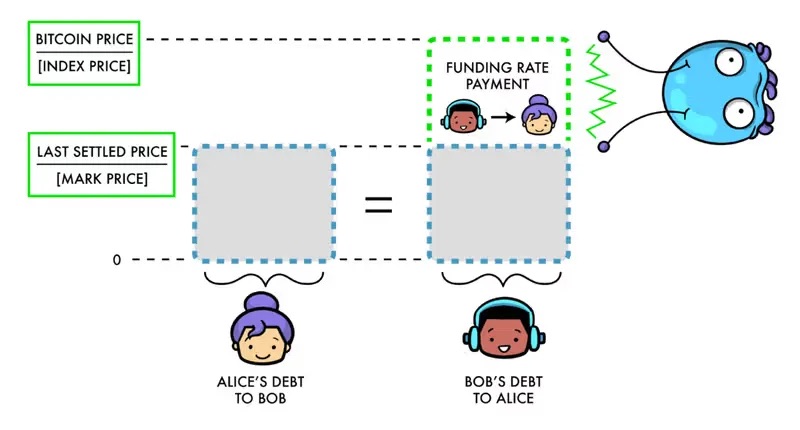
Source: Paradigm.xyz
The core competitive advantage driving rapid adoption: traditional futures fragment liquidity across quarterly contracts (e.g., March, June, September, December), whereas perpetuals concentrate all liquidity into a single order book—dramatically improving execution efficiency. Financial markets exhibit compounding efficiency effects: more participants narrow bid-ask spreads, which in turn attracts additional capital.
Offshore perpetual trading volume surged from $28 trillion in 2023 to over $90 trillion in 2025. Decentralized on-chain perpetuals grew even faster—reaching $6.7 trillion in 2025, a 346% year-on-year increase. On a typical day, perpetual trading volume exceeds spot volume by 10–15x. Crypto asset pricing is now fully dominated by derivatives: most daily Bitcoin moves of ±5% originate on perpetual order books—leveraged liquidations triggering cascading long/short squeezes, with spot prices passively following.
Until this U.S. regulatory milestone, the perpetual market—which effectively sets global prices—remained closed to U.S.-based institutions.
U.S. Regulatory Approval: What Changes for the Industry?
While the U.S. has legalized perpetuals, domestically compliant products differ fundamentally from offshore perpetuals. Even Coinbase must route user orders through its Bermuda subsidiary to Dubai-based Deribit. Offshore markets have accumulated massive liquidity amid years of regulatory ambiguity—liquidity that won’t meaningfully migrate stateside in the short term.
U.S.-compliant perpetuals cap leverage at 10x, with client assets fully segregated and protected under CFTC rules. In contrast, offshore platforms commonly offer 50–100x leverage: with 100x, $1 of margin controls $100 of notional exposure—meaning a 10% move in the underlying doubles or wipes out the position. Under identical 10% moves, a standard one-month Bitcoin call option yields only ~3x return—due to upfront premium payment and time decay. High leverage remains the offshore perpetual’s defining feature; U.S. compliant versions are structurally conservative and functionally distinct.
This explains why HYPE rose sharply post-approval despite initial fears of capital flight to Kalshi or Coinbase. Hyperliquid generated $907 million in revenue last year—without serving a single U.S. user. User cohorts are inherently bifurcated: retail speculators opening 50x short positions on meme coins at 3 a.m. won’t trade 10x Bitcoin on U.S. platforms; institutional allocators requiring regulated custody and asset segregation never intended to use Hyperliquid in the first place.
The CFTC’s approval essentially constitutes official recognition of the perpetuals sector’s legitimacy—a fundamental tailwind for Hyperliquid.
Currently, only Bitcoin-denominated perpetuals have received U.S. regulatory clearance. Hyperliquid, however, has long transcended crypto-native boundaries: under community-governed proposal HIP-3, anyone can launch perpetuals on any underlying asset—and multiple such markets are already live. In February, silver perpetuals hit $4 billion in daily volume; in April, oil perpetuals briefly surpassed Bitcoin in daily turnover.
Jeffrey Sprecher, CEO of Intercontinental Exchange (ICE)—NYSE’s parent company—remarked candidly at Bernstein’s industry conference ahead of the CFTC decision: “The Hyperliquid we’re discussing here is already larger than Nasdaq.” ICE teams have since proactively engaged Hyperliquid to study its product architecture—and even questioned regulators about why traditional exchanges cannot replicate similar offerings. Wall Street is now learning from a two-year-old, venture-capital-free decentralized exchange.
Perpetuals Are Eroding All Traditional Derivatives Markets
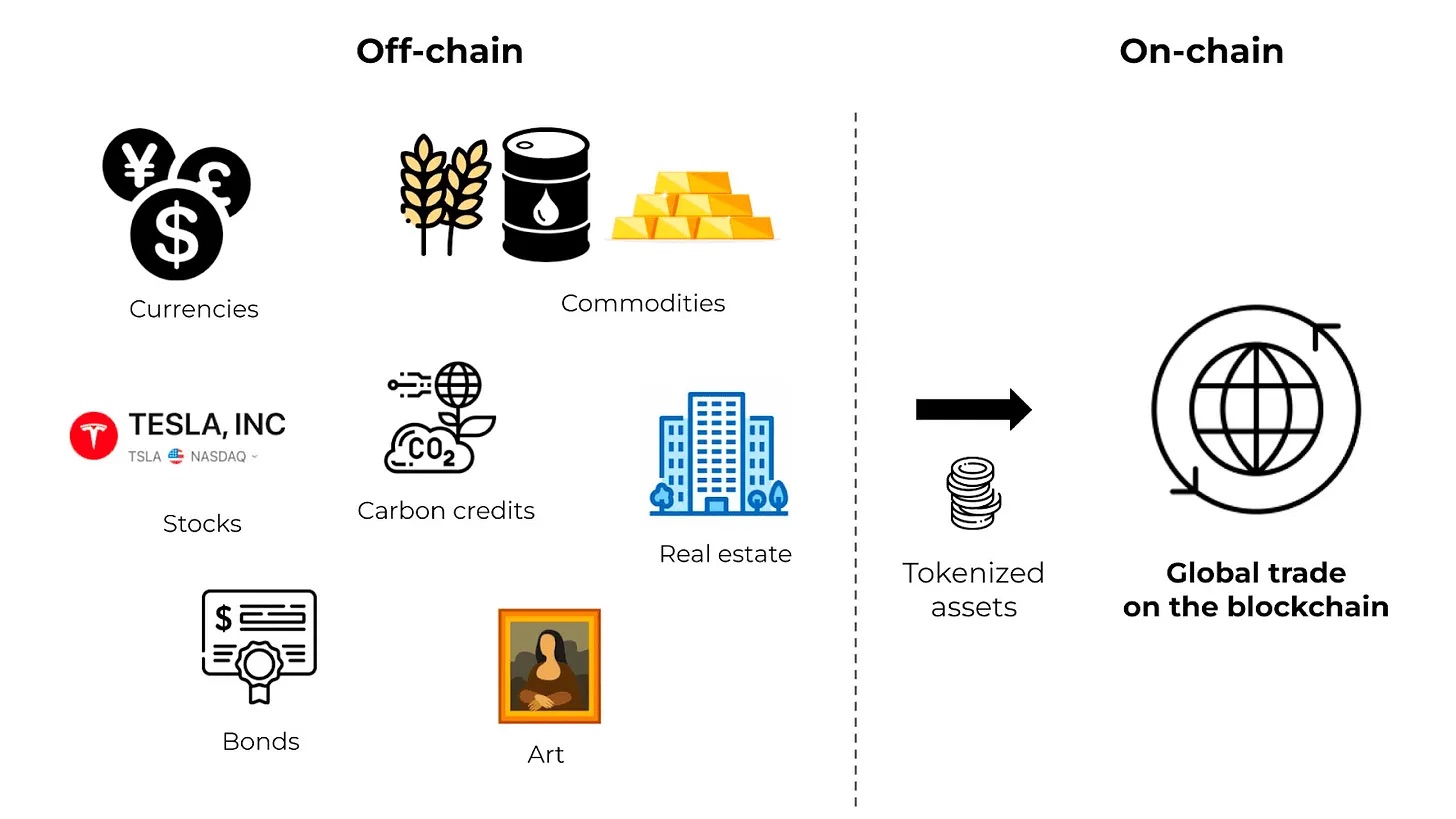
The deeper implication of this regulatory milestone is clear: perpetuals are no longer confined to crypto circles—they are systematically penetrating every asset class.
Product evolution path: from native Bitcoin, to all major altcoins; then to commodities like gold, silver, and crude oil; then to equities including NVIDIA and Tesla—and even pre-IPO equity in firms like SpaceX and OpenAI; finally, under HIP-4, prediction-market-style perpetuals are now live.
Source: EBC Financial Group
In just two years, perpetuals evolved from a crypto-niche innovation into a standardized, 24/7 tradable financial instrument—no expiration, no intermediary clearing, and linkable to any global asset. Traditional derivatives emerged from floor-based, manual trading eras: exchanges observe fixed daily holidays, and contract cycles reflect legacy paper-based settlement rules.
In today’s round-the-clock, globally interconnected digital markets, time-bound traditional instruments suffer inherent gaps: an oil trader seeking exposure ahead of weekend geopolitical flare-ups finds no equivalent instrument on traditional regulated exchanges—but can open a position instantly on Hyperliquid. A CFTC staff memo explicitly affirms this: “Crypto-linked derivatives, supported by digital infrastructure and global reach, are inherently suited to 7×24 continuous trading.”
The next industry battleground: Can U.S. traditional exchanges rapidly iterate products to retain market share? Fee comparisons reveal stark disparities: centralized traditional exchanges charge ~4 basis points for futures; Hyperliquid charges just 2. Spot fees stand at 15 bps on traditional platforms versus 5 bps on Hyperliquid. Switching platforms takes minutes—and capital naturally migrates toward lower-cost venues.
In the week of approval, Compass Point downgraded Coinbase to “Sell,” citing intensifying derivatives competition eroding platform pricing power and margins. Coinbase’s perpetual business generated $50 million in Q1 2026—but retail spot revenue fell to its lowest level since Q3 2024: perpetual growth continues cannibalizing high-margin spot activity.
The entire derivatives profit model is being compressed by perpetuals: holding perpetuals eliminates the need for frequent quarterly futures rollovers (each incurring double fees); most short-term traders hold positions for hours or days—making expirationless perpetuals vastly superior to periodic rollover contracts.
Short-dated options face substitution pressure too: both short-term options and perpetuals enable directional leveraged exposure. Options’ sole remaining edge is capped loss (limited to premium paid). In 2025, average daily U.S. equity 0DTE (zero-day-to-expiry) options volume reached 2.3 million contracts—most purely speculative bets on near-term moves. This demand is readily absorbable by low-cost perpetuals.
This article does not claim perpetuals will wholly replace options or traditional futures. Options’ unique capped-loss profile and non-linear payoff structure remain irreplicable by perpetuals. Yet for the highest-volume segment—short-term leveraged speculation—perpetuals deliver a superior solution via lower cost and no expiration. Their $90 trillion annual volume stands as definitive proof of market validation.
Join TechFlow official community to stay tuned
Telegram:https://t.me/TechFlowDaily
X (Twitter):https://x.com/TechFlowPost
X (Twitter) EN:https://x.com/BlockFlow_News