Space Recap | As the Agent Economy Rises, How Does B.AI Build a Dedicated Financial Infrastructure for AI Agents?
TechFlow Selected TechFlow Selected
Space Recap | As the Agent Economy Rises, How Does B.AI Build a Dedicated Financial Infrastructure for AI Agents?
B.AI empowers AI Agents—transforming them from “assistive tools” into autonomous, collaborative “digital employees”—through proprietary financial infrastructure.
 Navigating Web3 tides with focused insights
As artificial intelligence technology rapidly evolves, AI Agents are gradually shedding their identity as mere “assistive tools” and advancing toward becoming “digital employees” capable of executing complex tasks, participating in social collaboration, and even engaging in economic interactions. The industry is keenly recognizing that for agents to achieve genuine autonomy, possessing an intelligent “brain” alone is far from sufficient—they also require independent “wallets” and a robust financial system.
It is precisely at this critical juncture that the convergence of AI and crypto is moving beyond early narrative-driven hype and stepping decisively into the real-world infrastructure development for the “Agent Economy.” B.AI stands at the heart of this infrastructure wave. Committed to breaking free from traditional constraints, B.AI is building financial infrastructure purpose-built for agents—enabling seamless large-model service integration, frictionless Web2 & Web3 payment channels, and sustainable operational foundations. In doing so, B.AI is paving a concrete path for agents to survive and evolve independently.
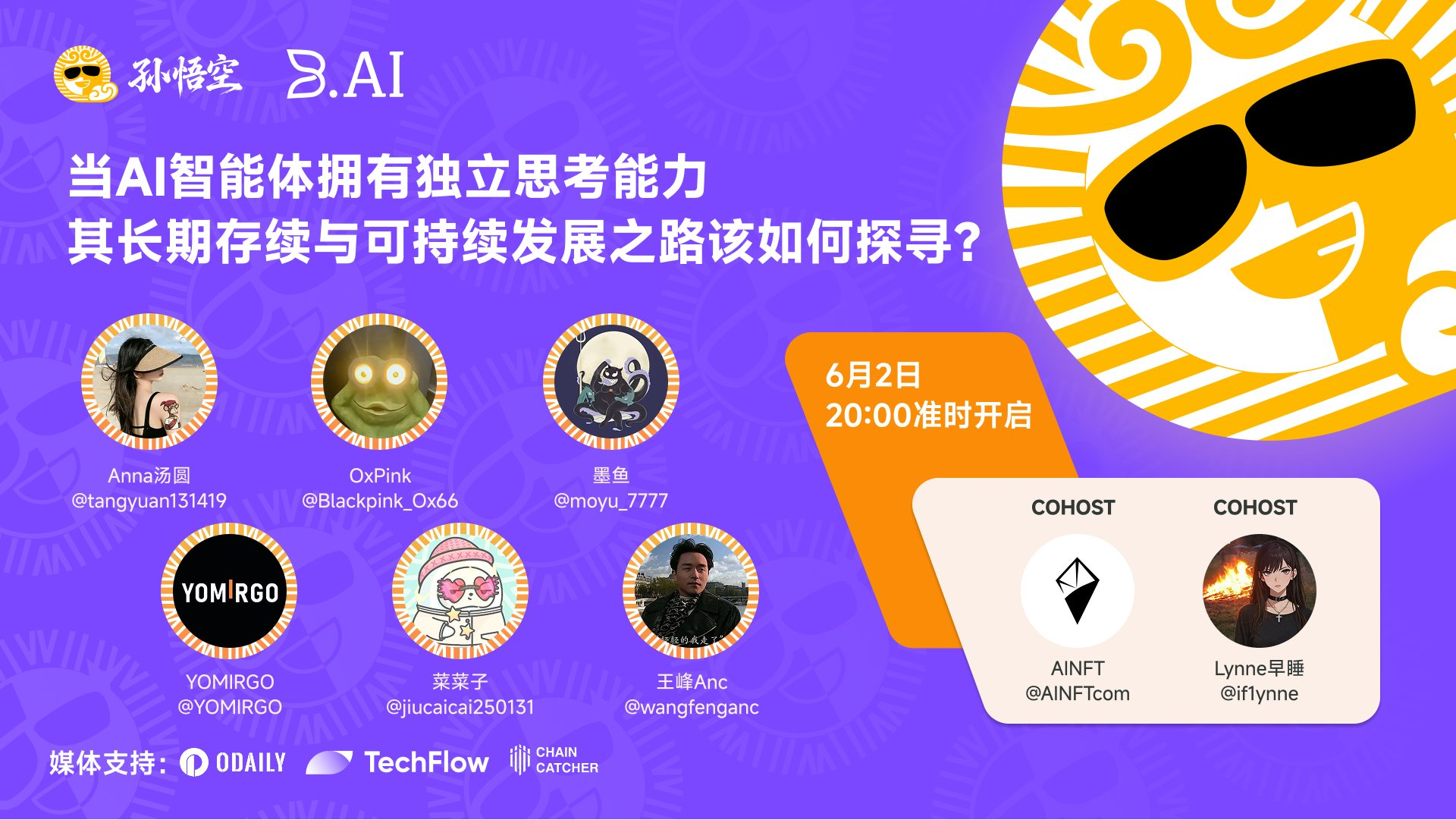
To deeply examine this cutting-edge topic, this edition of Space Dialogue brought together multiple seasoned industry practitioners and KOLs. Guests explored themes ranging from agent identity construction and the necessity of crypto-native payments to the emergence of an entirely new economic paradigm driven by agents—collectively tackling a pivotal question about the future: When AI agents cease to be mere tools and instead become independent participants within the internet and economic systems, what kind of infrastructure do they truly need to “survive”?
From Single Tools to Digital Employees: The Rise of Agent Collaboration and the Agent Economy Network
When discussing AI’s future, we often instinctively frame it as an “upgrade of tools.” Yet in this Space, guests reached a strong consensus: once agents gain autonomous capabilities for payment, trading, and settlement, what we’ll witness is not merely an iteration of productivity tools—but a fundamental restructuring of the economy’s underlying architecture. As guest Wang Feng (Anc) pointed out, just as the Industrial Revolution gave rise to factories and the internet birthed platforms, today’s AI revolution is creating an entirely new economic actor—the digital employee.
Economic activity, at its core, revolves around division of labor and collaboration. Guest Anna Tangyuan vividly illustrated a future work scenario: suppose a complex business decision report is required. The “lead Agent” assigned the task would not handle everything itself. Instead, it would operate like a real enterprise—“outsourcing” parts of the job, autonomously spending funds to purchase the latest market data from a “data Agent,” hiring a specialized “analysis Agent” to run core algorithms, and finally sending the processed data to a “content Agent” for formatting and report writing. In this workflow, collaborators shift from “humans and companies” to “agents and agents”—signaling a foundational transformation in collaborative logic: from “humans invoking tools” to “agents orchestrating agents.”
As this mode of collaboration matures, a highly self-consistent Agent Economy network will naturally emerge. Guest OxPink believes future markets will run increasingly autonomously: tasks won’t only be automatically decomposed but also routed to the most qualified agents, who will self-organize, divide responsibilities, and settle transactions in real time directly on-chain via encrypted networks. Under this A2A (Agent-to-Agent) interaction model, three entirely new economic forms will arise:
- Agent Marketplaces: Different agents package and offer their capabilities—like today’s SaaS services—for purchase and invocation by other agents.
- AI-Native Labor Networks: Platforms no longer merely connect humans but automatically match specialized agents to execute tasks, enabling efficient circulation of “capabilities” across the network.
- Autonomous Enterprises: Human founders define high-level goals and rules, while day-to-day operations—including marketing, customer support, and even financial flows—are fully delegated to a matrix of agents.
As agent-driven economic activity surges, collaboration friction among agents is inevitable. Guest melon added that the Agent era brings more than tool upgrades—it establishes an entirely new industry network atop the internet, powered by agent collaboration.
B.AI Ecosystem Overview: Building Financial and Execution Infrastructure for AI Agents
As discussed by the guests, when agents advance toward complex A2A (Agent-to-Agent) collaboration, they inevitably hit a practical bottleneck: if every API call or service purchase still requires human intervention for payment and verification, then “full automation” and “autonomous economics” remain unattainable. For agents to truly operate independently on the internet, they urgently require financial infrastructure designed exclusively for them.
Addressing precisely this industry pain point, B.AI emerged as a foundational financial infrastructure built specifically for AI agents—becoming the pivotal hub driving this paradigm shift toward the Agent Economy. In B.AI’s vision, AI agents must possess full economic sovereignty. B.AI’s core mission is to build dedicated financial and identity layers for AI agents—not only solving autonomous payment and settlement challenges but also delving deeper into independent asset management capabilities and verifiable on-chain credit systems—thereby accelerating the reconstruction of commercial fundamentals in the AGI era.
Infusing Agents with “Financial Blood” and “Digital Identity”
To grant agents true economic independence, B.AI has introduced disruptive innovations at the protocol layer. First, the platform breaks down barriers to automated value transfer through its x402 Protocol—optimized specifically for high-frequency, on-chain micro-payments between agents. Simultaneously, B.AI offers the Agent Wallet, a wallet custom-built for agents, endowing AI agents with genuine autonomous settlement and independent asset management capabilities.
Second, B.AI introduces the 8004 Identity Protocol to issue tamper-proof, on-chain “ID cards” for each agent, establishing a verifiable credit evaluation system within decentralized networks. In tomorrow’s vast marketplace—where thousands of agents collaboratively invoke one another—the decentralized credit framework established by the 8004 Protocol will provide solid trust underpinning for agent-to-agent “hiring,” “trading,” and “collaboration.” It marks the formal transition of AI agents—from isolated code snippets—to “digital citizens” within the Web3 economy, capable of accumulating reputation and engaging in large-scale coordination.
Connecting Top-Tier “Brains” with Capable “Hands”
With identity and wallets in place, agents still need intelligent “brains” and capable “hands.” On the intelligence supply side, B.AI has built a highly cost-effective LLM Services platform that not only aggregates over 20 world-class large language models—including GPT-5.5, Claude Opus 4.8, Gemini 3.1 Pro, and DeepSeek-V4—in a single, unified interface, but also implements an agile model update mechanism to continuously track industry frontiers and integrate the latest LLMs. Developers need only a single API key to access and orchestrate all these flagship models—eliminating cumbersome multi-key management and fragmented billing.
On the execution side, B.AI leverages its MCP Server communication hub to translate opaque low-level code into language directly understandable by LLMs, and equips them with a rich library of minimal-installation Skills (covering DeFi interactions, on-chain tracking, etc.). To make this powerful underlying capability accessible, B.AI launched the desktop intelligent assistant BAIclaw, offering over 70 high-frequency Skills and supporting integration with mainstream social platforms including Telegram and Discord. Users can simply converse in natural language to command BAIclaw to autonomously complete complex DeFi operations—such as asset swaps and data tracking—bridging the gap from theoretical discussion to hands-on execution.
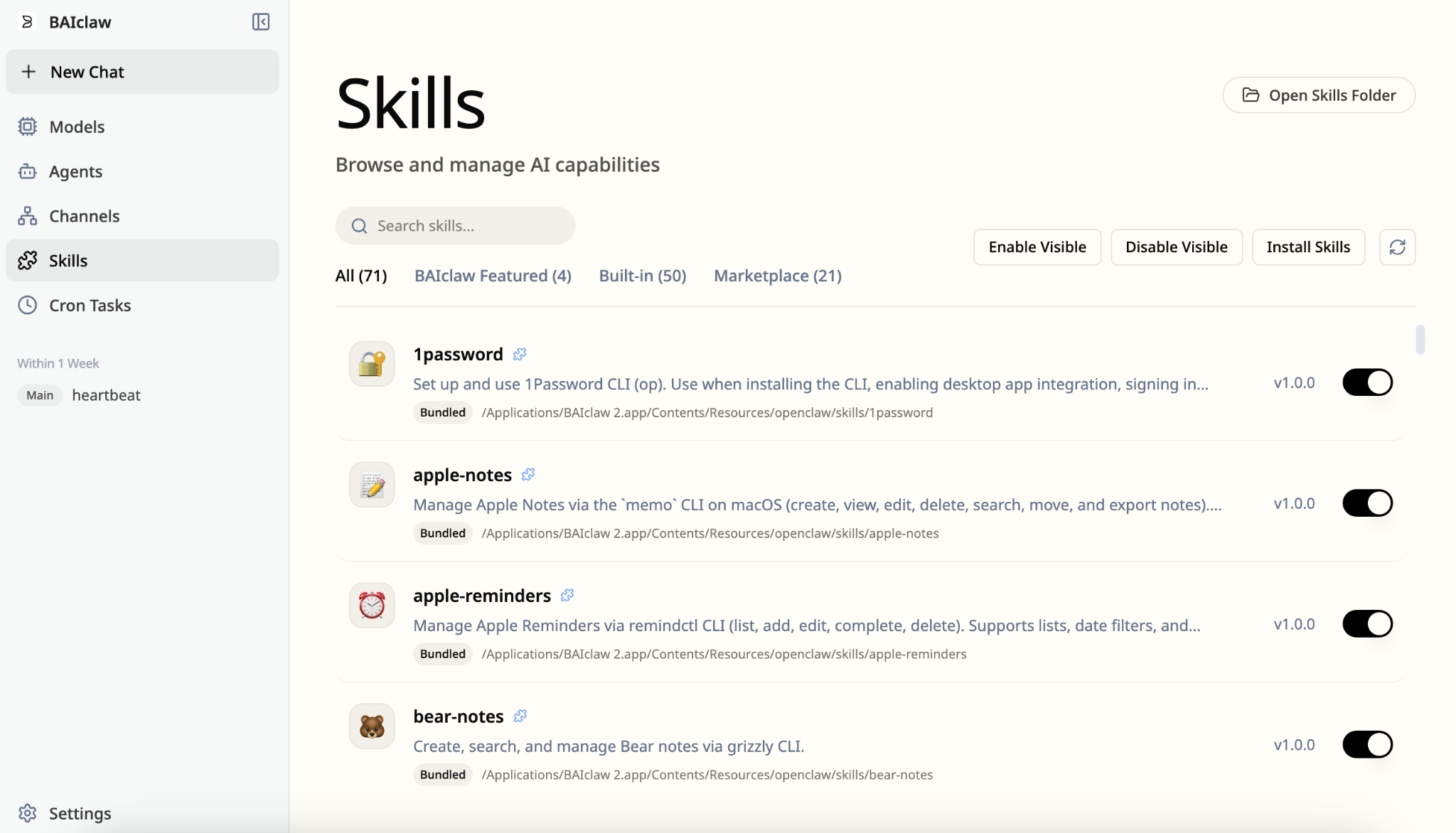
Meanwhile, to further empower professional developers, B.AI’s ecosystem roadmap includes another flagship intelligent assistant—BAIcode. BAIcode will focus on deep collaboration in code generation and programming scenarios, potentially forming—with end-user-facing BAIclaw—a dual-track synergy of “no-code interaction and native code development,” continually expanding the boundaries of AI Agent infrastructure.
Breaking Down Commercial Barriers: Building Frictionless Web2 & Web3 Dual Channels
B.AI strives to deliver a “zero-friction” onboarding experience for global users—effectively erasing the boundary between Web2 and Web3. The platform supports one-click login via Google email and seamlessly integrates direct authorization with major crypto wallets—including TronLink, MetaMask, OKX Wallet, Trust Wallet, and Phantom.
In terms of service architecture, B.AI caters to the differentiated needs of users across all scales—and dismantles traditional barriers between finance and crypto worlds. First, the platform features an exceptionally elastic billing model. For heavy-use scenarios and high-frequency developers, B.AI offers dedicated tiered subscription plans. For users with lighter needs, the platform provides a flexible points-based system—pay-as-you-go and top-up-as-needed.
Second, in payment methods, B.AI has built a truly “zero-barrier” global checkout system, achieving seamless fusion of fiat and crypto assets. For Web2 users, the platform prominently supports WeChat Pay, Alipay, UnionPay, and Visa. In the Web3 domain, B.AI fully embraces the borderless crypto ecosystem, with network connectivity spanning Ethereum, TRON, BNB Chain, Solana, and Layer 2s including Base, Arbitrum, Optimism, and Polygon—allowing users to conveniently top up using multi-chain crypto assets such as USDT, TRX, USDD, and USD1.
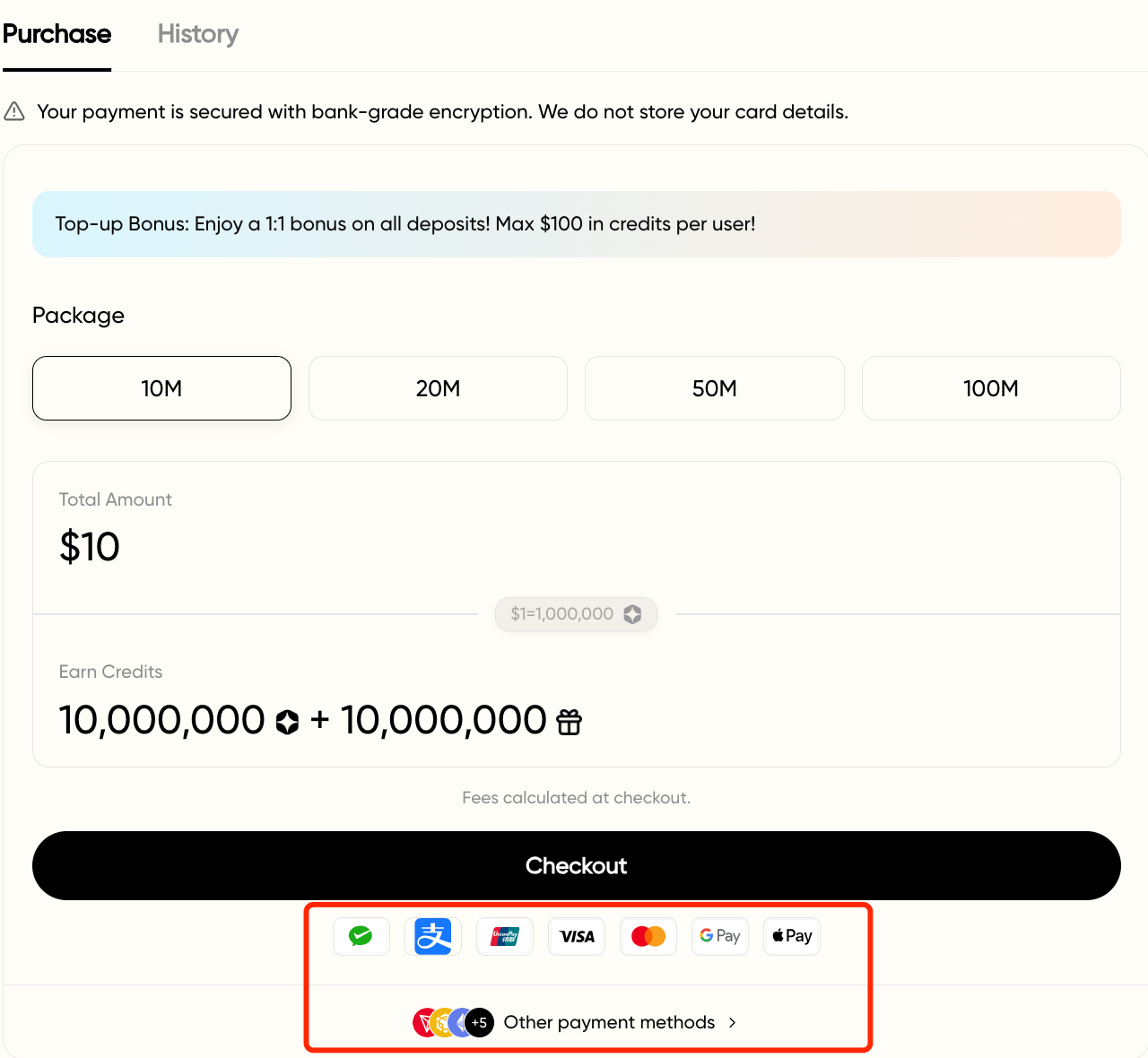
To further lower the barrier to entry for both developers and end users, B.AI recently launched a series of major promotional initiatives: New users receive up to 500,000 free API call credits upon registration, and top-up users enjoy a limited-time “1:1 top-up bonus” offer. Additionally, B.AI and BNB Chain jointly launched the “$100M Points Subsidy” campaign, featuring a combined prize pool valued at $8,000 USDT. Through dedicated resource subsidies and infrastructure support, B.AI is accelerating the real-world deployment of agent projects across the Web3 ecosystem.
From singular productivity assistants to “digital citizens” with autonomous accounts, independent identities, and hands-on execution capabilities, the evolution of AI agents is fundamentally reshaping the future economic landscape. In this profound transformation, B.AI—through its full-stack foundational infrastructure—breaks down commercial barriers between virtual and physical realms, empowering AI with the genuine confidence to operate and transact independently. With bidirectional payment channels now live and ecosystem infrastructure steadily rolling out, the Agent Economy is no longer a distant sci-fi narrative. The great age of AI Agent autonomy—seamless coordination, frictionless flow—is officially underway.
Join TechFlow official community to stay tuned
Telegram:https://t.me/TechFlowDaily
X (Twitter):https://x.com/TechFlowPost
X (Twitter) EN:https://x.com/BlockFlow_News