








Cobo: Web3 Institutions' Definite Opportunity in an Uncertain World
TechFlow Selected TechFlow Selected
Cobo: Web3 Institutions' Definite Opportunity in an Uncertain World
"The future of digital assets is a co-creation and win-win for the entire ecosystem," this is not only a trend but also an inevitable path for industry development.
 Navigating Web3 tides with focused insights
By: Lily Z.King
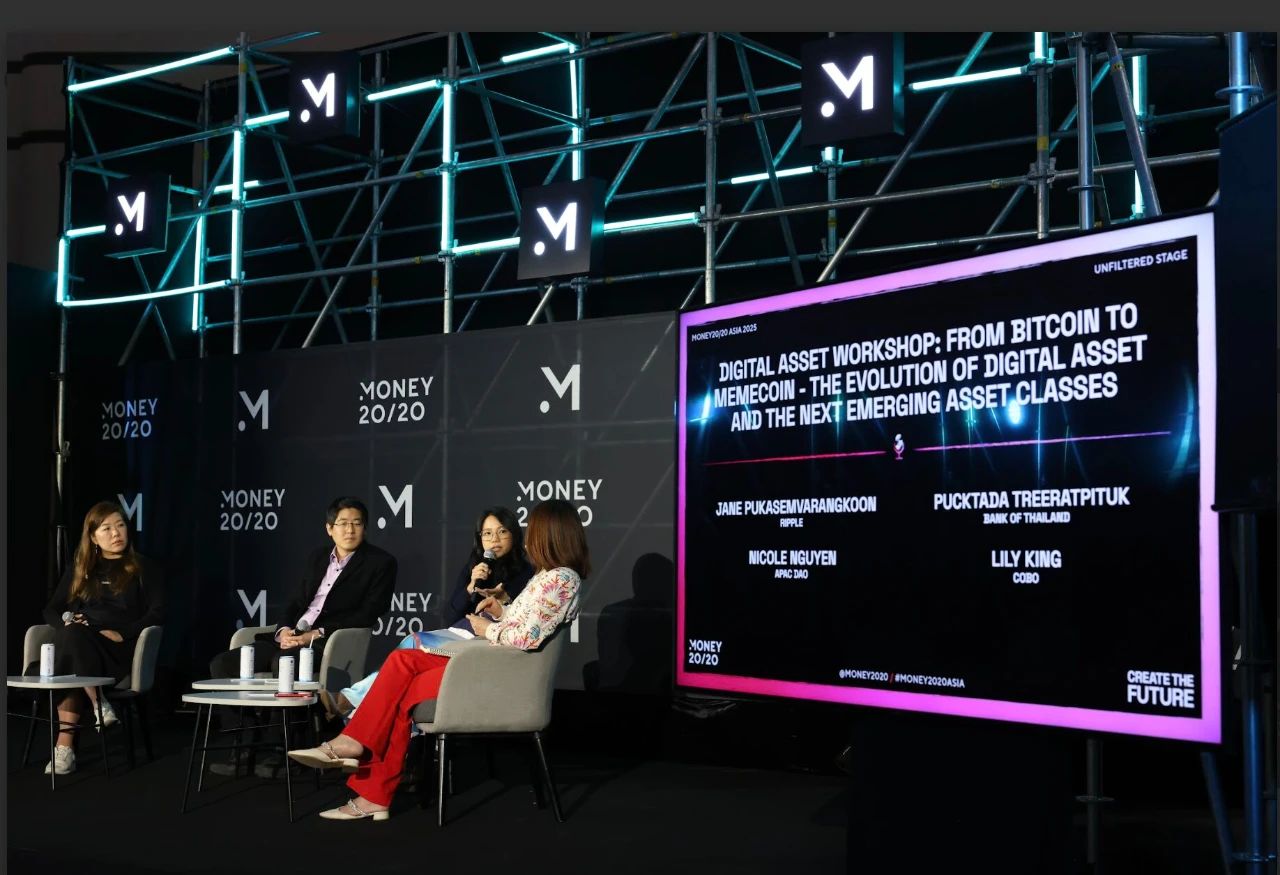
In April, the globally renowned fintech event Money20/20 Asia 2025 was held in Bangkok. Cobo COO Lily Z.King was invited to participate in a roundtable discussion hosted by APAC DAO founder Nicole Nguyen, alongside Pucktada Treeratpituk, Head of Payment Systems and Fintech at the Bank of Thailand, and Jane Pukasemvarangkoon, Strategic Customer Director for Ripple's Asia Pacific region, to discuss trends, opportunities, and challenges in digital asset development.
We've compiled Lily’s key insights from this discussion to share with Cobo users and readers.
From DeFi to RWA: Structural Upgrading of On-Chain Assets
Over the past few years, the blockchain world has experienced waves of ICOs and the boom of DeFi, innovations primarily driven by crypto-native communities. However, as on-chain incentives gradually diminish and DeFi yields normalize, purely on-chain assets are becoming less attractive. At this point, real-world assets (RWA) have emerged at the right time, offering users new investment opportunities.
RWA brings stable returns from traditional financial markets onto the blockchain—such as the 4–5% yield from U.S. Treasury bonds—while leveraging blockchain technology to enable instant settlement, global accessibility, and full transparency. BlackRock’s BUIDL fund is one of the best examples, reaching $1.4 billion in规模 within just one year. This marks institutional investors’ growing recognition and active participation in on-chain asset investments.
More importantly, the RWA wave has only just begun. In the future, art, intellectual property, farmland, green energy projects, startup equity, and even personal income rights will gradually be tokenized. This is not merely an expansion of asset categories, but rather a structural upgrade of on-chain assets.
Meanwhile, the pioneering crypto-native community will surely rise again, although such resurgence may occur only within niche domains and audiences, rather than entering the mass market.
Stablecoins Emerge as Mainstream Payment Solutions Amid Global Trade Uncertainty
Currently, global trade is facing complex dynamics with escalating trade tensions, significantly increasing friction costs for cross-border capital flows. Against this backdrop, inherently borderless assets like stablecoins and Bitcoin on blockchains are playing increasingly important roles.
Thanks to their features—instant settlement, borderless access, and 24/7 operation—these assets are gradually becoming mainstream channels for global capital movement. Unaffected by geopolitical factors, they offer truly neutral payment pathways, effectively helping institutions and individuals reduce risks and costs arising from global trade uncertainties.
The Essence of Web3 Development: Integration of Technological Innovation and Meme Culture Communities
Web3 is not merely a technological revolution, but also a profound socio-cultural phenomenon. The rise of meme coins clearly exemplifies this trend. Rather than viewing meme coins simply as speculative instruments, we should see them as the "first lesson" for younger generations entering the blockchain world. Carried by pop culture, meme coins help new users quickly become familiar with operations on decentralized exchanges (DEX), liquidity pools, and self-custody wallets.
This fusion of culture and technology not only promotes broader adoption of digital assets but also brings a large number of next-generation users into the industry, laying a solid foundation for sustained growth in digital assets.
Biggest Challenge to Digital Asset Adoption: Wallet Security and Usability
In traditional finance, bank accounts serve merely as endpoints for storing and transferring assets. In the Web3 world, however, wallets are the core gateway to all on-chain activities. This grants wallets immense functionality, but also introduces complexity and security risks.
To achieve widespread adoption of digital assets, wallet infrastructure must continuously evolve and improve. Emerging technological innovations such as MPC wallets, account abstraction, smart contract wallets, and zero-knowledge proofs are effectively lowering entry barriers for users. This is precisely the direction Cobo’s product suite is advancing toward.
Moreover, the integration of AI Agent technology will significantly enhance wallet security, building a more robust asset protection system.
Multilateral Collaboration and Ecosystem Win-Win: The Future Path of Digital Assets
The future of digital assets will not be dominated by any single asset, market, or participant type, but will require collective participation across the entire ecosystem. We need both stable, reserve-like assets such as Bitcoin, and creative, culturally driven assets such as meme coins.
In addition, structured regulation in mature markets and large-scale institutional investor participation bring stable capital and professional management, while emerging markets and individual users inject innovation vitality and diversified demand into the ecosystem.
"The future of digital assets is a co-created, win-win endeavor across the entire ecosystem"—this is not only a trend, but an inevitable path for industry development.
Join TechFlow official community to stay tuned
Telegram:https://t.me/TechFlowDaily
X (Twitter):https://x.com/TechFlowPost
X (Twitter) EN:https://x.com/BlockFlow_News
 Cobo
Cobo


