MCP + AI Agent: A New Framework for Artificial Intelligence Applications
TechFlow Selected TechFlow Selected
MCP + AI Agent: A New Framework for Artificial Intelligence Applications
With the continuous advancement of AI technology and the gradual maturation of the MCP protocol, broader applications in areas such as DeFi and DAO are expected in the future.
 Navigating Web3 tides with focused insights
Author: BitMart Research
1. Introduction to the MCP Concept
Previously in the field of artificial intelligence, traditional chatbots mostly relied on generic dialogue models and lacked personalized character settings, resulting in responses that often appeared monotonous and impersonal. To address this issue, developers introduced the concept of "character setting," assigning AI specific roles, personalities, and tones to make its responses better align with user expectations. However, even with rich character settings, AI remained a passive responder, unable to proactively execute tasks or perform complex operations. Thus, the open-source project Auto-GPT emerged. Auto-GPT allows developers to define a set of tools and functions for AI and register them into the system. When users make requests, Auto-GPT generates corresponding operation instructions based on predefined rules and tools, automatically executes tasks, and returns results. This transforms AI from a passive conversationalist into an active task-executing AI.
Although Auto-GPT achieved a certain level of autonomous execution, it still faced challenges such as inconsistent tool-calling formats and poor cross-platform compatibility. To solve these issues, MCP (Model Context Protocol) was developed to address key challenges in AI development, particularly the complexity involved in integrating with external tools. The core goal of MCP is to simplify the interaction between AI and external tools by providing a unified communication standard, enabling AI to easily invoke various external services. Traditionally, enabling large-scale models to perform complex tasks—such as checking weather or browsing web pages—required developers to write extensive code and tool descriptions, significantly increasing development difficulty and time costs. By defining standardized interfaces and communication specifications, the MCP protocol greatly simplifies this process, allowing AI models to interact with external tools more quickly and efficiently.
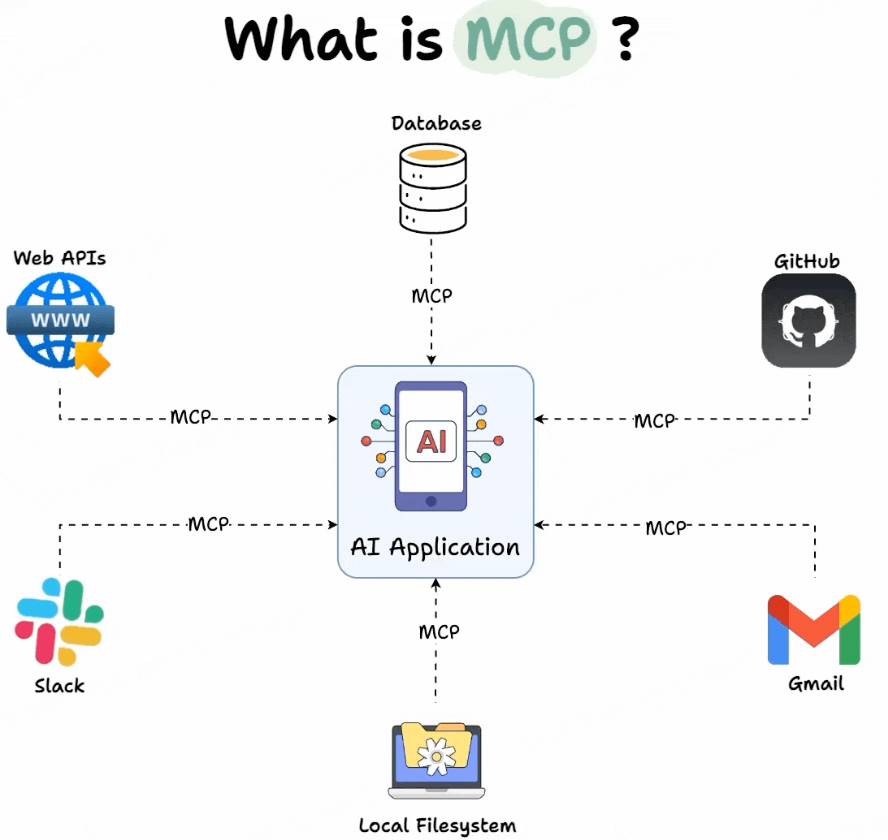
2. Integration of MCP and AI Agents
MCP and encrypted AI Agents have a mutually reinforcing relationship. The difference lies in that AI Agents primarily focus on blockchain automation, smart contract execution, and crypto asset management, emphasizing privacy protection and integration with decentralized applications. MCP, on the other hand, emphasizes simplifying interactions between AI Agents and external systems by providing standardized protocols and context management, enhancing cross-platform interoperability and flexibility. Encrypted AI Agents can achieve more efficient cross-platform integration and operations through the MCP protocol, thereby improving their execution capabilities.
Previous AI Agents had some execution capabilities, such as executing transactions or managing wallets via smart contracts. However, these functions were typically pre-defined and lacked flexibility and adaptability. The core value of MCP lies in providing a unified communication standard for AI Agents to interact with external tools—including blockchain data, smart contracts, and off-chain services. This standardization resolves the problem of fragmented interfaces in traditional development, enabling AI Agents to seamlessly connect with multi-chain data and tools, significantly enhancing their autonomous execution capability. For example, DeFi-focused AI Agents can use MCP to obtain real-time market data and automatically optimize investment portfolios. Moreover, MCP opens up new directions for AI Agents—specifically, collaboration among multiple AI Agents: through MCP, AI Agents can collaborate by functional division, combining efforts to complete complex tasks such as on-chain data analysis, market forecasting, and risk control management, thus improving overall efficiency and reliability. On-chain transaction automation: MCP connects various trading and risk-control agents, addressing issues like slippage, transaction wear, and MEV, enabling safer and more efficient on-chain asset management.
3. Related Projects
1. DeMCP
DeMCP is a decentralized MCP network. It aims to provide self-developed, open-source MCP services for AI Agents, offer a deployment platform with revenue-sharing for MCP developers, and enable one-stop integration with mainstream large language models (LLMs). Developers can access services by paying in stablecoins (USDT, USDC). As of May 8, its token DMCP has a market cap of approximately $1.62 million.
2. DARK
DARK is an MCP network built on Solana operating within a Trusted Execution Environment (TEE). Its token $DARK launched on Binance Alpha and had a market cap of about $11.81 million as of May 8. Currently, DARK's first application is under development and will leverage TEE and the MCP protocol to provide AI Agents with efficient tool integration capabilities, allowing developers to quickly connect to various tools and external services through simple configuration. Although the product has not been fully released, users can join the early access phase via email waitlist to participate in testing and provide feedback.
3. Cookie.fun
Cookie.fun is a platform focused on AI Agents within the Web3 ecosystem, aiming to provide users with a comprehensive index and analytical tools for AI Agents. By displaying metrics such as cognitive influence, intelligent following ability, user engagement, and on-chain data, the platform helps users understand and evaluate the performance of different AI Agents. On April 24, the Cookie.API 1.0 update introduced a dedicated MCP server, featuring plug-and-play MCP servers specifically designed for agents, tailored for both developers and non-technical users, requiring no configuration.
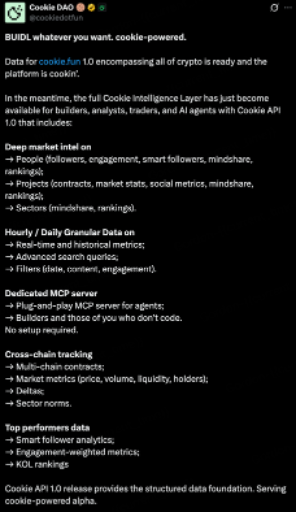
Source: X
4. SkyAI
SkyAI is a Web3 data infrastructure project built on BNB Chain, aiming to build blockchain-native AI architecture by extending MCP. The platform provides scalable and interoperable data protocols for Web3-based AI applications and plans to simplify development processes by integrating multi-chain data access, AI agent deployment, and protocol-level utilities, thereby promoting practical AI applications in blockchain environments. Currently, SkyAI supports aggregated datasets from BNB Chain and Solana, with over 10 billion rows of data. In the future, it plans to launch MCP data servers supporting Ethereum Mainnet and Base chain. Its token SkyAI launched on Binance Alpha and had a market cap of approximately $42.7 million as of May 8.
4. Future Outlook
As a new narrative for the convergence of AI and blockchain, the MCP protocol demonstrates significant potential in improving data interaction efficiency, reducing development costs, and enhancing security and privacy protection—especially in use cases like decentralized finance (DeFi), where it holds broad application prospects. However, most current MCP-based projects remain at the proof-of-concept stage and have yet to release mature products, leading to sustained declines in token prices after listing. For example, the DeMCP token dropped 74% in price within less than a month of launch. This reflects a crisis of market confidence in MCP projects, primarily due to long development cycles and lack of real-world application deployment. Therefore, accelerating product development, ensuring tight alignment between tokens and actual products, and improving user experience are core challenges facing current MCP projects. Additionally, promoting the MCP protocol within the crypto ecosystem still faces technical integration hurdles. Due to differences in smart contract logic and data structures across blockchains and DApps, developing unified, standardized MCP servers requires substantial development resources.
Despite these challenges, the MCP protocol itself shows considerable market potential. As AI technology advances and the MCP protocol matures, broader applications in areas such as DeFi and DAOs are expected. For instance, AI agents could use the MCP protocol to access on-chain data in real time and execute automated trades, improving the efficiency and accuracy of market analysis. Furthermore, the decentralized nature of the MCP protocol could provide AI models with a transparent and traceable operating platform, advancing the decentralization and tokenization of AI assets. As a key enabler in the integration of AI and blockchain, the MCP protocol—with ongoing technological maturation and expanded use cases—has the potential to become a major engine driving the next generation of AI agents. However, realizing this vision will require overcoming multifaceted challenges related to technical integration, security, and user experience.
Risk Warning:
The information provided is for general reference only and should not be considered as advice to buy, sell, or hold any financial assets. All information is provided in good faith. However, we make no express or implied representations or warranties regarding the accuracy, completeness, effectiveness, reliability, availability, or completeness of such information.
All cryptocurrency investments (including yield) are inherently highly speculative and involve significant risk of loss. Past, hypothetical, or simulated performance does not necessarily indicate future results. The value of digital currencies may rise or fall, and there are significant risks associated with buying, selling, holding, or trading digital currencies. You should carefully consider whether trading or holding digital currencies is suitable for you based on your personal investment objectives, financial situation, and risk tolerance. BitMart does not provide any investment, legal, or tax advice.
Join TechFlow official community to stay tuned
Telegram:https://t.me/TechFlowDaily
X (Twitter):https://x.com/TechFlowPost
X (Twitter) EN:https://x.com/BlockFlow_News
 @BitMart_zh