Exclusive Interview with Wang Xin: From Kuaiqiao's "Technology Is Not Guilty" to Web3's "Technological Fairness"
TechFlow Selected TechFlow Selected
Exclusive Interview with Wang Xin: From Kuaiqiao's "Technology Is Not Guilty" to Web3's "Technological Fairness"
Wang Xin shared his reflections on the past, his dedication to fair technology, and his belief in starting anew amid the Web3 wave.
 Navigating Web3 tides with focused insights
Author: Zen, PANews
During the golden era of China's internet development, KuaiBo was once a legend in countless people's hearts. The video player once occupied 80% of domestic video traffic and served over 500 million users. Its creator—Wang Xin—has experienced life’s dramatic rise and fall, from peak to rock bottom.
After regaining freedom, Wang Xin briefly returned to public view with renewed energy. But his entrepreneurial "second spring" didn’t go smoothly. As the hype around new products faded, Wang Xin gradually "retired," sinking into silence for years.
It wasn’t until early 2025 that Wang Xin reignited his entrepreneurial passion, announcing full commitment to Web3, focusing on the intersection of AI Agents and crypto economics. He introduced the concept of “technological fairness,” positioning it as the core value of his next venture.
In a recent exclusive interview with PANews, Wang Xin candidly shared reflections on his past, his persistence in pursuing fair technology, and his renewed belief in setting off again within the Web3 wave.
Twice Approaching Blockchain Without Entering
In 2011, Wang Xin first encountered Bitcoin. Out of curiosity about decentralized currency, he read its source code and mined a small amount. However, since he was focused on KuaiBo at the time, he didn't invest much effort or spend significant time studying it. Back then, BTC seemed more like an experimental toy for tech enthusiasts—highly volatile and uncertain in prospects.
"Looking at Bitcoin now, my mindset is completely different." Over a decade later, Wang Xin’s perspective has fundamentally shifted. On one hand, he deeply admires the technical innovation behind blockchain; on the other, Bitcoin has evolved from obscurity into a mainstream asset comparable to gold. Wang Xin said that building global trust through community-driven, non-centralized architecture overturned his initial skepticism and offered him great inspiration.
Compared to today’s cooling phase in the Web3 industry, 2018 was undoubtedly a hot period for practitioners and investors alike. Many internet entrepreneurs went all-in after ZhenFund founder Xu Xiaoping rallied them to "embrace blockchain." In February of that year, Wang Xin regained freedom and made a high-profile comeback during a private gathering with Xiaopeng Motors’ founder He Xiaopeng, 58.com CEO Yao Jinbo, YY (Joyu Era) CEO Li Xueling, and others. He Xiaopeng mentioned on social media that Wang Xin was healthy and aligned in thinking, discussing developments in AI, video, and blockchain technology together. At the time, many rumors circulated that Wang Xin would enter the blockchain space.
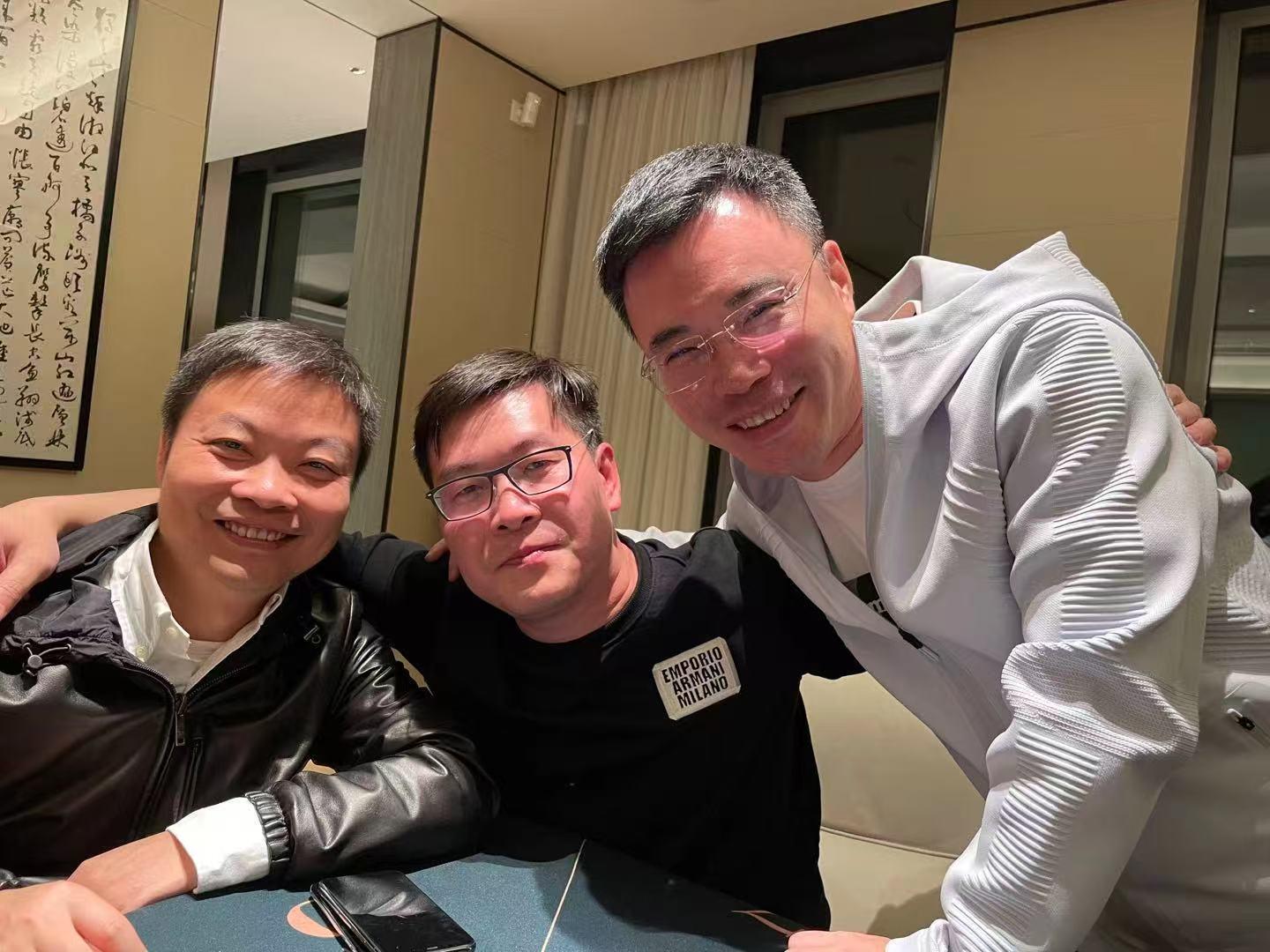
From left: He Xiaopeng, Yao Jinbo
However, Wang Xin ultimately chose to found Yungo Artificial Intelligence in Shenzhen, diving into social networking and AI. He launched products including “Toilet” and “Lingge AI.” Due to his previous experience, Wang Xin said he couldn't risk exposing his team to policy violations. "If I had gone all-in on blockchain back then, I feared crossing red lines," Wang Xin admitted.
Around 2018, although ICO fever still lingered, regulatory policies were highly uncertain, and the domestic blockchain startup environment tightened sharply. As a responsible entrepreneur who previously instructed his company to fire employees post-KuaiBo so they could claim labor arbitration compensation, he approached his second venture cautiously, unwilling to expose his team to risks. Still, internally, a small team continued monitoring the blockchain industry and kept learning about the technology.
Years of Hibernation Before Entering Web3
After launching the social app “Toilet” and the flexible employment recruitment product “Lingge AI,” Wang Xin largely disappeared from public view for three to four years. Regarding this period of “disappearance,” Wang Xin said it was both intentional and shaped by circumstances.
Beyond initial attention drawn by Wang Xin’s “celebrity founder” halo, neither “Lingge AI” nor “Toilet” gained traction afterward. Both products fell short of expectations, with “Toilet” even being halted before launch. These ups and downs led him to recognize the need for calm reflection. Wang Xin said: "This kind of adjustment is quite important for someone like me, a serial entrepreneur. I’ve had glory and lows—it requires a stronger inner self and clearer goals. Only by grounding myself can I go further."

In 2019, in an interview with *The Beijing News*, Wang Xin stated, "I can’t be a good investor, but I can be a great entrepreneur." Yet during these years of retreat, he actually invested in numerous projects, mostly in hardware and AI fields—such as the flying car company “Xiaopeng HTi,” rumored to be preparing for listing, and a lidar company holding a major share of the global market. Wang Xin explained he never intended to become an investor, but was invited by friends to offer guidance and support, eventually joining as an investor as his understanding deepened. He also revealed he currently isn’t involved in any Web3 investments.
Although not formally entering the space, Wang Xin has long-standing ties to blockchain. KuaiBo’s P2P technology allowed all users to publish and share files, resistant to central control—sharing similarities with blockchain network systems. Additionally, KuaiBo once launched the “Traffic Stone” project, aiming to aggregate idle bandwidth and CPU resources from personal devices, home networks, and enterprise nodes, optimizing real-time deployment via cloud computing—essentially using a sharing economy model for CDN (Content Delivery Network). In a way, this was a prototype of today’s DePIN.
With rapid advancements in AI, widespread adoption of large models like ChatGPT, and clearer Web3 policies emerging in places like Singapore and Hong Kong, Wang Xin realized these two technologies—one boosting productivity, the other improving production relations—could converge. This intersection became his entry point into Web3.
Focusing on Web3 + AI Agent
Across the AI industry, “Web3+AI” remains a niche field, with even prominent “Web3+AI” projects criticized as “poorly made.” In reality, Wang Xin’s experience and understanding in AI may surpass that of most current Web3 practitioners.
Based on his entrepreneurial and investment background, Wang Xin noted that small companies attempting general-purpose AI platforms face immense cost pressure. Computing costs often consume 80–90% of budgets, making it difficult for founders to sustain operations. He believes instead of building general platforms, startups should focus on vertical scenarios, creating “small and beautiful” practical products, or explore combining AI with Web3 to find new business models.
"AI is very centralized—large models are super centralized—and doesn’t really relate to Web3. So we asked: which part of AI connects with individuals? That’s AI agent," Wang Xin said.
An AI Agent is essentially a programmable automated workflow requiring human involvement for tuning and decision-making. Human choices in outcomes effectively participate in training the Agent. Wang Xin explained that when a community or KOL repeatedly optimizes a specific task, they own the core value of that Agent. Ownership and revenue distribution should thus belong directly to these contributors. Leveraging Web3’s public/private key system, each Agent can have a unique on-chain identity, while smart contracts record every contribution and corresponding reward in real time, ensuring “data contributors” truly become “value recipients.”
Moreover, Wang Xin sees Web3’s two core functions as asset issuance and asset transfer—both becoming increasingly accessible and infrastructure-robust. The real challenge lies in sustaining asset appreciation and ensuring equitable benefits among community members, operators, and ordinary users. Solutions lie not only in enhancing product strength but also in leveraging Web3’s reshaping of production relationships—wherein lies vast potential for innovation. For instance, addressing Web3 pain points like high learning curves, private key management, and gas fee settings can prevent alienating most internet users. Only when on-chain experiences closely resemble everyday operations can new professions, communities, and entrepreneurial opportunities emerge.
How Does the “Hidden” Gaming Giant View Chain Games?
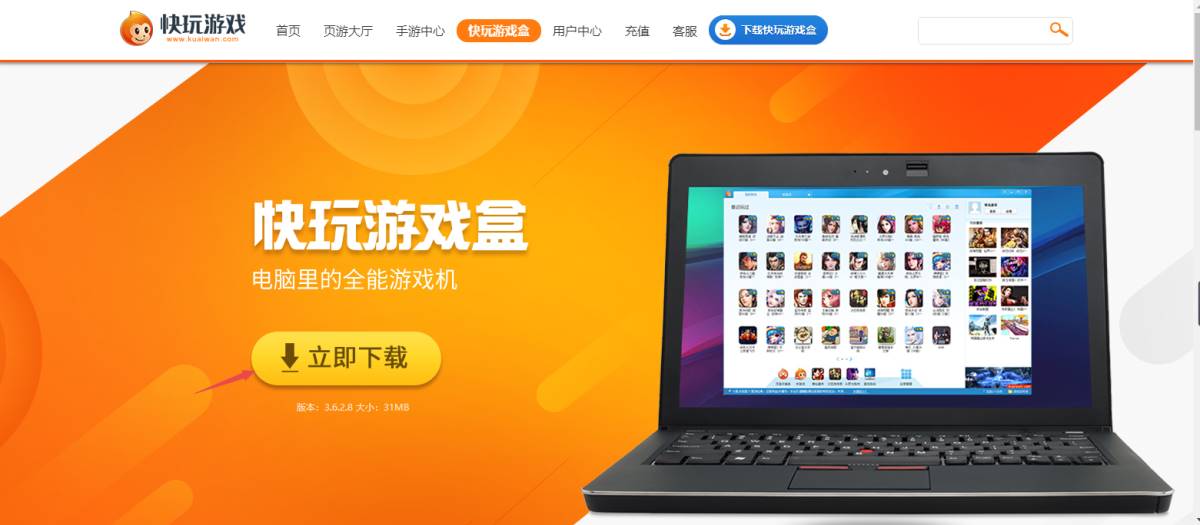
Beyond video playback, KuaiBo’s gaming platform “Kuaiwan Game Box” was a major revenue stream. This massive game-integrated platform opened doors to single-player games for countless players, once rivaling Steam China in peak popularity, with over a million monthly active users—surpassing most chain game projects. Meanwhile, in the Web3 realm, the once-promising gaming sector has remained stagnant for a long time.
"Playability and decentralization are hard to reconcile." When asked whether he is optimistic about Web3 gaming, Wang Xin frankly admitted that truly enjoyable games don’t depend on Web3 to exist. Whether AAA titles or classic web and single-player games, players chase immersion and fun—not underlying technical implementation. When developers treat blockchain merely as a “fundraising tool” or “token issuance channel” layered atop games, playability suffers. Players must learn private keys, worry about transaction fees, and fear asset security—completely deviating from the principle that “games should bring joy.”
"If a new game simultaneously carries innovative gameplay and a Web3 model, the chance of success is extremely low." Wang Xin emphasized that content remains the heart of gaming. Regardless of technological evolution, players seek storylines, visuals, controls, and social experiences. The right path starts by切入 (entering) through “a single aspect.” For example, using low-cost on-chain payments to replace traditional credit cards and App Store commissions, saving 3–10% in fees, reducing monetization pressure for game developers. Also, during cross-border publishing, stablecoins or multi-chain wallets can handle player top-ups, profit-sharing, and withdrawals, cutting costs without expensive ad campaigns.
When payment and revenue-sharing mechanisms are seamlessly and invisibly integrated into games, players enjoy traditional experiences while unknowingly utilizing Web3 infrastructure. Developers reduce intermediary cuts, gain higher profits, and reinvest in better products. "So how do they make profits? I think that’s where changing production relations via Web3 comes in."
Why Support the Meme Coin Fair3?
Since entering Web3, Wang Xin’s role seems less that of a serial entrepreneur and more of a supporter and evangelist. He frequently shares views on AI and blockchain on social media, sometimes directly mentioning Fair3, which he supports. According to Wang Xin, Fair3 isn’t a conventional “project,” but an ecosystem centered on the philosophy of “technological fairness.”
Wang Xin said Fair3 originated as a pure meme coin. After a core team (CTO team) took over, they began envisioning a deeper mission: going beyond community culture to build a truly decentralized ecosystem where every individual benefits from participation. Fair3 aims to leverage Web3 to challenge various unfairness caused by centralized algorithms and platform monopolies in traditional internet, transforming the cultural idea of “accumulating sand into a tower” into tangible ecological value.
"Every historical transformation in production relations solved the era’s core problem—agriculture solved food, industry solved capital," Wang Xin added. In today’s “knowledge age” and “attention economy,” data and algorithm monopolies heavily exploit ordinary users and creators. Mainstream platforms take high cuts from creators, e-commerce user acquisition costs reach 30–40%, and content distribution fees can hit 90%—all forms of injustice. Fair3 seeks to gather countless tiny individual “grains of sand,” using community cohesion and voice to expose unfairness, then employing decentralized technology to transition from cultural movement to real-world impact.
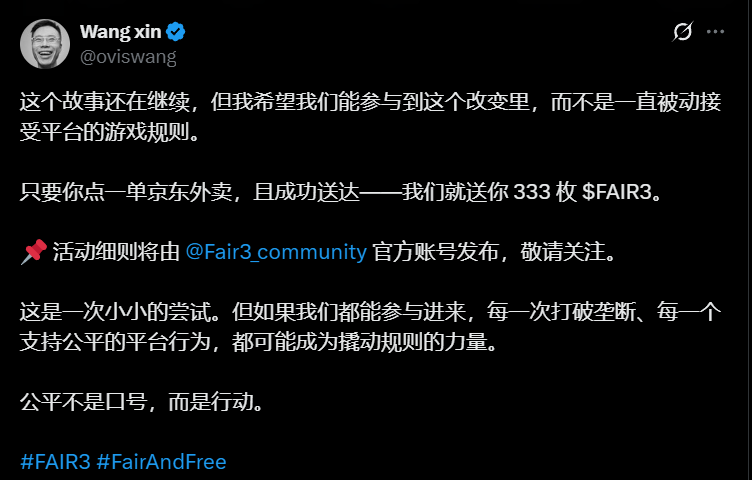
For instance, the CTO team has organized multiple small-scale meme creation and sharing events. Community members independently record “stories of unfairness,” documenting personal experiences and supporting each other. Recently, the community launched the “Fair Takeout” campaign, encouraging members to support JD Delivery and rewarding participants with token airdrops—using real consumption to reveal and correct platform subsidy and commission imbalances.
Wang Xin revealed that Fair3’s overseas community now includes two to three thousand people. As ecosystem development progresses, Fair3 plans to introduce more open-source projects and tools—including investment analytics, airdrop alerts, and consumer matchmaking platforms—to deliver real value to token holders and consumers.
What Is Technological Fairness?
Throughout the interview, Wang Xin repeatedly mentioned “technological fairness.” He shared its detailed meaning: true technological fairness must simultaneously satisfy three conditions—algorithm transparency, personal ownership of data, and sustained individual profitability.
Algorithm transparency means all core algorithms must be open-sourced and auditable, with no “black box” operations. Only when participants clearly see the logic can they maintain trust in results. Once opaque, algorithms invite widespread doubt and resistance. Wang Xin stated: "All our projects will adhere to open-sourced algorithms to ensure equal awareness of system rules for all users."
In large model training and digital services, massive personal data is often harvested by platforms for commercial gain, while original creators and ordinary users receive little or no benefit or recognition. Technological fairness demands that every piece of data belongs to its creator, who holds ownership and usage rights, with clear on-chain proof of provenance. Only then can individuals truly become “owners” in the digital economy, avoiding the loss of value from unpaid contributions.
Wang Xin believes individuals must not only participate in technological construction and data provision but also continuously earn economic returns through their contributions and consumption. He cited friend Li Xueling—who shared his weight-loss injection experience in a group and bought stock in the biotech firm. As more people benefited from his recommendation and increased holdings, both the original referrer and followers gained dual “consumption + investment” returns.
He also pointed out that traditional delivery riders, despite hard work, lack sustainable income—once they stop working, earnings and security vanish. In contrast, under decentralized token economies, early builders and active consumers can continuously share platform growth rewards through holding and promotion.
KuaiBo Belongs to the Past
After Wang Xin’s imprisonment, “I owe KuaiBo and Boss Wang a membership fee” became a popular internet meme in China. In a sense, behind the joke lies support, gratitude, and emotional connection. Given such grassroots backing, Wang Xin seemingly has the foundation to issue a personal token and “collect” those overdue memberships.
"It’s just an internet meme," Wang Xin laughed in response. When KuaiBo was forced to shut down years ago, it was users’ collective voices—“accumulating sand into a tower”—that helped him through tough times, and he remains deeply grateful. But he clearly stated that tokenizing this sentiment risks “exploiting fans,” contradicting his pursuit of technological fairness and potentially commodifying supporters’ emotions—thus he “will absolutely not issue a personal token.”
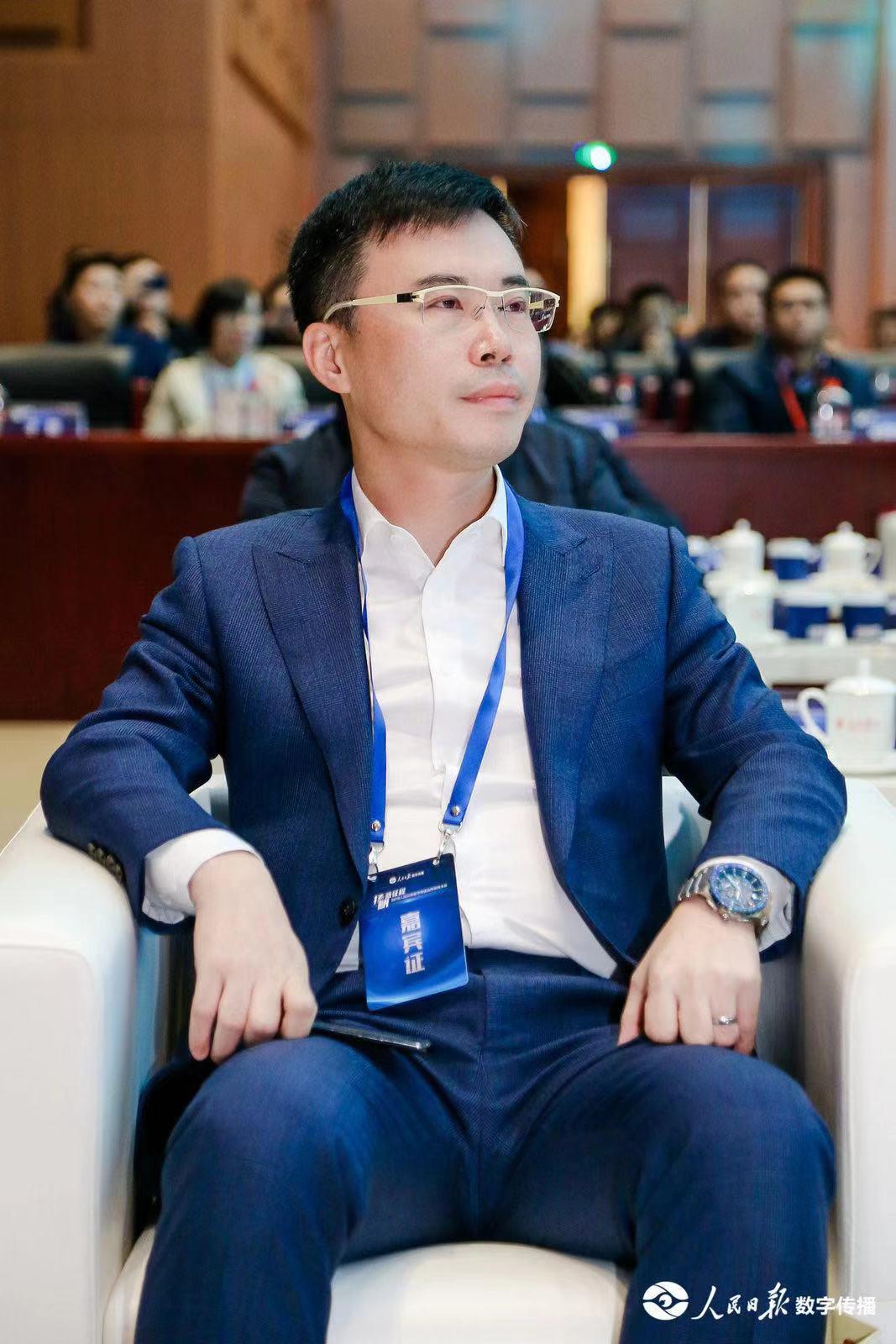
Additionally, he believes KuaiBo represents only the past, while strong memes (like cats and dogs) are timeless cultural symbols representing the future. KuaiBo’s “pastness” means it isn’t a good meme and thus unsuitable for tokenization.
Regarding external criticism accusing him of leveraging his image to promote Fair3 and “harvest韭菜 (suckers),” Wang Xin frankly admitted he once hesitated, fearing trouble. But community support strengthened his resolve—many believe he isn’t here to “harvest韭菜,” and quick-profit schemes aren’t his goal.
He revealed that Binance co-founder He Yi privately messaged him, warning: "Issuing tokens is like issuing debt." Once you launch or endorse a token, you assume responsibility and obligation to the community. Wang Xin sees himself as owing a “debt of technological fairness,” compelled to keep speaking for the community and building the ecosystem—not seeking one-time gains. Price fluctuations are inevitable, and free speech allows skepticism, but the key lies in persistently improving products and community, delivering continuous returns so holders genuinely benefit and the ecosystem thrives.
Wang Xin further stated that he, his team, and his fund are actively refining products and business models, hoping early participants receive ongoing returns. He compares the platform to a live-streaming ecosystem, where everyone has the potential to create value.
He also shared how he introduced Web3 to his family: "I’m doing some Web3 building at home," Wang Xin said, having already gotten his wife and children involved—owning wallets and trading meme coins—even earning some small profits through “PVP.” He encourages his high school daughter to consider her peers’ needs, such as game boosting or blind box exchanges, which could form small-scale community economies through simple tools and token design.
"I think future opportunities lie in AI and Web3. If she starts engaging now, it’s a great thing," Wang Xin added.
Join TechFlow official community to stay tuned
Telegram:https://t.me/TechFlowDaily
X (Twitter):https://x.com/TechFlowPost
X (Twitter) EN:https://x.com/BlockFlow_News
 PANews