AI in Crypto: After the Meme Hype, Will It Be Chaos or Rebirth?
TechFlow Selected TechFlow Selected
AI in Crypto: After the Meme Hype, Will It Be Chaos or Rebirth?
This research article will describe and analyze the current evolutionary path of AI in the Web3 domain.
 Navigating Web3 tides with focused insights
Author: Guatian Lab
Introduction
Since ChatGPT burst onto the scene at the end of 2022, the AI sector has remained a hot favorite in the crypto space. Web3 nomads already embrace the idea that "any concept can be hyped," let alone AI, which holds infinite narrative potential and application capabilities for the future. As such, within the crypto community, the AI concept initially gained popularity as a "meme craze" for a period before some projects began exploring its practical utility: what new real-world applications can crypto bring to the rapidly advancing field of AI?
This research article will describe and analyze the current evolution path of AI in the Web3 domain, tracing developments from early hype waves to today's emerging application-focused projects, using case studies and data to help readers grasp industry trends and future directions. Here, we'll lay out our preliminary conclusions upfront:
01
The era of AI memes is over; those who got rekt or made gains can now cherish them as eternal memory fragments;
02
Some foundational Web3 AI projects have consistently emphasized the security benefits of "decentralization" for AI, but users generally don't care—what matters most to them is "whether the token makes money" and "how usable the product is";
03
If you're looking to position yourself early in AI-related crypto projects, focus should shift toward pure application-based AI projects, or platform-type AI projects (which can host multiple tools or agents easy for end-users to adopt)—this could become the longer-term wealth hotspot following the AI meme cycle;
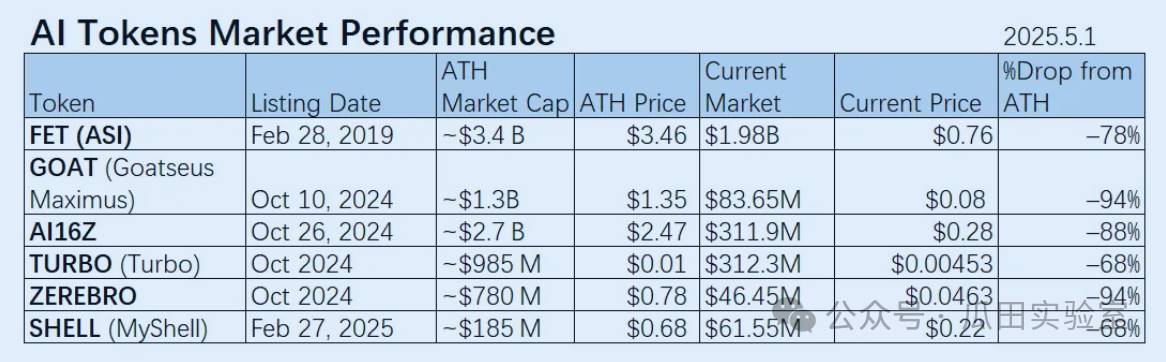
Differences in AI Development Paths Between Web2 and Web3
AI in the Web2 World
AI in the Web2 world is primarily driven by tech giants and research institutions, with a relatively stable and centralized development path. Large companies (such as OpenAI, Google) train closed black-box models whose algorithms and data are not publicly accessible—users can only consume outputs without transparency. This centralized control leads to non-auditable AI decisions, raising issues of bias and unclear accountability. Overall, Web2 AI innovation focuses on improving base model performance and commercial deployment, but the decision-making process remains opaque to the public. It is precisely this pain point of opacity that led to the rise in 2025 of seemingly open-source but actually "fishing-tank" AI projects like Deepseek.
Besides the issue of opacity, large Web2 AI models suffer two other key drawbacks: subpar user experience across different product formats and insufficient precision in specialized verticals.
For example, when creating a PPT, an image, or a video, users still seek out AI products with low entry barriers and superior user experience—and are willing to pay for them. Many current AI projects are experimenting with no-code AI tools specifically to lower user barriers even further.
Another example: many Web3 users have likely experienced frustration trying to obtain accurate information about a specific crypto project or token via ChatGPT or DeepSeek. Large models still lack precise coverage of detailed information in every niche industry. Hence, another direction for AI product development is achieving deep, accurate data analysis within specific verticals.
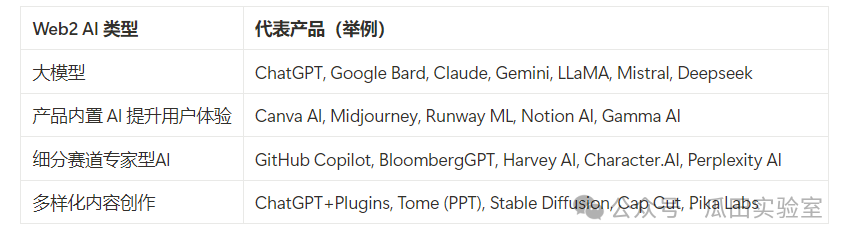
AI in the Web3 World
The Web3 world, centered around the crypto industry, is a broader concept integrating technology, culture, and community. Compared to Web2, Web3 strives more toward openness and community-driven development.
Leveraging blockchain’s decentralized architecture, Web3 AI projects typically emphasize open-source code, community governance, and transparent trustworthiness, aiming to use distributed methods to break the traditional AI monopoly held by a few corporations. For instance, some projects explore using blockchains to verify AI decisions (zero-knowledge proofs ensuring model output credibility) or having DAOs audit AI models to reduce bias.
In ideal scenarios, Web3 AI pursues "open AI," where model parameters and decision logic are auditable by the community, while token mechanisms incentivize developer and user participation. However, in practice, Web3 AI development faces technological and resource constraints: building decentralized AI infrastructure is extremely difficult (training large models requires massive computational power and data, yet no Web3 project comes close to even a fraction of OpenAI’s funding). A few so-called Web3 AI projects still rely on centralized models or services, merely integrating blockchain elements at the application layer. These relatively credible Web3 AI projects at least maintain genuine development efforts; meanwhile, the vast majority of Web3 AI projects remain pure memes or memes disguised under the banner of real AI.
Additionally, differences in funding and participation models shape their divergent development paths. Web2 AI is typically driven by research investment and product monetization, with a relatively smooth development cycle. In contrast, Web3 AI incorporates the speculative nature of crypto markets, often experiencing volatile "hype cycles" driven by market sentiment: during bullish phases, capital floods in, inflating token prices and valuations; during downturns, both project热度 and funding rapidly decline. This cycle makes Web3 AI development more volatile and narrative-driven. For example, an AI concept lacking substantive progress might still trigger a massive surge in token price due to market sentiment; conversely, even technically advanced projects may struggle to gain attention during bear markets.
Towards the dominant Web3 AI narrative of a "decentralized AI network," we maintain a "low-key and cautious hope"—after all, what if it actually works? The Web3 space already boasts epoch-defining innovations like BTC and ETH. But at this stage, it's essential to ground ourselves and envision practical, immediately applicable use cases—such as embedding AI agents into existing Web3 projects to boost efficiency; combining AI with other emerging technologies to generate novel ideas relevant to the crypto industry, even if just for attention; or developing AI products tailored specifically for the Web3 sector, offering services that meet the needs of Web3 communities through higher data accuracy and better alignment with Web3 organizational or individual work habits.
To be continued—the next article will mainly review and analyze five waves of AI hype in Web3 and several related products (such as Fetch.AI, TURBO, GOAT, AI16Z, Joinable AI, MyShell, etc.).
Join TechFlow official community to stay tuned
Telegram:https://t.me/TechFlowDaily
X (Twitter):https://x.com/TechFlowPost
X (Twitter) EN:https://x.com/BlockFlow_News
 瓜田实验室W Labs