Sequoia US latest internal sharing: How to capitalize on the trillion-dollar AI opportunity?
TechFlow Selected TechFlow Selected
Sequoia US latest internal sharing: How to capitalize on the trillion-dollar AI opportunity?
Applications are where the real value lies.
 Navigating Web3 tides with focused insights
Author: DeepCircle

While the entire tech industry is still busy chasing the AI wave, Sequoia Capital has already begun thinking about deeper opportunities behind this technological revolution. At their annual AI Ascent conference, three core partners—Pat Grady, Sonya Huang, and Konstantine Buhler—shared their unique insights into AI’s development trends and market potential.
This talk avoided intimidating technical jargon, instead using plain language to reveal how AI is transforming business and our lives. From market size to application-layer value, from data flywheels to user trust, they identified key success factors for AI startups. More importantly, they predicted the arrival of the AI agent economy and how it will fundamentally reshape the way we work. For entrepreneurs and investors, this session sent a clear signal: the AI wave has arrived, and now is the time to accelerate. Don’t worry about macroeconomic noise—the momentum of technology adoption will overpower any market fluctuation.
If you want to understand why Sequoia believes the AI market is ten times larger than cloud computing, how startups can win in this space, and how the coming “agent economy” will disrupt our world, this analysis delivers a first-hand intellectual feast.
Market Opportunity: Why AI Is a Trillion-Dollar Shockwave
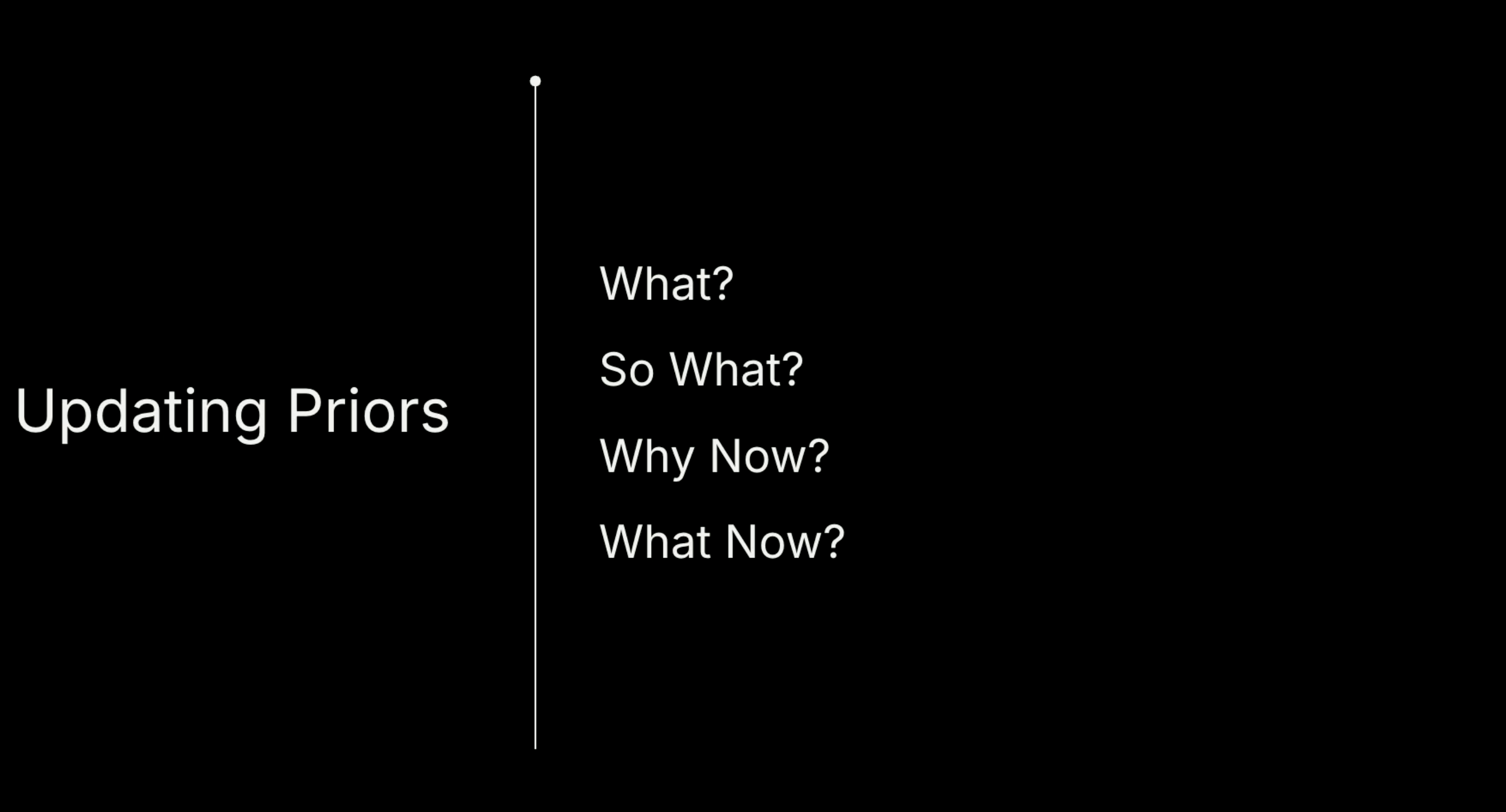
The presentation began with Pat Grady posing several key questions: What is AI? Why does it matter? Why now? And what should we do? This framework comes from Sequoia’s legendary founder Don Valentine, who used these questions to evaluate every emerging market.
Last year at the AI Ascent event, Sequoia presented a comparison chart showing cloud transformation on top and AI transformation below. Today, cloud computing is a $400 billion industry—larger than the entire software market was at its inception. By analogy, the starting market for AI services is at least an order of magnitude larger—ten times bigger than early cloud computing. Over the next 10 to 20 years, this market could grow far beyond imagination.
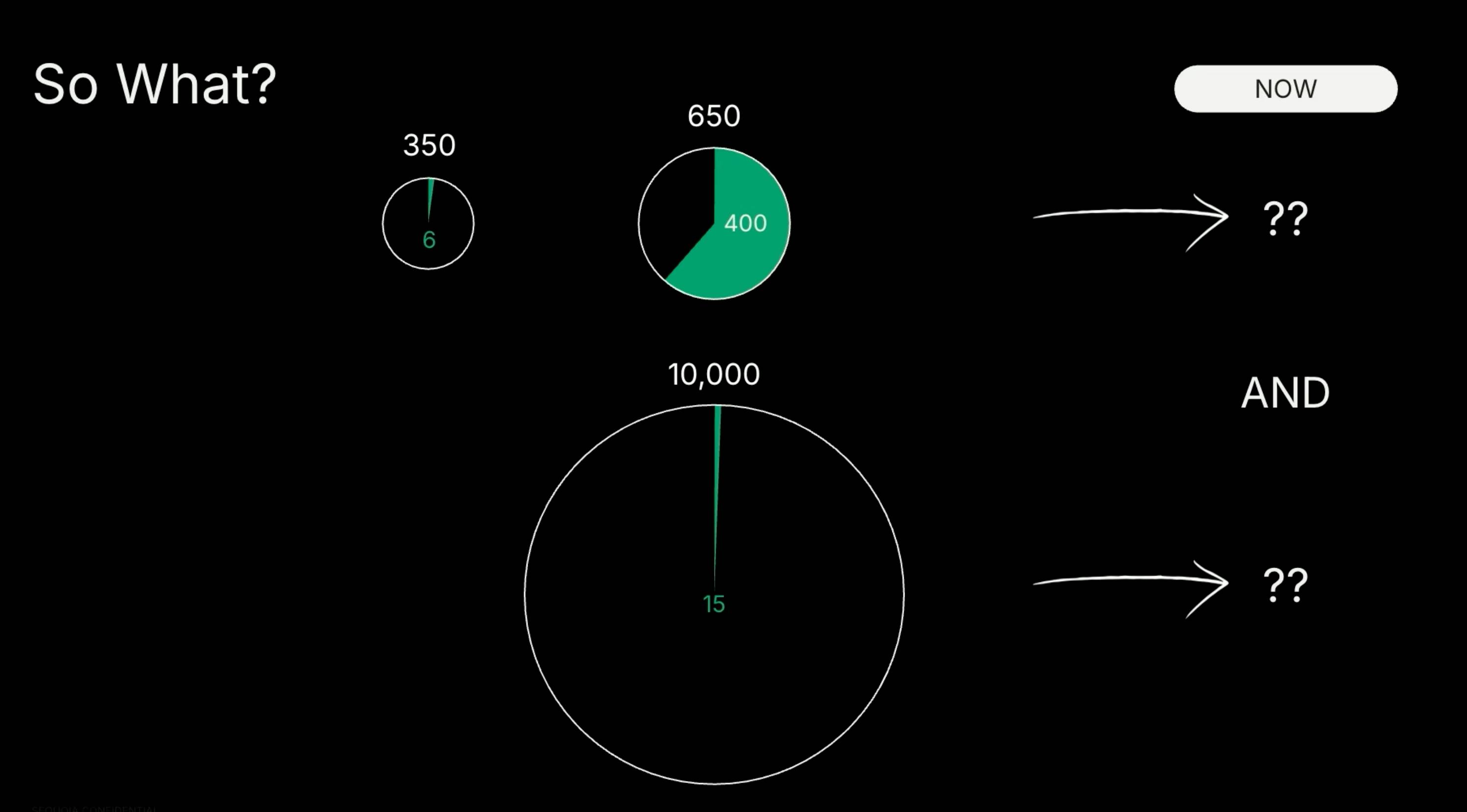
This year, Sequoia updated their view: AI isn’t just eating the service market—it’s also consuming the software market. We’re seeing many companies evolve from simple software tools into increasingly intelligent systems, progressing from "co-pilot" modes that assist humans to nearly fully automated "autopilot" modes. These companies are shifting from selling tools to delivering outcomes, moving from competing for software budgets to capturing human resource budgets. AI is disrupting both massive markets simultaneously.
Each technological revolution in history has been larger than the last, and AI is arriving faster than any prior revolution. Pat explained this with a simple model: for technology adoption, three conditions must be met—people must know your product, want your product, and be able to access it. Compared to the early days of cloud computing, AI’s adoption speed is astonishing. Back then, Salesforce founder Marc Benioff had to use guerrilla marketing tactics just to get attention. But on November 30, 2022, the moment ChatGPT launched, global focus instantly shifted to AI. Meanwhile, information-sharing channels have exploded—Reddit and Twitter (now X) alone have 1.2 to 1.8 billion monthly active users. Internet users have grown from 200 million to 5.6 billion, nearly covering every household and business worldwide.
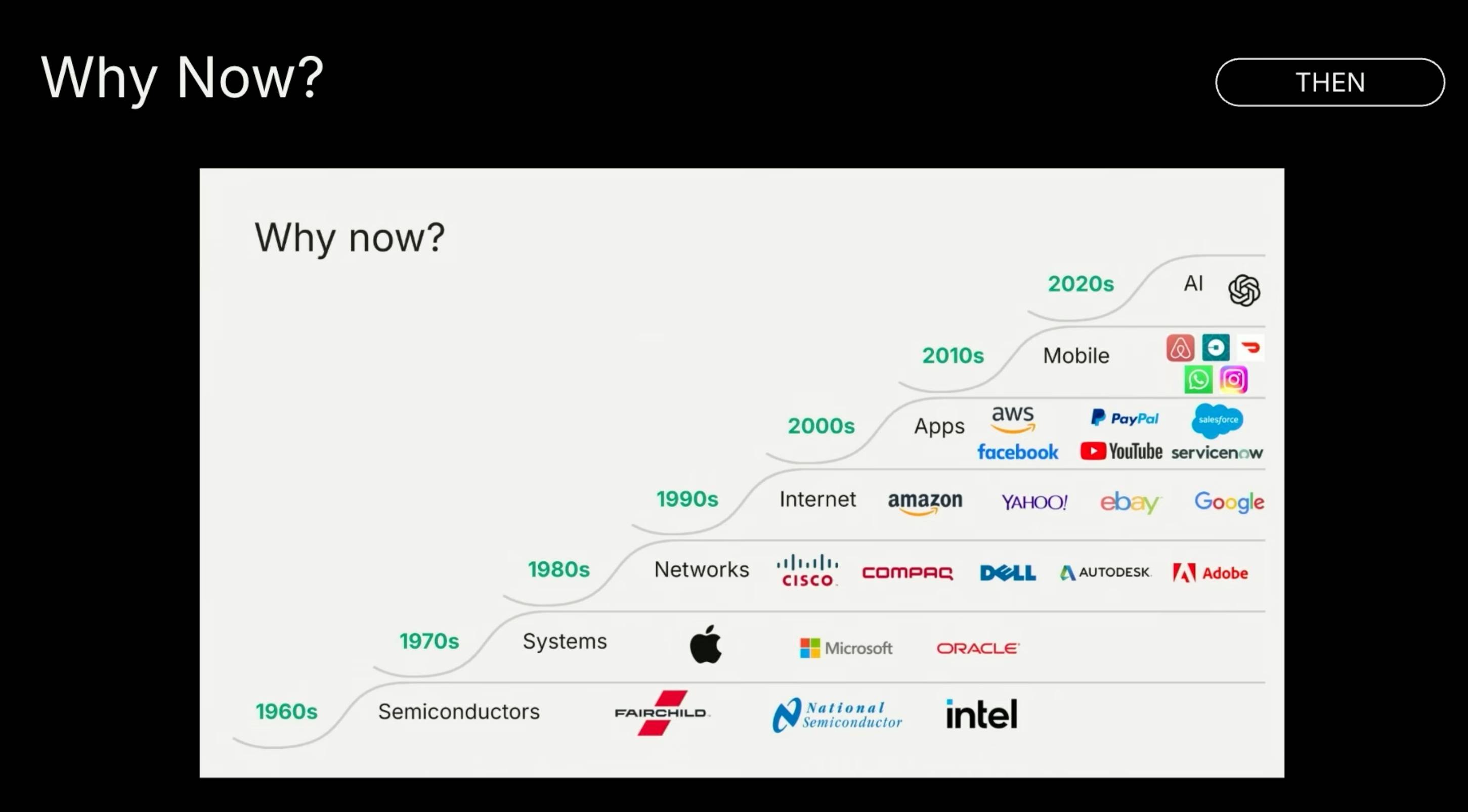
"This means infrastructure is already in place," Pat explained. "When the starting gun fires, there are no barriers to adoption. This isn’t unique to AI—it’s a new reality of technology distribution. The rules of physics have changed. The tracks are already laid."

Applications Are Where Value Lives: How to Win in the AI Era
Looking back at past technological revolutions—PCs, internet, mobile internet—the companies that achieved over $1 billion in revenue were mostly concentrated at the application layer. Sequoia firmly believes AI will follow the same pattern: real value lies at the application layer.
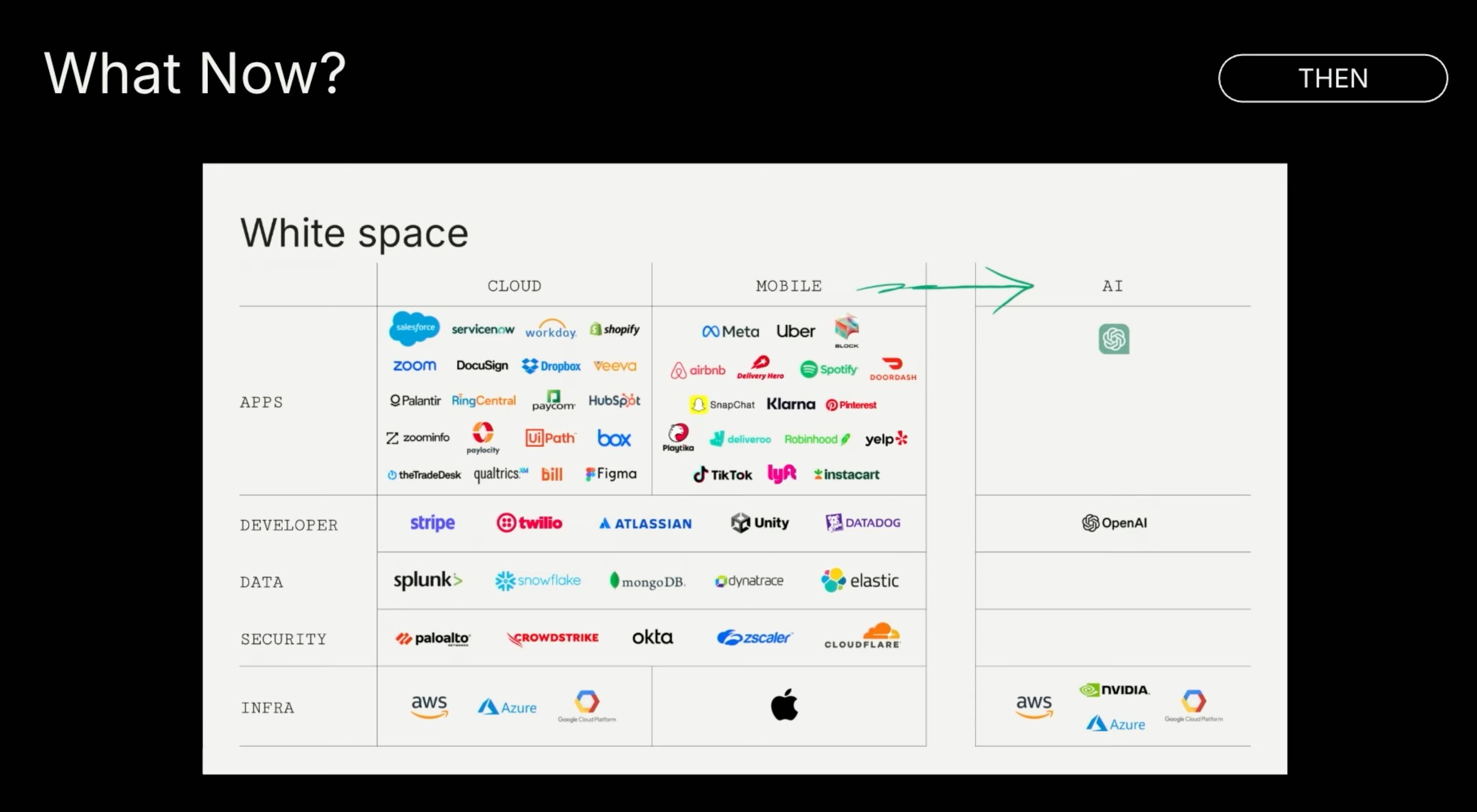
But today’s situation is different. With advances in large models, they’re now capable of reasoning, using tools, and communicating between agents—penetrating deep into the application layer. If you're a startup, how should you respond? Pat advised starting from customer needs, focusing on specific verticals and functions, and solving complex problems that may require human-in-the-loop. That’s where real competition happens—and where value is created.
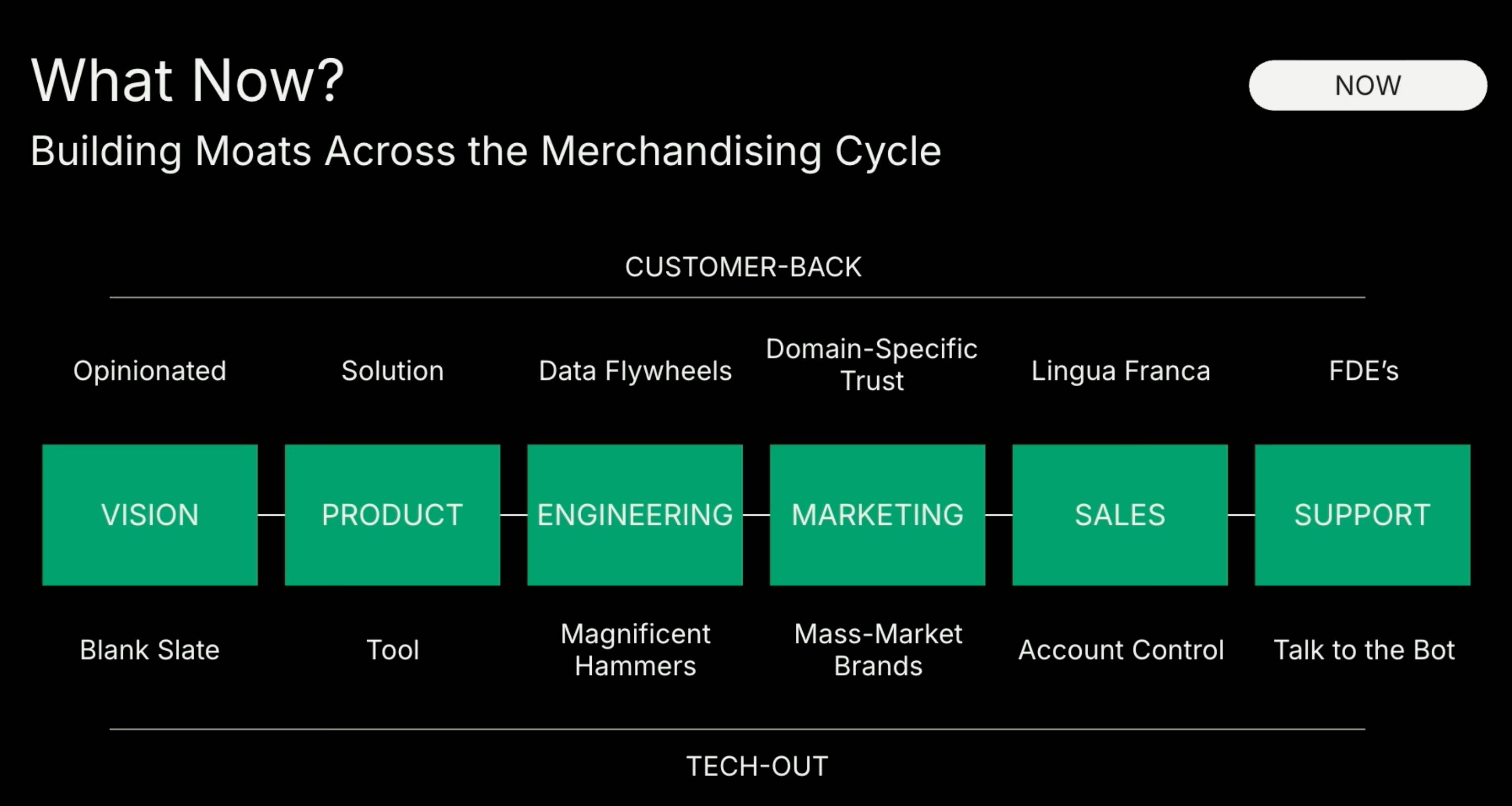
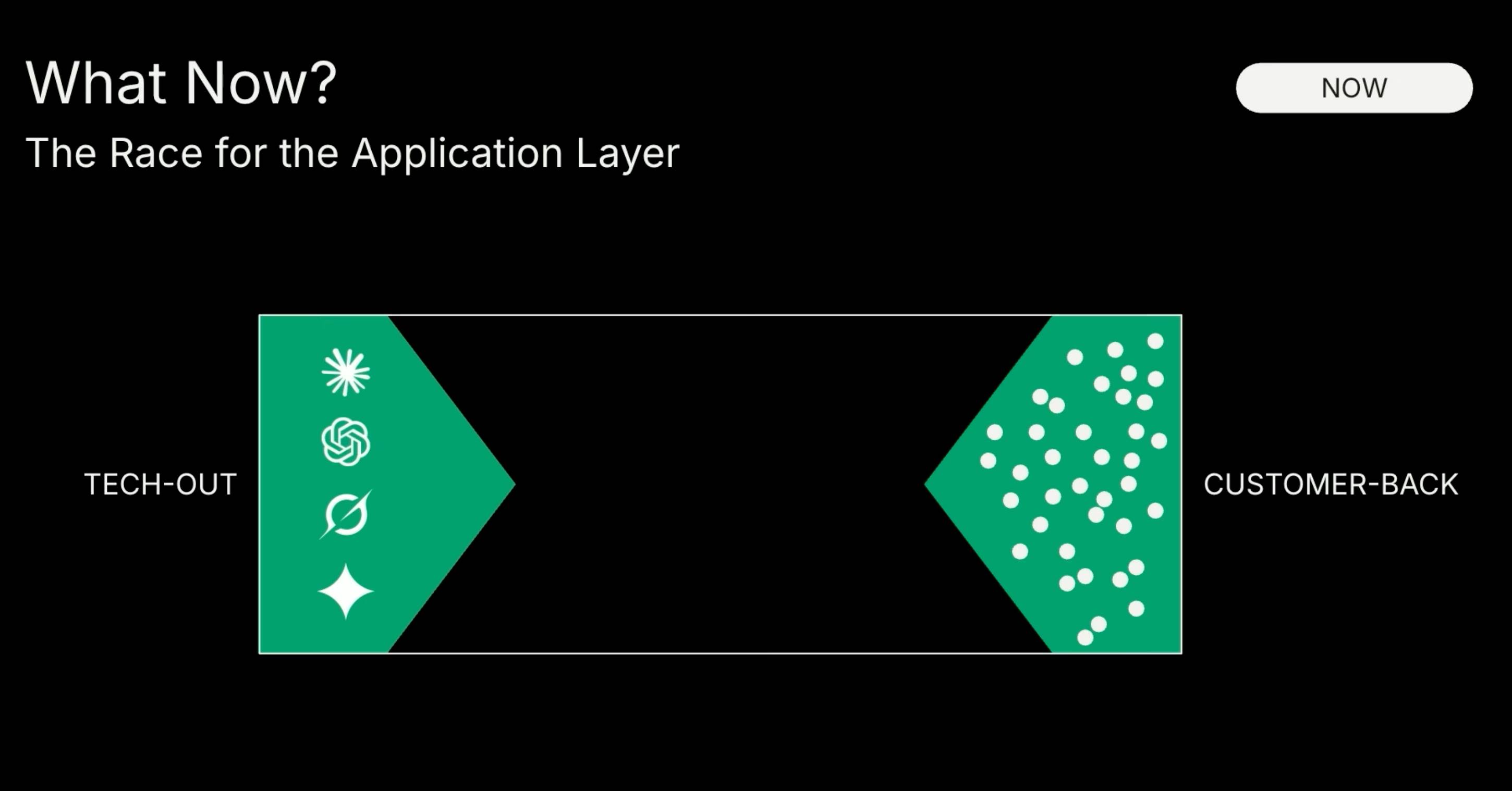
Is building an AI company fundamentally different? Pat said 95% is the same as building any company—solve important problems, find a compelling and differentiated approach, attract great talent. Only 5% is AI-specific, and he emphasized three key points:

First, beware of "vibe revenue." Many founders love "vibe revenue"—it feels great, growth seems fast—but it might just reflect customer experimentation, not real behavioral change. Founders should closely examine user adoption, engagement, and retention to see what people are actually doing with the product. Don’t fool yourself into thinking you have real revenue when it’s just "vibe revenue"—it will ultimately hurt you.
"At this stage, trust matters more than your product," Pat stressed. "Your product will improve over time. If customers trust that you’ll make it better, you’re fine. If they don’t, you’re in trouble."
Second, gross margins. Pat noted they don’t necessarily care about a startup’s current gross margin because cost structures in AI are rapidly changing. Over the past 12–18 months, the cost per token has dropped 99%. If founders successfully shift from selling tools to selling outcomes and move up the value chain, pricing will rise. Even if margins aren’t healthy today, the company should have a clear path toward sustainable margins.
Third, data flywheels. Pat asked the audience: "Who has a data flywheel? What business metrics does it improve?" If you can’t answer, your so-called data flywheel may be imaginary. It must directly impact specific business metrics—otherwise, it’s meaningless. This is especially critical because a data flywheel is one of the strongest moats a startup can build.
In closing, Pat offered a vivid metaphor: "Nature abhors a vacuum." He said there’s now a massive "pull" in the market for AI—macroeconomic noise like tariffs and interest rate fluctuations are irrelevant. The upward trend in technology adoption completely overshadows market volatility. "There’s a huge suction in the market. If you don’t seize the opportunity, someone else will. So regardless of moats or metrics, you’re in an industry where you must run as fast as possible. Now is the time to go all-in, to maintain maximum speed at all times."
From Hype to Real Value: AI User Engagement Skyrockets
Next, Sonya Huang reviewed the remarkable progress of AI applications over the past year. She shared an encouraging data point: in 2023, native AI apps had very low DAU/MAU ratios (daily active users vs. monthly active users), meaning users were curious but didn’t use them frequently—hype far exceeded real value. Now, that’s dramatically reversed. ChatGPT’s DAU/MAU ratio has climbed steadily and now approaches Reddit’s level.
"This is fantastic news," Sonya said excitedly. "It means more of us are deriving real value from AI. We’re collectively learning how to integrate AI into daily life."
Usage spans both fun and profound applications. Sonya admitted she personally burned through massive GPU resources trying to "Ghiblify" various images. But beyond playful uses, deeper applications are even more exciting—such as generating stunningly accurate and beautiful ad copy in advertising, instantly visualizing new concepts in education, and healthcare apps like OpenEvidence that assist in diagnosis.
"We’ve only scratched the surface of what’s possible," Sonya said. "As AI models grow more capable, what we can do through this 'front door' will become increasingly profound."

Voice Breakthrough and Programming Boom: Two Key Areas
In 2024, two major breakthroughs stood out in AI. The first is voice generation. Sonya called it the "Her moment" for voice—referencing the film *Her* where Joaquin Phoenix falls in love with an AI assistant. Voice generation has moved from "nearly there" to fully crossing the "uncanny valley," achieving near-perfect realism.

Onstage, Sonya played a voice demo so natural it was hard to distinguish between human and AI. "The gap between science fiction and reality is closing at an astonishing pace. It feels like the Turing test has quietly arrived among us."
The second breakthrough is in programming. Sonya noted this area has reached "screaming product-market fit." Since Anthropic released Claude 3.5 Sonnet last fall, there’s been a rapid "vibe shift" in programming. People are now using AI to produce impressive results—one person even built a DocSend alternative through "vibe coding."
"Whether you’re a seasoned '10x engineer' or someone who knows nothing about coding, AI is fundamentally changing the accessibility, speed, and economics of software creation," Sonya explained.
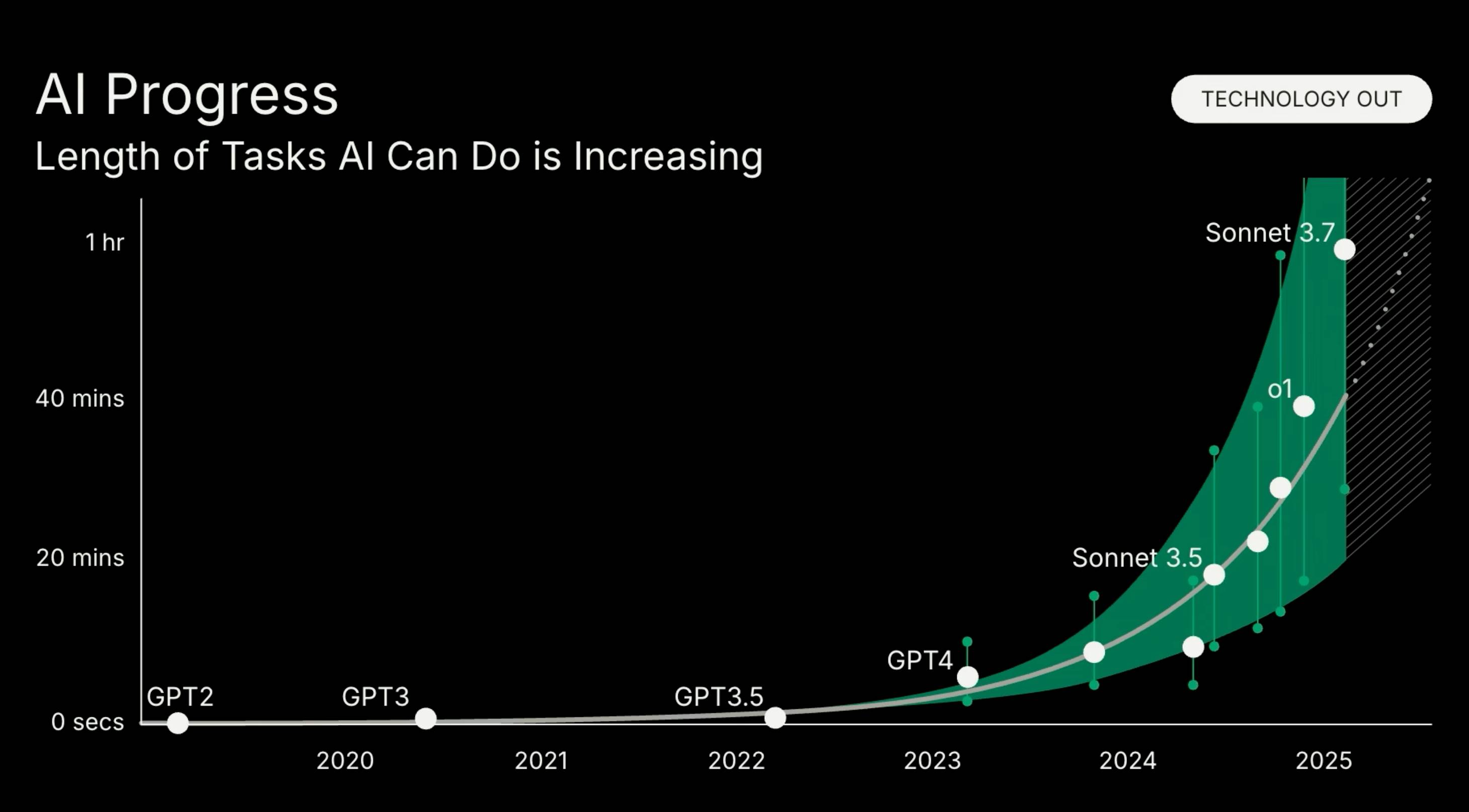
Technically, while progress in pre-trained models appears to be slowing, the research ecosystem is finding new paths forward. Key advances include OpenAI’s improved reasoning capabilities, along with rapid developments in synthetic data, tool usage, and AI agent orchestration (AI scaffolding). Together, these enable AI to perform increasingly complex tasks.
Where Value Is Created: The Application Layer Battlefield Heats Up
Sonya recalled debating with colleagues about where AI value would be created. She admitted she was initially skeptical of GPT-wrapper apps, while her partner Pat firmly believed value would emerge at the application layer. Now, Pat has proven right. Companies like Harvey and OpenEvidence, which start from real customer needs, are clearly creating substantial value.
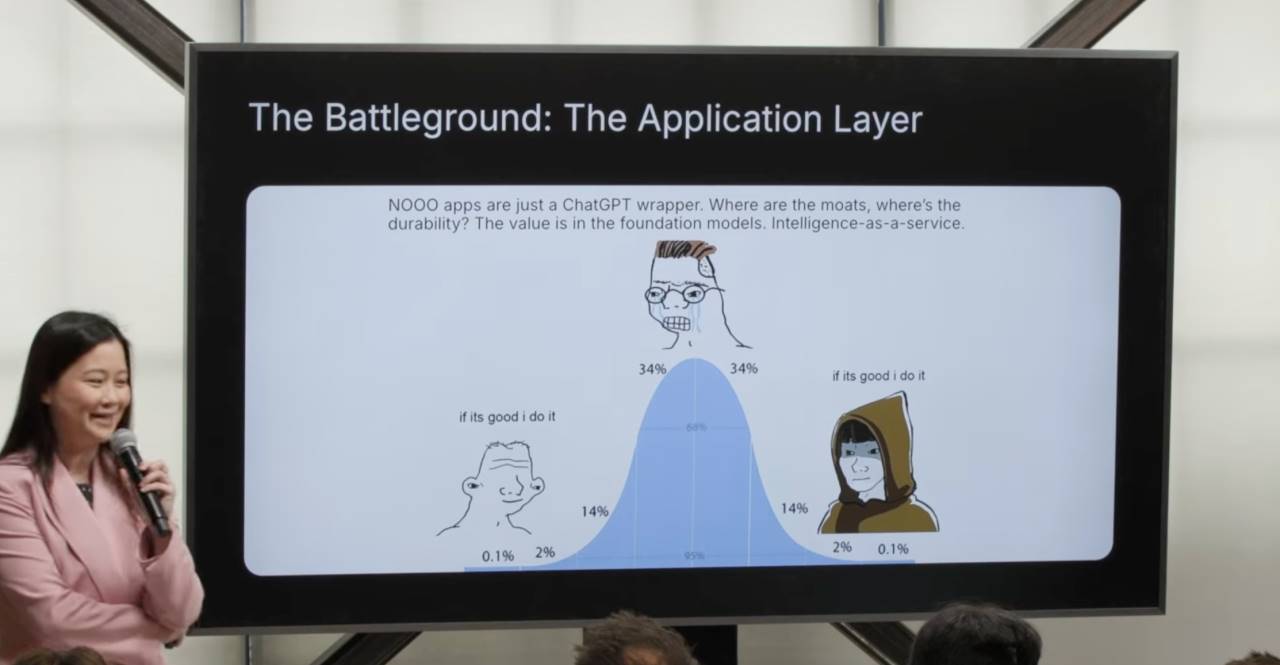
"We strongly believe the application layer is where value ultimately accumulates," Sonya said. "And as foundational models increasingly penetrate this layer, the battlefield is becoming fiercer."
She joked that the real winner might be Jensen Huang, CEO of NVIDIA, whose company is reaping massive gains from AI chip sales.
Sonya believes the first AI "killer apps" have emerged—not just ChatGPT, Harvey, Glean, Sierra, Cursor, but also a wave of new companies rising across specialized domains. She highlighted that many upcoming firms will be "agent-first," evolving their agents from crude prototypes into powerful products.

Vertical Agents: AI Assistants Specialized in Specific Domains
For 2025, Sonya is particularly bullish on vertical agents. This presents a golden opportunity for founders deeply embedded in specific fields. These agents are trained end-to-end on particular workflows, using reinforcement learning with synthetic and user data, enabling AI systems to excel at highly specific tasks.
There are already exciting early examples. In security, Expo demonstrated agents outperforming human penetration testers. In DevOps, Traversal built AI troubleshooters surpassing top human experts. In networking, Meter’s AI outperforms network engineers.

Though still early, these cases suggest vertically trained agents designed for specific problems can exceed the performance of today’s best human experts.
Sonya also introduced the concept of the "abundance era." Take programming: when labor becomes cheap and abundant, what happens? Do we flood the world with low-quality AI-generated content? And what occurs when "taste" becomes the scarce asset? The answers will hint at how AI transforms other industries.

The Agent Economy: AI’s Next Major Phase
In the final segment, Konstantine Buhler looked ahead to AI’s next phase—the "agent economy." Last year’s AI Ascent already discussed agents, when these machine assistants were just beginning to form business models. Today, networks of agents, known as "agent swarms," play crucial roles in many companies and are becoming key components of the AI tech stack.

Konstantine predicts this will mature into a full-fledged agent economy. In this economy, agents won’t just pass information—they’ll transfer resources, conduct transactions, record each other’s behaviors, understand trust and reliability, and develop their own economic systems.
"This economy doesn’t exclude humans—it’s entirely centered around humans," Konstantine explained. "Agents collaborate with people, and people collaborate with agents. Together, they form the agent economy."
Three Technical Challenges in Building the Agent Economy
To realize this grand vision, we face three key technical challenges:

The first challenge is persistent identity. Konstantine explained this has two aspects. First, agents themselves must remain consistent. If you’re doing business with someone who changes every day, you’re unlikely to form long-term partnerships. Agents must maintain their personality and understanding over time. Second, agents must remember and understand you. If your partner knows nothing about you—or can’t even recall your name—that undermines trust and reliability.
Current solutions like RAG (retrieval-augmented generation), vector databases, and long context windows are attempting to solve this, but true memory, memory-based self-learning, and agent consistency remain major hurdles.
The second challenge is seamless communication protocols. "Imagine personal computing without TCP/IP and the internet," Konstantine said. "We’re only just beginning to build the protocol layer for agents." He highlighted the development of MCP (Model Collaboration Protocol) as one of many future protocols needed to enable information transfer, value exchange, and trust verification.
The third challenge is security. When you can’t meet your partner face-to-face, security and trust become even more critical. In the agent economy, security and trust will be more important than in today’s economy, spawning an entire industry focused on trust and safety.
From Determinism to Stochasticity: A Fundamental Shift in Thinking
Konstantine believes the agent economy will fundamentally change our mindset. He introduced the concept of "stochastic thinking," which contrasts sharply with traditional deterministic thinking.
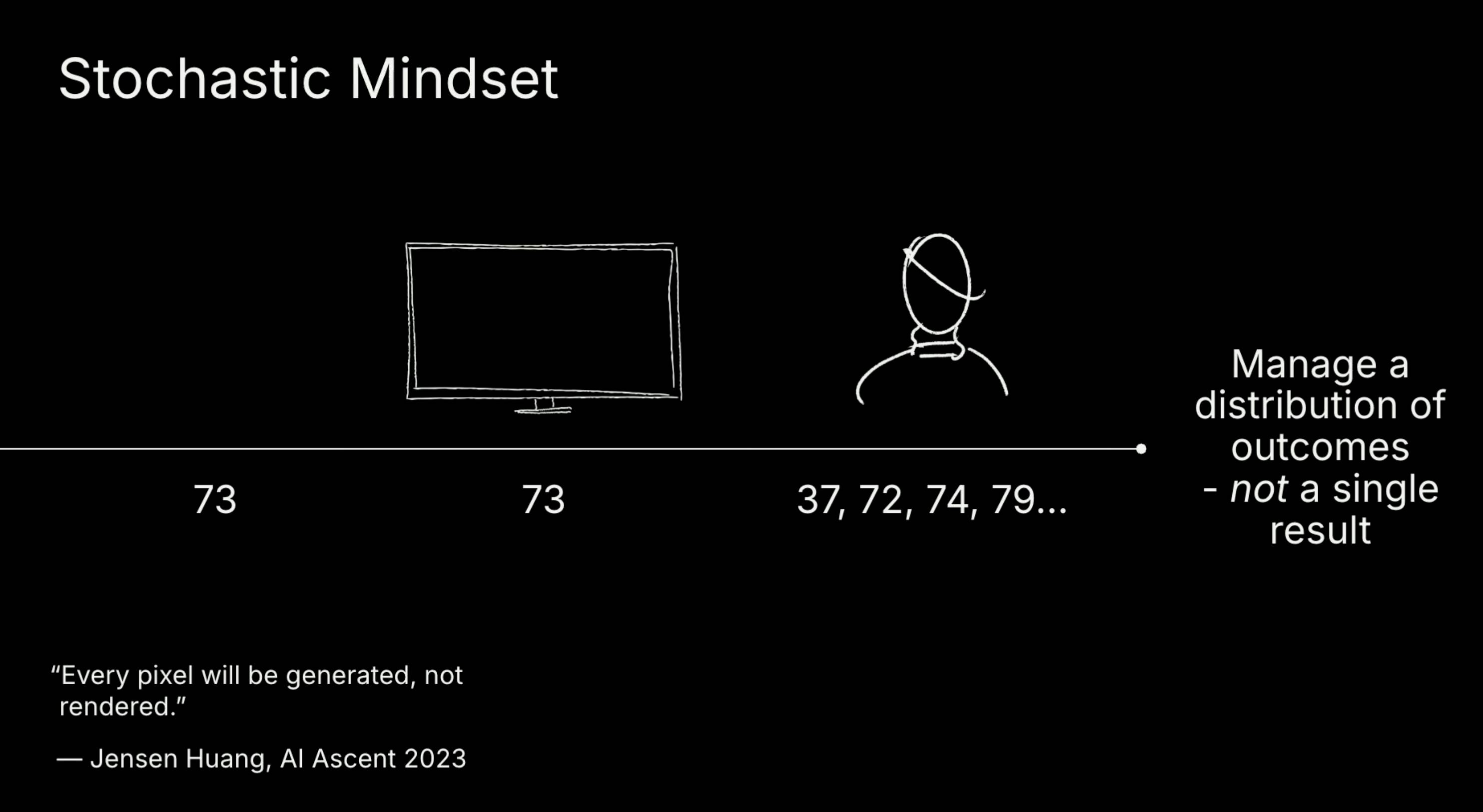
"Many of us fell in love with computer science because it was so deterministic," he explained. "You program a computer to do something, and it does exactly that—even if the result is a segfault. Now, we’re entering an era where computation will be stochastic."
He illustrated with a simple example: if you ask a computer to remember the number 73, it will remember it tomorrow, next week, next month. But if you ask a person or an AI, it might recall 73, 37, 72, 74, the next prime 79—or forget entirely. This shift in thinking will profoundly affect how we interact with AI and agents.
The second shift is in management mindset. In the agent economy, we need to understand what agents can and cannot do—similar to transitioning from individual contributor to manager. We’ll need to make more complex managerial decisions, such as when to stop processes or how to provide feedback.
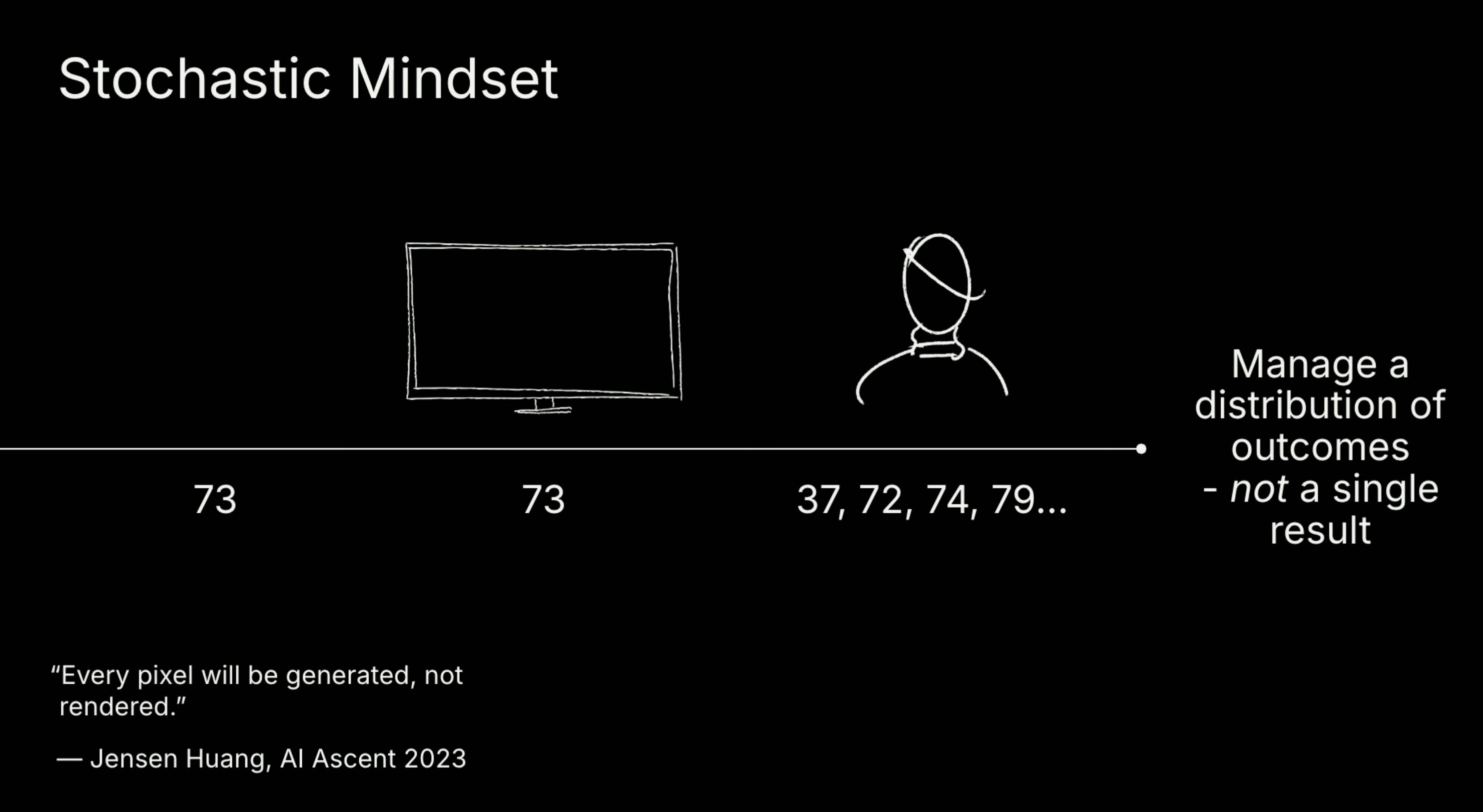
The third major shift combines the two: we’ll gain greater leverage, but with significantly reduced certainty. "We’re entering a world where you can do more, but you must manage uncertainty and risk," Konstantine said. "In this world, everyone here is exceptionally well-suited to thrive."
Ultimate Leverage: Reshaping Work, Companies, and the Economy
A year ago, Sequoia predicted that functional teams within organizations would begin adopting AI agents, gradually integrating until entire workflows are handled by agents. They even boldly predicted the first "one-person unicorn company."
While the "one-person unicorn" hasn’t arrived yet, we’re already seeing companies scale at unprecedented speed with fewer employees than ever before. Konstantine believes we’ll reach levels of leverage never seen before.
"Ultimately, these processes and agents will converge into a network of neural networks," he envisioned. "This will change everything—reshaping individual work, company structures, and the entire economy."
Through this talk, Sequoia’s three partners outlined a clear trajectory for AI—from current developments to future evolution. From macro-level market analysis to insights on application-layer value and the vision of the agent economy, they didn’t just explain the What and Why, but crucially, the How—to seize the lead and create value in this trillion-dollar opportunity.
For entrepreneurs, this is not just an intellectual feast, but a practical guide: capture application-layer value, build real—not "vibe"—revenue, establish data flywheels, prepare for the coming agent economy, and always remember—one thing above all: now is the time to go all-in and maintain maximum speed.

Join TechFlow official community to stay tuned
Telegram:https://t.me/TechFlowDaily
X (Twitter):https://x.com/TechFlowPost
X (Twitter) EN:https://x.com/BlockFlow_News