








Analyzing Haedal Protocol: The top contender in Sui's liquid staking race, dominating competitors in TVL
TechFlow Selected TechFlow Selected
Analyzing Haedal Protocol: The top contender in Sui's liquid staking race, dominating competitors in TVL
Haedal's innovative products and strong performance data make it one of the top investment picks in DeFi.
 Navigating Web3 tides with focused insights
Author: nicoleliu.eth
Translation: Tim, PANews
PANews Editor's Note: Haedal, a liquid staking protocol in the Sui ecosystem, will conduct its TGE on April 29, with users eligible to claim airdrops. The author is a founding partner at Comma3 Ventures, which participated in Haedal Protocol’s seed round. Haedal Protocol is a hidden gem in Sui’s liquid staking space. As the Sui staking market prepares for growth, Haedal’s innovative products and strong metrics position it as a top DeFi investment opportunity.
Here’s why it’s worth investing—and what you should watch👇 (All data as of April 15)
The liquid staking market on the Sui network remains underdeveloped. The total value of staked SUI stands at $307.48 million, with only 2% possessing liquidity. In comparison, 10.1% of the $4.29 billion worth of staked SOL on Solana has liquidity, while 30.5% of the $10.25 billion staked ETH on Ethereum is liquid. As the Sui ecosystem grows, Haedal—a staking protocol currently holding $120 million in TVL—has the potential to become the leading liquid staking platform in the ecosystem.
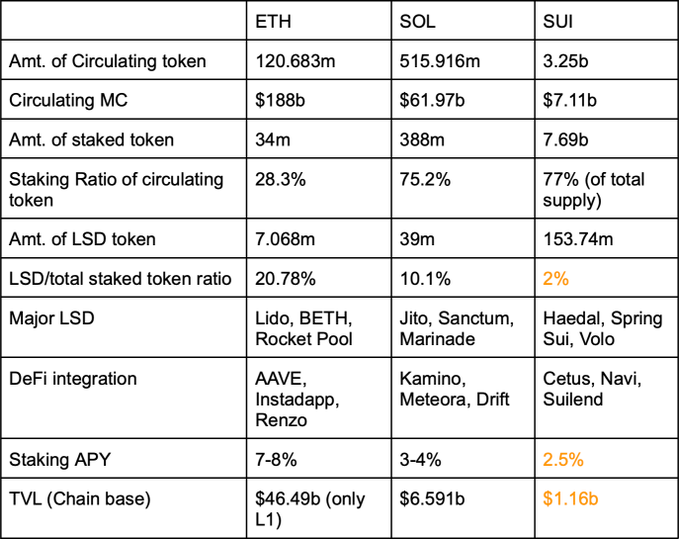
A key issue in Sui’s liquid staking derivatives market is its relatively low staking APY, around 2.5%, compared to 7–8% on Solana and 3–4% on Ethereum.
Haedal significantly enhances staking performance on the Sui network through a dynamic validator selection mechanism and its innovative Hae3 framework—comprising three core components: HMM, HaeVault, and HaeDAO—outperforming other LSD protocols.
By monitoring the status of all network validators, Haedal selects those with the highest APR when staking. When unstaking, it prioritizes withdrawing funds from validators with lower APRs. This strategy ensures that liquid staking tokens consistently maintain a high annualized yield.
HMM (Haedal Market Maker) optimizes liquidity across DEXs on the Sui blockchain by combining oracle pricing with real-time market data, earning a 0.04% transaction fee.
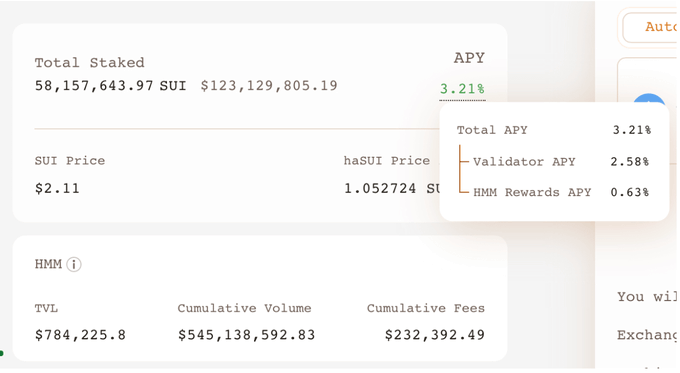
From February to March, trading volume surged from $59.13 million to $284.15 million, generating $236,000 in fees, with an average TVL of $800,000 during this period. After allocating 50% of revenue to incentives, haSUI’s APY increased by 24.4%, rising from 2.58% to 3.21%.
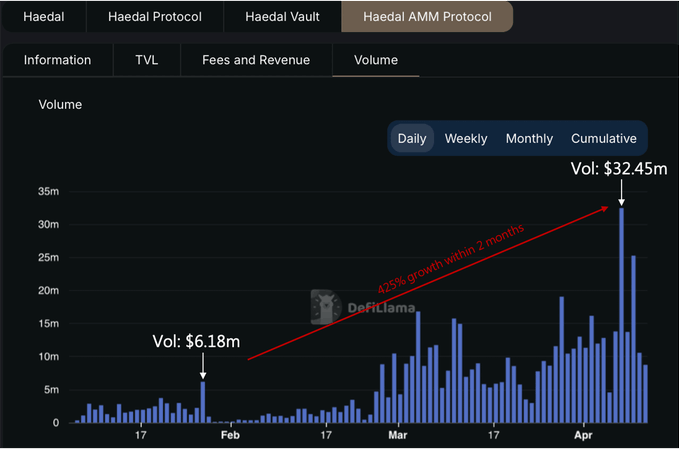
Cetus Protocol is the largest DEX in the Sui ecosystem, with a daily trading volume of $92 million. Haedal launched on January 6, 2025, and now achieves a daily trading volume of $5.69 million—equivalent to 6.12% of Cetus’ volume. With its oracle-based pricing mechanism, HMM is poised for rapid revenue growth by capturing arbitrage-driven trading volume.
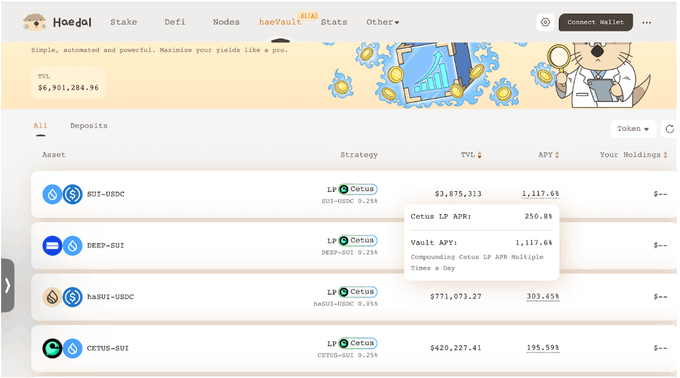
Haedal Vault simplifies liquidity provision for users with idle funds, eliminating the complexities of managing LP positions and enabling effortless deposits for higher returns.
HaeVault boosts yields through an ultra-narrow rebalancing strategy. For example, with the SUI-USDC pool, Cetus offers an APY of 250.8% (based on Cetus data), while HaeVault achieves an APY of 1,117%. After deducting a 16% fee, the net yield remains exceptionally high at 938%.
The Hae3 framework is deeply integrated into the Sui DeFi ecosystem (with over $1 billion in TVL). HMM captures DEX fee revenue, Haedal Vault optimizes returns for liquidity providers, and HaeDAO grants governance rights.
Volo and Suilend, which focus primarily on basic staking and lending, lack such synergies, making Haedal a superior yield optimizer.
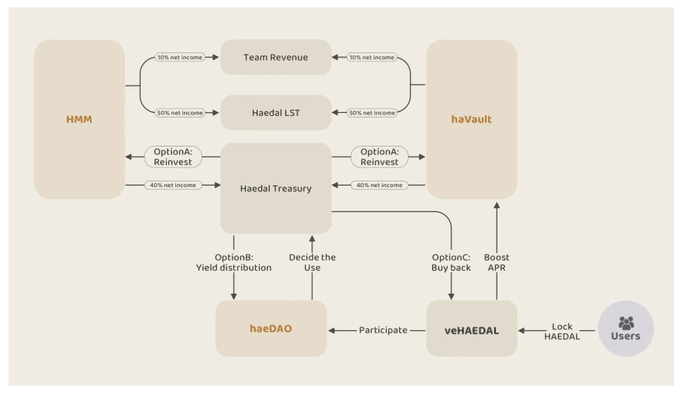
HAEDAL token use cases further strengthen its utility. Locking HAEDAL as a veToken enables participation in HaeDAO governance or boosts vault APYs. Additionally, potential airdrop opportunities—common within the Sui ecosystem—add further upside.
Haedal’s core metrics are robust: $117.36 million in TVL (compared to $117.4 million for Suilend and $50 million for Volo), over 44,000 daily active wallets, and 794,000 holders. Currently, Haedal leads in three key metrics—trading volume, APY, and holder count.
Support from prominent VCs such as Hashed, Comma3, OKX Ventures, and Animoca Brands further underscores its potential.
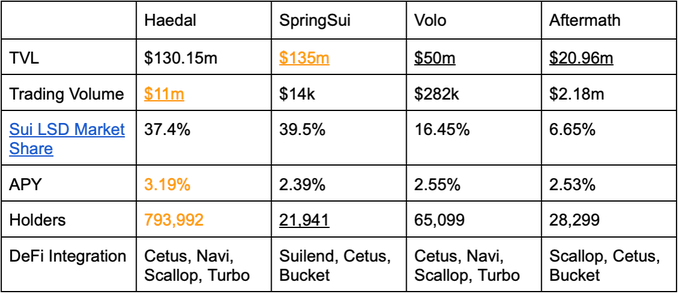
Haedal stands out through access to a high-growth market (LSD penetration at just 2%, offering 10x upside potential), innovative product design, and solid fundamentals. As the Sui ecosystem expands, the protocol is well-positioned in the liquid staking sector and has strong potential to emerge as a market leader.
Join TechFlow official community to stay tuned
Telegram:https://t.me/TechFlowDaily
X (Twitter):https://x.com/TechFlowPost
X (Twitter) EN:https://x.com/BlockFlow_News
 @0x_nico0






