
Crypto VC Amid Liquidity Anxiety: A Quietly Unfolding Imbalance
TechFlow Selected TechFlow Selected
Crypto VC Amid Liquidity Anxiety: A Quietly Unfolding Imbalance
A predicament involving invalid contracts, loss of liquidity control, and a complete failure of exit mechanisms.
 Navigating Web3 tides with focused insights
Author: ChandlerZ, Foresight News
Dashan, a partner at Waterdrop Capital, recently admitted in a Space discussion that all four projects he has invested in have been listed on Binance, yet none of them issued tokens to investors as originally stipulated in their investment agreements. Despite clear contractual terms regarding token distribution, projects are able to unilaterally modify these agreements upon listing, leaving investors with virtually no effective recourse.
He noted that such changes aren't necessarily driven by the project teams themselves, but rather stem from Binance's long-standing unwritten rules. He doesn’t blame the project teams, as they too are in a weak position relative to Binance. His current strategy is clear: persuade and support truly high-quality projects not to issue tokens at all, but instead go public—seeking to demonstrate their value in a cleaner, regulated market.
The contractual rights protections standard in traditional venture capital lack equivalent enforceability within crypto token investment structures. Once tokens are listed, circulation rules are controlled by exchanges, and on-chain asset distributions are not immediately subject to traditional legal systems, rendering investment agreements ineffective at critical junctures. In today’s market environment, a project’s ability to gain access to top-tier exchanges directly determines its survival, marginalizing the importance of contractual terms in the face of real economic incentives. To secure listings, project teams must comply with exchanges’ demands regarding release schedules, lock-up arrangements, and token allocations, while investors, lacking on-chain governance power or influence over liquidity, are left in a de facto state of diminished rights.
This candid revelation highlights a deep crisis currently facing the crypto VC investment system—one of failed contract enforcement, loss of control over liquidity, and the collapse of established exit mechanisms.
Shifting Power Dynamics: The New Relationship Between VCs, Projects, and Exchanges
Over the past few years, an industry model centered on “narrative building → multiple rounds of VC funding → token generation event (TGE)/listing on major centralized exchanges” has become dominant. Under this model, early-stage projects rely heavily on professional VC firms for capital, resources, and credibility. Through successive funding rounds at rising valuations, the ultimate goal is typically a token launch on a large centralized exchange, providing early investors with an exit path.
In previous bull markets, crypto VCs served as core gatekeepers, wielding significant influence over early fundraising and token design, playing a crucial role in driving rapid industry expansion and project incubation. During the last cycle, project teams gained some leverage, but VCs retained influence due to their capital size and liquidity advantages such as Launchpad participation.
However, as the market enters a new adjustment phase and altcoin liquidity dries up, the balance of interests between investors and project teams is shifting. Exchange power has risen dramatically, making them the absolute gatekeepers of liquidity. Key processes—including listing approvals, token allocation, and circulation strategies—are now tightly controlled by exchanges, placing project teams in an extremely weak negotiating position. Even with detailed investment agreements in place, project teams often cannot resist demands from exchanges to adjust token release conditions, ultimately breaking prior commitments to investors.
As exchanges become controllers of scarce listing resources, VCs are increasingly marginalized, with significantly reduced real-world influence.
The Prisoner’s Dilemma Amid Liquidity Contraction
The current困境 facing "VC tokens" is not caused by a single factor.
After multiple funding rounds, public market valuations at TGE are often already very high. This raises initial purchase costs for secondary market investors and means early stakeholders—including VCs, team members, and early supporters—hold large amounts of low-cost tokens with strong incentives to sell.
This expectation gap creates inherent selling pressure post-listing. Market participants may converge on “sell early” as the optimal strategy, triggering a negative feedback loop.
Moreover, tokenomics themselves are exacerbating the challenges faced by VC-backed tokens.
During bull markets, many projects adopted issuance models based on optimistic growth assumptions—such as continuously rising market caps and sufficient liquidity to support gradual unlocks. In practice, however, numerous projects lack sustainable revenue streams: DeFi yields rely on Ponzi dynamics, GameFi depends on subsidies, NFTs thrive on FOMO, and tokens lose all organic growth momentum.
Critically, in previous cycles, VCs could offload their tokens to retail investors in the secondary market, completing their exit. Today, however, there are minimal new retail entrants on-chain or on exchanges, and incremental capital has dried up. As a result, VCs are routinely dumping tokens onto each other.
At its core, early investors, project teams, market makers, and early users are now trapped in a closed-loop zero-sum game, making exits increasingly difficult.
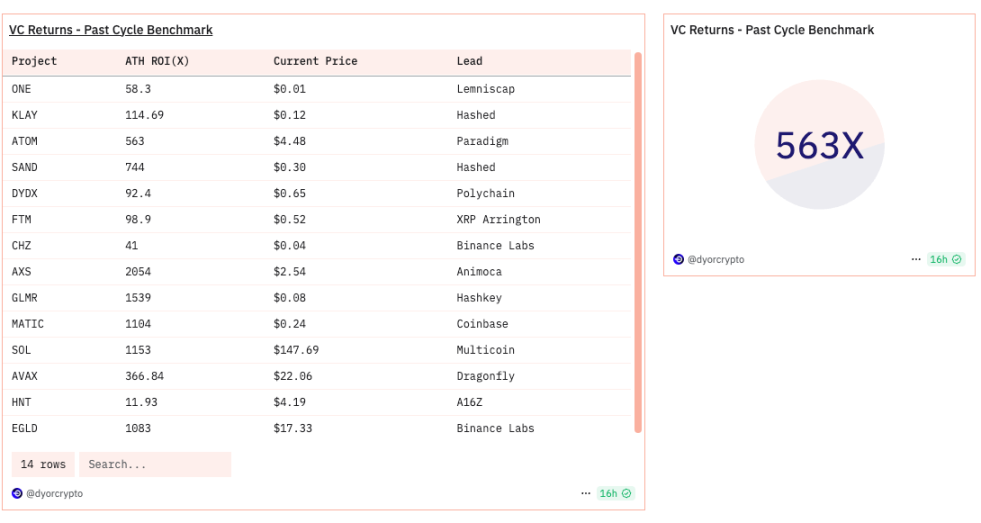
VC Returns in the Previous Bull Cycle
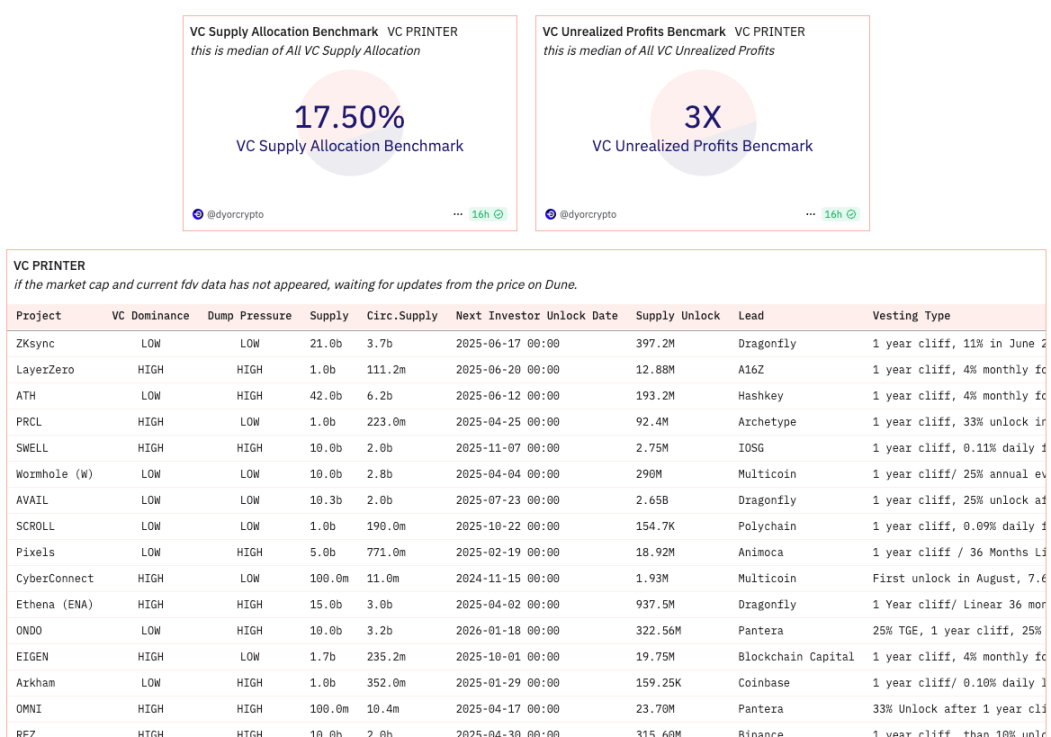
VC Returns in This Cycle
For VC firms, the traditional strategy of achieving high-multiple exits through rapid TGEs is now under strain. Return realization timelines may lengthen, and uncertainty increases. This could push VCs to place greater emphasis on a project’s long-term fundamentals, sustainable business models, reasonable valuations, and healthier token economics during investment decisions. Their role may also evolve—from primarily driving early investment and listings toward deeper post-investment management, strategic empowerment, and ecosystem development.
For project teams, it’s time to reevaluate token issuance strategies and community relations. With aggressive, high-valuation launches now questioned, exploring lower starting valuations, fairer distribution mechanisms, tokenomics that incentivize long-term holding, and improved operational transparency and accountability may prove more viable.
From a broader industry perspective, the current challenges represent a necessary adjustment toward market maturity. They expose structural flaws accumulated during periods of hypergrowth and may catalyze the emergence of a more balanced and sustainable funding and development ecosystem. This requires all market participants—including VCs, project teams, exchanges, investors, and regulators—to adapt and collectively seek a new equilibrium between innovation incentives and risk control, efficiency and fairness.
Join TechFlow official community to stay tuned
Telegram:https://t.me/TechFlowDaily
X (Twitter):https://x.com/TechFlowPost
X (Twitter) EN:https://x.com/BlockFlow_News
 Foresight News