Tokenized Equity Is Disrupting the VC One-Stop Financing Business
TechFlow Selected TechFlow Selected
Tokenized Equity Is Disrupting the VC One-Stop Financing Business
Understanding the Paradigm Shift in Primary Market Venture Capital Through Securitize's Listing Practice
 Navigating Web3 tides with focused insights
By: Prathik Desai
Compiled by: Saoirse, Foresight News
Want to sell me a product? No need for a long-winded introduction of features; first prove whether you use it yourselves. Amazon built its business on AWS; all products sold on the platform run on the same servers open to competitors. If a company isn't willing to use its own product, what right does it have to convince customers to buy?
Securitize's main business is providing asset tokenization infrastructure, dedicated to pushing listed companies, private funds, and asset management institutions to put various securities assets on-chain. To prove the value of stock tokenization to the market, the best demonstration is undoubtedly to tokenize its own stock first, and that is exactly what Securitize did.
On July 2, 2026, Securitize Co-founder and CEO Carlos Domingo rang the bell at the NYSE, completing the company's listing. On the morning of the listing, the company's stock simultaneously landed on the Solana and Avalanche public chains in token form. This is not an encapsulated derivatives model; rather, equity ownership is directly registered on the blockchain, independent of traditional centralized registration institutions. On the first day of listing, common stock worth approximately $270 million was registered on-chain.
Choosing to promote stock tokenization simultaneously with listing will inevitably attract key regulatory scrutiny; most new listed companies will deliberately avoid such risks, but Securitize actively chose to face regulatory scrutiny.
This raises a thought-provoking question: Since listed companies can issue tokenized stocks simultaneously upon listing, why can't private startups replicate this model during the Series A financing stage?
This article will explore how tokenized stocks will fundamentally reconstruct the entire service system that venture capital institutions output to startups based on a bundled Term Sheet.
What Exactly Does a Term Sheet Include?
Founders seeking venture capital (VC) investment are demanding far more than just capital. Whenever a VC signs a Term Sheet, it is essentially committing to provide a package of bundled services.
- First, capital support. VCs commit to investing capital to help companies complete growth expansion from zero to one.
- Second, valuation pricing. All private enterprises need valuation, and in the private market, valuation work is usually led by lead investors.
- Third, value endorsement (Curation). The appearance of well-known institutions on the shareholder list is equivalent to sending a signal to the market that the target is worth investing in, helping companies attract follow-up investors, business customers, and high-quality talent.
VCs can also rely on industry connections to connect companies with corporate clients, senior technical talent, and core industry resources. In some cases, VCs will also include an implicit commitment to follow-on investment: as the company continues to develop, continue to follow up with additional investment. Finally, and crucially: the Term Sheet includes corporate governance clauses. As consideration for the investment transaction, VCs generally obtain board seats, information rights, protective provisions, and the power to establish equity transfer restrictions.
The entire set of content above is the complete service package that VCs sell to startups in a round of financing.
The reason this bundled model can exist stably for a long time lies in the fact that private equity has long been closed to ordinary investors. Ordinary individual investors wanting to trade private shares and participate in price formation are highly dependent on corporate cooperation.
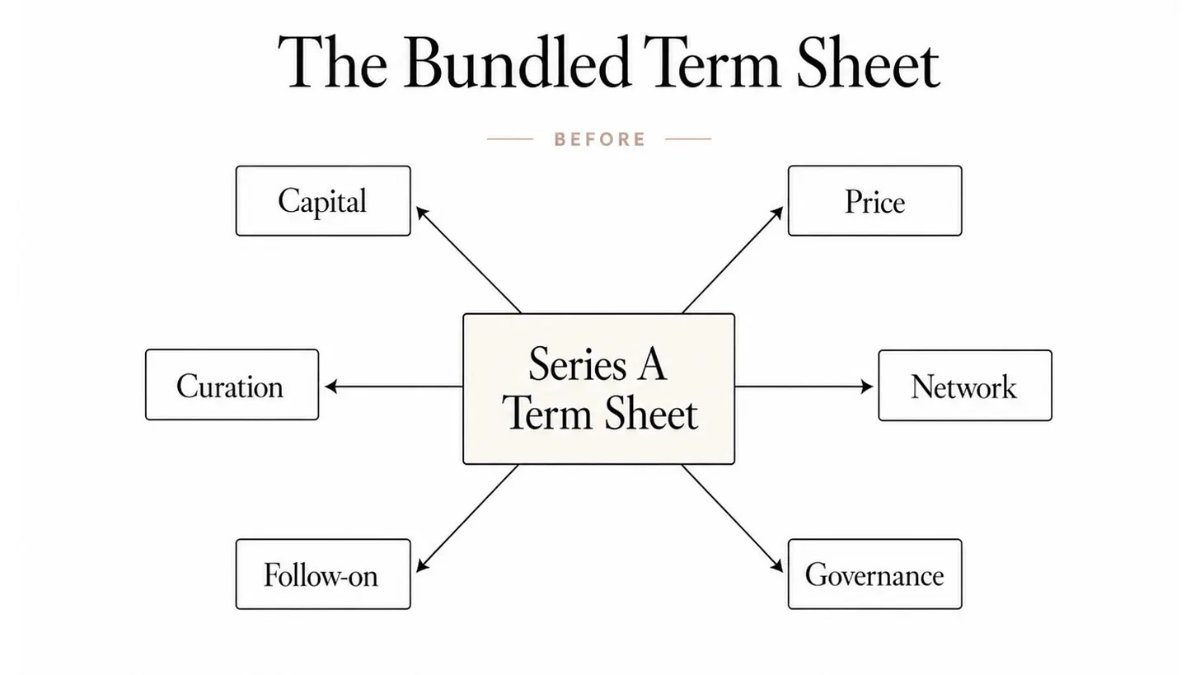
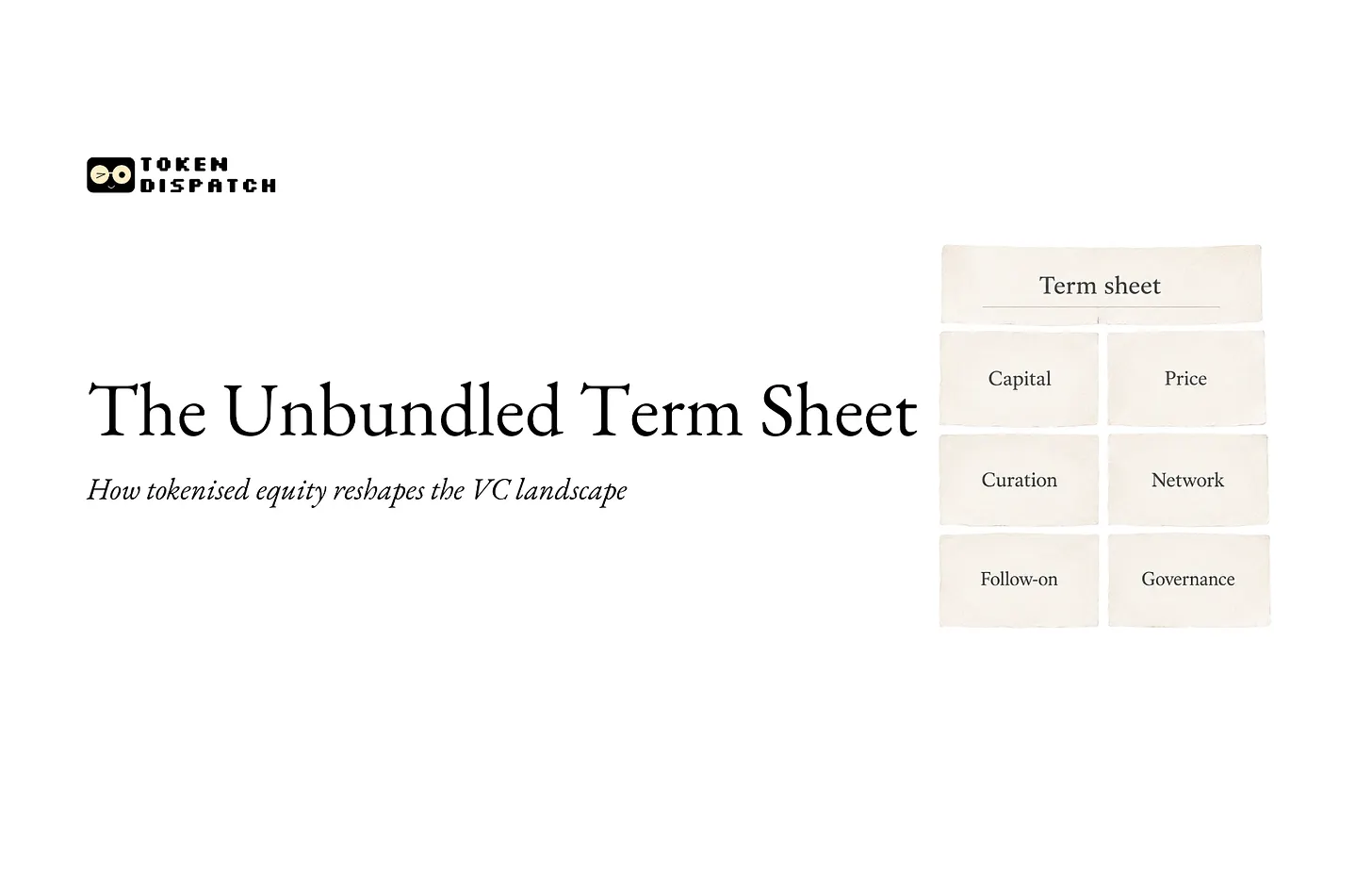
This chart shows that the traditional Series A investment term sheet belongs to the bundled model: one Term Sheet provides a full set of six categories of services including capital, pricing, value endorsement, industry resources, follow-on investment, and corporate governance at once; founders cannot purchase them separately.
Last month, I elaborated on how blockchain infrastructure splits the functions of banks in IPO underwriting business. Today, similar technology supporting stock tokenization further reveals: VCs no longer monopolize the valuation pricing rights of private enterprises.
However, there are key prerequisite constraints here.
When Securitize promoted stock tokenization, it was already a mature enterprise operating for ten years, possessing audited financial statements, cash flow that could be disclosed externally, and the platform carried tokenized asset scales exceeding $4 billion; the market had sufficient information to conduct valuation. In contrast, for a Series A startup, the outside world can only rely on the founder's resume, personal reputation, and business concept to make judgments. The underlying assets of the two types of targets are both equity, but the core basis supporting valuation is completely different.
This precisely reflects the core significance of value endorsement in the Term Sheet. For Series A projects, the value of VCs is not just having their names appear on the shareholder list, but completing credit endorsement for enterprises lacking public operational data. Late-stage Pre-IPO enterprises like SpaceX and OpenAI find it easier to achieve equity tokenization; their operational characteristics are already close to listed companies, and long before official listing, secondary trading markets, tender offers, perpetual contracts, and broker research reports have already formed price references.
Although the implementation of equity tokenization for early-stage enterprises is more difficult and the market lacks sufficient data to form fair pricing, this cannot stop the unbundling of VC bundled services.
The Wave of Service Unbundling is Coming
Securitize is not the first enterprise to move listed stocks onto the blockchain in the US. In 2021, Exodus already completed practice on Algorand, and digital asset and data center enterprise Galaxy Digital also issued on-chain equity. But Securitize achieved an industry breakthrough, becoming the first company to issue native on-chain equity simultaneously on the first day of listing.
Tokens traded on the Solana and Avalanche chains have equal legal effect to stocks circulating on the NYSE. Each token enjoys fully equivalent voting rights, dividend rights, and residual asset claims; it is neither a synthetic derivative simply tracking price, nor a revenue certificate based on offshore Special Purpose Vehicles (SPV) holding shares on behalf. Securitize's tokenized common stock is completely equivalent to the off-chain native stock SECZ rights.
Investors often confuse the ownership nature of various on-chain stocks on the market. Vaidik sorted out two types of mainstream "stock tokens" in the article "Who Really Holds Your US Stocks? 83% of Stocks Nominally Belong to This Institution": one type is natively issued by the issuer (e.g., SECZ, Exodus), where the token itself represents equity; the other type belongs to the custody encapsulation model, such as xStocks, Robinhood stock tokens, where real shares are held by SPV, and investors only enjoy profit claim rights. Only the first type of token carries complete shareholder rights, and this is exactly the foundation on which the entire venture capital business model relies.
Once equity can be continuously priced and freely circulated, the various services originally bundled in the Term Sheet no longer need to be sold as a package; various needs can find independent solutions with lower costs and higher efficiency.
For mature enterprises with a valuation basis, capital raising and valuation pricing are gradually handed over to the market layer to undertake: the market forms fair prices, and capital flows following prices. Currently, the total value of tokenized equity locked in Ondo Global Markets has exceeded $1 billion; on the Hyperliquid platform, the price of Cerebras' pre-listing perpetual contract differs from its Nasdaq opening price by only 1.3%.
Project endorsement and network resources still require anchor investors, but lead investment capital and brand credit no longer must rely on the complete systems of large institutions like Sequoia and a16z. Elad Gil established a single-person fund with a scale of about $1.5 billion; relying only on individuals and rolling funds, he can complete lead investment and provide brand endorsement.
Niche professional service providers undertake various supporting needs: Fairmint and Pulley are responsible for equity ledger management; Coinbase acquired LiquiFi in July 2025, laying out the token exercise track; Echo acquired in October 2025 focuses on financing tools; Magna and Sablier handle installment exercise business. Founders in 2026 can independently combine a full set of tools to achieve back-end capabilities that could only be purchased from VCs as a package in the past.
Corporate governance is moving towards programmability. Fairmint's architecture supports a continuous fundraising model similar to SAFE (Simple Agreement for Future Equity), capable of automatically completing equity conversion according to preset rules; exercise lock-up periods and vesting rules are enforced by smart contracts, no longer relying solely on lawyers drafting written documents.
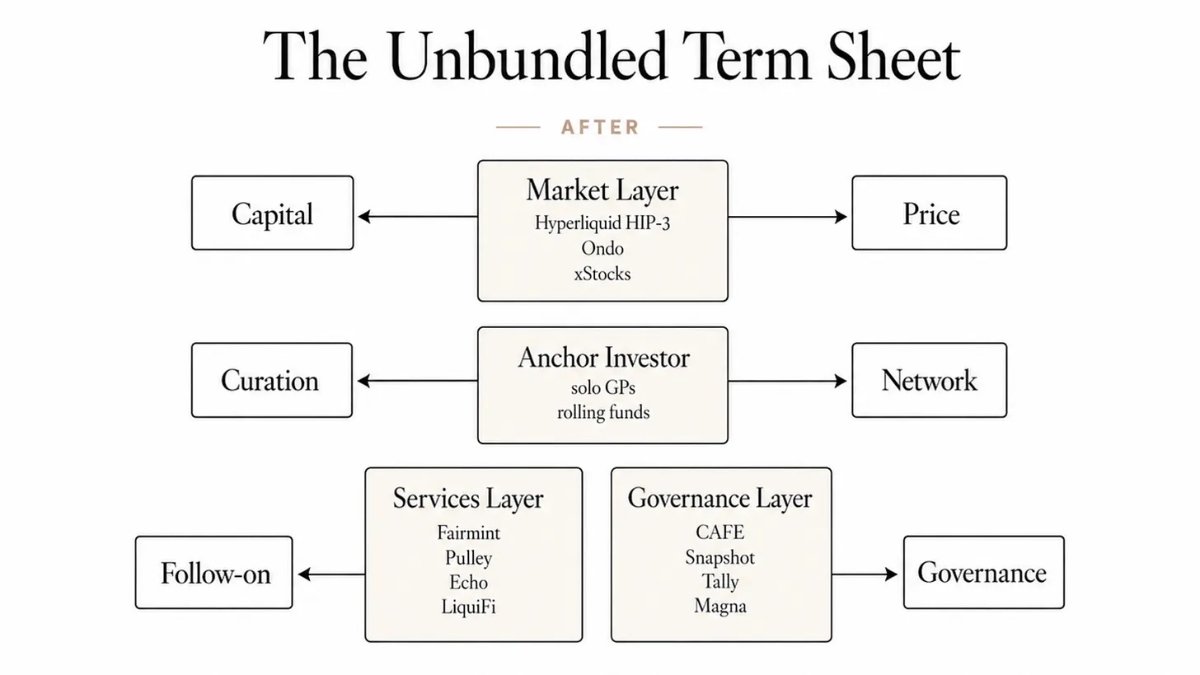
In the era of tokenized equity, the investment term sheet achieves service unbundling: the six major functions originally covered by a single Series A Term Sheet are split; capital and valuation are handed over to the market layer, credit endorsement and networks are provided by anchor investors, equity operations and corporate governance are handed over to professional technical service providers respectively, and founders can purchase various services separately according to needs.
Secondary liquidity channels continue to expand, and internal employees and early investors of enterprises have more exit options. Employees and angel investors of tokenized private enterprises do not need to wait long for an IPO to reduce holdings and cash out.
Continuous liquidity is precisely the profound change brought by tokenized stock trading. Liquidity completely reshapes the logic by which founders and employees view equity. When shares can be traded at any time, the interest game behind exercise lock-up periods and cash-out windows changes accordingly. In the past, employees often needed to wait four years to have the opportunity to participate in tender offers; now they can connect to the secondary market at any time. But the new model also has trade-offs.
Similar cases have already appeared in the crypto industry: Layer 2 network governance tokens like Arbitrum ARB and Optimism OP can be traded upon listing; after exercise expiration, team tokens are sold off centrally, token prices become decoupled from the network's actual operational status, and founders are forced to spend a lot of energy watching the market, diverting focus from product research and development.
Of course, this analogy has limitations: ARB and OP belong to governance tokens, not corporate equity; prices reflect ecological activity more than company operating performance. But the incentive mechanism conflicts exposed therein are highly similar. Reg D 506 (c) accredited investor access, Rule 144 lock-up requirements, and multi-year lock-up agreements can alleviate the phenomenon of concentrated selling, but cannot eliminate the problem from the root. Tokenized equity opens up new exit channels for internal holders, breaking the traditional mechanism of the private market relying on time to smooth out vesting pressure.
And the follow-on investment that founders generally value most is the segment in the entire VC service package that still lacks a mature tokenized alternative solution.
The reason is that all current implemented regulatory frameworks — including SEC-approved DTCC pilots, Nasdaq token trading systems, and related businesses DTCC will launch in October — are all targeting listed enterprises such as Russell 1000 components. At this stage, there are no compliant channels supporting tokenized equity of Series A startups to be publicly traded on the above platforms.
Which Core Values Will Still Remain in the Hands of VCs?
After the arrival of the streaming era, the music distribution link was completely commoditized, but record companies did not perish. Anyone can upload songs to Spotify; what cannot be commoditized is the A&R artist mining business: screening creators worth investing in, building artist brands, and opening up industry resources that cannot be reached by data alone. Record companies that completed the transformation ultimately evolved into institutions relying on data to conduct value judgments. The originally integrated business was split among various service providers, and record companies guarded the scarce value judgment link.
The venture capital industry is highly likely to replicate this evolution path. Tokenized stocks gradually undertake all procedural affairs in the Term Sheet: ownership registration, price discovery, share transfer, and scheduled unlock exercise. The efficiency of blockchain handling standardized processes is far superior to paper Term Sheets.
What is forever scarce is investors who can facilitate the next round of financing, convince large customers to switch suppliers, and move senior talent to leave large factories to join startups solely based on their own reputation. Token technology cannot complete business value endorsement for founders.
But any wave of service unbundling will eventually usher in a new round of integration, and the leaders of integration are often emerging participants. The 1986 London Big Bang split broker and market maker businesses; within a short ten years, universal banks reintegrated various niche businesses.
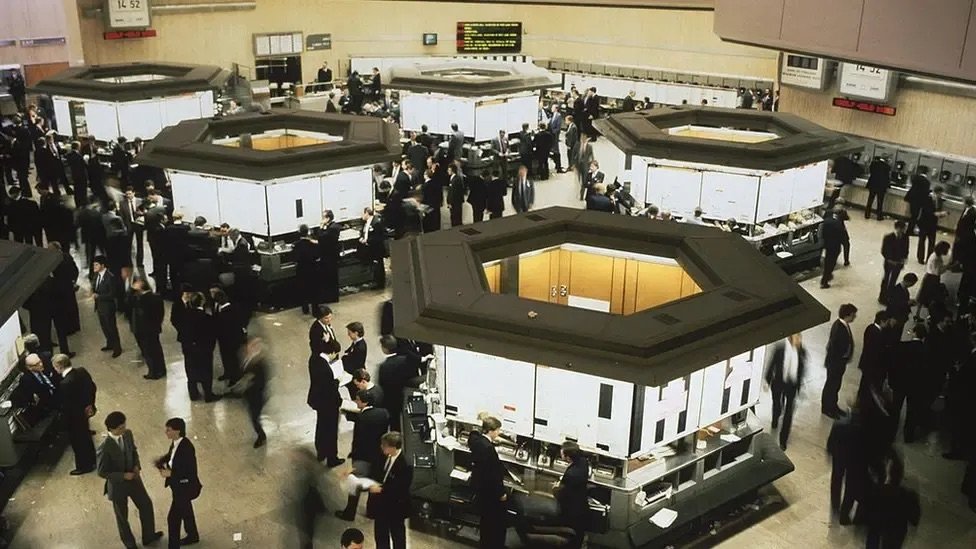
After the London "Big Bang" reform introduced electronic trading, the trading floor of the London Stock Exchange lost the necessity of its existence. Source: Getty Images, BBC
For decades, founders actively connected with VCs because only here could they obtain all services including capital, valuation, project endorsement, and governance support in one stop. Tokenized equity is like a long corridor with multiple independent doors distributed: one connects to capital, one provides pricing, one solves governance needs. Founders still need all services, but no longer need to purchase uniformly from the same institution.
This also changes the early decision logic of entrepreneurs from the bottom up. Founders are no longer forced to struggle with "which fund to choose to enter the shareholder list to solve all development problems at once," but gain autonomous choice: which businesses are handed over to market mechanisms to operate, and which links choose to trust human subjective judgment.
Standardized processes in the Term Sheet will complete tokenization transformation first; this type of business is easiest for the market to undertake; the value judgment link is digitized last, or perhaps never can be digitized; the market always needs humans to provide this service. A Series A startup may be able to achieve equity on-chain in the future, but still needs someone to make a judgment: is this equity worth pushing to the market.
Join TechFlow official community to stay tuned
Telegram:https://t.me/TechFlowDaily
X (Twitter):https://x.com/TechFlowPost
X (Twitter) EN:https://x.com/BlockFlow_News