








Trump's "Monopoly" Game
TechFlow Selected TechFlow Selected
Trump's "Monopoly" Game
Rules are arbitrary, obsessed with wealth accumulation, and have no moral底线.
 Navigating Web3 tides with focused insights
By TechFlow
In early 2025, the TRUMP token emerged out of nowhere, exploding like thunder just days before Trump's inauguration speech. Its price surged from an initial $0.18 to $75.35, but then rapidly collapsed, losing 90% of its peak market value.
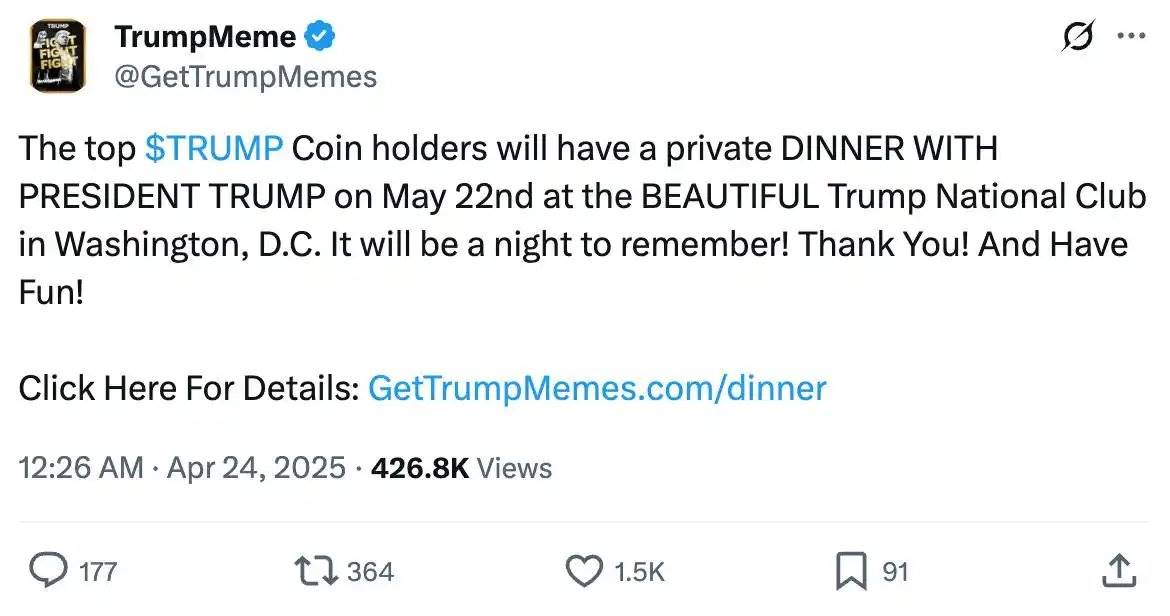
On April 18, the TRUMP token entered its first unlock period; on April 23, the official website announced that holders ranked among the top 220 by average Memecoin holdings would be invited to a private dinner, sending the token price soaring.
This seemed to offer a glimmer of hope, yet it felt more like dangling an apple forever out of reach, luring holders onward.
Now, two sources familiar with the matter reveal that Trump’s latest project will be a Trump-branded crypto game, designed similarly to Monopoly GO, scheduled to launch by the end of April.
New bait keeps appearing—just as the crypto world recovers from tariff policy turbulence, it now faces another round of Trump’s games.
From reality to crypto, this former businessman and current politician is thriving.
"Buy land, collect rent, bankrupt your opponents..." These familiar scenes keep repeating. And Trump, who has always said he believes Monopoly is a great game, has never stopped playing.
NFTs, Presidency Coins, Blockchain Games... What’s Next?
To the crypto world, Trump is arguably one of the most unpredictable variables. In 2025, the president has been especially active.
On January 18, just days before his inauguration, Trump announced the launch of a meme coin named after him on his social platform, triggering a surge in its value that peaked at $75.35. Within two days, it became the 19th most valuable cryptocurrency globally.
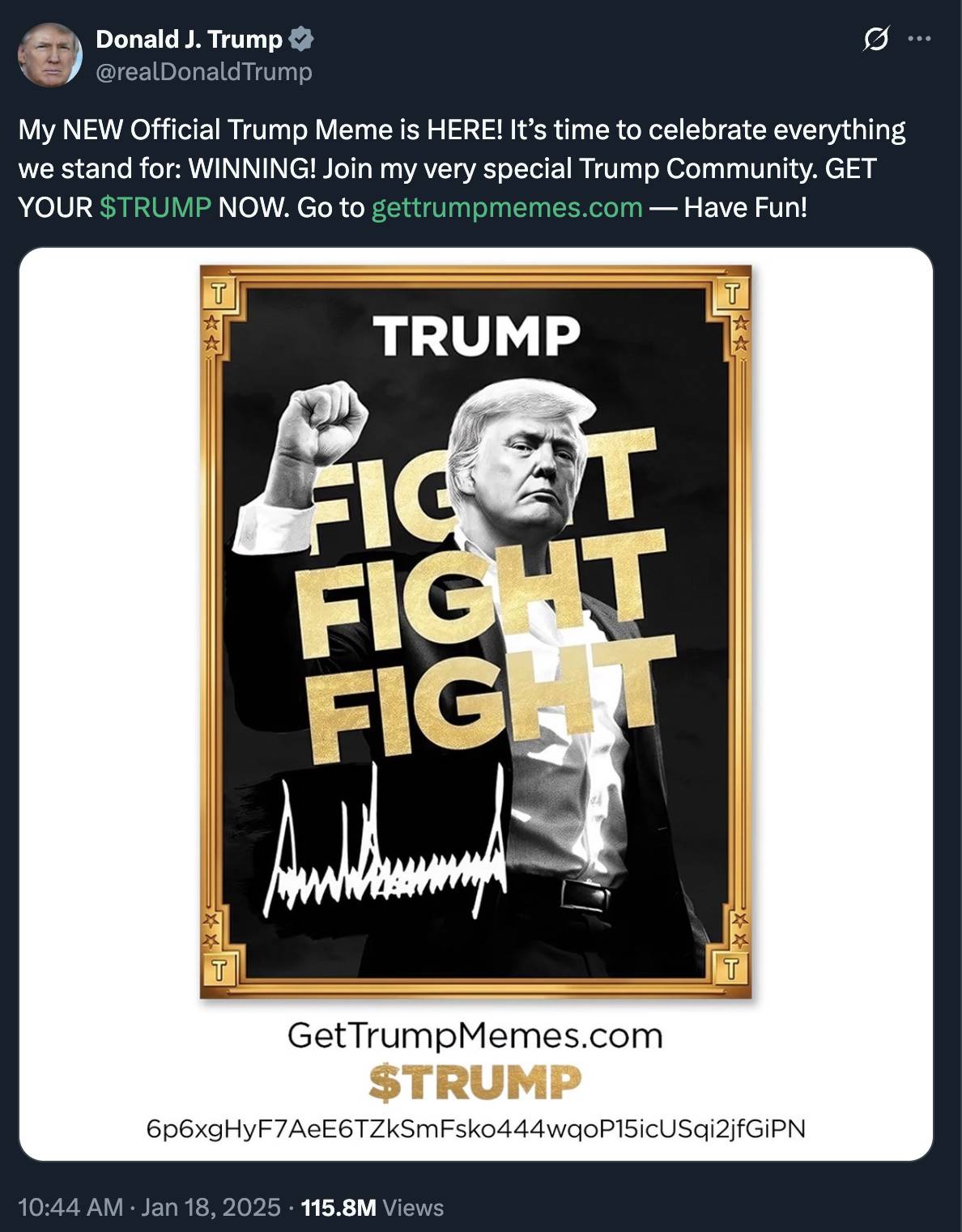
The token had an initial supply of 200 million, with 80% held by two entities under Trump’s control according to the official site. The originally scheduled April 18 unlock of 40 million tokens—worth approximately $300 million and representing 20% of circulating supply—raised widespread bearish expectations.
Yet, $TRUMP did not immediately crash after unlocking on April 18. Especially on April 23, when the "Trump Coin" official website announced a closed-door shareholder dinner for holders, the news created significant excitement. $TRUMP surged 50% within 24 hours, reaching a high of $14.71.
Beyond this, according to a report by Fortune magazine on April 15, Trump plans to launch a crypto game allowing players to build virtual properties and earn in-game currency through a "play-to-earn" model. This game will become the newest addition to Trump and his family’s growing list of cryptocurrency investments.
Although Kevin Mercuri, spokesperson for Trump’s longtime associate Zanker, denied similarities between the project and Monopoly GO!, confirmation remains that a new game will launch by the end of April.
This is not the full extent of Trump’s IP entering the crypto space.
Between 2022 and 2024, Trump released three NFT series featuring cartoon depictions of himself (such as superhero and presidential portraits). Back then, buyers holding at least 47 of Trump’s “Mugshot Edition” NFTs received an “exclusive reward”—an invitation to a dinner event. “I own some cryptocurrency,” said Jordan, one of the invitees, in an interview, “but for me, this is more about getting a chance to meet President Trump.”
Despite claims by the company selling these NFTs that they are unrelated to Trump’s campaign, both the NFTs and presidency coin have drawn criticism over “politicians profiting from the crypto market,” being labeled “the worst conflict of interest in modern history.”
A longtime fan of Monopoly, Trump previously launched a board game titled *Trump: The Game* in 1989, inspired by Monopoly. Whether in real life or the crypto world, Trump has continuously been “buying land and building houses,” and his methods go far beyond mere IP licensing.
Bringing the Nation Into the Game: Winning Half a Move Ahead
Trump once expressed skepticism toward cryptocurrencies. Four years ago, he publicly denounced Bitcoin as a “scam” undermining the dollar’s value. But during the 2024 presidential campaign, he shifted dramatically, showing enthusiasm for Web3, promising to make the U.S. a global hub for crypto innovation and criticizing the Biden administration’s regulatory approach as overly restrictive.
Three days after returning to the White House for his second term on January 23, Trump issued Executive Order 14178, titled “Strengthening American Leadership in Digital Financial Technology,” laying the foundation for a “National Digital Asset Reserve.” On March 6, 2025, President Trump signed another executive order establishing a Strategic Bitcoin Reserve and U.S. Digital Asset Stockpile, fulfilling his pledge to make America the world capital of cryptocurrency.
He stated: “I am very positive and open-minded toward cryptocurrency companies and everything related to this emerging industry. Our nation must become a leader in this field.”
On the same day, the White House hosted its first-ever Crypto Summit, gathering prominent founders, CEOs, and investors from the crypto industry—many of whom had faced crackdowns under the Biden administration. However, no substantive policy documents were released, and most speeches overflowed with gratitude and praise for Trump’s “visionary leadership,” resembling a grand “Thanksgiving” celebration. The official livestream mysteriously cut off just 20 minutes into the event, leaving much to speculation.
Beyond political support, Trump and his family members have all personally entered the crypto market.
In September 2024, the Trump family founded a cryptocurrency lending platform called World Liberty Financial (WLF). According to its GOLD PAPER, the Trump family receives 75% of the crypto income while bearing zero liability. In November 2024, Trump Media & Technology Group filed a trademark application for a crypto payment and trading service named “TruthFi,” hinting at a potential acquisition of crypto platform Bakkt. In February 2025, the Trump Organization filed a trademark application with the U.S. Patent and Trademark Office under DTTM operations, signaling possible expansion into the metaverse and NFT sectors. In March, Trump’s two sons publicly announced their investment in a new Bitcoin mining company to expand the family’s business interests in the crypto industry.
Initiatives including meme coins have brought billions in revenue to the family. Government ethics experts say these commercial activities represent the most blatant conflict of interest in presidential history. It’s no surprise then that Timothy L. O'Brien, a biographer who has long written about Trump, once said, “Anyone who walks into Trump’s office and offers him a simple way to make money immediately captures his attention. He is always opportunistic about policy.”
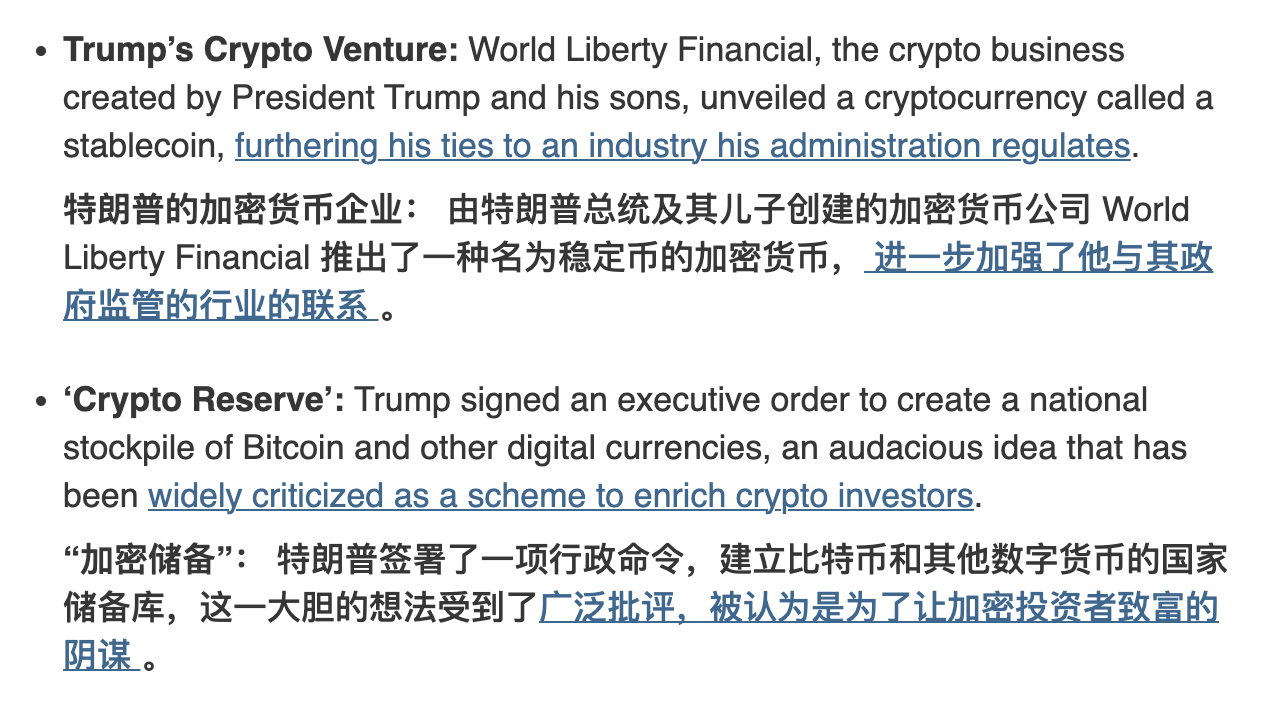
Related coverage by The New York Times
Speaking about the Biden administration’s investigations into crypto firms, Trump said: “They weaponized the government against the entire industry.”
In a memo dated April 7, U.S. Deputy Attorney General Todd Blanche cited President Donald Trump’s promise to “end the weaponization of regulation against the crypto industry,” disbanding the National Cryptocurrency Enforcement Team (NCET), stating, “The Department of Justice will no longer pursue litigation or enforcement actions imposing regulatory frameworks on digital assets.”
Strategic asset allocation, leveraging trends, maximizing returns—much like planning a play-to-earn blockchain game, the Trump family is walking this path, and has always been walking this path.
Monopoly Life
As the fourth child of New York real estate tycoon Fred Trump, after earning a degree from the Wharton School at the University of Pennsylvania, Donald Trump was seen as the heir to his father’s empire. Before joining the family business, he entered the real estate industry with a $1 million loan from his father. The family’s property enterprise expanded steadily, followed by a string of other Trump-branded developments—casinos, apartments, golf courses, and hotels.
The 2004 reissue of *Trump: The Game* carried the slogan: “It takes brains to make millions, but it takes Trump to make billions.” In this game, strategy and fun aren’t the main focus—money is the core, both the means and the ultimate goal. Much like his actual life.
Trump excels at monetizing his fame, and his media presence has grown alongside his business empire.
From founding beauty pageants like Miss Universe, Miss USA, and Miss Teen USA, to creating and hosting the NBC reality show *The Apprentice*, Trump became a household name in American society over nearly half a century. He stamped his name across hotels, towers, plazas, competitions, and golf courses around the world—most of which involved little more than branding deals.
In 2011, Forbes financial experts estimated the Trump brand was worth $200 million, but Trump disputed this figure, claiming his brand was actually worth around $3 billion.
This isn’t surprising—when it comes to exaggeration and negotiation, Trump has always been a master.
In *The King of the Castle: Donald Trump*, biographer Gwenda Blair wrote: “In *The Art of the Deal*, Trump claims business transactions define him… but his most original creation is constant self-inflation.” — While *The Art of the Deal* promoted his business success, it took him two decades to realize how fictional much of it was. In 2016, co-author Schwartz criticized his past self on *Good Morning America*, saying he had been “putting lipstick on a pig.”
From business to politics, controversy has never left Trump’s side. As a businessman, he has been involved in over 4,000 legal cases. During his previous presidency, he faced more than 3,700 unresolved conflict-of-interest allegations due to failure to fully divest from business interests. Yet he never backed down—and indeed achieved what he wanted, completing a tarnished yet dazzling transformation.
In January 2025, Trump—who had already been sentenced to life imprisonment for felony convictions—officially became the first person ever elected president while serving time for serious crimes, returning to power and shaking up the global chessboard once again.
Looking back at that poorly-selling Monopoly-style board game branded with Trump’s name in 1989: its rules were arbitrary, obsessed with wealth accumulation, devoid of moral boundaries, and bore the slogan: “It’s not whether you win or lose, it’s whether you win!”
Does that sound familiar?
Join TechFlow official community to stay tuned
Telegram:https://t.me/TechFlowDaily
X (Twitter):https://x.com/TechFlowPost
X (Twitter) EN:https://x.com/BlockFlow_News
 深潮TechFlow


