








Bankless: Can Bitcoin Thrive On-Chain?
TechFlow Selected TechFlow Selected
Bankless: Can Bitcoin Thrive On-Chain?
The transition of Bitcoin to a chain-based economy will not happen overnight, and it shouldn't.
 Navigating Web3 tides with focused insights
Author: Jean-Paul Faraj
Translation and compilation: Bitpush News

Despite firmly holding the top spot in cryptocurrency market capitalization, Bitcoin's relatively low participation in decentralized finance (DeFi) is sparking a profound discussion about its future role.
For over a decade, Bitcoin has been the cornerstone of the crypto ecosystem—praised for its decentralization, censorship resistance, and provable scarcity. Yet, despite its dominant market cap and recent surge in popularity, it remains largely disconnected from one of the most dynamic sectors in crypto: DeFi.
According to data from Bitcoin Layers, only around $30 billion worth of Bitcoin (just 1.875% of its total supply) is currently used in DeFi. In contrast, Ethereum has approximately $50 billion worth of ETH locked in DeFi protocols, representing about 23% of its circulating supply.
This gap highlights a central contradiction in today’s Bitcoin narrative: while BTC holds immense value, only a small fraction is actively being utilized on-chain to generate yield. This disparity is fueling innovation around wrapping, staking, and other methods to bring Bitcoin into the DeFi economy—unlocking ways to make BTC a productive capital asset.
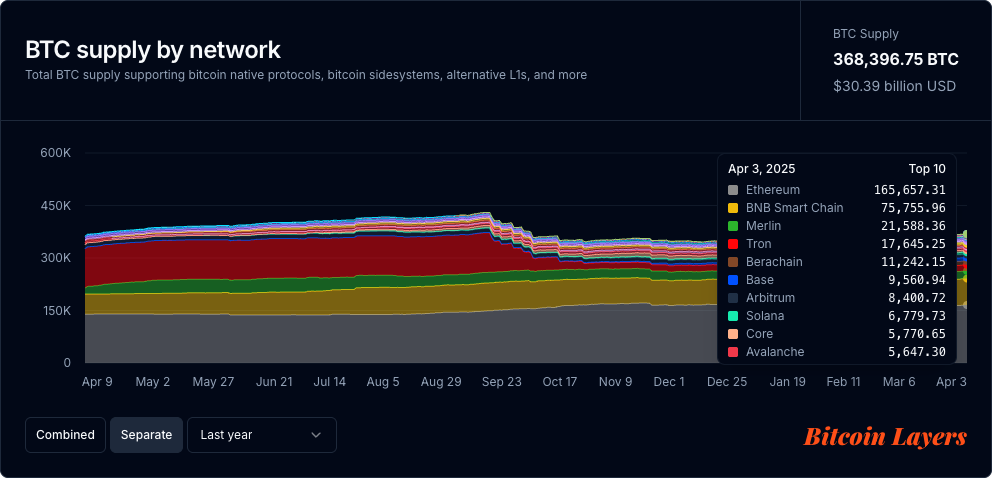
Bitcoin Layers*: BTC supply by network, showing all wrapped BTC
Ethereum’s DeFi ecosystem has matured to include tools for lending, staking, and trading. By comparison, native Bitcoin remains difficult to use efficiently, especially for new users. Transaction times are slow, fees are variable and often high, and Bitcoin’s architecture lacks the programmability that powers Ethereum-based applications.
As the broader cryptocurrency space matures, this raises an important question: Can Bitcoin meaningfully participate in on-chain economies? And if so, how can we enable widespread participation without forcing average BTC holders to navigate a maze of bridges, wrapped tokens, and unfamiliar applications?
The Problem: Bitcoin’s Design vs. DeFi Practicality
Bitcoin’s underlying architecture was not optimized for the high degree of programmability seen in modern smart contracts. It prioritizes security and decentralization through its Proof-of-Work (PoW) mechanism rather than complex logic execution—a design choice that makes it a reliable store of value but limits adaptability in smart contract and advanced DeFi applications. As a result, native Bitcoin struggles to integrate with composable financial ecosystems thriving on chains like Ethereum and Solana.
Past workarounds have included:
-
Wrapped Bitcoin: Users convert BTC into ERC-20 tokens to access Ethereum-based DeFi. This introduces custodial risk, as token liquidity may be opaque and isn’t always backed 1:1 by BTC held by third-party custodians.
-
Bridging protocols: Cross-chain platforms allow BTC to move into other ecosystems. However, manual bridging increases friction, complexity, and risk—especially for non-technical users.
-
Custodial platforms: Centralized services like Coinbase offer BTC yield products but require users to relinquish custody and typically pay returns in points, stablecoins, or proprietary tokens instead of BTC.
-
Each option involves trade-offs that challenge core Bitcoin principles: security, simplicity, and user sovereignty.
Barriers to Entry: Why User Experience Still Matters
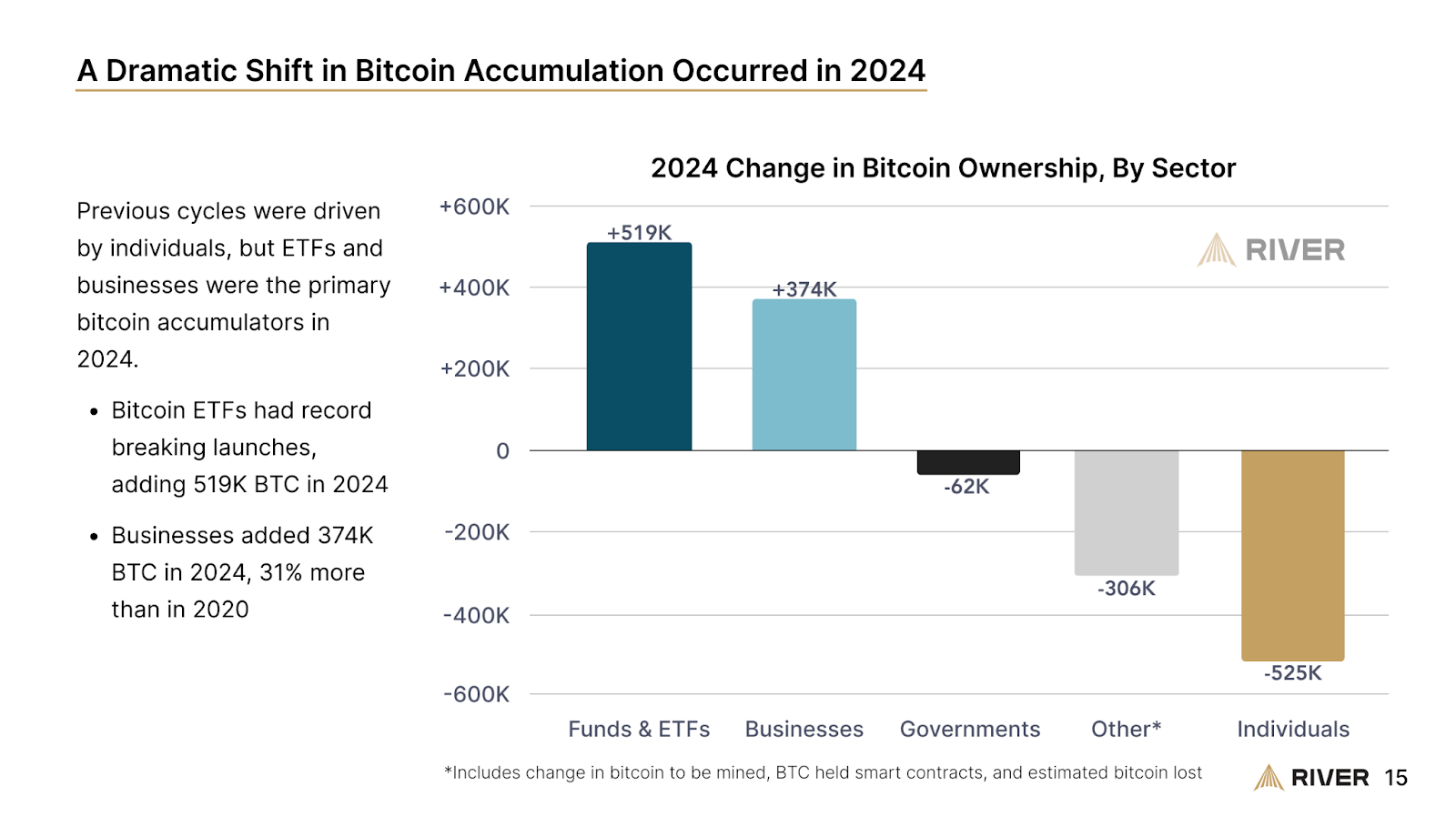
BTC accumulation in 2024, river.com
For Bitcoin holders curious about doing more with their assets—earning yield, participating in on-chain governance, or experimenting with DeFi—the onboarding path remains fragmented, unintuitive, and often intimidating. While infrastructure has evolved, user experience lags behind—not just compared to other blockchains, but also against traditional finance (TradFi).
This friction creates a significant barrier to entry. Most users don’t want to become DeFi experts—they simply want to grow their net worth and BTC holdings securely and easily, without navigating the labyrinth of apps, bridges, and protocols, unlike recent buyers who acquired large amounts off-chain via brokers, ETFs, or products like Michael Saylor’s strategy.
To transition the next wave of users from passive off-chain holders to active on-chain participants, tools must eliminate this complexity without compromising control, self-custody, or transparency. This is where emerging protocols and modern wallet experiences begin to play a crucial role—offering accessible DeFi functionality while preserving Bitcoin’s core values.
Better user experience isn’t just a nice-to-have—it’s essential infrastructure for the next phase of Bitcoin adoption.
New Approaches to On-Chain BTC Yield and Productivity
Many emerging solutions aim to make Bitcoin more usable in DeFi—each with different trade-offs:
1. Staking, Restaking, and Points-Based Yield Programs
Platforms like Babylon and Lombard now offer Bitcoin-related yield programs through points or reward tokens, often enabled by staking or restaking. These tokens can usually be redeemed for benefits or future airdrops. Such systems appeal to early adopters and crypto-native users chasing airdrops and platform-specific tokenomics. These products typically involve converting BTC into wrapped BTC standards, then locking assets into various plans or products to earn variable yields. High returns are possible for sophisticated on-chain traders, but they require deeper knowledge of crypto usage, including manual bridging, wrapping, and depositing funds.
Pros:
-
Broad yield opportunities
-
Often self-custodial
Cons:
-
Rewards not paid in BTC
-
Typically require lock-up periods
-
Uncertain long-term value of rewards
2. Bitcoin Layer 2s and Meta-Protocols
Developments such as the Lightning Network, Rootstock (RSK), Alkanes, and emerging Layer 2s like Botanix and Starknet are bringing new capabilities, programmability, and speed to Bitcoin. These innovations enable use cases like fast payments, NFTs, and smart-contract-like behaviors. As a result, users can now leverage their BTC across a wide range of DeFi opportunities—such as securing networks by locking funds, participating in market-making, borrowing/lending, or converting assets to support wrapped BTC standards across various protocols. As more teams build on these networks, the ecosystem of Bitcoin-based yield opportunities will continue expanding.
Pros:
-
Expands Bitcoin’s use cases
-
Aligned with Bitcoin’s architectural ethos
-
Wide range of on-chain yield options
Cons:
-
Still relatively early-stage and fragmented
-
Requires intermediate to advanced understanding to utilize effectively
-
Demanding developer resources needed to rebuild utility already present on other smart contract chains
3. Smart Wallet Integration and Native BTC Yield
Wallets like Braavos offer features enabling users to earn native BTC yield without manually wrapping their Bitcoin or surrendering custody. Users can invest BTC directly through their wallets, bypassing the usual hurdles of bridging or using external apps. Complex steps—like deposits, wrapping, and bridging—are seamlessly handled in the background, with BTC deployed into specific DeFi strategies. This user-friendly approach aims to make BTC yield accessible to everyone, regardless of technical background or crypto experience.
Pros:
-
Rewards paid in BTC (not points or proxy tokens)
-
No need for manual bridging or third-party custody
-
Self-custodial by default
-
User-friendly for beginners
Cons:
-
Relies on conversion to wrapped BTC
-
Requires some trust in bridging mechanisms and yield protocol infrastructure
The Bigger Picture: Bitcoin’s Evolving Role On-Chain
Bitcoin’s narrative has long centered on “store of value”—a role it has reliably fulfilled. But as on-chain economies evolve, pressure grows for Bitcoin to integrate into this emerging financial stack and realize its potential as a robust payment infrastructure.
To achieve this without sacrificing decentralization or user trust, new infrastructure must make these opportunities accessible without requiring technical expertise or compromising Bitcoin’s core principles.
This means:
-
Yield should be paid in BTC, not derivative assets
-
Custody must remain with users
-
Complexity must be abstracted away, not shifted onto users
Products like Braavos, Lombard, Babylon, and others mentioned here exemplify how these ideals can be realized. Whether through staking that generates yield or embedding direct Bitcoin support within self-custodial options while automating backend complexity, they make DeFi more accessible to Bitcoin holders without requiring them to fully leave the Bitcoin ecosystem.
Bridging the Gap Carefully
Bitcoin’s transition into on-chain economies won’t happen overnight—and it shouldn’t. Caution, simplicity, and self-sovereignty are foundational to Bitcoin’s ethos. But as more tools emerge that respect these values while offering new functionality, BTC’s role in the broader crypto economy continues to evolve.
The current challenge is building open, secure, and above all—accessible systems. If the next billion users enter crypto through Bitcoin, their experience must meet existing needs and be embraced by a wider audience.
Join TechFlow official community to stay tuned
Telegram:https://t.me/TechFlowDaily
X (Twitter):https://x.com/TechFlowPost
X (Twitter) EN:https://x.com/BlockFlow_News
 Bankless


