Uncovering Rollman Management's Capital Game: Using VC as a Front for Marketing Schemes
TechFlow Selected TechFlow Selected
Uncovering Rollman Management's Capital Game: Using VC as a Front for Marketing Schemes
The primary investment market is cooling down, and VCs that rely on "investment commitments" to prop up junk projects are making a comeback.
 Navigating Web3 tides with focused insights
Author: Nianqing, ChainCatcher
Yesterday, Web3 social media platform Wunder.Social announced a $50 million funding round led by Rollman Management. The news, reported by CoinDesk, also mentioned that Wunder.Social plans to launch its token later this month. Against the backdrop of a persistently weak primary market, this large-scale financing stands out. Combined with the obscurity of both the project team and the venture capital firm, doubts about the authenticity of the funding have deepened.
Rollman Management is no stranger to media appearances. Founded in 2022, the firm began actively investing only at the end of 2024. In less than five months, Rollman Management has invested in 11 crypto projects, mostly with amounts exceeding $20 million. Its total cumulative investment exceeds $200 million.
Meanwhile, Rollman Management's portfolio projects are relatively unknown, primarily based in Europe, Australia, and similar regions. Their funding history features only one unusually large investment from Rollman. At the end of these funding press releases, most projects are preparing for an IDO or token sale. Additionally, Rollman Management almost always invests alone, without co-investing alongside well-known venture capital firms.
Broad Business Scope
According to its official website, Rollman Management Digital is a global investment network and advisory company providing services in M&A, venture capital, real estate, and digital assets for family offices, high-net-worth individuals, and entrepreneurs. As described, Rollman’s business spans a wide range, offering strategic planning consulting, investment and transactions, marketing, customized banking advisory solutions, and institutional-grade Web3 services.
The scope of its institutional-grade Web3 services is nearly all-encompassing—covering over-the-counter (OTC) trading, banking, hedge funds, venture capital, marketing, cryptocurrency/artificial intelligence mining, fundraising, issuance platforms, market making, liquidity provision, and comprehensive solutions for decentralized exchanges (DEX) and centralized exchanges (CEX). Rollman Management also provides marketing strategies to help projects increase visibility and enhance customer engagement.
Portfolio and Investment Pattern Analysis
Data from RootData and Cryptorank show that Rollman Management currently has 11 portfolio projects, as illustrated below:
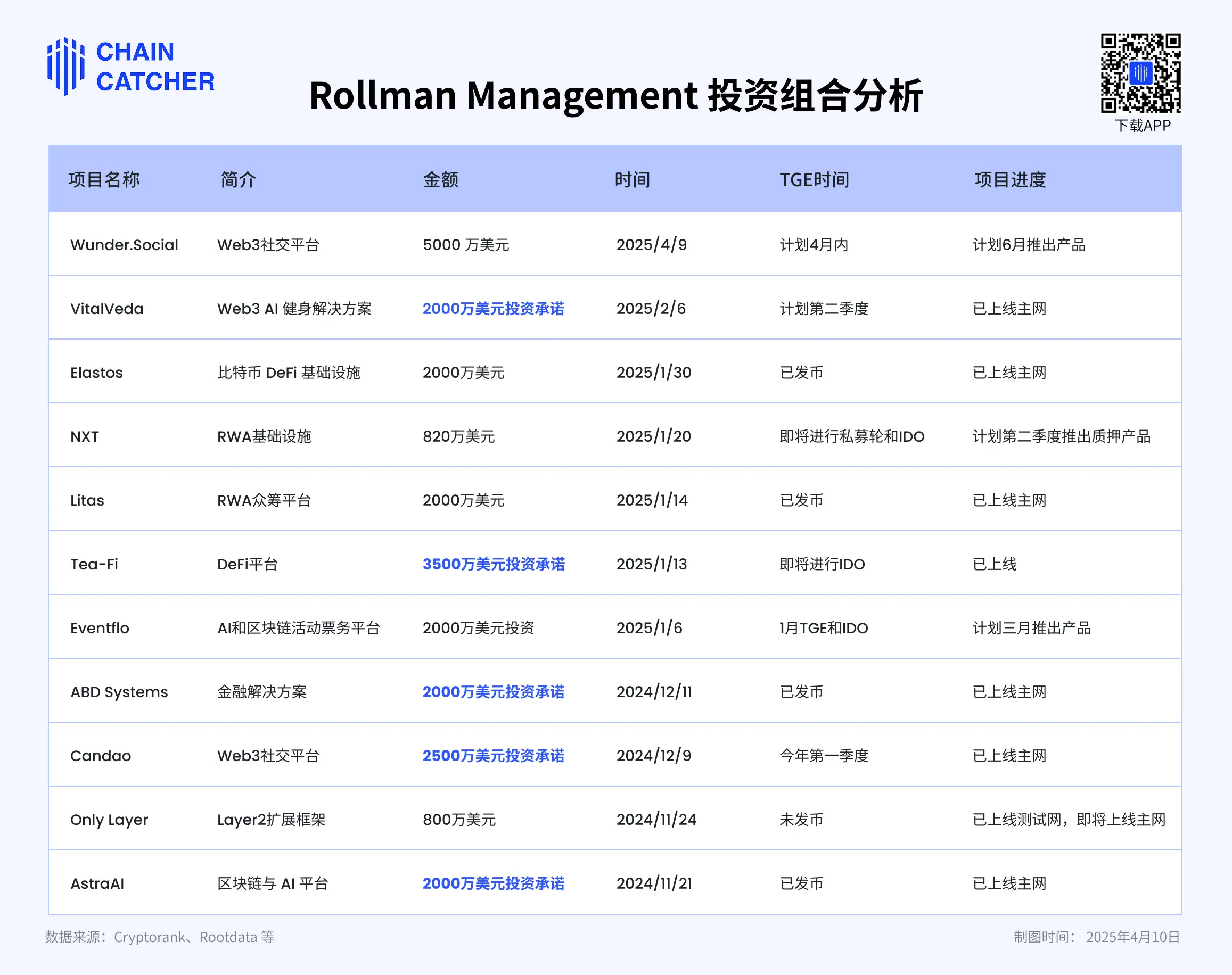
"Investment commitment" is a term that warrants caution. Literally, it refers to a promise by an investor to provide a specific amount of funding. However, this term leaves significant room for manipulation.
Previously, ChainCatcher investigated GEM Digital, a venture capital firm with an investment style similar to Rollman Management. A project founder revealed that GEM Digital contacted them via email, promising a $50 million investment. However, upon reviewing the contract, they discovered that GEM did not intend to transfer funds directly; instead, it would cover the investment amount using profits generated from selling the project’s tokens.
Related reading: Behind GEM Digital, Crypto’s “Wealthiest” VC: A Concealed and Bizarre Capital Game
While Rollman Management’s “investment commitments” may differ from those of GEM Digital, their overall investment patterns are strikingly similar:
1. Frequent, large-scale "investment commitments": Rollman Management’s investments are diversified across sectors including social, RWA, AI, infrastructure, and DeFi, with a median investment size of $20 million. Nearly half of its portfolio projects—including VitalVeda, Tea-Fi, and Candao—are labeled as “investment commitments” rather than standard investments.
2. Targeting low-profile projects: Among the 11 projects Rollman has invested in, only Elastos (a long-established project founded in China) enjoys some recognition and activity within Chinese-speaking communities. The rest had virtually no prior news coverage, and even launched projects have not been listed on major exchanges.
3. Leveraging media to generate hype: News about Rollman Management’s investments frequently appear on mainstream platforms like Cointelegraph and CoinDesk. Most are published on Cointelegraph (clearly marked as “Sponsored”) and follow a template-like format with highly repetitive structures, clearly authored or orchestrated by Rollman itself. (Click on the project names here to get a sense: AstraAI, Tea-Fi, Eventflo)
The sole purpose of Rollman’s investment announcements is to promote the project’s token. Exploiting the crypto community’s sensitivity to funding news, Rollman uses authoritative media to spread stories of “massive investments,” attracting market attention and potentially driving up token prices. Even if a project hasn’t issued a token yet, it typically has plans for an upcoming IDO or other token sale.
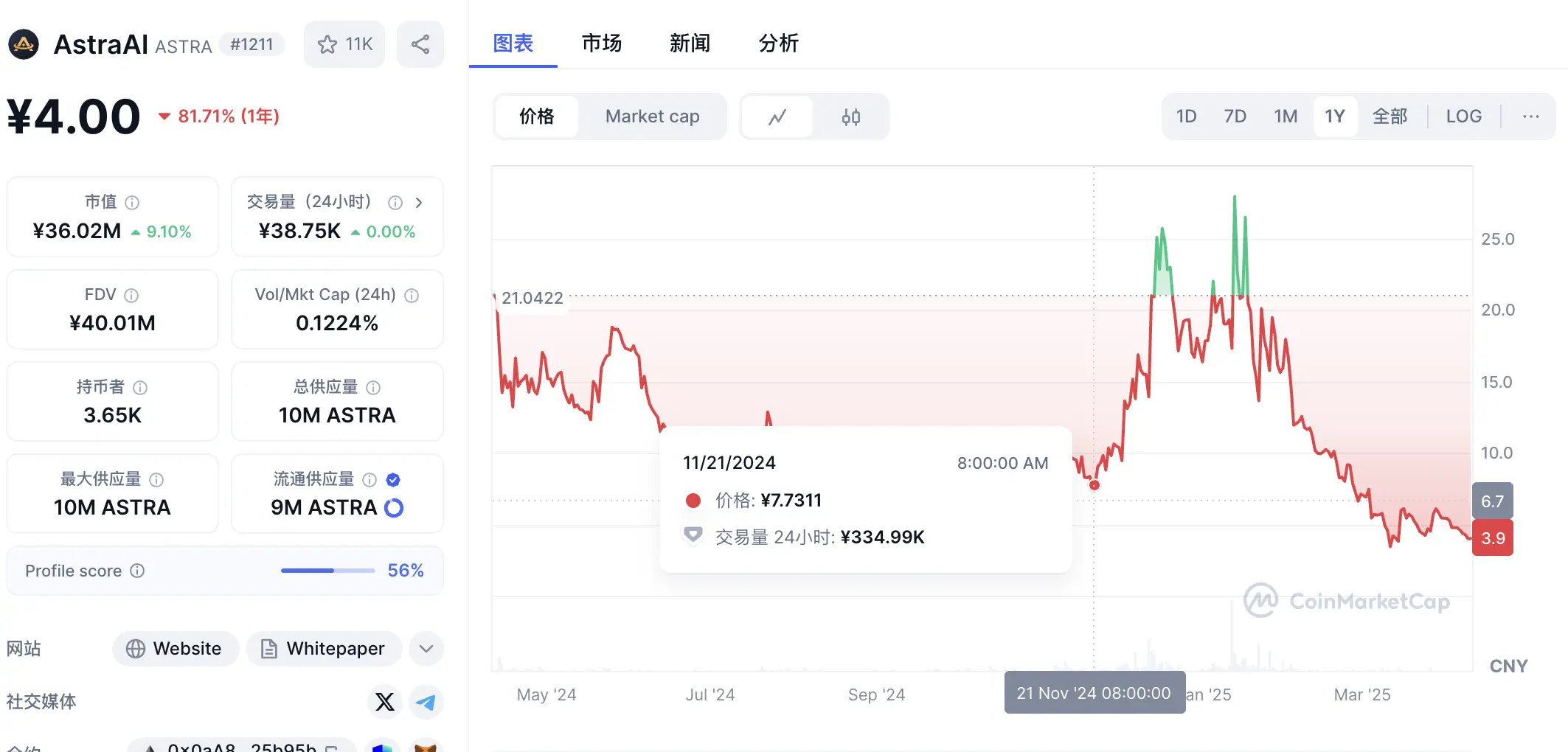
4. Portfolio tokens exhibit “pump and dump” price patterns: Tokens of Rollman-backed projects consistently show sharp price increases following news of investment, followed by steep declines. For example, on November 21, 2024, after the announcement of Rollman’s investment in AstraAI, its token surged from $7.70 to a high of $25 before falling back to $4.
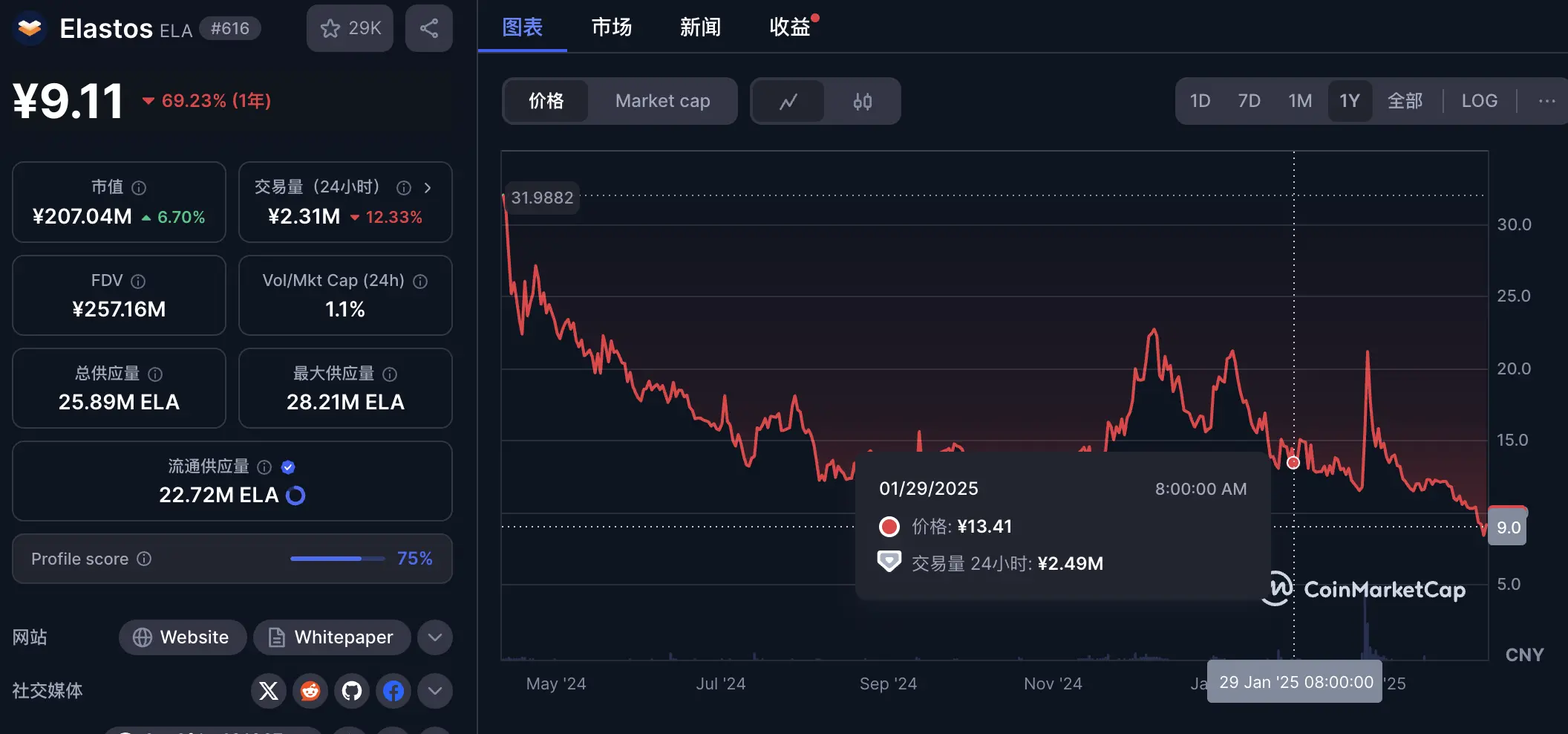
On January 30 this year, Rollman announced its investment in Elastos, which triggered a rapid price spike—from $13 to $21.
Selling Marketing Under the Guise of VC
Overall, Rollman resembles a more conservative version of GEM Digital. Most of its partnered projects have not yet launched tokens, so unlike GEM Digital’s model of inflating prices through positive news, Rollman essentially uses investment announcements as a tool for token promotion.
"Pump and dump" schemes were extremely common in the early days of cryptocurrency, especially during the ICO boom, when many projects raised funds through false claims and exaggerated funding announcements before disappearing or collapsing. The practices of firms like Rollman and GEM Digital can be seen as an “upgraded” version of this strategy—using “investment commitments” to cloak their activities in legitimacy while systematically leveraging media and obscure projects.
With the current crypto market downturn and cooling in the primary market, survival has become harder for projects—especially those lacking reputation or track record. Where there’s demand, there’s supply. Coupled with inadequate regulation, particularly around ambiguous practices like “investment commitments,” firms like Rollman find ample space to operate.
ChainCatcher urges all industry participants—including investors, project teams, media outlets, and retail users—to remain vigilant against such funding activities and avoid becoming victims of capital games.
Join TechFlow official community to stay tuned
Telegram:https://t.me/TechFlowDaily
X (Twitter):https://x.com/TechFlowPost
X (Twitter) EN:https://x.com/BlockFlow_News
 ChainCatcher 链捕手