Quick Overview of the Personalized AI Identity Platform Honcho: How to Enable Hyper-Personalized Experiences for LLM Applications?
TechFlow Selected TechFlow Selected
Quick Overview of the Personalized AI Identity Platform Honcho: How to Enable Hyper-Personalized Experiences for LLM Applications?
Plastic Labs' Honcho platform offers a "plug-and-play" solution designed to enable developers to access deep user profiles without having to reinvent the wheel.
 Navigating Web3 tides with focused insights
Author: Daniel Barabander, General Partner & Investment Partner at Variant
Translation: Zen, PANews
On April 11, Beijing time, AI startup Plastic Labs announced it has raised $5.35 million in Pre-Seed funding led by Variant, White Star Capital, and Betaworks, with participation from Mozilla Ventures, Seed Club Ventures, Greycroft, and Differential Ventures. Angel investors include Scott Moore, NiMA Asghari, and Thomas Howell. Concurrently, its personalized AI identity platform "Honcho" has officially opened early access.
As the project is still in its early stages, the broader crypto community knows little about Plastic Labs. At the same time that Plastic shared the above fundraising and product update on X, Daniel Barabander, General Partner and Investment Partner at lead investor Variant, published an in-depth analysis of the project and its Honcho platform. Below is the original piece:
With the rise of large language model (LLM) applications, the need for personalization in software has never been greater. These applications rely on natural language, which inherently changes depending on who you're speaking to—just as your explanation of a math concept would differ when talking to your grandparents versus your parents or children. You instinctively adapt your communication based on your audience, and LLM applications must similarly "understand" who they are conversing with in order to deliver more effective and contextually relevant experiences. Whether it's a mental wellness assistant, legal advisor, or shopping companion, such applications can only deliver value if they truly understand the user.
Yet despite the importance of personalization, there is currently no ready-made solution available for LLM applications to plug into. Developers often have to build fragmented systems from scratch, storing user data—typically in the form of conversation logs—and retrieving it when needed. This results in every team reinventing the wheel, constructing their own user state management infrastructure. Worse, methods like storing user interactions in vector databases and using retrieval-augmented generation (RAG) can only recall past conversations, failing to capture deeper characteristics such as user interests, communication preferences, tone sensitivity, and personality traits.
Plastic Labs introduces Honcho, a plug-and-play platform that enables developers to easily add personalization to any LLM application. Instead of building user modeling systems from scratch, developers can integrate Honcho and immediately gain access to rich, persistent user profiles. These profiles are far more nuanced than traditional approaches, leveraging advanced techniques drawn from cognitive science, and support natural language queries—allowing LLMs to dynamically adapt their behavior based on detailed user understanding.
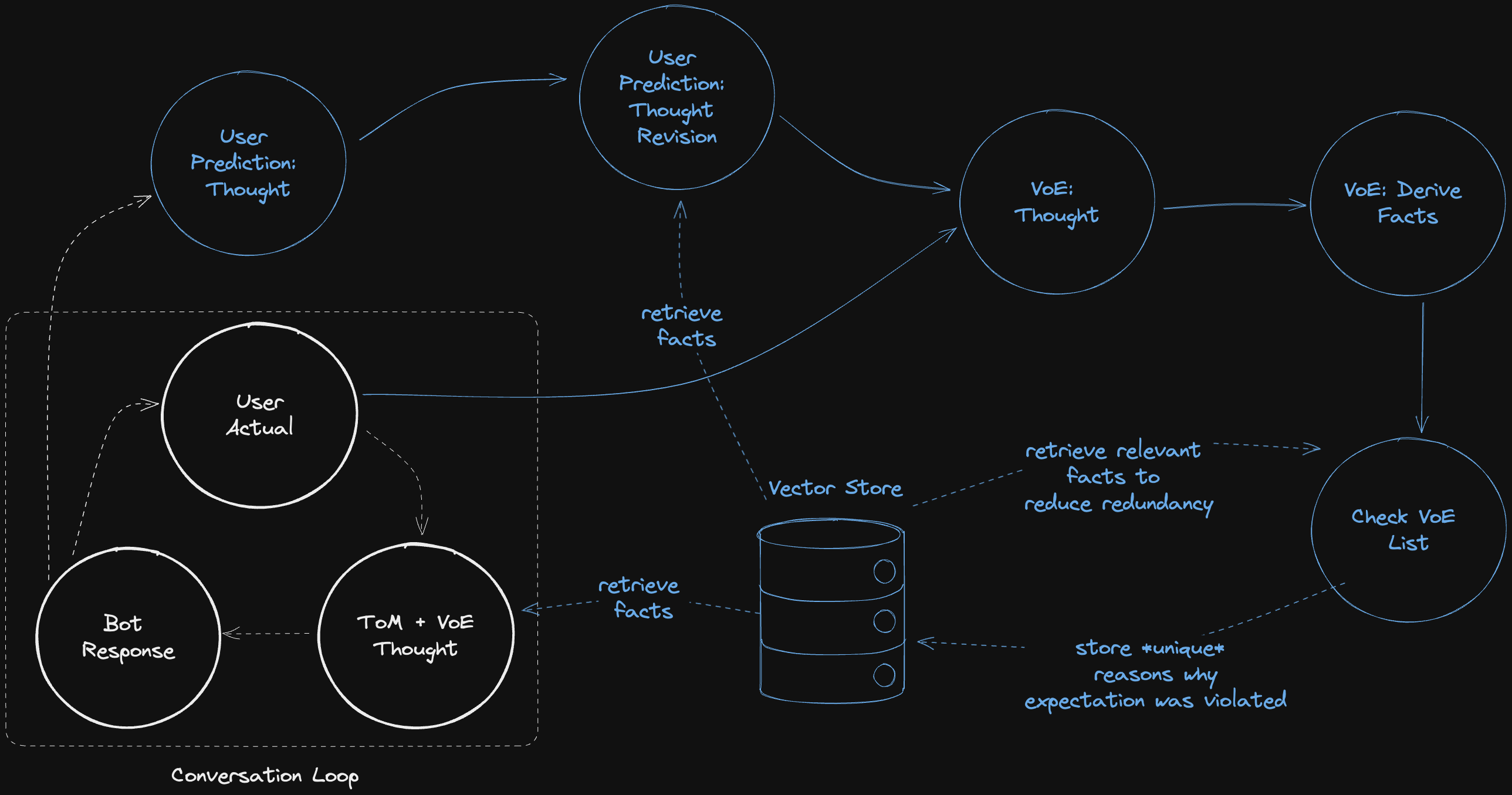
By abstracting away the complexity of user state management, Honcho unlocks a new level of hyper-personalization for LLM applications. But its significance goes even further: the rich, abstracted user profiles generated by Honcho also pave the way for a long-elusive vision—the “shared user data layer.”
Historically, attempts at creating shared user data layers have failed for two main reasons:
-
Lack of interoperability: Traditional user data is highly context-specific and difficult to transfer across apps. For example, social platform X might model you based on who you follow, but that data is useless for your professional network on LinkedIn. In contrast, Honcho captures higher-order, generalizable user traits that can seamlessly serve any LLM application. If a tutoring app discovers you learn best through analogies, your therapy assistant could leverage that insight to communicate more effectively—even though the contexts are entirely different.
-
Lack of immediate value: Previous shared layers struggled to attract early adopter apps because they offered no tangible benefit to pioneers—yet these early participants are precisely the ones needed to generate valuable user data. Honcho takes a different approach: it first solves the “first-order problem” of user state management for individual apps. Once enough apps are onboarded, network effects naturally solve the “second-order problem”—new applications not only join for personalization but can immediately leverage existing shared user profiles, completely eliminating cold-start friction.
Currently, hundreds of applications are on Honcho’s closed beta waitlist, spanning use cases such as addiction coaching, educational companions, reading assistants, and e-commerce tools. The team’s strategy is clear: first focus on solving the core challenge of user state management for individual apps, then gradually roll out the shared data layer to willing participants. This layer will be incentivized cryptoeconomically: early-adopter apps will receive ownership shares in the layer, allowing them to share in its growth value. Meanwhile, blockchain-based mechanisms will ensure the system remains decentralized and trustworthy, removing concerns about centralized entities extracting value or launching competing products.
Variant believes the Plastic Labs team is uniquely positioned to tackle the challenge of user modeling in LLM-driven software. While building Bloom, a personalized chat-based tutoring app, the team personally experienced how difficult it was for applications to truly understand students and their learning styles. Honcho was born directly from this insight, addressing a pain point that every LLM application developer will soon face.
Join TechFlow official community to stay tuned
Telegram:https://t.me/TechFlowDaily
X (Twitter):https://x.com/TechFlowPost
X (Twitter) EN:https://x.com/BlockFlow_News
 Variant