
Huobi Growth Academy | Tokenized Gold In-Depth Report: A New On-Chain Paradigm Reshaping Safe-Haven Assets
TechFlow Selected TechFlow Selected
Huobi Growth Academy | Tokenized Gold In-Depth Report: A New On-Chain Paradigm Reshaping Safe-Haven Assets
In an era of unstable credit, heightened dollar volatility, and a reshaping global monetary landscape, gold is undergoing a "digital rediscovery."
 Navigating Web3 tides with focused insights
1. Introduction: The Return of Safe-Haven Demand in a New Cycle
Since the beginning of 2025, frequent geopolitical conflicts, persistent inflation pressures, and sluggish growth among major economies have reignited demand for safe-haven assets. Gold, traditionally regarded as a "safe asset," has once again taken center stage, with prices repeatedly hitting record highs—surpassing the $3,000 per ounce mark—and becoming a global refuge attracting massive capital inflows. At the same time, as blockchain technology accelerates its integration with traditional assets, "tokenized gold" has emerged as a new frontier in financial innovation. It retains gold's value-preserving properties while adding liquidity, composability, and smart contract interoperability inherent to on-chain assets. An increasing number of investors, institutions, and even sovereign funds are now considering tokenized gold as part of their portfolios.
2. Gold: An Irreplaceable "Hard Currency" in the Digital Age
Despite humanity’s entry into a highly digital financial era marked by the emergence of various financial instruments—from fiat currencies and government bonds to stocks and recent cryptocurrencies—gold continues to hold its status as the "ultimate store of value" due to its unique historical depth, value stability, and cross-sovereign monetary attributes. Gold is called "hard currency" not only because of its natural scarcity and physical tamper-resistance but also because it rests not on the credit backing of any specific nation or organization, but rather on millennia of societal consensus. In macro cycles where sovereign currencies may devalue, fiat systems could collapse, and global credit risks accumulate, gold remains the final line of defense—the ultimate means of payment under systemic risk.
Over the past few decades, especially after the collapse of the Bretton Woods system, gold was temporarily marginalized, with its role as a direct settlement instrument supplanted by the U.S. dollar and other sovereign currencies. However, experience has shown that fiat money cannot escape the cyclical fate of crises. Rather than being erased, gold’s significance is repeatedly reaffirmed during each monetary crisis. The 2008 global financial crisis, the wave of monetary easing following the 2020 pandemic, and the high inflation and interest rate volatility since 2022 all drove significant increases in gold prices. Particularly from 2023 onward, the convergence of geopolitical tensions, U.S. debt default risks, and entrenched global inflation propelled gold back above the critical threshold of $3,000 per ounce, triggering a shift in global asset allocation logic.
The behavior of central banks most directly reflects this trend. According to data from the World Gold Council, global central banks have consistently increased gold holdings over the past five years, with particularly aggressive purchases by non-Western nations such as China, Russia, India, and Turkey. In 2023 alone, net central bank gold purchases exceeded 1,100 tons—a historic high. This resurgence of gold is not merely short-term tactical maneuvering; it stems from deeper strategic considerations around asset security, the multipolarization of sovereign currencies, and declining confidence in the stability of the U.S.-centric monetary system. Amid ongoing restructuring of global trade and geopolitics, gold is once again seen as a reserve asset with the highest degree of trust. From the perspective of monetary sovereignty, gold is increasingly replacing U.S. Treasury bonds as a key anchor point for central banks adjusting their foreign exchange reserve structures.
Structurally speaking, gold’s safe-haven value is regaining recognition across global capital markets. Unlike credit-based assets such as U.S. Treasuries, gold does not depend on an issuer’s ability to repay and carries no default or restructuring risk. Against a backdrop of soaring global debt levels and widening fiscal deficits, gold’s “no counterparty risk” feature stands out prominently. Today, the debt-to-GDP ratios of most major economies exceed 100%, with the United States surpassing 120%. As fiscal sustainability comes under growing scrutiny, gold becomes uniquely attractive in an age of weakening sovereign credit. In practice, large institutions—including sovereign wealth funds, pension funds, and commercial banks—are raising their allocations to gold to hedge against systemic economic risks. This shift is transforming gold’s traditional role as a “countercyclical and defensive” asset into a more enduring “structurally neutral” position within investment frameworks.
Of course, gold is not without flaws as a financial asset. Its relatively low transaction efficiency, difficulty in physical transfer, and inability to be programmatically coded appear cumbersome in the digital age. But this doesn’t mean it will be phased out—it instead drives a new round of digital upgrades. We observe that gold’s evolution in the digital world is not static preservation, but an active integration into fintech logic through "tokenization." This transformation is no longer about competition between gold and digital currencies, but rather a fusion of “value-anchored assets” with “programmable financial protocols.” By moving onto blockchains, gold gains liquidity, composability, and cross-border transfer capabilities, enabling it not only to serve as a wealth carrier in the physical world but also to function as a stabilizing anchor within digital financial systems.
Notably, gold as a store of value complements rather than competes directly with Bitcoin—the so-called “digital gold.” Bitcoin exhibits far higher volatility than gold and lacks sufficient short-term price stability. During periods of macroeconomic uncertainty, it tends to be viewed more as a risk asset than a safe haven. In contrast, gold maintains advantages in anti-cyclicality, low volatility, and broad acceptance, supported by its vast spot market, mature derivatives ecosystem, and widespread institutional adoption at the central bank level. From a portfolio construction standpoint, gold remains one of the most important risk-hedging components in global investment strategies, holding an irreplaceable foundational “financial neutrality” status.

Overall, whether viewed through the lenses of macro financial security, monetary system restructuring, or shifts in global capital allocation, gold’s status as hard currency has not diminished with the rise of digital assets. On the contrary, amid strengthening global trends such as de-dollarization, geopolitical fragmentation, and sovereign credit crises, gold’s importance is being re-elevated. In the digital age, gold serves both as a stabilizing force in traditional finance and as a potential value anchor in future on-chain financial infrastructure. The future of gold lies not in replacement, but in continuing its historical mission as the “ultimate credit asset” across old and new financial systems through tokenization and programmability.
3. Tokenized Gold: Gold’s Expression in the On-Chain World
Tokenized gold is essentially a technological and financial practice that maps physical gold assets onto blockchain networks in the form of cryptographic tokens. It uses smart contracts to represent ownership or value of physical gold as digital tokens, freeing gold from being confined to vaults, warehouse receipts, and static records within banking systems. Instead, it can circulate freely and programmatically in standardized formats across chains. Tokenized gold does not create a new type of financial asset; rather, it reconstructs traditional commodities by injecting them into new financial systems in digital form. It embeds gold—a hard currency that transcends historical cycles—into the decentralized financial operating system represented by blockchain, giving rise to a novel structure for value representation.
At the macro level, this innovation is a crucial component of the global trend toward asset digitization. The widespread adoption of smart contract platforms like Ethereum provides the foundational programmability needed for gold’s on-chain expression. Meanwhile, the development of stablecoins has demonstrated both market demand and technical feasibility for “on-chain value-anchored assets.” In many ways, tokenized gold extends and elevates the concept of stablecoins—not only aiming for price stability but also backed by real, tangible assets free from credit default risk. Unlike fiat-backed stablecoins, gold-anchored tokens naturally avoid the volatility and regulatory risks associated with single sovereign currencies, offering cross-border neutrality and long-term inflation resistance. This becomes especially significant amid rising regulatory and geopolitical concerns surrounding the current dominance of dollar-based stablecoins.
At the micro level, tokenized gold typically follows two implementation paths: one based on “100% physical collateral + on-chain issuance” via custodianship, and another using “programmatic mapping + verifiable asset certificates” through protocol design. Projects like Tether Gold (XAUT) and PAX Gold (PAXG) fall into the first category, relying on custodial institutions that ensure each token corresponds exactly to a specified amount of physical gold, subject to regular audits and off-chain reporting. Others, such as Cache Gold and Digital Gold Token, attempt to bind programmable asset certificates directly to batch numbers of physical gold bars, enhancing token verifiability and liquidity. Regardless of the approach, the core objective remains the same: to establish a trusted mechanism for representing, transferring, and settling gold on-chain—enabling real-time transfers, divisibility, and composability, thereby overcoming chronic issues of fragmentation, high barriers, and low liquidity in traditional gold markets.
The greatest value of tokenized gold goes beyond technological advancement—it fundamentally transforms the functionality of the gold market. Traditional physical gold trading involves high costs related to transportation, insurance, and storage, while paper gold and ETFs lack true ownership rights and on-chain composability. Tokenized gold aims to overcome these limitations by introducing a native on-chain form of gold that is divisible, instantly settleable, and globally transferable—transforming what was once a “static asset” into a dynamic financial instrument characterized by high liquidity and transparency. This dramatically expands the use cases of gold in DeFi and global financial markets, allowing it not only to act as a store of value but also to participate in activities such as collateralized lending, leveraged trading, yield farming, and cross-border clearing and settlement.
Further still, tokenized gold is driving a shift in the gold market from centralized infrastructure to decentralized alternatives. Historically, gold value transfers relied heavily on centralized entities such as the London Bullion Market Association (LBMA), clearing banks, and vault custodians—leading to persistent problems including information asymmetry, cross-border delays, and high costs. Tokenized gold, built on smart contracts, establishes a permissionless, trustless system for issuing and circulating gold assets. It makes processes like title verification, settlement, and custody transparent and efficient, significantly lowering market entry barriers and enabling retail users and developers equal access to the global liquidity network of gold.
In sum, tokenized gold represents a profound value reconstruction and systemic integration of traditional physical assets into the blockchain world. It preserves gold’s safe-haven characteristics and store-of-value functions while expanding its functional boundaries as a digital asset in next-generation financial systems. Under the broader trends of financial digitization and monetary multipolarization, the on-chain reconfiguration of gold is destined to be neither temporary nor experimental, but a long-term process aligned with the evolution of financial sovereignty and technological paradigms. Those who succeed in establishing a standard for tokenized gold that combines compliance, liquidity, composability, and cross-border utility will likely gain control over the narrative of the future “on-chain hard currency.”
4. Analysis and Comparison of Major Tokenized Gold Projects
Within today’s crypto-financial ecosystem, tokenized gold has already produced several representative projects serving as bridges between traditional precious metals markets and emerging on-chain asset systems. These initiatives explore different dimensions—technical architecture, custody mechanisms, compliance pathways, and user experience—gradually forming a prototype of the “on-chain gold” market. While they all follow the basic principle of “physical gold collateral + on-chain mapping,” their specific implementations vary, reflecting the current state of competition and lack of standardization in the tokenized gold space.
Currently prominent projects include Tether Gold (XAUT), PAX Gold (PAXG), Cache Gold (CGT), Perth Mint Gold Token (PMGT), and Aurus Gold (AWG). Among these, Tether Gold and PAX Gold stand out as industry leaders, leading in market capitalization and liquidity. They also enjoy advantages in user trust and exchange support thanks to robust custody frameworks, high transparency, and strong brand credibility.
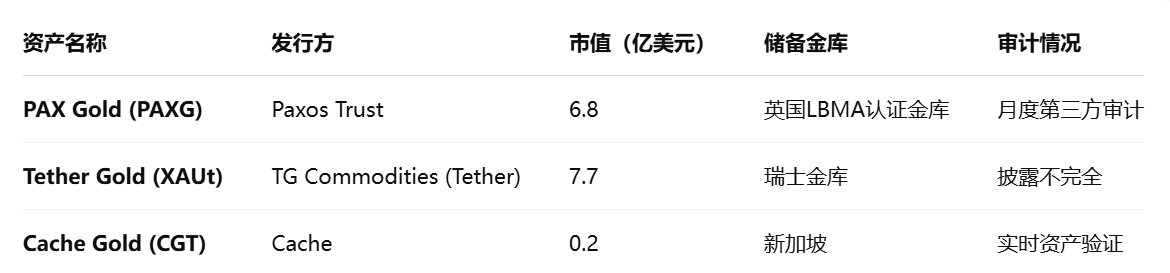
Tether Gold (XAUT), launched by stablecoin giant Tether, anchors each token to one troy ounce of standard London gold bar stored in Switzerland. Leveraging the Bitfinex ecosystem behind Tether, XAUT enjoys first-mover advantages in liquidity, trading channels, and stability. However, it maintains a relatively conservative stance on disclosure and transparency—users cannot directly verify on-chain which specific gold bar each token corresponds to. This opaque custody model sparks controversy within the more decentralization-focused crypto community. Additionally, XAUT’s compliance framework primarily targets offshore international users, posing higher entry barriers for investors seeking regulated financial on-ramps.
In contrast, PAX Gold (PAXG), issued by U.S.-licensed fintech firm Paxos, pushes further in terms of compliance and transparency. Each PAXG also represents one troy ounce of London-standard gold, with verifiable serial numbers and custody data accessible on-chain. More importantly, Paxos operates as a trust company regulated by the New York Department of Financial Services (NYDFS), meaning its gold custody and issuance mechanisms undergo regulatory oversight—enhancing PAXG’s compliance credentials. The project actively promotes DeFi compatibility and is already integrated into major protocols such as Aave and Uniswap, enabling PAXG to be used as collateral for borrowing and liquidity mining, thus unlocking compound financial value on-chain.
Cache Gold (CGT) exemplifies a different direction—one emphasizing decentralization and verifiable asset provenance. Using a “Token Wrapper + gold bar registration” system, each CGT represents one gram of physical gold linked to a specific batch number in independent storage facilities. Its standout feature is a strong on-chain/off-chain binding mechanism: every gold deposit generates a Proof of Reserve, with batch details and movement tracked immutably on the blockchain. This enables greater transparency in tracing underlying physical assets, though it introduces challenges in custody efficiency and liquidity aggregation, limiting its scalability and adoption across mainstream DeFi applications.
Perth Mint Gold Token (PMGT) is an official product launched by Perth Mint, Australia’s state-owned precious metals mint. Backed by Australian government guarantees and stored in national vaults, PMGT ranks among the most credible tokenized gold projects in theory. However, due to limited engagement with cryptocurrency markets, scarce trading pairs, and poor DeFi integration, it lags far behind Tether Gold and PAX Gold in liquidity and user adoption despite its superior safety and official endorsement.
Innovative projects like Aurus Gold (AWG) and Meld Gold are experimenting with new paradigms—multi-custodian models, NFT-wrapped ownership, and cross-chain deployment—to enhance resilience and flexibility. For example, AWG employs a multi-mint issuance model integrated with multiple exchanges and wallets, reducing reliance on centralized issuers, while using NFTs as wrappers for gold ownership to offer greater asset management versatility. These projects align more closely with Web3-native asset principles but remain in early stages, lacking broad market consensus.
Overall, the current tokenized gold landscape shows a polarized structure: on one side are “centralized + high-trust” projects like Tether Gold and PAX Gold, leveraging institutional backing, mature custody, and exchange connectivity to dominate market share; on the other are “decentralized + verifiable” models like Cache Gold and Aurus Gold, prioritizing transparency and on-chain autonomy but constrained by lower market acceptance, coordination inefficiencies, and limited DeFi integration. This divide mirrors the broader tension in the crypto ecosystem between “trust thresholds” and “technological ideals.”
Looking ahead, the future standard for tokenized gold will likely converge around four pillars: compliance, verifiability, composability, and cross-chain capability. Only assets with transparent, audited custody frameworks established under strong regulatory oversight will earn lasting trust from mainstream institutions and users. At the same time, projects must deeply integrate into DeFi and Web3 infrastructure, achieving “primitive-level” status for gold tokens—otherwise, they risk remaining little more than “digitally packaged gold certificates” unable to unlock meaningful utility or network effects.
5. Tokenized Gold from an Investor Perspective: Value, Opportunities, and Risks
As a novel financial instrument combining traditional value anchoring with on-chain asset features, tokenized gold is gradually emerging as an alternative asset class in investor portfolios. Unlike traditional gold ETFs or physical bullion, its core value lies not just in gold’s inherent safe-haven qualities, but in the enhanced liquidity, ease of access, and expanded composability enabled by blockchain infrastructure. From an investor’s viewpoint, tokenized gold strikes a balanced point between “financial stability anchor” and “innovation dividend,” offering a practical path to hold “on-chain hard currency” amid the high volatility of crypto markets.
First, tokenized gold inherits gold’s fundamental investment rationale as a global safe-haven asset. Historical patterns show that during periods of heightened macroeconomic uncertainty, rising inflation, or escalating geopolitical risks, gold typically earns a risk premium in capital markets, serving as a preferred hedge against fiat depreciation and market turbulence for both institutional and individual investors. Tokenized gold preserves this property and, particularly during sharp downturns in crypto markets, offers portfolio diversification benefits due to its low or even negative correlation with other digital assets. During multiple crypto market declines in 2022 and 2023, tokens like PAXG and XAUT exhibited significantly lower volatility compared to mainstream cryptocurrencies and occasionally served as short-term “on-chain safe havens” for capital.
Second, tokenized gold grants unprecedented liquidity and accessibility to gold assets. Traditional gold investment suffers from multiple pain points: high entry barriers, restricted trading hours, inconvenient storage and withdrawal, and strong geographical constraints. As ERC-20 or cross-chain assets, tokenized gold can be instantly transferred across any public chain-compatible wallet worldwide, enabling high-frequency trading, DeFi staking, and cross-border settlements. This leap in liquidity greatly expands operational possibilities for gold, transforming it from a passive “warehouse asset” into an actively managed “on-chain cash flow base asset.”
More importantly, as DeFi and Web3 infrastructures mature, tokenized gold is gaining composability—the ability to interact seamlessly with other protocols. This means it is evolving beyond being merely “digital gold” into a modular building block of on-chain ecosystems. Investors can pledge PAXG to borrow stablecoins and unlock liquidity for other opportunities, provide liquidity in pools to earn yields, or transfer tokenized gold across chains via interoperability protocols to meet global payment and settlement needs. This “asset-as-protocol” vision opens up innovative pathways impossible within traditional gold finance.
Nevertheless, despite its numerous advantages, tokenized gold faces structural risks and developmental bottlenecks that investors must carefully weigh. First is custody and redemption risk. Most tokenized gold projects still rely on centralized physical custody, requiring investors to trust issuers to securely store gold and enable timely physical delivery when needed. Yet redemption processes across most platforms remain complex, costly, geographically limited, and legally uncertain—especially under extreme market conditions. Whether users can smoothly convert on-chain tokens back into physical gold remains operationally and legally ambiguous. Moreover, insufficient disclosure in audit reports and proof-of-reserves undermines user confidence and hampers long-term viability as a reliable “on-chain safe-haven anchor.”
Second is external regulatory and compliance risk. Given gold’s high-value sensitivity, its tokenization intersects with regulations governing precious metals, securities law, and KYC/AML requirements. Legal recognition and regulatory treatment vary widely across jurisdictions, creating significant uncertainty for projects. For institutional users aiming to use tokenized gold for cross-border settlements or large-scale transactions, navigating compliant frameworks is essential to adoption.
Finally, from a market dynamics perspective, tokenized gold currently plays a supplementary role in investment portfolios and is unlikely to become a dominant holding. While its stability and hedging value are crucial during bear markets, its returns generally lag behind riskier crypto assets like Bitcoin and Ethereum during bull runs. This “stable value, limited upside” profile makes tokenized gold better suited as a tool for smoothing portfolio volatility and stabilizing returns, rather than a core vehicle for high-growth investing.
In summary, for investors, tokenized gold serves both as a new form of “value storage” and a “security-first” option in the digital economy. Its logic builds upon gold’s millennia-tested value foundation while reshaping how it is traded, held, and combined through blockchain technology. As DeFi evolves, cross-chain infrastructure improves, and regulatory clarity emerges, tokenized gold may play an increasingly vital role in the “full lifecycle management of digital assets.” For individual users, it offers a practical way to strengthen risk resilience and implement countercyclical strategies. For institutions, it could become the foundational “core holding” in on-chain portfolios, ushering in a true era of “on-chain asset management.”
6. Conclusion: The On-Chain Upgrade of Gold—Not Replacement, But Continuation
In an era defined by unstable credit, heightened U.S. dollar volatility, and a shifting global monetary order, gold is undergoing a process of “digital rediscovery.” It is not being replaced by digital assets like Bitcoin, but rather being tokenized, programmable, and integrated with smart contracts—participating in the construction of new financial systems in a more flexible form. For users, this evolved version of gold remains “hard currency,” simply taking on a new on-chain form. It continues to offer security, value preservation, and risk resistance—becoming a genuine “stability anchor” in the digital world.
Join TechFlow official community to stay tuned
Telegram:https://t.me/TechFlowDaily
X (Twitter):https://x.com/TechFlowPost
X (Twitter) EN:https://x.com/BlockFlow_News
 @HTXAcademy