








From Scapegoat Theory to the Crypto Market: Why the Bottom Has Not Yet Arrived?
TechFlow Selected TechFlow Selected
From Scapegoat Theory to the Crypto Market: Why the Bottom Has Not Yet Arrived?
The scapegoat is about to appear, and it might be wearing a suit.
 Navigating Web3 tides with focused insights
Author: Matti
Translation: Luffy, Foresight News
This is a story woven from myths, legends, and historical analogies—not one derived from first principles. Throughout my writing, I’ve applied René Girard’s scapegoat theory to the world of cryptocurrency, and I recommend familiarizing yourself with his framework before diving in.
Rationally, I know that as the crypto industry matures, viewing it through traditional cyclical lenses has become outdated. Yet, deeply influenced by Girardian thought, I can't ignore the recurring mythic patterns. When you hold a hammer, everything starts to look like a nail.
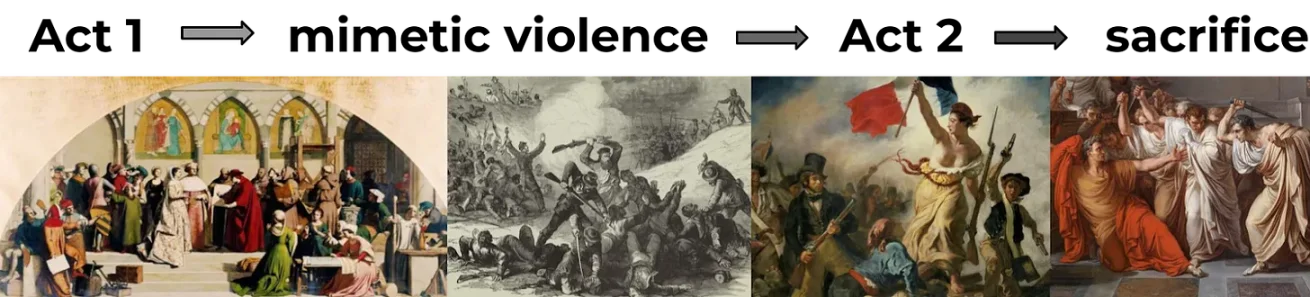
In this article, I will explore how crypto bull markets unfold in two acts: the first driven by an episode of "mimetic crisis," followed by the second, which resolves it through a "sacrificial crisis."
The first act begins with rising prices, generating mimetic desire across the community. A subsequent price collapse triggers chaos and conflict—an almost symbolic state of “every man against every man”—where internal strife consumes the crypto space.
The second act resolves the crisis of the first through another surge in prices, concluding the cycle and identifying the ultimate scapegoat. Each cycle ends due to the excesses of its foundational principle, and each cycle produces a scapegoat.
This reveals both a cyclical rhythm (this time is not really different) and a linear progression (this time actually *is* different). In the end, we always arrive at a new place.
The collapse of the initial coin offering (ICO) era left Ethereum desolate, while the summer of decentralized finance (DeFi) brought it back to life. DeFi Summer raised doubts about Bitcoin's viability as a financialized asset—doubts later dispelled by MicroStrategy and BlackRock.
The 2017 bull market was an Ethereum-driven rally fueled by ICOs. The “world computer” became a slot machine. As ICO projects cashed out their raised Ether, the “computer” collapsed under its own weight—only to be revived in 2020 by the DeFi boom, which itself ended in the implosion of over-leveraged speculators like Three Arrows Capital and SBF. The scapegoat of 2017 wasn’t highly individualized, but it was real.
In 2017, Ethereum’s ICOs were both the source of prosperity and the cause of downfall; in 2021, the heroes of DeFi Summer followed the same arc. The best scapegoats are those who initially brought wealth and celebration—whether the riches from Ethereum ICOs or the frenzied lending and token emissions of DeFi, where mere participation made millionaires—only to later become the symbol of decay.

Bubbles are side effects of mimesis
Both the 2017 and 2021 bull markets clearly unfolded in two acts—and shared a striking similarity: sharp price drops during the summers of 2017 and 2021. These interludes—brief but intense periods of decline—interrupted the initial upward momentum, only for the rally to reignite in the second act with renewed vigor, propelled by new market leaders.
Escalation of Mimetic Conflict
During these interludes, with no scapegoat yet identified, mimetic conflict turns inward. Those familiar with Girard’s theory know that such chaotic “everyone-against-everyone” states are unsustainable; the search for a scapegoat later serves as a purifying mechanism. But until then, conflict intensifies.
In 2017, the ICO boom and Bitcoin’s scaling struggles triggered a steep price drop in early summer: Bitcoin fell from $2,700 to below $2,000, Ethereum dropped from $400 to $150, sparking collective conflict. The SegWit debate divided Bitcoin’s community over block size, while the Bitcoin Cash (BCH) fork deepened the rift.
When Ethereum’s ICO bubble burst, users and developers blamed each other, and the Ethereum Foundation was accused of enabling network congestion and fraud. Conflict erupted between Ethereum Classic (ETC) and Ethereum (ETH), with ETC promoting a “pure” vision and surging tenfold between June and August, while fee disputes between miners and users further fractured the community.
In 2021, a similar pattern emerged after the May price crash. Bitcoin plunged from $64,000 to $30,000, Ethereum fell from over $4,000 to $1,700—sparked by Elon Musk’s criticism of Bitcoin and regulatory crackdowns in China.
Conflict erupted amid even more complex dynamics: Ethereum’s gas fee issues fueled debates between L1 and L2 camps over scalability; the Bitcoin Mining Council split purists from pragmatists; the collapse of DeFi yield farming projects like Iron Finance pitted speculators against one another; and rumors surrounding Tether intensified competition among stablecoins.
The Second Act
From a Girardian perspective, these interludes are turning points: dominant actors from the first act collapse under unsustainable excess, triggering internal conflict—until the second act redirects desire toward new assets, postponing the final sacrificial crisis.
In 2017, the first act was dominated by Ethereum and ICO projects. By June, fueled by token sales like Bancor and Tezos, Ethereum surged from $8 to $400, outpacing Bitcoin. After the interlude, the second act saw retail-driven FOMO propel Bitcoin to $20,000, with Bitcoin Cash (peaking at $4,000) and EOS—the so-called “Ethereum killer”—joining the rally.
The first act belonged to Ethereum and ICOs; the second to Bitcoin.
In 2021, the first act featured Bitcoin, Ethereum, and blue-chip DeFi projects like Aave and Uniswap, gradually maturing into “institutional-grade” assets. After the interlude, the second act shifted attention to LUNA’s meteoric rise, OlympusDAO’s (3,3) staking frenzy, and Solana’s peak at $260, with Avalanche (AVAX), Polkadot (DOT), and meme coins (DOGE, SHIB) riding the wave.
The first act belonged to Bitcoin, Ethereum, and DeFi blue chips; the second to LUNA, OlympusDAO forks, Solana, and the broader altcoin surge.
Original Sin
Unlike the technological innovations represented by 2017’s ICOs and 2021’s DeFi, the core driver of this cycle is institutional adoption—a top-down transformation powered by spot Bitcoin ETFs and MicroStrategy’s capital. Yet all cycles share a common thread of financial engineering: global capital coordination in 2017, on-chain yields in 2020, and institutional access in 2024.
The meme coin frenzy may distract observers, but it’s merely bait—like NFTs in the last cycle. It’s a small cycle within a larger one. Yet it plays a crucial role in revealing society’s rejection of grand narratives: price becomes both means and end, a final attempt to break free before institutions fully take control and fraud becomes the exclusive domain of white-collar professionals.
Institutions have arrived. This is no longer the empty talk of the 2017 Enterprise Ethereum Alliance, but the 2024 reality of spot Bitcoin ETFs launching on January 11. Donald Trump’s election, promising to make America a crypto superpower, marked a major leap forward. By November 2024, the crypto market was euphoric: Wall Street had entered, strategic reserves seemed imminent, and a stablecoin bill hinted at a new form of dollarization.
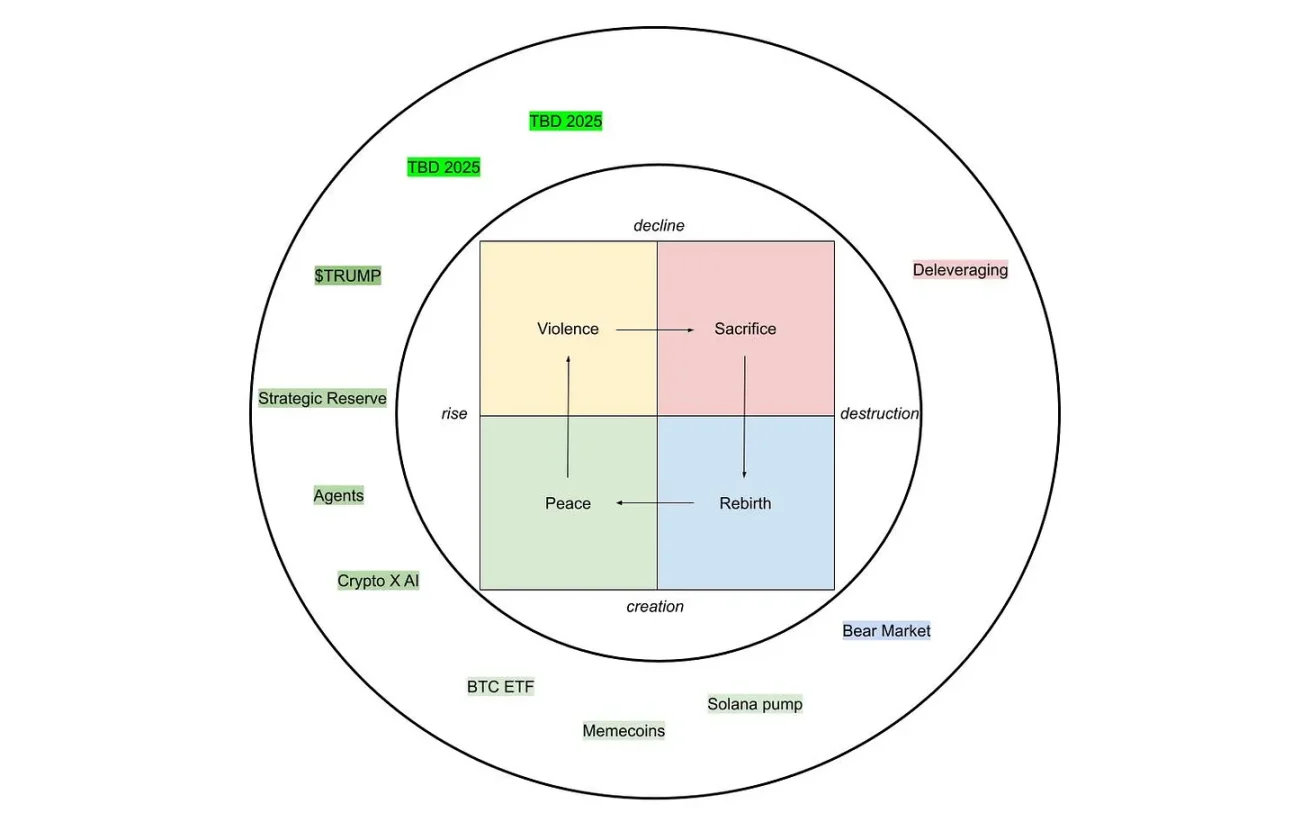
But Trump’s January 2025 inauguration brought anxiety. Amid trade war rumors and macroeconomic turmoil, hopes that the government would intervene like a deity faded. The crypto community realized that Trump—the ultimate influencer—had destroyed the market with his own meme coin, abruptly ending the meme coin supercycle. The first act was over. The community looked to institutions for salvation—but still, no scapegoat had emerged.
Before the Second Act, the Bottom Has Not Come
It’s now March 2025. We’re in the interlude phase of the first act: Bitcoin has fallen from its peak, and the broader altcoin market has been severely battered. This phase risks spiraling out of control because many truly believe it’s all over. Conflict escalates, the community descends into chaos—but the scapegoat remains absent.
History suggests the second act often brings a manic price surge, redirecting desire and delaying the sacrificial crisis. But that doesn’t guarantee prices will explode. The key question is: when the excesses of institutional adoption finally become unsustainable, whom will we blame?
The scapegoat must come from the very institutions that brought hope to this cycle. Will it be a vague, collective outcry—“institutions killed crypto”—directed at BlackRock’s ETF empire, or the anonymous suited figures who once defied dollarization?
Or will it take a more concrete, personal form? Could MicroStrategy collapse, its $40 billion Bitcoin bet vaporized in a spectacular leveraged implosion, turning Michael Saylor into the ultimate speculator—once hailed as visionary, now sacrificed for our sins? Perhaps Trump, the top-tier KOL who abandoned us with meme coin hype, will also become a target.
This isn’t the bottom—not yet. Mimetic chaos continues. The second act is coming. Whether it will bring, as in the past, a mad surge before plunging into deeper abyss, remains to be seen.
One thing is certain: the scapegoat is coming, and it may well be wearing a suit. If it isn’t, it might be blamed for that too.
Join TechFlow official community to stay tuned
Telegram:https://t.me/TechFlowDaily
X (Twitter):https://x.com/TechFlowPost
X (Twitter) EN:https://x.com/BlockFlow_News
 @mattigags


