The End of Data Monopolies: How zkTLS Turns Personal Data into Priced On-Chain Assets?
TechFlow Selected TechFlow Selected
The End of Data Monopolies: How zkTLS Turns Personal Data into Priced On-Chain Assets?
Despite Web3 having built powerful tools and infrastructure, ordinary internet users still live in Web2.
 Navigating Web3 tides with focused insights
Author: Figo @IOSG
Preface
Cryptocurrency has come a long way. Layer 2 scaling solutions are live, zkVMs have arrived, and even ETFs have been approved. Yet for most people, blockchain still feels like a parallel universe — something they read about but haven't actually used.
Why is this the case?
The answer isn't in the technology itself, but in what it currently fails to touch: our digital lives. While Web3 has built powerful tools and infrastructure, everyday internet users still live in Web2 — browsing, transacting, and socializing on centralized platforms that control their data.
Mainstream adoption remains out of reach until we can connect these two worlds in a trustless, privacy-preserving way.
Why Web3 Hasn't Broken Through
We constantly interact online — through banks, social media, streaming platforms, government portals. But all of this happens within tightly controlled ecosystems. Our digital identities are fragmented across platforms, each holding a piece of our lives: bank statements here, passport scans there, work history on LinkedIn.
This fragmentation creates two fundamental problems:
-
Data silos: Your online identity is scattered across platforms, each with its own rules and permissions.
-
Lack of ownership: You don’t truly own your data. At best, you have access — which can be revoked, restricted, or monetized arbitrarily by others.
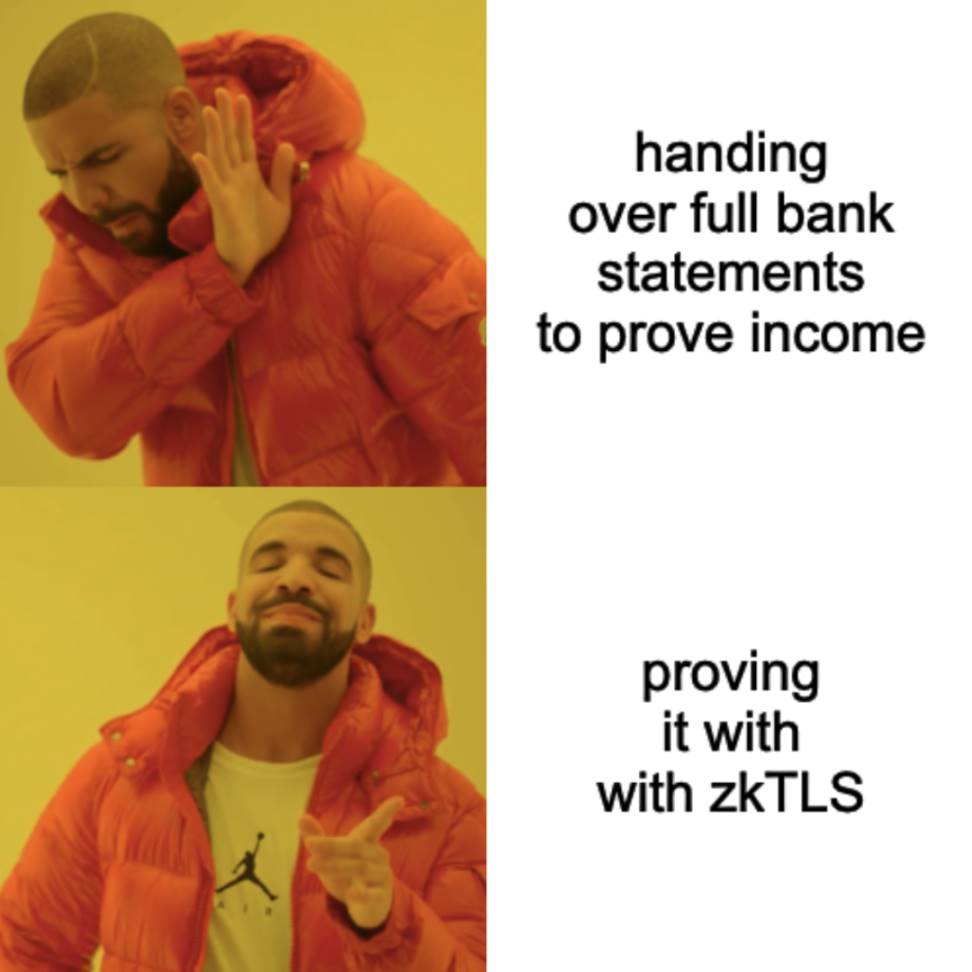
These issues manifest as friction in our daily lives. Want to prove your income? You might need to hand over full bank statements. Need to verify your address? Prepare to upload an entire utility bill. These systems assume total transparency is the only path to trust, because there's no infrastructure for selective, verifiable disclosure.
Web3 promises user control, but so far it hasn’t delivered on that promise — at least not for everyday, Web2-originating data.
The Missing Piece: Verifiable Web2 Data
This is the real bottleneck: enabling Web3 applications to use data we already generate — without compromising user privacy or introducing new trusted intermediaries.
Two key challenges stand out:
-
Verifiability: How do we cryptographically prove data from Web2 sources is authentic, without relying on centralized oracles or APIs?
-
Privacy: How do we prove only what’s necessary — without exposing the underlying full dataset?
Chainlink and other oracle providers have addressed part of the verifiability challenge, especially for public data like asset prices or weather conditions. But personal, user-specific data — such as financial records, qualifications, or identity credentials — requires a different approach. These data points exist behind logins and encrypted channels, designed never to be extracted or shared.
This is where zkTLS comes in.
What Is zkTLS?
Most of the internet runs on TLS (Transport Layer Security) — the cryptographic protocol powering HTTPS. It secures roughly 95% of web traffic. When you visit a website, TLS ensures your communication is encrypted and tamper-proof.
zkTLS (zero-knowledge TLS) builds something entirely new on top: it allows users to extract and prove specific facts from Web2 data streams, without revealing the full content or trusting third parties.
This unlocks two critical capabilities:
-
On-chain verifiability: zkTLS can prove data originated from a specific Web2 source and hasn’t been altered.
-
Selective disclosure: It can prove specific attributes — such as “my annual income exceeds $80,000” — without revealing the actual bank statement.
How does it work? In simple terms:
-
It captures the encrypted TLS session between a user and a website.
-
It generates a zero-knowledge proof that a specific claim is true (e.g., a certain value appeared in the response).
-
This proof can then be verified on-chain — trustlessly and privately.
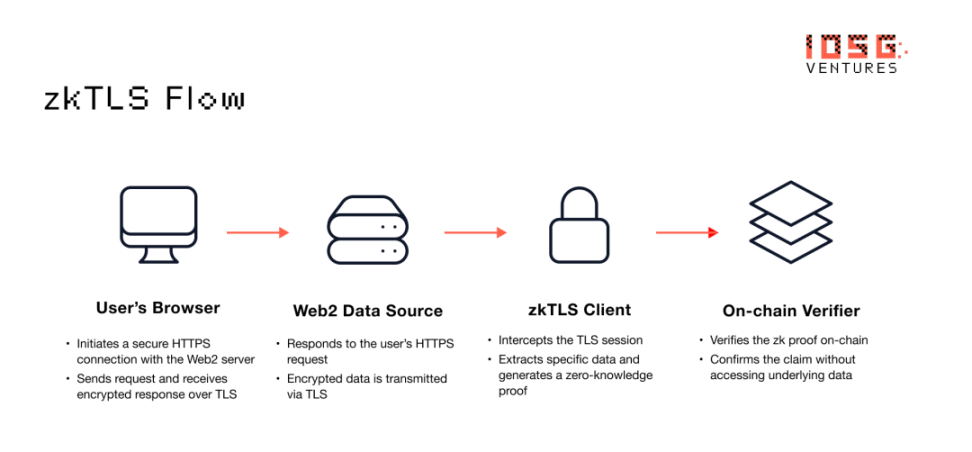
▲ Source: IOSG Ventures
This eliminates the need to expose data to third parties or rely on centralized servers for verification. Instead, trust is embedded directly into the cryptographic proof itself.
This isn’t just theoretical. zkTLS implementations have already been tested and deployed in consumer and DeFi use cases, signaling that verifiable Web2 data will soon become the default input for Web3 applications.
How zkTLS Works
Not all zkTLS implementations are the same. Depending on whether speed, decentralization, or simplicity matters most, different approaches excel in different contexts. Here are three common architectures:
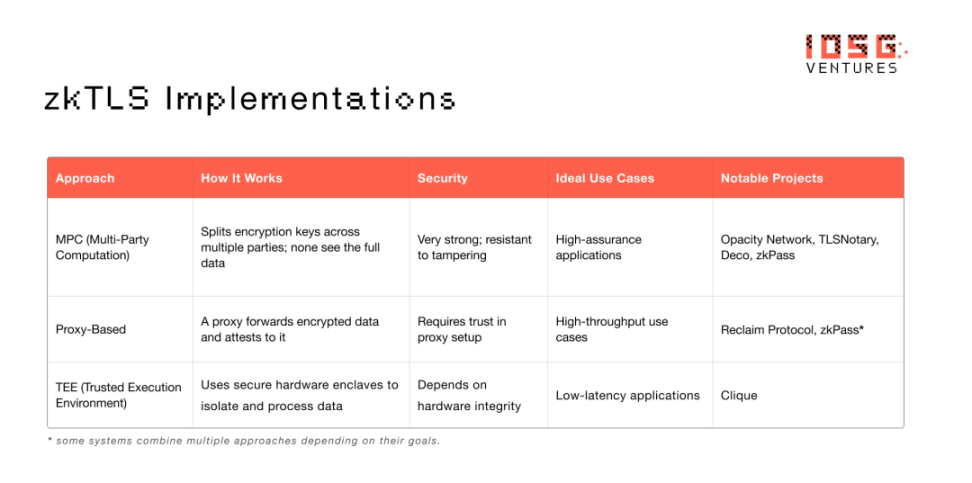
▲ Source: IOSG Ventures
Real-World Applications: Where zkTLS Changes Everything
zkTLS doesn’t just optimize data handling — it redefines the boundary between Web2 and Web3. By enabling trust-minimized, private access to off-chain data, it allows applications to incorporate real-world context without sacrificing privacy or decentralization.
Here’s how it’s being applied across domains today.
Financial Services
Due to the lack of trusted identity and on-chain financial data, most DeFi protocols still rely on over-collateralization. zkTLS makes it possible to verify income, cash flow, or account history — without exposing sensitive documents.
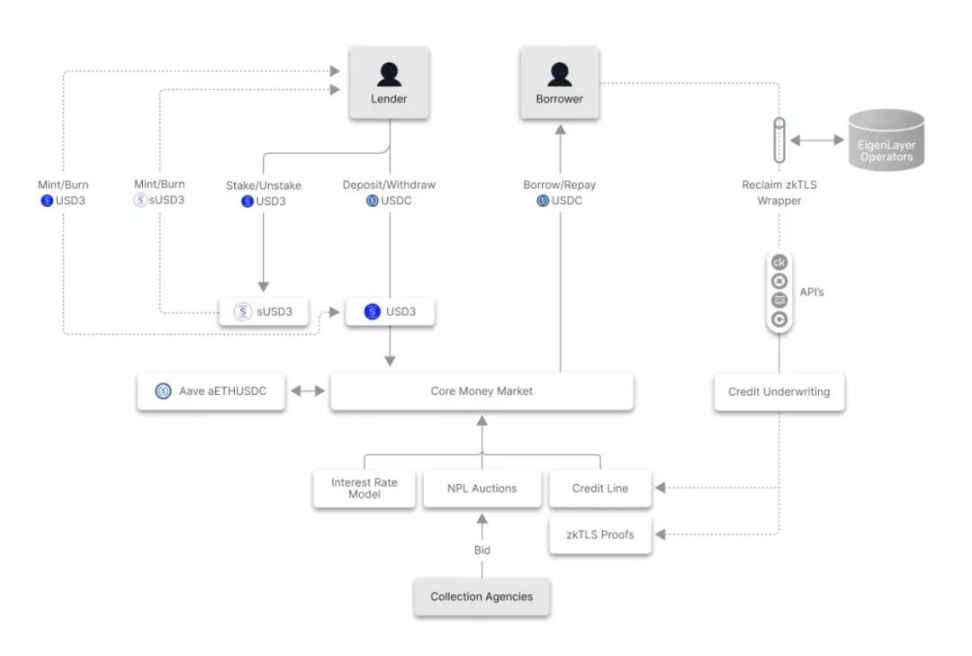
▲ Source: 3Jane
-
3Jane (3jane.xyz) is building a peer-to-pool credit protocol, offering traders, farmers, and businesses real-time, uncollateralized USDC credit lines. Borrowers link their wallets and Web2 financial data via Plaid, unlocking credit based on verifiable proofs from DeFi, CEXs, and banks — no collateral required.
-
Stormbit (stormbit.finance) supports a flexible peer-to-peer lending market where borrowers can privately prove income or account activity using zkTLS to unlock funds.
-
RWA (real-world assets) tokenization projects are beginning to use zkTLS via government portals to verify land or property ownership, enabling compliant on-chain assetization.
-
zkP2P (zkp2p.xyz) is building decentralized fiat-to-crypto onramps, allowing users to prove payments from Venmo, Wise, or Revolut using zkTLS — no KYC, no intermediaries, instant settlement.
These systems expand access to capital, bring creditworthiness on-chain, and build compliant bridges between TradFi and crypto.
Consumer Platforms
In Web2, access to digital goods, subscriptions, and purchase history is locked behind centralized APIs. zkTLS makes this data portable and provable — without needing permission from platforms.
▲ Source: CSFloat
-
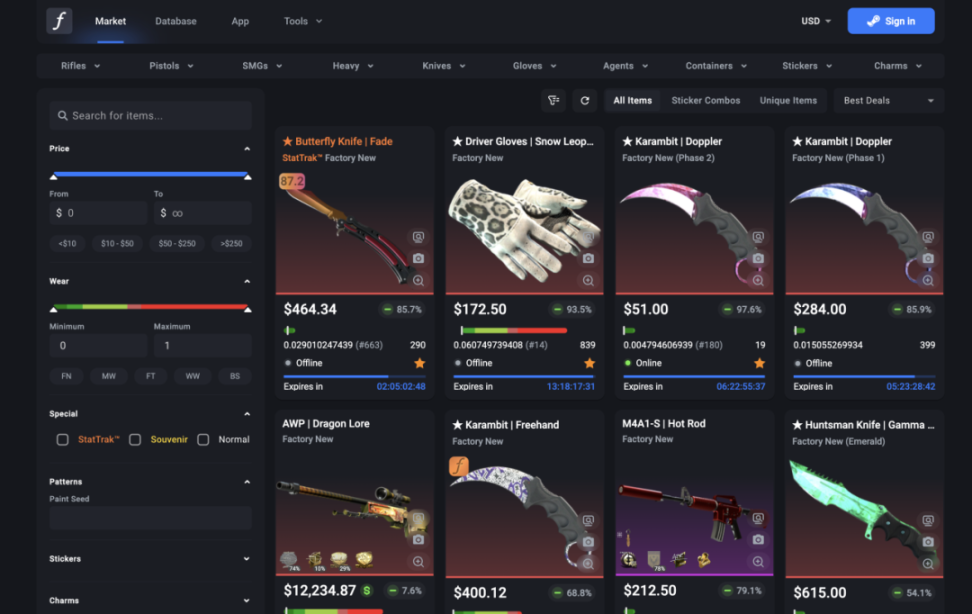
CSFloat (csfloat.com) enables users to verify ownership of Counter-Strike skins and collectibles via Steam data, facilitating secure peer-to-peer trades without platform involvement.
-
zkTLS is also used to prove access to closed communities, subscriptions, or premium content — without account linking or API access.
-
In e-commerce, users can prove past purchases or loyalty program activity to unlock cashback, token rewards, or resale markets.
Now imagine proving you have a Spotify subscription — or a luxury brand purchase — without exposing your full account. That’s the power of zkTLS.
Identity & Reputation
Today’s digital identities are fragmented and over-exposed. Proving who you are often means sharing everything. zkTLS changes this by enabling selective disclosure from trusted sources.
▲ Source: zkMe
-
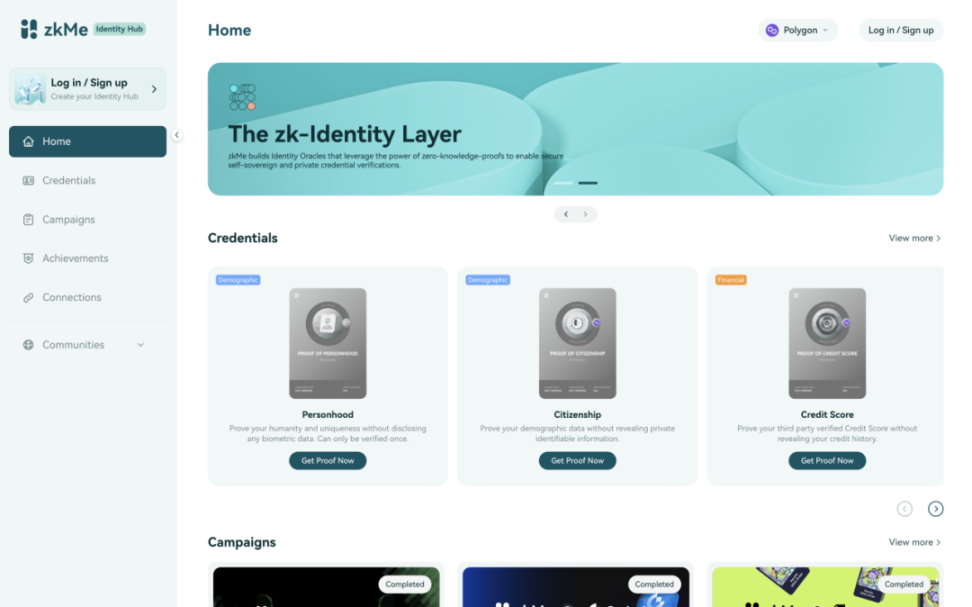
zkMe (zk.me) acts as a privacy-preserving identity oracle, transforming files and data from Web2 platforms into selective on-chain proofs.
-
Zeru (zeru.finance) supports zScore, a cross-app reputation layer on Base. It verifies credit scores, location, or Uber history — without KYC — so users can build verifiable profiles usable across apps and ecosystems.
-
Icebreaker (icebreaker.xyz) enables professionals to create trusted, verifiable work profiles based on employment history and social graphs.
Imagine someone building a Web3 version of Uber or DoorDash. Drivers arrive with zkTLS-verified credentials — no onboarding friction, no need to rebuild reputation.
Social & Content
What we watch, play, and engage with says a lot — but this data is trapped inside platforms. zkTLS unlocks it, making participation portable and programmable.
▲ Source: EarnOS
-
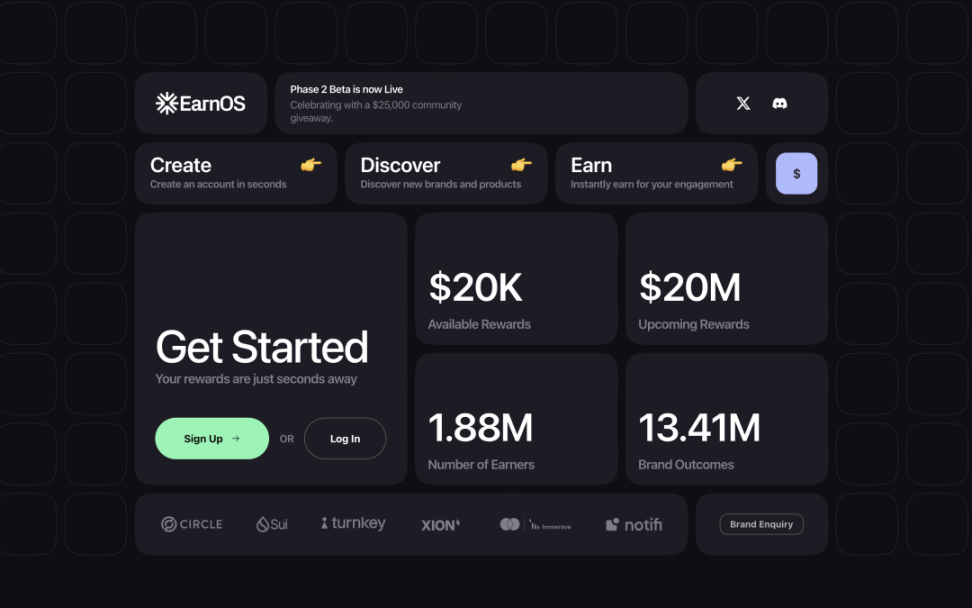
EarnOS (earnos.com) lets users prove they’ve viewed or interacted with ads — without revealing their identity. Advertisers reach real people, users get rewarded, and data stays private.
-
Showdown (showdown.win) uses zkTLS via FACEIT to verify gaming profiles and performance data. Players can prove skill and claim game-based rewards — no screenshots needed.
This unlocks the next wave of attention markets and engagement-driven rewards — finally portable across platforms.
Impact & Behavior
Behavioral systems — whether fitness, sustainability, or reward programs — require data that is often private and hard to verify. zkTLS makes it possible to prove actions without surveillance.
-
Daylight (https://linktr.ee/godaylight) uses IoT and registration data to verify solar panel ownership and usage — without exposing user identity or location.
-
Fit Club (x.com/fitclubonbase) ties workout rewards to verified Strava activities, without leaking health or GPS data.
-
Other applications are exploring zkTLS to prove public transit usage, recycling, or participation in environmental initiatives — enabling transparent, privacy-safe incentive systems.
With zkTLS, we can finally prove real-world actions — without being watched.
Emerging Frontiers
At the intersection of AI, agents, and decentralized coordination, zkTLS provides foundational infrastructure for proof and trust.
-
ElizaOS (elizaos.ai) is building autonomous agents that generate zk-backed logs of their actions — making AI decisions verifiable and auditable.
-
Ketl (ketl.xyz) enables whistleblowers and experts to prove affiliations or insights without revealing identity — bringing credibility to anonymous communication.
-
zkTLS is also being used to verify machine learning training data — ensuring authenticity while protecting contributor privacy.
As agents and AI grow more autonomous, zkTLS anchors them in verifiable facts.
From Credentials to Ownership
zkTLS doesn’t just make Web2 data usable in Web3 — it makes it ownable. Credentials once isolated within platforms become portable, programmable, and privacy-preserving.
As more applications adopt zkTLS, we’ll see a compounding effect: more verifiable data leads to stronger applications, giving users greater control — and more incentive to unlock data on their own terms.
This isn’t about replacing existing systems. It’s about giving users control over them — and building a path where trust, privacy, and composability scale together.
The Road Ahead
If crypto is to go mainstream, it must meet users where they already are — on the internet they already use. zkTLS provides the infrastructure to make that happen.
It enables:
-
Cryptographic trust in data from Web2 services
-
Privacy-preserving verification without third parties
-
User-controlled, composable identity layers
-
New applications built on verifiable real-world interactions
As more of our online lives become accessible through verifiable claims, a new generation of applications will emerge — ones that give users greater control, reduce friction, and unlock real value. zkTLS is not just another protocol — it’s a new way of thinking about how information moves between platforms, and how trust is established on the internet.
Join TechFlow official community to stay tuned
Telegram:https://t.me/TechFlowDaily
X (Twitter):https://x.com/TechFlowPost
X (Twitter) EN:https://x.com/BlockFlow_News
 IOSG Ventures