IMF Unveils New Standards, New Regulatory Framework for Virtual Assets on the Horizon
TechFlow Selected TechFlow Selected
IMF Unveils New Standards, New Regulatory Framework for Virtual Assets on the Horizon
Web3 assets are gradually entering the statistical frameworks, policy models, and even enforcement scopes of mainstream financial systems.
 Navigating Web3 tides with focused insights
Author: Iris, CryptMiao
What do you think cryptocurrency is—currency, commodity, or security?
Currently, some countries and regions around the world have begun discussing and determining the nature of cryptocurrencies.
For example, the United States passed the "21st Century Financial Innovation and Technology Act (FIT for the 21st Century Act)" in 2024, which specifically categorizes virtual assets as either “commodities” or “securities” and assigns corresponding regulatory oversight. Germany classifies cryptocurrencies as private money. More countries, such as China and Dubai, have ruled in certain cases that virtual assets constitute property.
However, as cryptocurrencies become increasingly popular globally, it may be time to establish a unified standard.
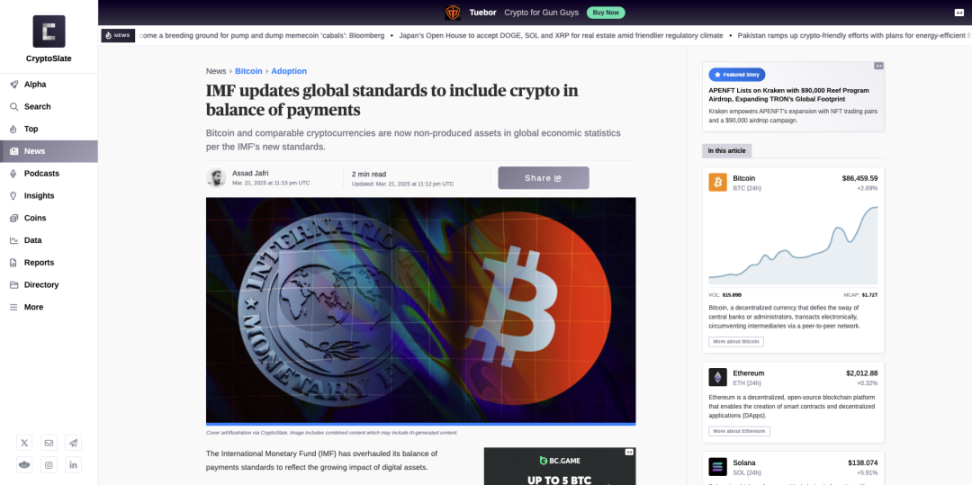
On March 22, 2025, according to Cryptoslate, the International Monetary Fund (IMF) released the seventh edition of the Balance of Payments Manual (BPM7), formally defining Bitcoin (BTC) and similar digital currencies for the first time and incorporating them into the balance of payments statistics.
This marks the IMF's first systematic definition of digital assets within the global financial statistical framework. Although this classification does not equate to regulatory authorization, its authority will inevitably have a profound impact on central banks, finance ministries, tax authorities, and the crypto industry itself worldwide.
Before discussing these implications, let’s take a moment with Manqin Law to understand just how authoritative the IMF really is.
Who Is the IMF?
The IMF, short for International Monetary Fund, might sound like a distant financial institution, but it plays a significant role in shaping global financial rules.
To date, the IMF has existed for nearly 80 years and includes over 190 member countries. Similar to the FATF we’ve discussed previously, the IMF is not an agency belonging to any single nation—it is a collectively funded international body serving as a “financial advisor + global data steward + debt crisis responder,” an entity that no central bank or ministry of finance can afford to ignore.
The IMF has three primary responsibilities:
-
First, monitoring global economic risks. The IMF issues warnings when a country faces high external debt, exchange rate imbalances, or fiscal instability;
-
Second, providing loans and financial assistance. Countries facing foreign exchange shortages can apply for emergency funding from the IMF;
-
Third—and most importantly for our discussion today—establishing “global economic statistical standards.”
You can think of the IMF as the chief accountant behind national financial statements. Concepts like the balance of payments, capital accounts, and external asset-liability tables all rely on standards set by the IMF’s Balance of Payments Manual.
While the IMF doesn’t directly regulate individuals like the SEC or tax agencies do, the statistical frameworks it establishes ultimately flow down to every regulatory department responsible for overseeing you:
-
National statistical bureaus use these standards to classify your assets;
-
Finance ministries and foreign exchange regulators use them to monitor your capital flows;
-
Tax and regulatory bodies determine whether and how to tax you based on them.
Therefore, the inclusion of BTC and similar cryptocurrencies within the statistical scope of the latest Balance of Payments Manual (BPM7) sends a clear signal globally: cryptocurrencies are no longer an asset class that can be excluded from official reporting.
While this signal may not immediately trigger new regulations, it certainly lays the foundation for future enforcement—providing regulators with the tools, justification, and measurement mechanisms they need.
Establishment of Regulatory Standards
Now, let’s turn to the sections of the updated Balance of Payments Manual concerning digital assets.
The document states that crypto assets not backed by liabilities (such as Bitcoin) should be classified as “non-produced, non-financial capital assets” and separately recorded under the “capital account” in the balance of payments.
If you assume that classifying Bitcoin and similar assets as “non-currency” implies looser regulation, you’d be mistaken. In fact, this classification may be exactly what global regulators are hoping for.
Why is that?
As mentioned at the beginning of this article, many jurisdictions have long disagreed on how to categorize digital assets, leading to cross-border regulatory gaps where “everyone wants to regulate, yet no one can effectively do so.” Now, the IMF has provided a definitive answer: Bitcoin and similar assets are neither money nor debt—they are capital assets you hold, akin to gold, real estate, or artwork.
For regulators worldwide, this classification is ideal. It means these assets are no longer “gray-zone” items outside the system but can now be integrated into national asset-liability accounting systems. This paves the way for tracking, reporting, and even taxation in the future.
Notably, BPM7 also specifies that liability-backed stablecoins such as USDT and USDC should be categorized as “financial instruments,” offering direct guidance for stablecoin regulation—essentially allowing existing financial product rules to apply. Additionally, platform tokens like Ethereum (ETH) and Solana (SOL) may be treated as equity-like instruments upon holding, reflecting their investment characteristics.
From this point forward, regulators have a clear entry point for oversight. And with that entry point established, three areas will be most immediately affected: reporting, taxation, and compliance with capital flows.
Reporting Obligations for Holders
Historically, Web3 has been associated with anonymity and decentralization. Even though blockchain data allows visibility into holdings, regulators often don’t know who owns what.
But now, countries have grounds to include non-liability-backed crypto assets in the statistical recording of “external capital accounts.” This means that if you are a resident of a given country and control or hold BTC, ETH, or DAO-related assets issued or governed outside your jurisdiction—even if stored domestically—these could be classified as “foreign assets” under balance of payments definitions, triggering mandatory foreign asset disclosure requirements.
This is just the first layer. More critically, domestic tax authorities are increasingly demanding transparency about “what you own,” regardless of whether the asset is held domestically or abroad.
Take the U.S. as an example: if you are a tax resident, even if your assets are held on a local exchange like Coinbase or in a self-custodied wallet, once your holdings exceed a certain threshold, you may still be required to report them on Form 8938.
Taxation Obligations for Traders
Whether Bitcoin (BTC) is treated as a non-financial capital asset or Ethereum (ETH) and Solana (SOL) are viewed similarly to equity instruments, disposing of these assets triggers tax obligations based on realized gains.
So what crypto traders truly need to focus on is: when does a taxable event occur, and how is taxable income calculated?
For instance, trading one token for another after appreciation may be considered a capital gain—even if no fiat currency or stablecoin was involved.
Similarly, passive income sources such as staking rewards, airdrops, and liquidity provision are treated in some jurisdictions—including the U.S.—as ordinary income taxed at fair market value upon receipt, regardless of whether a sale occurred or profit was realized.
Furthermore, creators or protocol developers earning tokens, NFT sales revenue, or protocol fee shares through on-chain activity may face business or other taxable income obligations, requiring inclusion in personal or corporate income tax filings.
Compliance Challenges Around Capital Flows
If including digital assets in official records changes the logic around “what you hold” and “taxation upon movement,” then the final unavoidable question becomes: where did these assets come from, and where are they going?
For years, on-chain fund movements operated in a state of technological advancement outpacing regulation. Projects send stablecoins directly to developer wallets after fundraising, distribute salaries or grants via multisig addresses, conduct airdrops, and users freely transfer USDT or pay with BTC—all seemingly moving “on their own” across chains, without banks, reports, or intermediaries imposing controls.
In the past, these activities were seen as expressions of transactional freedom or user experience. But under the new statistical framework, they are now redefined as “capital account changes” or “financial account inflows/outflows.” In some countries, this could activate existing foreign exchange or payment compliance thresholds, enabling regulators to apply established policy tools.
For Web3 project teams, if the technical team operates domestically while funds are sent directly from overseas wallets to team members’ wallets, regulators might interpret this structure as “capital inflow” or “repatriation,” requiring explanations about the nature of funds, mandatory reporting, and potentially facing penalties including asset freezes or foreign exchange violations.
For individual investors, receiving stablecoin transfers into non-custodial wallets and subsequently withdrawing, converting, or depositing into fiat accounts may trigger scrutiny due to unclear source trails or complex counterparty identities. Exchanges’ risk control systems may block transactions or require additional KYC verification and proof of fund origins.
Manqin Law Summary
It must be emphasized that BPM7 is not a regulatory rulebook. It won’t directly dictate how much tax you owe, whether you can transfer funds abroad, or immediately impose KYC checks, audits, or asset freezes. However, beneath the surface, it fundamentally shifts the regulatory mindset—from treating digital assets as “invisible” to making them “classifiable.”
For regulators, this represents a technical breakthrough: moving from “lack of regulatory basis” to “integration into existing systems.” For the industry, it signals that Web3 assets are gradually being incorporated into mainstream financial statistics, policy models, and enforcement frameworks.
While the resulting changes won’t immediately affect every user, those who fall into the following categories should seriously consider restructuring and preparing for compliance:
-
Project teams still using traditional models of receiving funds offshore and spending onshore
-
Users relying on stablecoins for cross-border transactions
-
High-net-worth individuals holding substantial on-chain assets
Especially considering the growing trend toward stricter regulations involving on-chain identity verification, tax reporting interfaces, and cross-border transaction audits, the cost of proactive adaptation today is far lower than reactive compliance tomorrow.
We understand that every Web3 builder and user is accustomed to narratives of “decentralization” and “free circulation.” But as demonstrated by BPM7, global regulators aren’t rejecting digital assets—they’re developing a framework to bring them “within the rules.”
Since the scoring system of this game is already changing, at the very least, we need to learn how to read the scoreboard.
Join TechFlow official community to stay tuned
Telegram:https://t.me/TechFlowDaily
X (Twitter):https://x.com/TechFlowPost
X (Twitter) EN:https://x.com/BlockFlow_News