WOO X Research: Is the next narrative taking shape? Web3 + MCP taking over from AI Agent?
TechFlow Selected TechFlow Selected
WOO X Research: Is the next narrative taking shape? Web3 + MCP taking over from AI Agent?
MCP combined with blockchain has potential, but faces dual challenges of technical barriers and market pressure.
 Navigating Web3 tides with focused insights
The significance of AI lies in liberating human labor and raising the baseline capabilities for most jobs. However, current LLMs still have significant limitations—they require back-and-forth conversations to offer suggestions, and users must manually execute recommended actions. There remains a gap between this reality and the vision of truly leveraging AI to work on our behalf.
Now imagine being able to interact with AI that can actually operate your computer—replying to emails, writing reports, or even automating cryptocurrency trading. Does this bring us closer to the dream of liberated productivity? This technology is known as MCP, one of the hottest keywords in the AI field today.
What is MCP?
MCP (Model Context Protocol) is a standardized protocol released by Anthropic in November 2024, designed to solve the longstanding problem where AI models could only "talk" but not "act."
Breaking Down the Name MCP
-
Model: Refers to various large language models (LLMs), such as GPT, Claude, Gemini, etc.
-
Context: Represents additional data or external tools provided to the model
-
Protocol: A universal, standardized specification or interface
Put together: Through a unified standard, MCP enables AI not only to speak but also directly control external tools to complete various tasks.
Commonly used LLMs like ChatGPT or Grok are limited to text input and output within conversational contexts. To perform actual operations—such as reading files from a folder, sending emails, or querying databases—we typically issue commands to the LLM, manually carry out its suggested actions, report results back to it, receive further textual advice, and repeat this cycle iteratively.
MCP changes this paradigm. With MCP, AI can read local files, connect to remote databases, and even directly operate specific web services. In other words, AI moves beyond generating text—it becomes capable of handling numerous repetitive or procedural tasks autonomously.
How MCP Works: A Brief Overview
-
MCP Host (Manager): Manages and coordinates the entire MCP system. For example, Claude Desktop acts as a host, helping AI access local data or tools.
-
MCP Client (Client-side): Receives user requests and communicates them to the LLM (AI model). Common examples include chat interfaces or IDEs integrated with MCP, such as Goose, Cursor, or Claude Chatbot.
-
MCP Server (Server-side): Can be seen as a curated and annotated collection of APIs, offering functionalities that AI can use—such as database queries, email sending, file management, or calling external services.
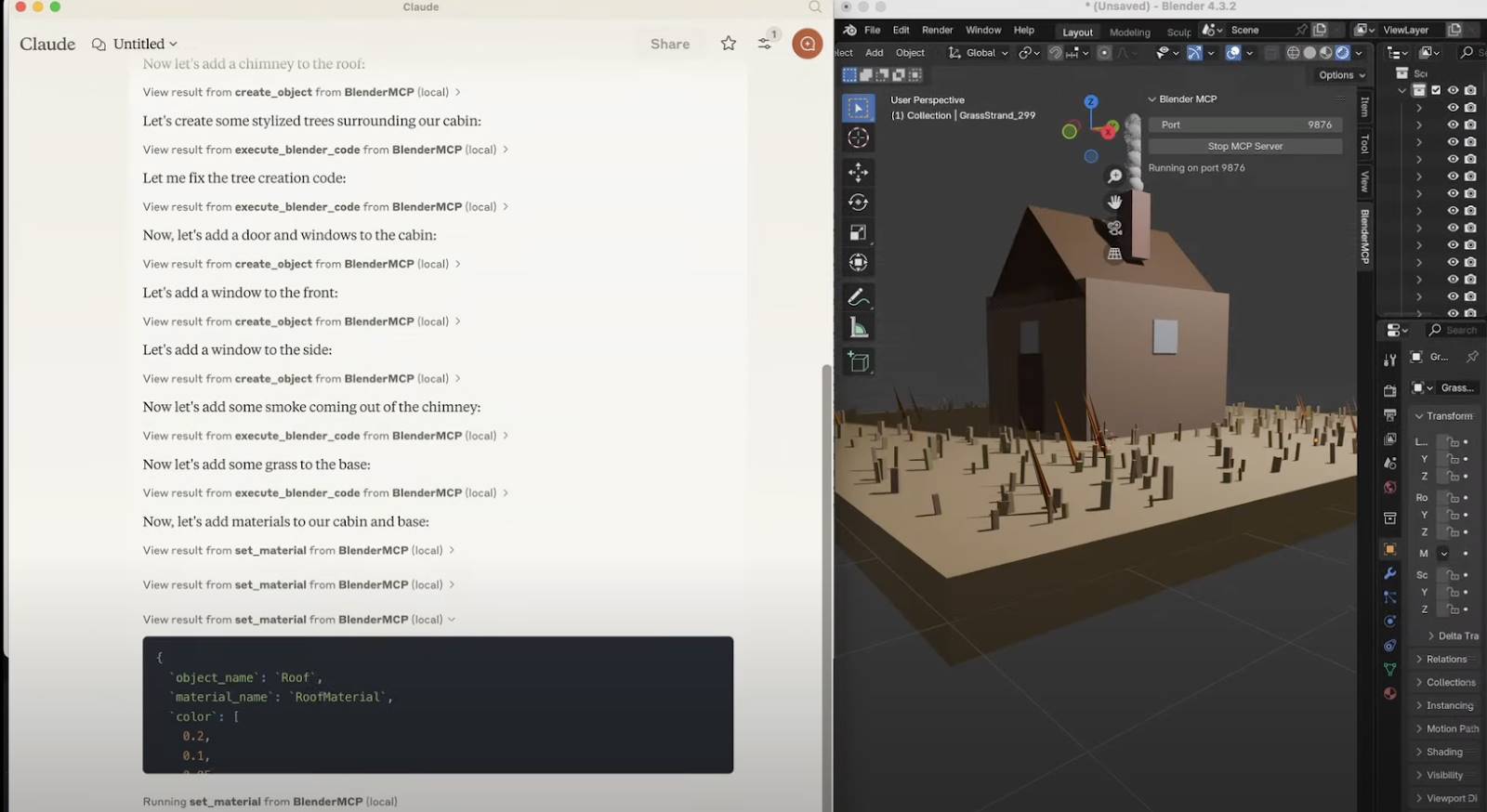
With MCP, AI not only understands human language but can translate specific phrases into actionable instructions, enabling automated workflows. For instance, organizing sales reports, emailing clients, or even executing 3D modeling commands directly in Blender.
Reference: https://www.youtube.com/watch?v=FDRb03XPiRo&t=4s
Why is MCP Important?
Bridging AI and External Tools
LLMs are inherently limited because their knowledge comes from pre-training data and isn't updated in real time. This means an LLM only knows information available up to its training cutoff date. For example, if an LLM was trained in February 2025, it has no knowledge of events occurring after that month.
The current mainstream solution is RAG (Retrieval-Augmented Generation), which combines a retrieval system with a generative model. In this architecture, relevant up-to-date information is retrieved before the LLM generates a response, and this retrieved content serves as context for more accurate and timely outputs:
-
Retrieval: Before answering a question, a retrieval tool (e.g., web search or internal database query) finds the most recent relevant data.
-
Generation: The retrieved data is passed to the LLM as contextual support, improving the quality and relevance of the generated answer.
An example of RAG is when an AI first uses Bing or Google to find the latest information, then incorporates those results into its response.
The key differences between MCP and RAG are:
-
RAG enhances LLM responses using relatively static data, while MCP allows AI to actively "take action"—querying databases, invoking APIs, or modifying file contents.
-
Standardization & Universality: MCP functions like USB-C—a universal connector. Different vendors can independently develop features compliant with the MCP standard, just as all devices can use the same USB-C cable. Without MCP, every developer would need to define custom ways for AI to call specific APIs, leading to redundant development efforts. With MCP, everyone follows one common standard, eliminating reinvention.
-
From Passive Response to Active Execution: Traditional AI tools merely respond to questions without taking action. With MCP, AI can decide what command to execute based on context, read the returned result, and determine the next step. This ability to adapt dynamically greatly enhances AI's practical utility.
-
Security and Control: MCP does not require all data to be sent to the AI model. Access can be managed via permissions, API keys, and other controls, ensuring sensitive information remains protected.
How Does MCP Differ From AI Agents?
What is an AI Agent?
In Q3 last year, GOAT led a surge in popularity around AI Agents. Most crypto users encountered AI Agents through a Web3 lens. An AI Agent generally refers to an AI system capable of autonomously performing specific tasks—not just conversing with humans, but also taking initiative, using tools, or calling APIs to complete multi-step processes. One common example is an AI that autonomously posts on Twitter.
Limits of AI Agents:
-
Lack of Standardization: Anyone can build an agent, but without a unified standard, you end up with situations like “this agent only works with Model A” or “that agent can only call System B’s API.”
-
Siloed Development: While AI agents can perform tasks, developers often need to write extensive custom code for each API format and rule. The lack of shared ecosystems across different agents makes integration difficult.
Relationship Between MCP and AI Agents: MCP is a protocol; AI Agent is a concept or implementation approach.
-
AI Agent emphasizes the AI’s ability to act proactively and use tools.
-
MCP focuses on how different AI models communicate with external tools, serving as a universal standard.
How MCP Empowers AI Agents:
-
Without MCP, AI Agents may need to write separate API rules for every tool and platform—an arduous task for development and maintenance.
-
With MCP, AI Agents simply follow the MCP specification, discover available tools from a “Server List,” dynamically choose which ones to use, and securely and conveniently access external resources.
Different Scope of Functionality:
-
AI Agent: Focuses on decision-making and logic—determining what steps to take and how to achieve goals.
-
MCP: Specializes in tool integration and standardized formats—providing AI with unified access to external services, databases, and file systems.
Together: AI Agent + MCP = AI that not only knows *what* to do but also *where* and *how* to act.
Which Crypto Projects Are Exploring MCP Concepts Today?
Base MCP
A framework developed by Base, launched on March 14, enabling AI applications to interact with the Base blockchain. Users can deploy smart contracts or use Morpho for lending/borrowing—all through natural language conversation, without needing any coding skills.
-
BORK was the first token deployed using Base MCP, issued on March 14. Its market cap peaked at $4.6 million but has since dropped to $110,000, with only $90,000 in 24-hour trading volume—indicating the project has likely ended.
-
Flock is a decentralized AI training platform. It points out that current MCP implementations still rely on external, centralized LLMs. Flock offers a Web3-based agent model, allowing AI-driven blockchain tasks to run locally, giving users greater control.
LyraOS (LYRA)
Full name LYRA MCP-OS, a multi-AI agent operating system that enables AI agents to directly interact with the Solana blockchain—for actions like buying and selling cryptocurrencies.
The team is currently exploring the creation of thousands of "AI16ZDAOs"—AI-driven decentralized autonomous organizations focused on crypto investment. A demo of LYRAOS is scheduled for release between March 21–22, 2025, with the official product launch planned for the following week.
Current token market cap: $923,000 | Peak: $2.64M | 24h trading volume: $3M | Holder count: 2,922
Conclusion: The AI Narrative Resurfaces—But Needs Time to Prove Itself
While MCP offers a standardized way for AI to interact more easily and securely with external tools—and appears promising in the Web3 space—there are still few successful cases. Key reasons may include:
-
Immature Technical Integration: In the Web3 ecosystem, each chain and DApp has unique contract logic and data structures. Uniformly packaging these as MCP-accessible servers requires substantial development effort.
-
Security and Regulatory Risks: Allowing AI direct control over smart contracts and financial transactions demands robust private key management and permission controls—both technically complex and costly.
-
User Habits and Experience: Most people remain skeptical about letting AI manage wallets or make investment decisions. Combined with blockchain’s already high usability barrier, overly complex experiences or unclear use cases will deter new users from sustained engagement.
-
Market Fatigue and Cooling Sentiment: The previous wave of AI Agent hype in crypto saw many unproven projects reach nine- or ten-figure valuations during peak frenzy. Now, the bubble is deflating—most such projects have dropped over 90% in value, reflecting a broader disillusionment with AI-driven narratives.
MCP can be seen as a supercharged version of AI Agents. After experiencing the earlier AI boom in crypto, the market has become more discerning, better distinguishing between speculative concepts and real-world utility. Without genuinely innovative and useful applications, investors and users won’t easily buy in again. Early MCP projects like BORK failed to gain traction due to lack of differentiation or tangible use cases—this, in my view, is the primary reason why MCP hasn’t yet gone mainstream.
The combination of MCP and blockchain holds potential, but faces dual challenges: technical complexity and market skepticism. If future projects can integrate stronger security mechanisms, deliver intuitive user experiences, and uncover truly valuable innovations, then “Web3 + MCP” might transcend its current status as just another speculative topic and emerge as the next major narrative in tech evolution.
Join TechFlow official community to stay tuned
Telegram:https://t.me/TechFlowDaily
X (Twitter):https://x.com/TechFlowPost
X (Twitter) EN:https://x.com/BlockFlow_News
 @WOOXResearch