Great concealment lies in privacy — written before Nillion's token launch
TechFlow Selected TechFlow Selected
Great concealment lies in privacy — written before Nillion's token launch
It's not that privacy technology isn't important, but rather that the combination of privacy technology and tokens is no longer important, at least for now.
 Navigating Web3 tides with focused insights
Author: Zuoye
Shang Yang tests horses; Bi Gan sees hearts. NIL ascends to heaven, XMR gets delisted.
Blockchain originated from privacy technologies, especially cryptography—from elliptic curves to zero-knowledge proofs—all demonstrating the success of privacy economics in the Web3 era.
But things aren't perfect. From repeated CEX/DEX delistings of XMR to the arrest of Tornado Cash’s founder, you’ll notice that even as Nillion lands on Binance, the hacker spirit behind privacy projects is fading, and their actual product delivery remains far from ideal.
When it comes to refining privacy products, blockchain projects must learn from their Web2 counterparts and level up their game.
Proton Proves Privacy Can Be a Well-Functioning Product
Privacy is a Feature, Not a Product.
Talking only about how privacy enhances product design lacks meaning. In other words, privacy needs PMF (Product-Market Fit) too. Giants like Google and Meta manage to invade privacy while remaining irresistible because of convenience and network effects—plug-and-play usability and widespread adoption mean individuals and workplaces alike end up accepting all of Google's offerings by default.

Image caption: Fines against tech giants, source: Proton
On this front, regulatory fines-as-control have proven utterly ineffective. Even using legendary fine-resilient Google’s $2.974 billion penalty as an example, Google could earn that back in roughly 16 extra days. These fines don’t flow into European tech firms’ coffers, leaving them perpetually outmatched against Google.
To address this, Proton has taken the route of building its own full suite of tools. Born at CERN (European Organization for Nuclear Research), its scientific origins grant it innate credibility higher than commercial companies. With cryptographic expertise, open-source code, and audited products, Proton builds privacy solutions with real-world relevance—you can actually replace Google’s ecosystem and still get things done.
Of course, current network and scale effects still can’t rival the giants. But compared to its blockchain peers, Proton offers products usable in daily life—making it a legitimate Google alternative.
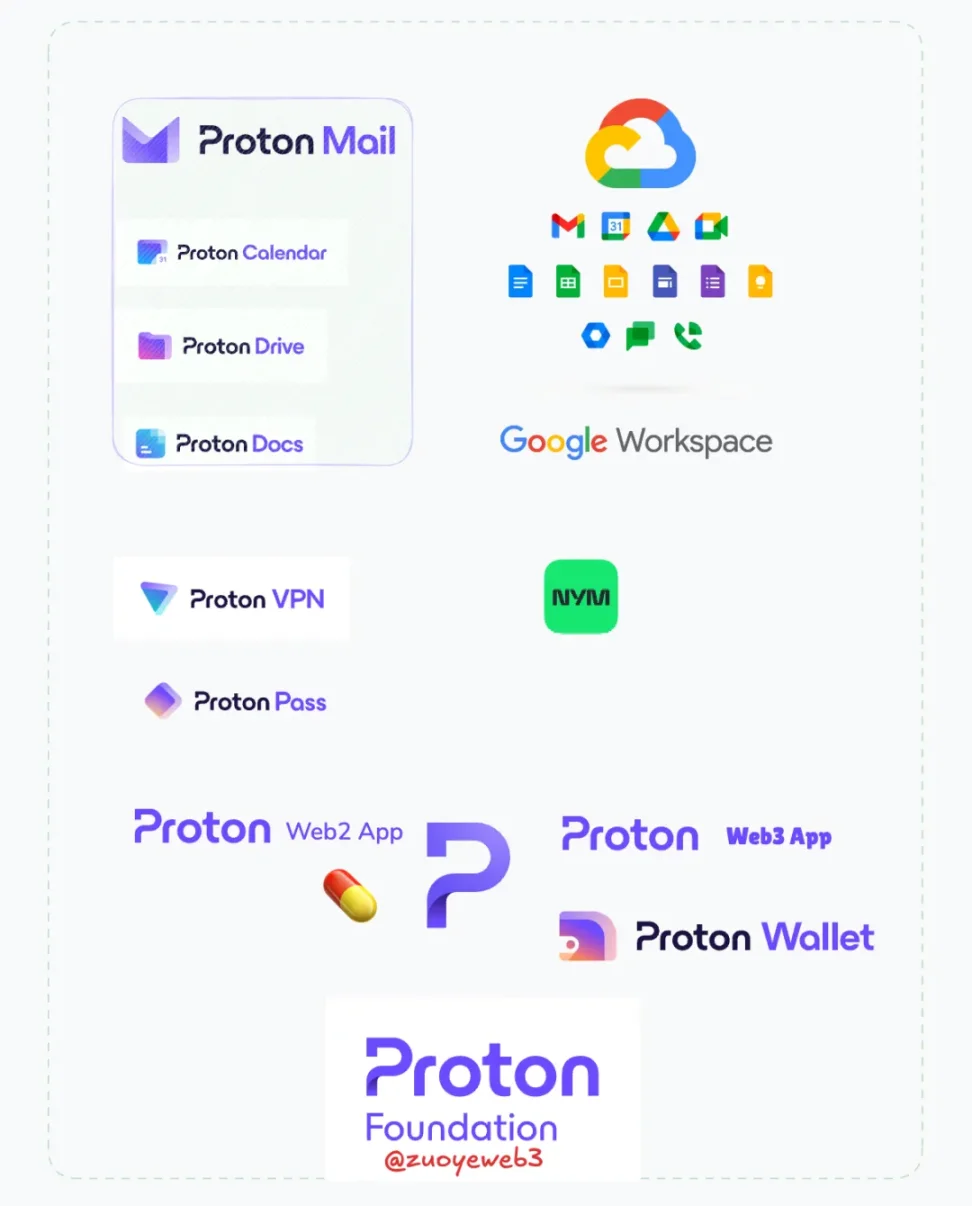
Image caption: Proton products and partial comparison, source: @zuoyeweb3
Compared to Google Workspace, Proton today centers largely around equivalents to its core offering, Proton Mail. Notably, Proton Mail is a favorite among founders like Jack Dorsey of Twitter and Square.
Unlike typical email services, Proton Mail requires no phone number registration and supports end-to-end encryption, ensuring private message transmission. Before Telegram faced regulatory crackdowns, pairing Proton Mail with Telegram’s end-to-end encrypted chats enabled a relatively high-grade commercial privacy experience.
After Telegram’s decline, Proton Mail combined with Signal still satisfies most users’ needs for private browsing.
Like Telegram, Proton has also entered the Web3 space with its first product: Proton Wallet. Unlike transaction-focused wallets such as Bitget Wallet or Binance Wallet, Proton Wallet is unusually restrained—its functionality is quite basic.
The significance of Proton lies in proving the viability of building products based on privacy technology. Unlike traditional giants relying on ad-based revenue models, Proton adopts a paid subscription model. Unlike its Web3 peers obsessed with tokenomics, Proton hasn’t issued a token—making it a case of:
Crypto Technology Without Tokenization.
From Skiff to Nillion: The Tokenization of Encryption Technology
If Proton is Don Quixote, then Skiff, Nym, Privasea, and Nillion are dwarves—still searching for their PMF while rushing ahead with tokens (“Snow White”) already minted.
On February 9, 2024, Notion announced the acquisition of Skiff—the first instance of a major Web2 product acquiring a Web3 startup, setting a new industry trend without issuing tokens. A side note: Stripe’s acquisition of Bridge was actually the second such case.
Skiff resembles Google’s suite as well—a document suite built on IPFS and encrypted email service—but suffers a critical flaw: extremely poor UI and terrible user experience. This reflects the biggest issue facing current Web3 products: constrained by blockchain’s slowness and high costs, building large-scale applications atop it struggles to compete with Web2 alternatives.
Proton qualifies as a proper Google Alternative; Skiff does not qualify as a viable Proton Alternative.
Beyond that, other Web3 privacy projects haven’t fared well either. Nym gradually shifted focus toward the VPN market. Privasea, focusing on Fully Homomorphic Encryption (FHE), emphasizes compatibility with AI use cases. Meanwhile, today’s Nillion remains stuck in the previous cycle’s MPC narrative.
Yes, narratives evolve in cycles. The MPC and Blind Compute (NBC) concepts constructed by Nillion stem from Ethereum and ZK applications within the L2/Rollup domain—account abstraction wallets and MPC paradigms fall under this umbrella. As ETH’s price stagnates, privacy tech products are being abandoned by the market. The clearest sign: FHE has failed to become the next step after ZK. For reference, see the debunked article: “FHE Is the Next Step After ZK—So Says Crypto.”
It’s not that privacy technology isn’t important—it’s that combining privacy tech with tokens is no longer important, at least for now.
Without privacy technology, Proton couldn’t build its business logic or product matrix—that’s what true PMF looks like. But for products like Nillion, investments from Binance and Hack VC seem more crucial than technological substance.
As for the concept of blind computation, trust layers, multi-chain interoperability, and privacy AI—none of these are Nillion’s real profit drivers. We all know the truth: Nillion’s only real product might just be its token. At least Nym genuinely aims to capture market share from existing VPN providers.
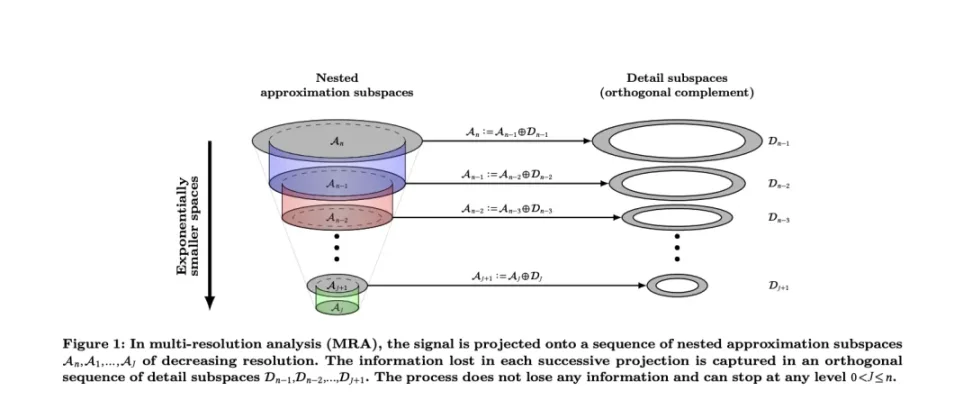
Image caption: Nillion’s latest paper, source: Nillion
In its latest technical paper, Nillion’s research focus remains on practical MPC implementation. Traditional secret-sharing MPC algorithms suffer explosive data growth during computation. Nillion is researching ways to reduce algorithmic complexity to improve computational efficiency.
How should we view this? Let’s just wait and see how Nillion’s token performs at launch. Once again, Web3 privacy technologies fused with AI fail to find real-world applications—OpenAI and DeepSeek operate successfully without these features. If a new product incorporating privacy tech could steal market share from them, that would be meaningful innovation.
If not, perhaps look instead to @Optimism, which truly believes privacy matters.

Still, “Privacy is Good” must be demonstrated through actual Privacy Products. Endlessly discussing MPC / ZK / TEE / FHE / AI has no value. Empty slogans that don’t solve problems are easy for anyone to chant—but they ultimately damage public trust in the underlying technologies.
The consequences are already visible: people now flinch at the mention of L2s, and many suspect ZK is a scam.
After Safe caused massive losses at Bybit, those who fell silent weren’t just Vitalik—but also frontend devs and multisig advocates.
Conclusion
Monero (XMR) may feel unfamiliar to those immersed in today’s BNB Chain meme culture. Yet it represents one of the last genuine attempts after Bitcoin to thoughtfully integrate cryptography with real-world application scenarios.
On February 7, 2024—two days before Skiff officially announced joining Notion—XMR was delisted from Binance, losing access to its largest liquidity source. Perhaps from now on, so-called privacy technologies will be like F-47—merely part of "winning studies." Only difference: Web3 privacy economics hasn’t gone fully bankrupt—yet.
Join TechFlow official community to stay tuned
Telegram:https://t.me/TechFlowDaily
X (Twitter):https://x.com/TechFlowPost
X (Twitter) EN:https://x.com/BlockFlow_News
 @zuoyeweb3