Uber Engineers Founded Nillion, What's Innovative About the "Blind Computation" Network?
TechFlow Selected TechFlow Selected
Uber Engineers Founded Nillion, What's Innovative About the "Blind Computation" Network?
Nillion believes there is no silver bullet for privacy-enhancing technologies, and all solutions must be combined to achieve optimal results.
 Navigating Web3 tides with focused insights
By angelilu, Foresight News
According to the ancient Greek historian Herodotus, Persian King Darius wanted to send a secret message to the Greek city-state of Athens. He selected a slave, shaved his head, and tattooed the secret message onto his scalp. After the hair grew back, he sent the slave to Athens. Upon arrival, the slave’s hair was shaved again, revealing the hidden message.
This ancient story is remarkable for successfully concealing sensitive information during transmission—hiding it beneath an ordinary appearance. However, challenges in today's digital world are far more complex. We not only need to hide the existence of information but also process it without exposing its contents.
Therefore, Nillion proposes a decentralized "blind computing" network. Much like how Darius concealed his message beneath the slave’s hair, Nillion’s technology enables high-value data to be stored, transmitted, and processed while remaining fully encrypted throughout the entire journey.
Blind computing generally refers to a broad range of techniques that allow computations on data without revealing the input—this is a comprehensive concept resulting from the convergence of multiple cryptographic and secure computation technologies, including blind signatures, secure multi-party computation (MPC), homomorphic encryption (which allows direct computation on encrypted data), trusted execution environments (TEEs), and zero-knowledge proofs.
What is Nillion?
In short, Nillion can be understood as a decentralized secure computing network designed to build an infrastructure where high-value data remains encrypted at all stages—storage, transmission, and computation—solving the current issue of requiring decryption before computation and re-encryption afterward.
How It Works
Nillion believes that existing privacy-enhancing technologies (PETs) such as fully homomorphic encryption (FHE) and multi-party computation (MPC) each have their unique strengths. There is no one-size-fits-all solution in PET; optimal results require orchestrating different approaches. Nillion’s goal is to aggregate all PETs and create a framework that allows new PETs to easily integrate into its orchestration layer.
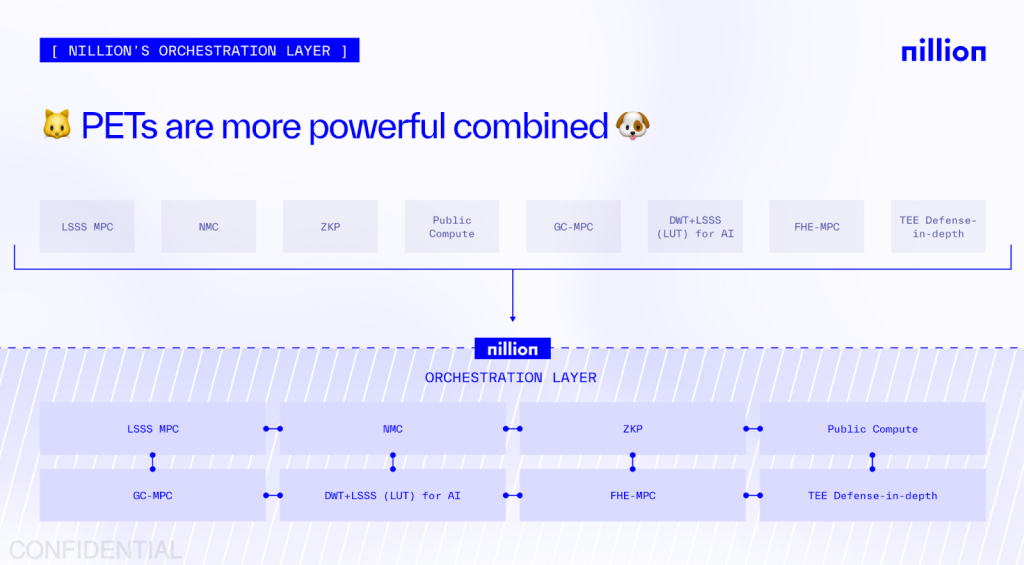
Nillion’s ultimate goal is to create a development environment where developers don’t need to understand any details about PETs. They should simply be able to use familiar data types—integers and fixed-point arithmetic—to build privacy-enhancing applications. The compiler will then automatically select the best combination of PETs to realize the developer’s vision.
To achieve this, key components of Nillion include: the Nada programming language compiler and the Nillion Network.
The Nada Language Compiler
Nillion provides developers with Nada, a Python-based MPC programming language. Developers can write programs using Nada and compile them with the Nada compiler, then upload the compiled program to the Nillion Network for execution. With Nada, developers can manage storage of high-value private data and perform blind computations—all while the data remains encrypted throughout processing.
Nillion Network’s Two-Layer Architecture
Currently in testnet phase, users can create a Nillion wallet via Keplr or Leap to connect to the Nillion testnet. Although its initial testnet campaign, “Genesis Sprint,” concluded on July 6, Nillion has announced plans to launch a second phase of activities.
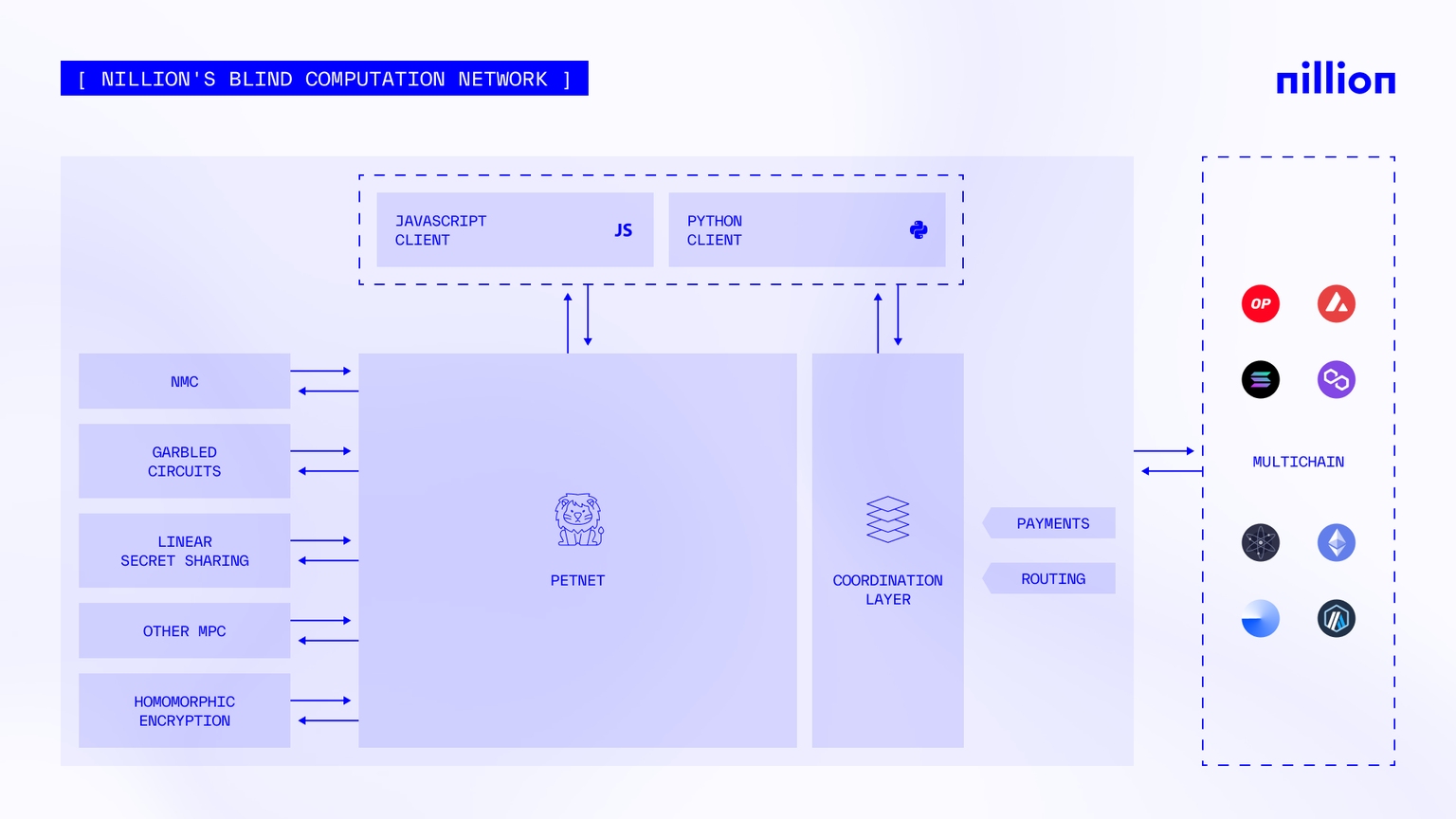
A key feature of the Nillion Network is its two-layer architecture, composed of the core Petnet and the coordination layer NilChain, enabling functional separation and decentralized governance.
-
NilChain serves as the coordination layer of the Nillion Network, managing payments for blind computation and storage operations executed on the network.
-
Petnet leverages Nillion’s privacy-enhancing technologies (PETs) to protect distributed high-value data and execute blind computations.
Funding Status
In December 2022, Nillion raised $20 million in seed funding at an $180 million valuation, led by Distributed Global, with participation from AU21, Big Brain Holdings, Chapter One, GSR Markets, HashKey, and others.
Nillion recently announced it has completed a Series A private token sale at a $400 million valuation, led by Hack VC, with participation from industry figures such as Ansem and CL, as well as angel investors from Worldcoin and LayerZero. The exact funding amount was not disclosed. Additionally, last month, Nillion conducted a public community token sale of 35 million NIL tokens (3.5% of total supply) on CoinList, matching the $400 million valuation of the Series A round. Nillion’s token generation event (TGE) is expected in late August 2024.
Team Background
Nillion’s team is highly impressive. Its development company, Nilogy, was incubated through CoinList’s Seed Program. Nilogy’s founder and CTO is Conrad Whelan, a founding engineer at Uber. The Chief Strategy Officer is Andrew Masanto, founding CMO of Hedera Hashgraph. The Chief Business Officer is Slava Rubin, founder of the U.S. crowdfunding platform Indiegogo. The General Counsel is Lindsay Danas Cohen, former Vice President of Legal for Products at Coinbase.
Join TechFlow official community to stay tuned
Telegram:https://t.me/TechFlowDaily
X (Twitter):https://x.com/TechFlowPost
X (Twitter) EN:https://x.com/BlockFlow_News
 Foresight News