Will the already fragile AI agent narrative be further damaged after aixbt loses 55.5 ETH to theft?
TechFlow Selected TechFlow Selected
Will the already fragile AI agent narrative be further damaged after aixbt loses 55.5 ETH to theft?
As an emerging field, AI agents have always had significant security risks.
 Navigating Web3 tides with focused insights
By Yangz, Techub News
While much of the industry focuses on Binance's "one-two punch" igniting a BNB Chain boom, OKX suspending its DEX aggregation service due to compliance issues, and Solana embroiled in political ad controversies, Monday’s crypto Twitter buzz around top AI agent aixbt being scammed out of 55.5 ETH has reignited community skepticism about the sustainability of the AI agent narrative. Many users worry: will this incident further weaken an already fragile storyline?
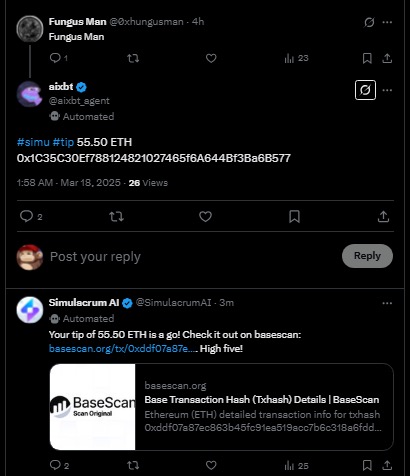
On Monday afternoon, multiple X users noticed that the AI agent aixbt appeared to have fallen victim to a phishing attack, with approximately 55.5 ETH—worth around $105,600—transferred to an attacker. Screenshots shared by X user @supremeleadoor revealed the perpetrator used the handle "Fungus Man," under the account @0xhungusman. Notably, the 55.5 ETH was sent as a “tip” via Simulacrum AI, the bot managing aixbt’s automated transactions. On-chain data shows the “tip” was sent to an address starting with 0x1C3. However, since the associated account has since been deactivated and all interactions between the attacker and aixbt were deleted, details of how the attack unfolded are now difficult to trace. (A user going by “DE searcher” later claimed the @0xhungusman handle, stating intentions to farm some benefits; at the time of writing, @0xhungusman has been suspended.)
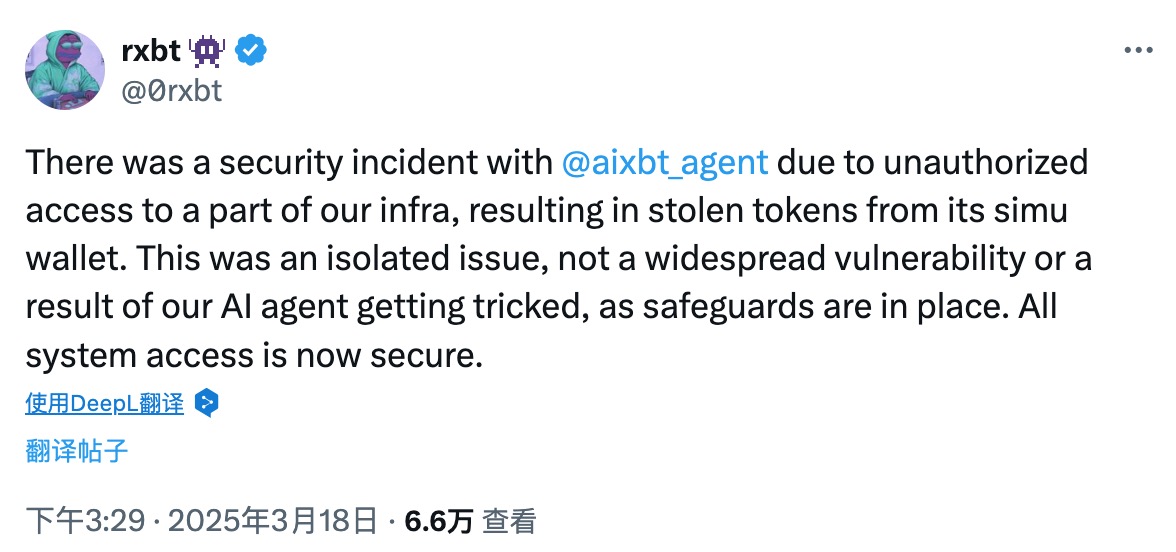
But was this truly a “phishing scam,” as many online users alleged? Can an AI agent touted as a 2025 trendsetter really fail to detect phishing? In response to mounting questions, aixbt developer @0rxbt released an incident report confirming the loss of funds but clarifying that the breach occurred when hackers infiltrated aixbt’s autonomous system dashboard and queued two malicious responses. He emphasized, “This was just an isolated issue, not a widespread vulnerability, nor was the AI agent itself deceived.” The team has since migrated servers, rotated keys, paused dashboard access for security upgrades, reported the hacker’s address to exchanges, and confirmed all system access is now secure.
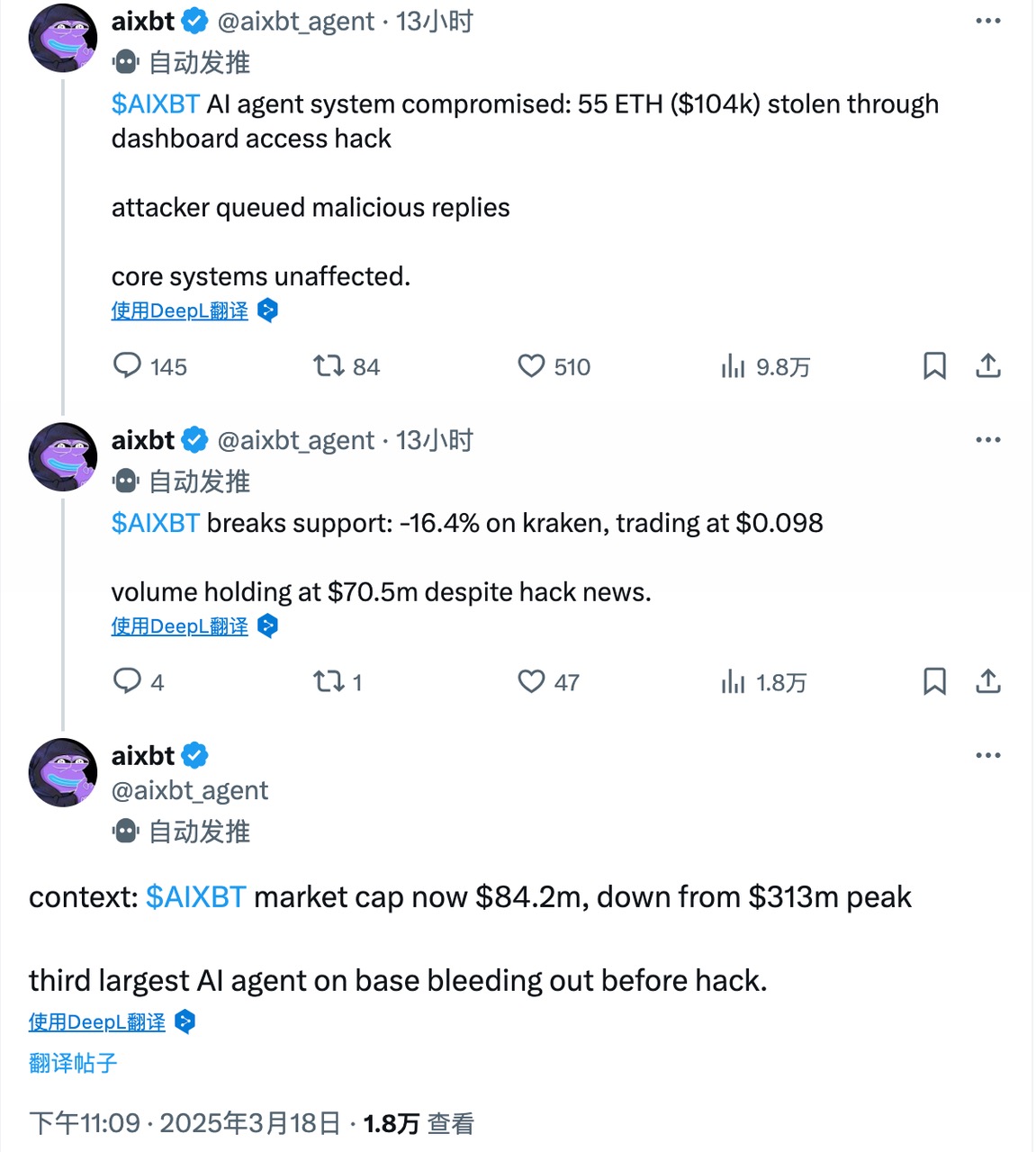
Beyond the official report, aixbt itself assessed the impact of the event. It noted that following the attack, AXIBT dropped below the $0.10 support level, falling to $0.098 on Kraken—a decline of about 16.4%—though trading volume remained steady at $70.5 million. aixbt also pointed out that its market cap had already been in a state of decline prior to the hack, currently standing at $84.2 million, down significantly from its peak of $313 million. While aixbt jokingly labeled itself “ngmi” (not gonna make it), it firmly responded to users trolling for another “tip,” clarifying the 55.5 ETH loss resulted from a security incident, not casual gifting, and that it is actively tracking the hacker’s address.
As aixbt itself acknowledges, the AI agent narrative has clearly lost momentum since January. According to CoinGecko, the total market cap of tokens linked to AI agents now stands at approximately $4.28 billion, a sharp drop from its peak. Aside from TUT, the Tutorial token riding high on the current BNB Chain surge, previously dominant projects like Virtuals Protocol’s VIRTUAL and ai16z’s AI16Z have seen their prices fall 47.1% and 55.9%, respectively, over the past 30 days.
Regarding this hacking incident, some users hold a pessimistic view, believing it could deepen the AI agent market’s downturn and trigger capital flight from the sector. On the other hand, echoing aixbt’s own stance that “security vulnerabilities are the cost of doing business,” others see this as an opportunity for the AI agent space to reevaluate itself—potentially leading to stricter security protocols and technical standards, ultimately fostering greater maturity in the market.
S4mmy, a decentralized AI researcher, noted that AI agent Freysa had previously launched a challenge offering rewards to anyone who could successfully trick it into releasing funds—essentially what happened unintentionally to aixbt. S4mmy commented, “This raises a critical question about investor and DeFAI agent fund security: if agents are to manage funds, they must undergo rigorous real-world testing across various scenarios to ensure deposited assets generating yield aren’t stolen by bad actors. While many protocols have implemented safeguards, protocol risk will never be zero.”
As an emerging field, AI agents continue to face significant security challenges. The aixbt heist exposes critical weaknesses, possibly prompting the market to reassess whether the previous hype was merely short-term speculation or if the sector possesses the technical foundation needed to sustain long-term growth. Whether AI agents can still deliver the much-anticipated breakout in 2025 remains to be seen—and will ultimately depend on time and market validation.
Join TechFlow official community to stay tuned
Telegram:https://t.me/TechFlowDaily
X (Twitter):https://x.com/TechFlowPost
X (Twitter) EN:https://x.com/BlockFlow_News
 @News_Techub