








Berachain sees $360 million in fund inflows, ranking second among public blockchains—can the "liquidity narrative" last?
TechFlow Selected TechFlow Selected
Berachain sees $360 million in fund inflows, ranking second among public blockchains—can the "liquidity narrative" last?
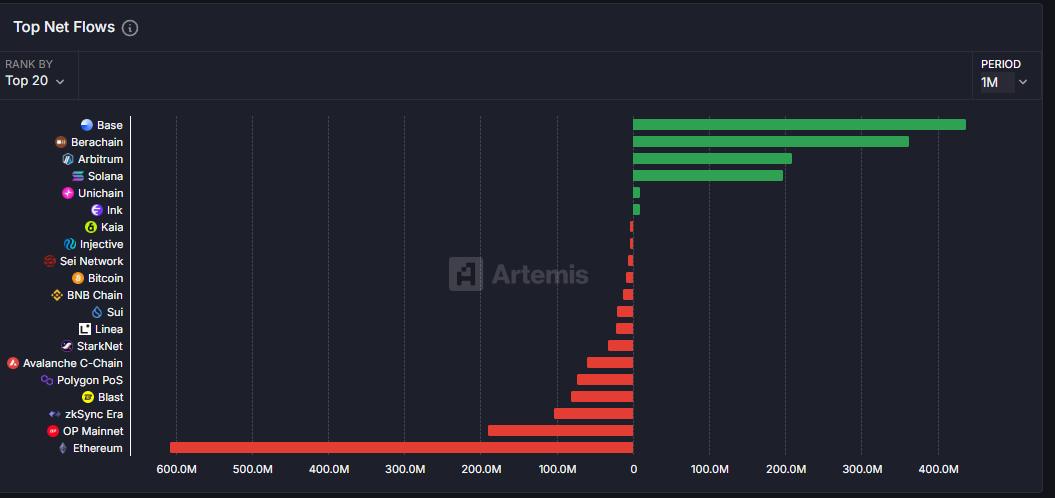
Against the backdrop of a generally sluggish crypto market recently, Berachain has ranked second among public blockchain projects with nearly $360 million in net inflows over the past month, emerging as one of the few Layer 1 projects experiencing逆势 growth.
 Navigating Web3 tides with focused insights
Author: Frank, PANews
Amid a recent downturn in the broader crypto market, Berachain has emerged as one of the few Layer 1 projects experiencing逆势 growth, ranking second among public blockchain protocols with approximately $360 million in net capital inflows over the past month. After its mainnet launch, Berachain’s total value locked (TVL) stabilized at around $2.9 billion, securing sixth place across all networks and validating the attractiveness of its Proof-of-Liquidity (PoL) mechanism to staked capital.
However, the ecosystem has also faced controversies—significant price volatility of the BERA token, unequal airdrop distributions raising fairness concerns, and co-founders publicly reflecting on flaws in the tokenomics model. Following the conclusion of the airdrop, can Berachain leverage its PoL-driven liquidity narrative to regain community trust and transition from a rising contender into a long-term survivor?
Second-Highest Monthly Capital Inflow, TVL Ranks Top Six
Capital inflow stands out as Berachain’s strongest performance metric. As of March 18, Berachain recorded about $360 million in net inflows over the past month, trailing only Base. This achievement is particularly notable given the overall bearish sentiment affecting other blockchain ecosystems.
A closer look reveals that most of this capital influx occurred between February 16 and March 3—coinciding with Berachain's mainnet launch, testnet rollout, and airdrop claim period. Thus, some level of capital attraction during this window was expected.
Beyond capital inflows, Berachain’s TVL has remained relatively stable post-mainnet, avoiding both explosive spikes and sharp declines despite market fluctuations. As of March 18, Berachain’s TVL stood at approximately $2.9 billion. Among all networks, this places it sixth—behind only Bitcoin, Ethereum, Solana, BSC, and Tron. From this perspective, Berachain’s PoL (Proof-of-Liquidity) consensus mechanism demonstrates inherent advantages in attracting staked funds.

The largest portion of these staked assets resides in Infrared Finance, the primary application for Berachain’s liquidity consensus mechanism.
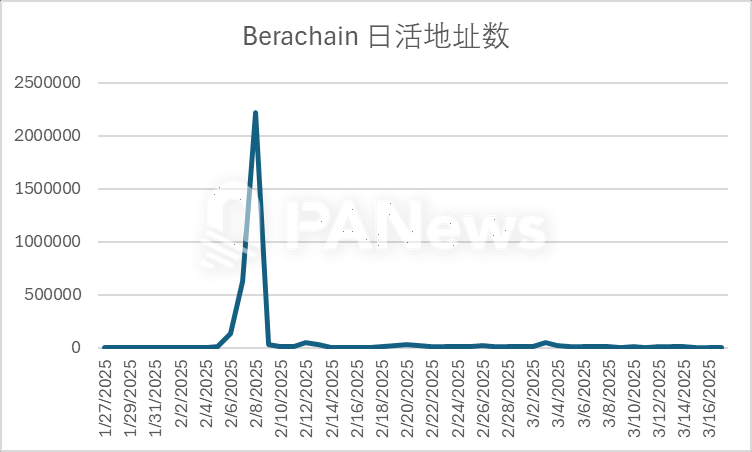
In addition to capital accumulation, network activity serves as a key indicator of a new blockchain’s real health. According to official data, Berachain experienced a dramatic surge and subsequent drop in daily active users. Between February 4 and February 10, daily active addresses exceeded 2 million before settling back down to around 10,000. Over the past month, the average number of daily active addresses has been approximately 13,400. While still far behind other major blockchains, this figure indicates relative stability. However, longer-term data will be needed to assess sustainable user engagement.
On the token performance front, BERA has become the focal point of much scrutiny and controversy.
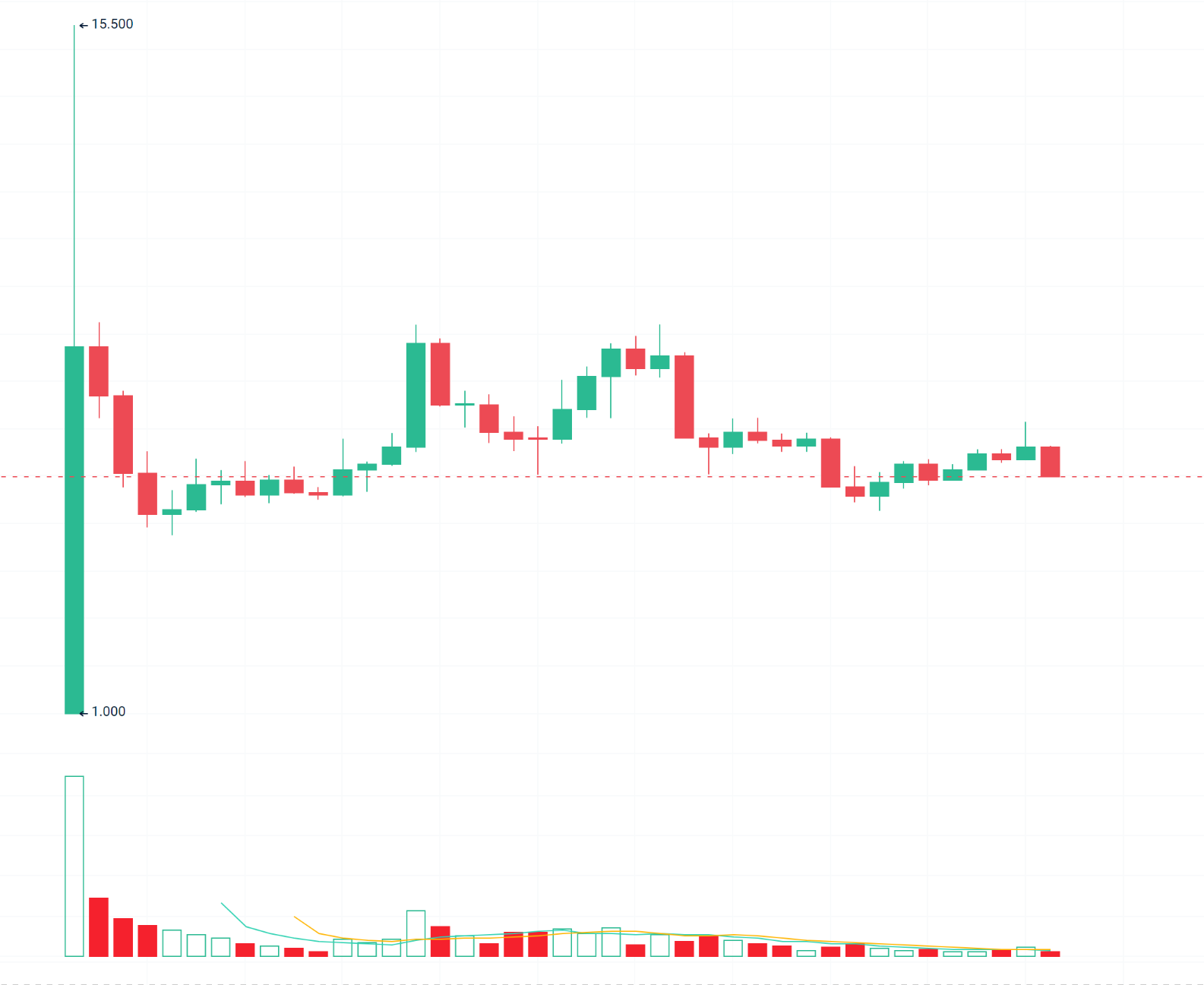
As shown in the chart, the BERA token initially spiked to $15.50 after launch before entering a downtrend—a pattern similar to many large airdrop projects. However, BERA has since exhibited extreme volatility, oscillating repeatedly between $5 and $9. It often surges nearly 90% within days, only to plunge 40% back to baseline levels. Given the limited circulating supply early in its lifecycle, such sharp swings are more easily triggered.
From Airdrop Euphoria to Trust Crisis
Criticism surrounding BERA primarily centers on the airdrop distribution and tokenomics design. PANews previously analyzed Berachain’s airdrop outcomes (see: Berachain Airdrop “Wealth Gap”: NFT Holders Earn Up to $55.77M, Testnet Users Get Just $60), revealing stark disparities: NFT holders received vastly higher allocations compared to regular testnet participants, resulting in significant inequality.
Additionally, early venture capitalists (VCs), although not yet eligible to unlock their tokens, were allowed to stake locked tokens and earn rewards—an arrangement many users perceived as unfair. Over 35% of BERA tokens were allocated to private investors, fueling concerns about centralization and fairness.
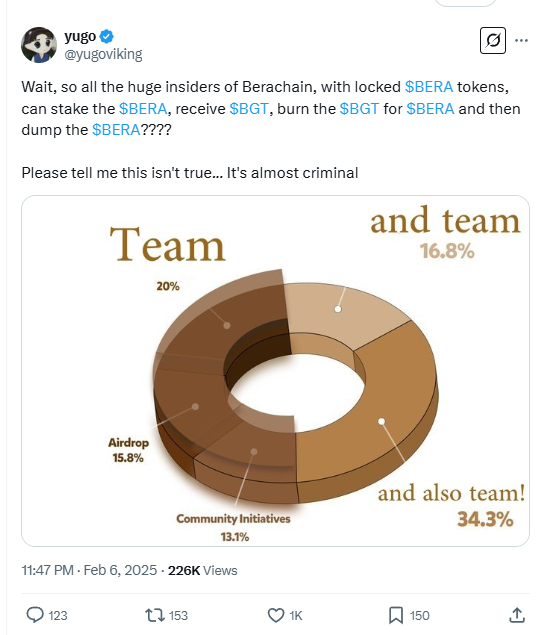
Later, Smokey the Bera, Berachain’s anonymous co-founder, admitted in an interview with Unchained: “I don’t think the criticism is entirely wrong. If we could do it again from scratch, we probably wouldn’t have sold so much of the supply to VCs.”
Moreover, blogger Ericonomic reported that one of Berachain’s co-founders sold 200,000 BERA tokens received through the airdrop. The Berachain team did not respond to this revelation.
As airdrop excitement faded and token prices swung wildly, Berachain’s social media presence gradually diminished. The next major headline came from a security incident involving one of its ecosystem projects.
On March 15, Berally, a social trading platform using AI agents within the Berachain ecosystem, announced a security breach: “Partial deployment key information was leaked, leading to the sale of all vested tokens and withdrawal from liquidity pools.” Fortunately, Berally responded quickly, announcing a compensation plan offering up to 120% replacement tokens the following day, claiming they had already identified and contained the hacker via centralized exchanges.
Airdrop Claims Ending, Liquidity Experiment Begins
Berachain’s airdrop claim window will close on March 20. Once the airdrop concludes, the critical question becomes whether Berachain can continue attracting users through its PoL mechanism or must rely on breakthroughs from other ecosystem projects to drive new growth.
Recently, several key partners within the Berachain ecosystem have made progress. Infrared, the app holding the largest share of deposited funds on Berachain, secured another $14 million in Series A funding on March 4, bringing its total raised to $18.75 million. From a product standpoint, Infrared offers staking products with APRs reaching as high as 95.45%, which is undoubtedly eye-catching.
However, since this high-yield pool involves WBERA-HONEY, and considering BERA’s wild price swings, the real value of this return lies in whether it can offset BERA’s volatility.
Other ecosystem partners like Orderly, XrossRoad, and Moby have also seen minor updates. Yet none represent significant milestones. Meanwhile, Berachain’s core team appears focused primarily on governance development and finalizing the PoL mechanism. As of March 18, Berachain had 60 validators, and the PoL mechanism had not yet gone live.
Judging by repeated official statements, the team expresses strong confidence in PoL’s future performance. But after NFT holders received massive airdrops and VCs gained yield advantages despite lockups, community trust in Berachain may already be running low. At this point, the only way forward may be proving itself through the successful implementation of PoL.
Looking ahead, Berachain’s ability to transform PoL into a genuine moat for its ecosystem—and strike a balance between decentralized governance and fair value distribution—will determine whether it evolves from a “dark horse” into a true “blue chip.” After the airdrop ends on March 20, the real test of this liquidity experiment may just be beginning.
Join TechFlow official community to stay tuned
Telegram:https://t.me/TechFlowDaily
X (Twitter):https://x.com/TechFlowPost
X (Twitter) EN:https://x.com/BlockFlow_News
 PANews


