








Those Who Left Telegram Mini Games
TechFlow Selected TechFlow Selected
Those Who Left Telegram Mini Games
The rise and fall of Telegram mini-games is not an isolated phenomenon—it's merely an extreme "microcosm" of the entire Web3 industry.
 Navigating Web3 tides with focused insights
Author: Jaleel
Last week, the power struggle within the Yescoin team brought attention back to the "TON ecosystem." It had been so long since we'd heard from the TON chain that we began reminiscing about this Telegram-backed public blockchain, which lingered on the brink of takeoff for three years before enjoying only a few months of explosive popularity.
At its peak, exchanges rushed to list tokens from Telegram mini-games. In just over four months, Binance—the world's largest cryptocurrency exchange—listed five different TON ecosystem tokens. Hundreds of mini-games emerged overnight, with more than 2,000 reportedly in preparation. Notcoin achieved monthly revenue exceeding $300,000, while Catizen generated over $16 million. The Total Value Locked (TVL) on the TON chain surged by 70 times. TON’s price climbed from $2 to a high of $8. Market expectations for the TON ecosystem reached an all-time high, and many inside and outside the industry believed Web3 had finally found its new traffic goldmine.
Yet this seemingly vibrant ecosystem was nothing but a short-lived speculative game. In the summer of 2024, everything came to a sudden halt—exchanges stopped listing TON ecosystem tokens, Telegram’s founder was arrested, projects fell silent, and player groups turned into ghost towns. Overnight, this once-celebrated “traffic goldmine” became an empty mine, leaving behind only data black boxes, a drained market, and abandoned developers.
What exactly happened during this period? BlockBeats interviewed three former Telegram mini-game project founders to uncover the true reasons behind the TON ecosystem’s fleeting rise and fall.
False Prosperity; Opaque Traffic
The extremely low user acquisition cost of Telegram mini-games has always been a popular talking point—and one of the main reasons most project teams chose to build on it. Looking back now, it was also the root cause of the entire ecosystem’s bubble.
"In Web3, user acquisition costs for companies like exchanges or major blockchain games typically range between $10 and $15. But through Telegram mini-games, this cost can drop well below $1, hovering around $0.70," said KinKin, a former mini-game project founder who left the space six months ago and is now researching AI Agent applications. She added: "In certain regions like India, it gets even more extreme—acquisition costs can go as low as $0.002 to $0.05."
This ultra-low acquisition cost created a paradise for project factories, where real users became almost irrelevant.
"Before listing on exchanges, I didn’t really need real users—studio-generated volume was enough. We could reach 200,000 to 300,000 users quickly, which is considered a baseline metric for a successful Telegram mini-game—a decent scale for lightweight or mid-sized projects," said Xiaoguang, who previously managed token launches for multiple Telegram mini-games. He openly discussed the industry’s operational model with BlockBeats.
This approach had become standardized and systematized across the industry. Long-term collaborating studios were highly skilled, outlasting most Web3 projects. "Project teams and studios would agree upfront on how much volume was needed early on and how much to supplement before TGE (Token Generation Event)," Xiaoguang explained. If bot-generated traffic wasn’t sufficient, "volume swapping" was used to inflate metrics further.
"Once we hit 200,000–300,000 users, we’d do volume swaps—two games referring users to each other—to push us into the next tier," Xiaoguang added. Compared to traditional blockchain games, Telegram mini-game metrics far exceeded those of most Web3 projects. But every coin has two sides: low cost often means low quality, and inflated data masked deeper systemic issues.
"Data in the TON ecosystem has always been opaque. Unlike most VC-backed projects whose metrics—addresses, transaction volumes—are publicly verifiable on platforms like Dune, real data for Telegram mini-games remains hidden. Only a few insiders know the actual number of users or the proportion of genuine ones," Xiaoguang noted. To him, this environment was fertile ground for project factories.
"Do you know how many real users Notcoin actually has? You don’t. All external data is what project teams want you to see," he stated bluntly.
A declining ratio of real users further amplified the illusion of prosperity. "Early games like Hamster Kombat were relatively decent, with about 60% real users. But as the ecosystem expanded, this percentage kept dropping—later on, hitting 40% was already impressive," Xiaoguang revealed.
And even within that 40%, no account was taken for professional reward farmers—the so-called "airdrop tax"—whose sole goal was claiming rewards, not playing the game. "When we analyzed depositing users, we found 90% of addresses belonged to the same group—they farm airdrops and leave immediately after."
This user structure directly led to a vicious cycle in the Telegram mini-game ecosystem: in the short term, inflated data concealed reality, allowing investors and exchanges to keep buying in; long-term, however, the entire ecosystem suffered from abysmal user quality and near-zero retention.
To exchanges and investors, Telegram mini-games appeared to boast astonishing monthly active users and massive traffic. Yet actual user retention and conversion rates were shockingly poor. "If your only goal is to generate MAU and wallet address numbers for exchanges and investors, then these cheap traffic sources are sufficient," said Sleepy, founder of the Xiao You Ling NFT project, who announced this month they were pausing mini-game development on Telegram.
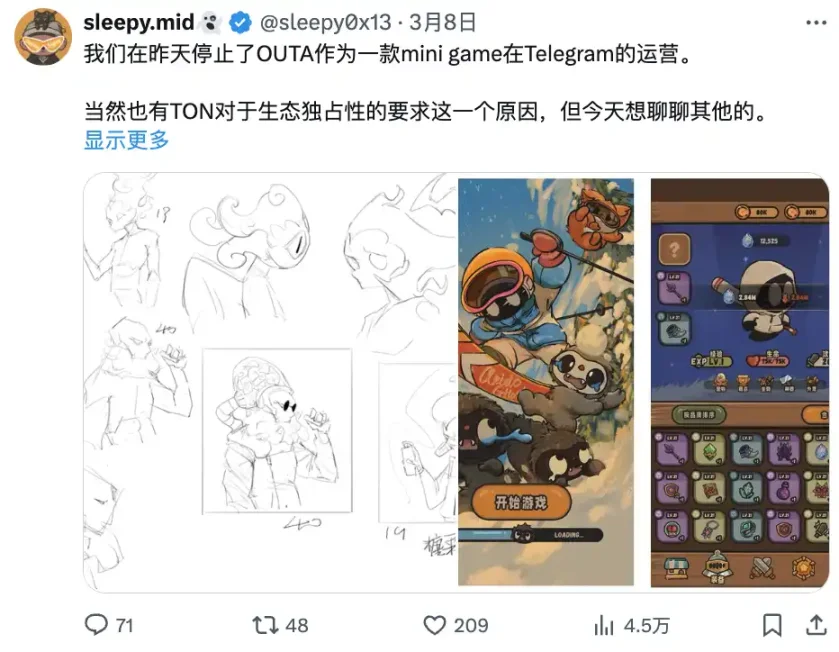
"But if you're looking for genuinely active users—people who actually play your game and use your app—you absolutely cannot acquire them at such low costs," Sleepy emphasized. "Now it seems, once again: you get what you pay for."
"Our promotion still relies on crypto Twitter, community marketing, crypto ad channels, and mutual volume swapping between projects," Sleepy said. "But swapping among ourselves never broke us out of this echo chamber."
In other words, traffic simply flowed from one project to another, but the overall pool remained stagnant, with no new inflow of fresh users.
The TON ecosystem never truly bridged the gap between Telegram’s 900 million users and Web3. It seemed neither the TON Foundation nor Telegram built an effective distribution channel to bring crypto apps to broader audiences. "Maybe they’re trying, but I haven’t seen any results yet," Sleepy said.
TON and Telegram have never been the same thing.
TON Foundation: Power Vacuum and Directional Chaos
Over the past six months, when speaking with industry insiders about the TON Foundation, many mentioned internal factional struggles: the Russian team, the Taiwan team, and later the Dubai team after TON obtained a financial license there. Instead of synergy, these factions caused severe imbalance in resource allocation—support in the TON ecosystem often depended solely on proximity to the Russian team.
The TON Foundation was originally co-founded by two key figures: Steve Yun, who remains active in various online and offline events as the foundation’s chairman, and Andrew Rogozov, former CEO of VK (the precursor to Telegram, often described as Russia’s Facebook), regarded by some as part of the inner circle.
But at some point, the power dynamics subtly shifted—Andrew Rogozov appeared to step back from core management and founded TOP (The Open Platform). Today, TOP functions more like a real foundation—or even a Consensys within the TON ecosystem—and has taken the lead in building TON’s core infrastructure.
"Frankly, we receive very little information from Telegram. Pavel Durov and his team don’t discuss anything with us. They only communicate with the wallet team because the wallet is the only real integration point. And that team isn’t ours—it’s a completely separate company called TOP," Jack Booth, marketing director of the TON Foundation, said in a July 2024 interview, indirectly confirming TOP’s growing influence.
TOP’s influence soon surpassed that of the TON Foundation. It invested in and supported the most critical projects on TON, controlled key infrastructure—operating Telegram’s official wallet TON Space, backing the most widely used wallet Tonkeeper, the largest DEX Stonfi, and even the sole staking protocol Tonstakers. From a network perspective, TOP had become the de facto core builder of the TON ecosystem, while the TON Foundation increasingly resembled an external PR arm, its authority gradually hollowed out.
Then, on January 14, 2025, the TON Foundation announced the appointment of Manuel Stotz, board member and founder of Kingsway Capital, as its new president. Former president Steve Yun remained on the board.
Given this "power erosion," it’s understandable why rumors circulated that the Taiwan-led TON Foundation had little say in major decisions.
The marginalization of Chinese-speaking teams in resource allocation became increasingly evident. "The Taiwan team holds little influence; core technical decisions remain firmly in the hands of the Russian team," Xiaoguang pointed out. "If you maintain good relations with the Russian team, you gain maximum support. For example, Catizen enjoys excellent ties with them, securing investments and abundant resources."
Xiaoguang’s claim is corroborated by TOP’s investment portfolio, which includes Pluto Studio, the developer behind Catizen.
Similarly, Sasha Plotvinov, founder of the breakout mini-game Notcoin, openly admitted his close ties with the TON Foundation. This connection gave Notcoin a first-mover advantage and established it as a benchmark in the Telegram mini-game space. Notably, Sasha is also CEO of Open Builders, whose product lineup closely overlaps with TOP’s—placing him firmly within the "inner circle." "DOGS was also made by the same Notcoin team—all part of the Russian-controlled ecosystem," Xiaoguang remarked. "Their price charts show striking similarities."
Indeed, examining the price movements of the three tokens since August last year reveals nearly identical trends. Additionally, on March 16, news that Telegram founder Pavel Durov had been allowed to leave France triggered gains across select TON ecosystem tokens: TON rose 20.7% in 24 hours to $3.53; NOT gained 18.7% to $0.002543; DOGS increased 10% to $0.0001475. (Prices accurate as of writing on March 17.)
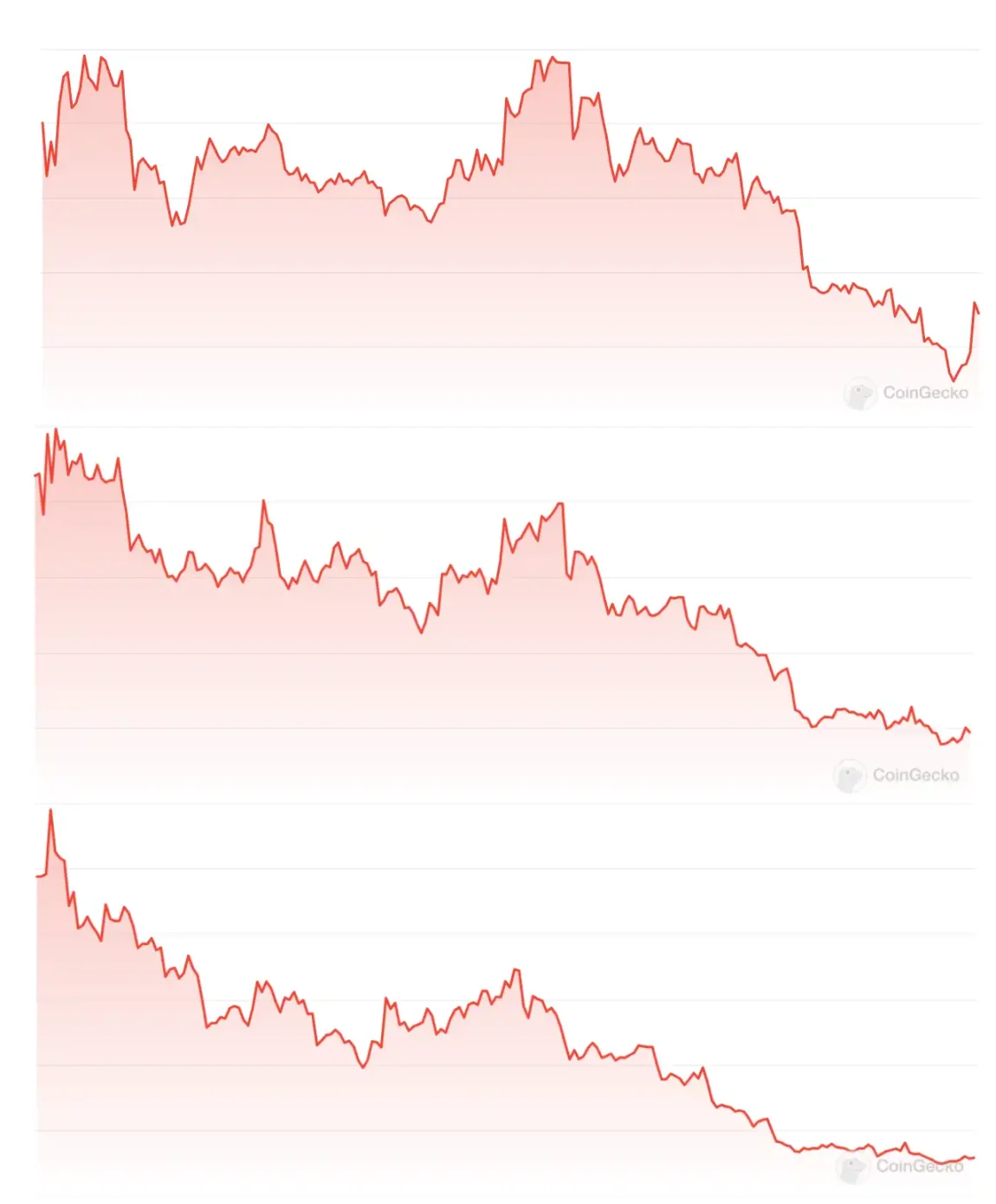
Top to bottom: TON, NOT, DOGS
Catizen and Notcoin’s success was less about market merit and more about concentrated access to core TON resources. Both launched nearly half a year earlier than most competitors and received full backing from the foundation. In essence, the boom in Telegram mini-games wasn’t a sign of an open ecosystem, but rather a game of resource allocation.
Another fatal flaw in the TON ecosystem was strategic confusion and abrupt pivots—specifically, the foundation’s rapid shift in focus from Telegram mini-games to DeFi, forcing many game developers to abandon their projects.
"When we engaged with the foundation, we clearly noticed that after a certain point, they stopped paying attention to game projects altogether and started aggressively seeking DeFi projects," Sleepy said. "This shift came too suddenly and dealt a massive blow to serious product teams, leading to significant loss of developers and users."
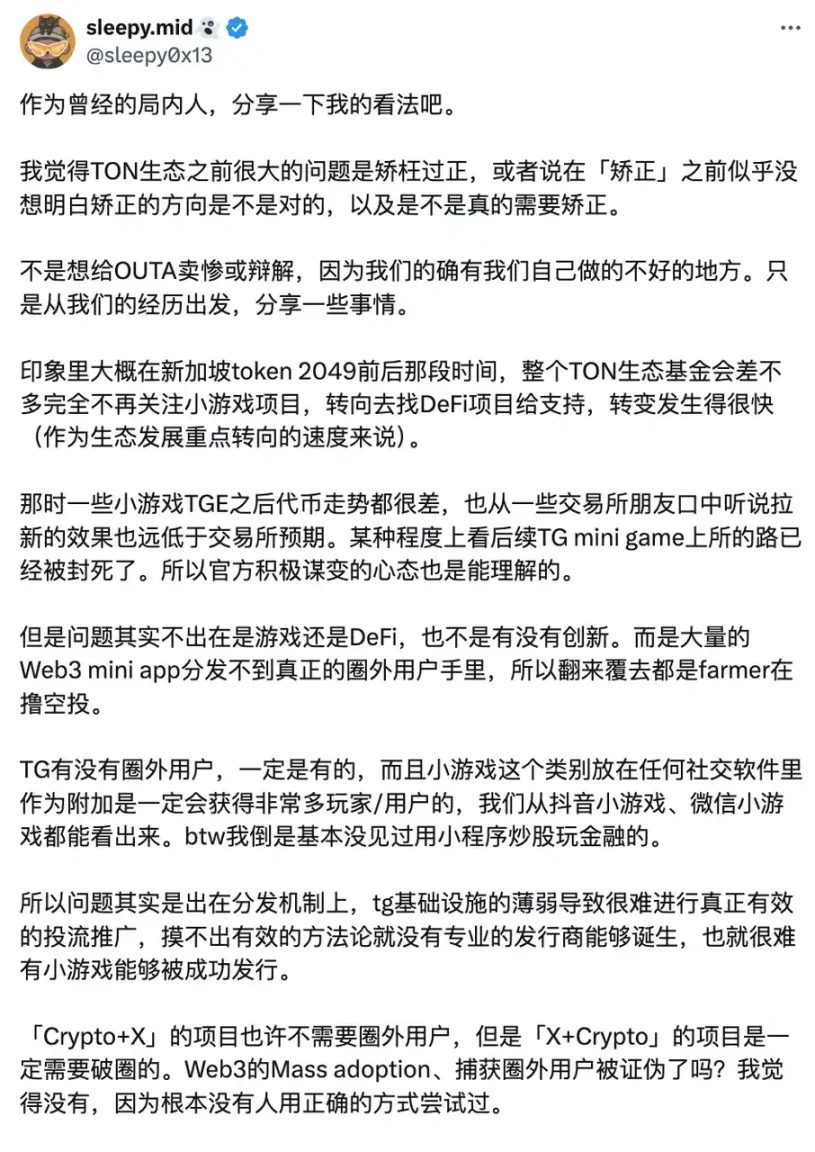
Sleepy strongly disagreed with the strategic pivot: "I think TON shouldn’t just copy what other blockchains are doing. Without leveraging Telegram, TON wouldn’t have achieved its current user base given its performance, programming language, and development difficulty. Therefore, its future should be shaped around social platform characteristics—not mimicking others."
"We initially believed TON’s ecosystem would resemble WeChat Mini Programs or Douyin Mini Games—part of a social platform’s monetization strategy." But the foundation’s decisions veered sharply off course. "They’re building stablecoins and DeFi—major missteps. It’s like WeChat launching stock trading mini-programs. Would you really trade stocks through WeChat?" Sleepy said candidly.
This strategic blunder not only caused the ecosystem to lose its narrative direction but also triggered a crisis: in August 2024, TON founder Pavel Durov was arrested in France. The incident severely impacted the TON ecosystem and plunged the foundation into chaos.
"The reason was essentially a new feature enabling fiat-to-stablecoin exchange, which involved compliance and political sensitivities—especially against the backdrop of the Russia-Ukraine war," Xiaoguang told BlockBeats. Other sources had previously shared similar views—that a stablecoin-related function attracted regulatory scrutiny.
The TON ecosystem was already unstable due to strategic inconsistency and unequal resource distribution. The founder’s arrest removed the final pillar of stability.
"Death Accelerator": Project Factories and Exchanges
Beyond opaque traffic, internal foundation conflicts, and sudden shifts in support, project factories and exchanges were key accelerants in the demise of the Telegram mini-game sector. This entire frenzy was fundamentally a brief capital game—real user growth had stalled long ago.
In this space, game development followed an industrialized model. Project factories mass-produced mini-games using assembly-line efficiency, testing them in the market until a few succeeded. "Pluto Studio, the developer behind Catizen, ran over a dozen games before identifying the cat-breeding model as the winner and doubling down on it," KinKin said.
In other words, Catizen’s success wasn’t accidental—it resulted from intensive experimentation. This model thrived on high turnover, low cost, and rapid iteration.
"Development costs were incredibly low," KinKin explained. "Many studios simply took proven games from the WeChat Mini Program market, grabbed the code, re-skinned the H5, integrated it with Telegram’s SDK (Software Development Kit), and launched directly. By the end, mini-game code prices dropped dramatically."
Low cost, short cycles, and fast deployment made these projects highly speculative. Crucially, once a game model proved successful, it was quickly copied and scaled, with market leaders gaining pricing power. "Catizen was extremely aggressive when negotiating listings—once demanding $500,000 from OKX," KinKin recalled.
Success dramatically boosted a project’s bargaining power. Catizen could negotiate assertively because, after failing with numerous games, it accumulated valuable market insights and identified users willing to spend money. "Games like Catizen, validated through a dozen iterations, eventually matured into solid products that captured genuinely paying users," KinKin said.
The success of top-tier projects brought another issue—extreme concentration of resources. "Hamster Kombat alone commanded traffic comparable to a mid-sized exchange."
However, the Telegram mini-game ecosystem never attracted new external users. The intense saturation from project factories left little room for other mini-games, let alone Web2 game developers—who held vast inventories of unused, unlaunched games with minimal trial costs. Under such competitive pressure, the Telegram mini-game sector rapidly declined.
Another driving factor was exchange competition. Seeing new traffic potential, exchanges rushed to list TON mini-game tokens, prematurely exhausting market appetite. Reviewing Binance’s listing timeline reveals shrinking intervals:
-
May 16: Notcoin listed;
-
84 days later: TON listed;
-
13 days later: DOGS listed;
-
23 days later: Catizen listed;
-
13 days later: Hamster Kombat listed
"When DOGS launched, every exchange scrambled for its data—even offering incentives like 'withdraw via our platform and get rewarded with DOGS.' Why did they know DOGS had traction? Because NotCoin had already proven it. NotCoin and DOGS were made by the same team—just reskinned and replaying the same playbook," KinKin told BlockBeats.
A deeper issue lay beneath: user growth in this cycle lagged far behind the previous one. Until Trump’s token launch, anxiety over Web3 user growth was palpable—and this stress spilled over to exchanges. Despite questionable user quality, early TON traffic still delivered some data boosts to exchanges. But this growth was inherently unsustainable.
In the end, the more projects factories produced and the faster exchanges listed them, the quicker the sector cooled down.
After several rounds, exchange user growth plateaued, removing their incentive to continue listings. For latecomers, first-mover advantages were already maximized, leaving minimal survival space for new entrants. All of this made the collapse of the Telegram mini-game ecosystem inevitable.
TG + Web3: A False Promise?
"Have you ever envied those projects that got listed on Binance?" When asked by BlockBeats, Sleepy responded quickly—clearly having thought about this before.
"It depends on how you define success. Many see exchange listings as industry validation, but I don’t. For me, launching a token isn’t the end goal. Treating it as such is damaging—to yourself, your community, and your investors. Everyone sees how poorly these tokens perform post-listing, and how underwhelming their user acquisition is compared to exchange expectations," Sleepy said.
The "fast money" logic of the TON ecosystem made everything simplistic and brutal—new schemes rotated every three weeks, dominated by quick-profit operators. Teams genuinely wanting to build games became outliers, inevitably被淘汰.
Sleepy and his team ultimately chose the latter path. He downsized 80% of his team, with core members forgoing salaries, diverting part of their resources to Web2 design outsourcing to sustain operations.
"We’ve also secured grant discussions with several blockchains—already receiving our first Launch Grant, and will continue development to fulfill remaining KPIs. We’ve applied to hackathons like Monad Madness to try and achieve something. Our income over recent months already exceeds what we earned building games on TON," he joked self-deprecatingly.
After the TON ecosystem collapsed, former participants found new paths.
KinKin has moved into the AI Agent space and is optimistic about BASE chain’s future. Xiaoguang, known for crafting successful projects, is now exploring memes—he recognized early on that "Telegram mini-games were structurally never sustainable, just a few-month window." A former TON Foundation member who once worked to grow the ecosystem now researches Kaia, a South Korea-Japan merged WeChat-style chain.
An ecosystem obsessed with traffic ends up with only traffic. The TON ecosystem failed to become "the future of crypto social"; instead, it was just another cyclical Web3 narrative—an even shorter, faster, and more extreme version of the market game compared to public chains or ZK sectors.
Looking back at this frenzy, for developers, the TON ecosystem posed as the hope of "social + Web3," luring them in, only to turn them into producers of opaque data; for players, airdrops created illusions of instant wealth, ending with $0.99 game packs becoming the new era’s "cyber incense money."
Viewed across the broader industry, the rise and fall of Telegram mini-games isn’t an isolated event—it’s an extreme microcosm of the entire Web3 space. Whether public chains, ZK Rollups, or Layer 2s, many sectors share the same essence, merely better disguised, more expensive, and longer-lasting. Most Web3 projects are essentially large-scale versions of Telegram mini-games—some just last longer than others.
"Is Telegram + Web3 a false promise?"
Each interviewee offered their own answer, but I’ve decided not to write them here. Because dear reader, this time, I’d like to hear your thoughts.
Join TechFlow official community to stay tuned
Telegram:https://t.me/TechFlowDaily
X (Twitter):https://x.com/TechFlowPost
X (Twitter) EN:https://x.com/BlockFlow_News
 BlockBeats




