








Binance is no longer the "nice guy" for project teams
TechFlow Selected TechFlow Selected
Binance is no longer the "nice guy" for project teams
With greater ability comes greater responsibility to the community.
 Navigating Web3 tides with focused insights
Author: Golem, Odaily Planet Daily
Recently, Binance, the leading cryptocurrency exchange, has once again become the focus of market discussions—earning widespread praise from the crypto community through a series of decisive actions.
The first incident involved RedStone (RED), which launched on Binance’s pre-market trading and initially announced an airdrop of 10% of its total token supply to the community. However, it later betrayed users by granting airdrop eligibility to only over 4,000 people. After detecting negative market sentiment, Binance swiftly sided with the community and paused the RED token listing. Ultimately, the project team had no choice but to back down, reallocating 2% of the total supply from the "ecosystem and data providers" pool to community members who were originally excluded from the initial airdrop.
This was not an isolated case. On March 4, GoPlusSecurity (GPS) launched on Binance and immediately entered a downtrend; no matter where retail investors bought in, they became bagholders as the price halved instantly.
Just when the community thought they were once again being used as exit liquidity and could only vent their frustration through harmless complaints, Binance stepped in. On March 7, after confirming that the GPS market maker was continuously selling tokens without placing any buy orders, Binance temporarily froze the market maker's account.
On March 9, Binance issued another official announcement stating that during its investigation into one of GoPlus Security (GPS)'s market makers (hereinafter referred to as "the market maker"), it discovered that the same entity also managed market making for MyShell (SHELL). To better protect Binance users, Binance took the following additional measures against the market maker’s misconduct: delisting the market maker and banning them from conducting any further market-making activities on Binance; confiscating the market maker’s related profits, which will be used to compensate users of both the GPS and SHELL projects (the specific compensation plans will be determined and announced by the respective project teams).
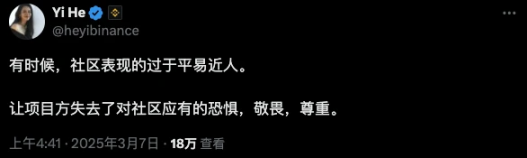
These actions have earned Binance widespread acclaim from the community. Many users exclaimed that Binance—the so-called “terminator of crypto liquidity”—has finally taken a stand alongside the community. Binance co-founder He Yi even joined in on the popular meme trend on X, emphasizing that what projects should truly fear, respect, and revere is the community itself.
Sometimes, Binance appears too approachable, causing projects to lose the fear, reverence, and respect they should rightfully have toward Binance.
Binance’s support for the community is not just “occasional goodwill”
As the saying goes, “a tall tree catches the wind.” Starting in 2024, as the crypto industry collectively criticized VCs and altcoins for increasingly predatory behavior, Binance—as a central liquidity hub—was also accused of colluding with projects and VCs to run schemes that exploited the community. Rumors such as “girlfriend coins,” external or internal favoritism allowing low-quality projects to get listed, and other negative narratives periodically surfaced, forcing Binance to repeatedly defend its integrity.
When a company grows large enough, corporate bloat and corruption are inevitable. Even Web2 giants like ByteDance saw 353 employees dismissed for violations throughout 2024. In the Web3 space, which is closer to users and more directly tied to money, malicious actors are even more prevalent. The market maker involved in the GPS incident was rumored to be part of a so-called “fast-track brokerage pipeline” that allegedly cleared Binance listings within a year while systematically exploiting retail traders. There may well be many more such bad actors lurking beneath the surface. However, Binance’s handling of the GPS incident clearly demonstrates its alignment with the community and retail users, effectively refuting previous conspiracy theories accusing Binance of helping projects “harvest the community.”
Yet Binance’s pro-community actions are not merely occasional gestures made during times of reputational crisis. Binance has consistently valued community feedback and long treated it as a key driver of its development.
Binance co-founder He Yi has long referred to herself as “Binance’s No.1 customer service agent,” frequently engaging on social media platforms like X to resolve user issues, gather feedback for Binance’s Web3 wallet product, and respond to criticisms about Binance. Despite being a founder who could remain entirely behind the scenes, she chooses to lead by example, signaling Binance’s desire to hear more voices and encourage broader participation in shaping the platform.
On March 7, Binance announced an upgrade to its listing mechanism, introducing two new community governance features: “Vote for Listing” and “Vote for Delisting,” aimed at giving users greater decision-making power. Under “Vote for Listing,” users holding at least 0.01 BNB can vote to support projects they wish to see listed; projects receiving high votes and passing due diligence will be listed on Binance. “Vote for Delisting” allows users with at least 0.01 BNB to express their preference for removing projects already placed in the “Monitoring Zone.” These mechanisms return more power to the community.
In the past, user complaints about VC-backed tokens stemmed largely from the lack of upside potential after high-valuation tokens hit secondary markets, leaving retail investors to absorb VC sell-offs. The second half of 2024 marked the peak of backlash against VC coins and Binance, coinciding with the height of the Solana meme coin craze. Binance successfully met speculative demand by listing meme coins with strong community support and low market caps, achieving a win-win outcome for both itself and the community. (Recommended reading: Can listing meme coins really create a win-win for Binance and the community?)
Today, as the meme coin frenzy subsides, attention has partially shifted back to so-called “value coins,” and user demands have reverted to seeking sufficient early-stage (left-side) trading opportunities. At this moment, Binance’s focus has evolved: protecting the community from malicious exploitation while using innovative mechanisms to provide users with ample left-side access to new tokens.
Everything Binance does may not always be perfect, but it is invariably responsive to what the market and community need.
With great power comes great responsibility
Historically, due to disparities in roles and influence within the industry, end-users—the community and retail investors—have remained at the bottom of the crypto ecosystem. Isolated by information asymmetry, they’ve not only lost their voice but have often been exploited by upstream players such as VCs, projects, exchanges, and market makers. Examples abound: VCs dumping massive amounts of low-cost tokens upon unlock, project teams secretly selling off insider airdrops, or exchanges charging listing fees in exchange for community exit liquidity.
Trust between different layers of the crypto industry is rapidly eroding. Gradually, avoiding VC coins and altcoins altogether, immediately selling airdrops upon receipt, and shorting newly listed tokens at launch have become the无奈 consensus among the community and retail investors—helpless responses to an inability to sanction industry-wide malpractice.
Nevertheless, although we operate in a sector not yet fully reached by regulators, there are still entities capable of stopping such abuses.
“With great power comes great responsibility.” Cryptocurrency exchanges continue to play a pivotal role in the entire ecosystem, serving as both rule-makers and enforcers. As such, they bear a critical responsibility to promote fair competition and safeguard user interests.
Binance is now fulfilling this responsibility. Whether standing with the community against unfair airdrop practices or freezing malicious market makers’ accounts, Binance is proving through action that it will no longer be a passive “yes-man” to projects, but instead become a guardian of the industry ecosystem. The future needs more “Binances” like this—ones that make fairness, transparency, and sustainability the foundation of the crypto industry.
Join TechFlow official community to stay tuned
Telegram:https://t.me/TechFlowDaily
X (Twitter):https://x.com/TechFlowPost
X (Twitter) EN:https://x.com/BlockFlow_News
 Odaily






