Weeding Out the Weak: A Look at Recent Performance of Seven Major DEXs
TechFlow Selected TechFlow Selected
Weeding Out the Weak: A Look at Recent Performance of Seven Major DEXs
The Pump Era is Over: Who is the Real DEX Winner?
 Navigating Web3 tides with focused insights
Author: Scof, ChainCatcher
Editor: TB, ChainCatcher
In the past week, the current state of decentralized exchanges (DEXs) has sparked widespread discussion.
Hyperliquid shook the market due to a "self-destructive arbitrage" incident involving a whale using 50x leverage. Its HLP vault suffered nearly $4 million in losses after taking on liquidation orders.
On the other side, GMGN—once thriving during the Pump era—is now facing significant challenges. According to Dune data, the platform's revenue plummeted from $2.34 million on January 19 to just $74,000 on March 11, a staggering drop of nearly 97%. Meanwhile, community feedback highlights high marketing costs for KOLs, user attrition, and intensified competition from CEXs entering the space, all contributing to growing concerns about GMGN’s future.
Against this backdrop, ChainCatcher reviews the recent earnings performance of seven major DEXs for readers’ reference.
Quick Takeaways (Straight to the point)
-
Jupiter and PancakeSwap maintain relatively high daily revenues with stable long-term performance.
-
Hyperliquid leads in the last 24 hours but remains well below its historical peak.
-
Raydium and Shadow Exchange have seen sharp declines in revenue, signaling a clear drop in market activity.
-
Aerodrome and THENA, though significantly down, still retain some profitability.
Below is a comparison of several mainstream DEXs' recent 24-hour revenues versus their historical highest single-day earnings:
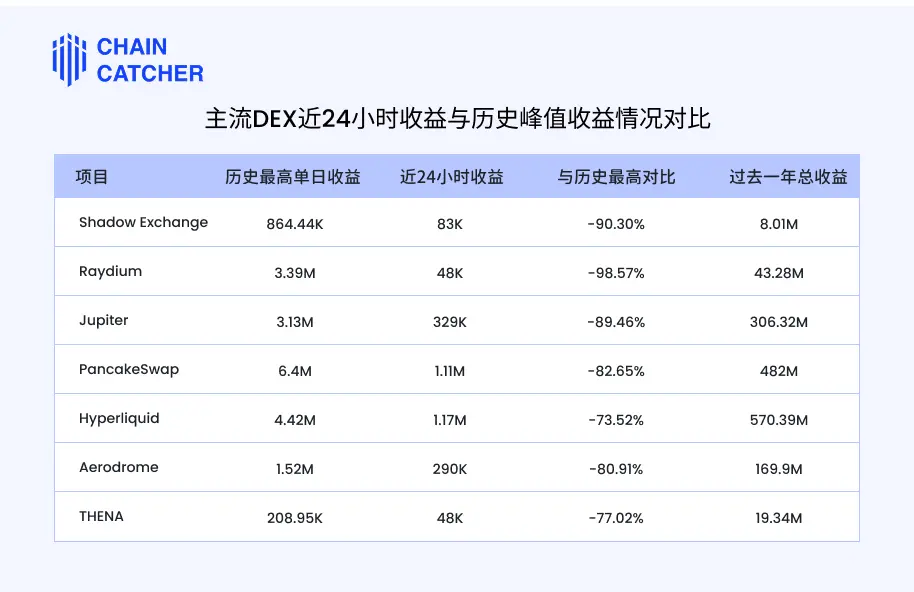
Note: All data sourced from Defillama, as of March 12
Detailed Breakdown: Current Status and Trends of Major DEXs
1. Shadow Exchange
✅ Background & Positioning: A native concentrated liquidity layer and exchange deployed on Sonic, supported by the x(3,3) incentive model, aiming to deliver efficient and low-cost trading experiences.
📉 Revenue Data: Historical high at $864.44K; last 24 hours: $83K—a 90.30% decline.
📊 Market Performance: Ranked within the top ten cryptocurrency protocols by revenue over the past 30 days, with steady user activity. The x(3,3) mechanism enhances capital efficiency, while MEV protection improves trade execution. Liquidity providers and traders enjoy attractive yields. The Gems reward system encourages deep participation in the Sonic ecosystem, driving protocol expansion and demonstrating sustained growth potential.
2. Raydium
✅ Background & Positioning: A leading AMM DEX in the Solana ecosystem, historically attracting users with low fees and fast transactions.
📉 Revenue Data: Historical high at $3.39M; last 24 hours: only $48K—a 98.57% drop—indicating a severe decline in market activity. Its native token
📊 Market Performance: In Q4 2024, it accounted for 61% of Solana DEX trading volume, yet its TVL was only 39% of Uniswap’s, suggesting strong trading activity but relatively insufficient liquidity. Given that much of Raydium’s volume stems from Pump.fun, it must now seek expansion beyond meme-centric areas into new non-meme domains.
3. Jupiter
✅ Background & Positioning: The leading DEX aggregator in the Solana ecosystem, offering optimal routing and serving as a core pillar of Solana DeFi trading volume.
📉 Revenue Data: Historical high at $3.13M; last 24 hours: $329K—a 89.46% decline—but still maintains higher activity compared to other DEXs.
📊 Market Performance: As the largest DEX by trading volume in the Solana ecosystem, Jupiter benefits from deep liquidity and broad cross-platform integration, resulting in low transaction costs. However, it recently faced allegations of insider trading related to the Libra incident; no official findings have been released yet.
4. PancakeSwap
✅ Background & Positioning: The dominant DEX on BSC, maintaining competitiveness through low gas fees, fast transactions, and multi-chain expansion (Ethereum, Arbitrum, Polygon, etc.).
📉 Revenue Data: Historical high at $6.4M; last 24 hours: $1.11M—a 82.65% decline—but still maintains strong profitability within the DeFi space.
📊 Market Performance: Leveraging the active BSC ecosystem, PancakeSwap enjoys a broad base of DeFi users and continues to expand its product offerings (e.g., NFTs, staking).
5. Hyperliquid
✅ Background & Positioning: A decentralized derivatives trading platform on Arbitrum, utilizing an active market-making mechanism and differentiating itself from competitors like GMX.
📉 Revenue Data: Historical high at $4.42M; last 24 hours: $1.17M—a 73.52% decline—but still holds a dominant position in the DeFi derivatives market.
📊 Market Performance: Attracts traders with high-leverage trading, maintaining leadership in both volume and profitability. However, recent whale arbitrage incidents have raised doubts about its liquidity management mechanisms, prompting some risk-averse capital withdrawals.
6. Aerodrome
✅ Background & Positioning: The core DEX on Base, employing a ve(3,3) economic model to incentivize liquidity providers and enhance trading experience.
📉 Revenue Data: Historical high at $1.52M; last 24 hours: $290K—a 80.91% decline. Liquidity has decreased, but the platform retains moderate activity.
📊 Market Performance: Dominates the Base ecosystem. With signs of revival in Base-linked memecoins ("gold dogs"), market performance remains strong, with continuous growth in trading volume and market cap, alongside high community engagement.
7. THENA
✅ Background & Positioning: One of the DEXs in the BNB ecosystem, adopting the ve(3,3) economic model to improve the sustainability of liquidity incentives.
📉 Revenue Data: Historical high at $208.95K; last 24 hours: $48K—a 77.02% decline. Despite the drop, it maintains a degree of competitiveness within the BSC ecosystem.
📊 Market Performance: A second-tier DEX in the BSC ecosystem, facing intense competition from PancakeSwap. Nevertheless, its ve(3,3) model continues to attract some liquidity. According to public disclosures, THENA plans to migrate to version V3. This upgrade will introduce "Hooks," enabling smart contracts to be deployed on specific liquidity pools to execute custom logic during user interactions. This will support advanced order types, complex applications, and customized use cases, significantly enhancing the protocol’s flexibility and functionality.
Currently, DEXs overall are experiencing declining revenues, intensifying competition, and structural divergence. Mainstream platforms have seen their incomes fall between 70% and 98% from historical highs, with clear impacts on market activity.
Jupiter and PancakeSwap remain firmly in the lead, sustaining high daily revenues and relatively stable long-term performance, supported by solid ecosystem positioning and user bases. Hyperliquid still holds a key place in the derivatives market, but the whale arbitrage incident has triggered concerns over its risk control capabilities, affecting liquidity. Raydium and Shadow Exchange have suffered steep revenue drops—Raydium due to declining Pump.fun volumes, and Shadow Exchange due to weaker overall market activity. Aerodrome and THENA continue generating profits but face increasing pressure from stronger competitors within their respective ecosystems.
Looking ahead, DEXs must address three core challenges:
-
How to sustain trading activity—As markets cool and user willingness to trade declines, how can DEXs improve user retention?
-
How to optimize liquidity management—With whale arbitrage and growing CEX competition, how can platforms build more robust liquidity systems in DeFi?
-
How to achieve sustainable revenue—In a bear market cycle, high-fee models are unsustainable. Do DEXs need new profit models?
Facing industry-wide challenges, the path forward for DEXs may no longer be about chasing trading volume alone, but rather competing on liquidity depth, risk management, and ecosystem strategy.
Join TechFlow official community to stay tuned
Telegram:https://t.me/TechFlowDaily
X (Twitter):https://x.com/TechFlowPost
X (Twitter) EN:https://x.com/BlockFlow_News
 ChainCatcher 链捕手