









House Overturns 'DeFi Broker Rule'—How Many Hurdles Remain in Crypto Regulation?
TechFlow Selected TechFlow Selected
House Overturns 'DeFi Broker Rule'—How Many Hurdles Remain in Crypto Regulation?
The battle over the "DeFi Broker Rules" is nearing its end—what's next for crypto institutions?
 Navigating Web3 tides with focused insights
By Bright, Foresight News
On March 11, local time in the United States, the U.S. House of Representatives passed a resolution by a vote of 292 to 132 to overturn the Internal Revenue Service (IRS) broker rule for DeFi entities—a regulation that would have required decentralized finance (DeFi) platforms to collect users' tax and transaction information. Earlier, on March 4, 70 senators had already voted in favor of repealing the rule; however, due to budgetary procedures, the Senate must still conduct a second vote. If the Senate passes it again and President Donald Trump signs it into law, the rule will be permanently prohibited from being reintroduced.
Repealing the "DeFi Broker Rule": The Battle Between Regulation and the Vision of Decentralization
Since 2014, when the IRS issued Notice 2014-21 formally classifying cryptocurrency as property rather than currency and establishing a corresponding tax framework, the struggle between decentralization and regulatory oversight has never ceased. The passage of the Infrastructure Investment and Jobs Act (IIJA) in 2021 further mandated reporting for all transactions involving digital assets and introduced Form 8300, expanding the scope of crypto asset reporting under Form 1099, thereby intensifying tax scrutiny over digital asset transactions. Form 1099 requires brokers not only to detail the date and type of transaction (e.g., buy, sell, exchange), but also to precisely report transaction amounts, including total proceeds, potential gains or losses, and cost basis. Crucially, brokers are required to provide comprehensive investor information such as name, address, and Social Security Number, extended to specifics like the type, quantity, and fair market value of digital assets.
TaXDAO: "U.S. Crypto Broker Rules: A Bitter Pill or a Fatal Poison?"
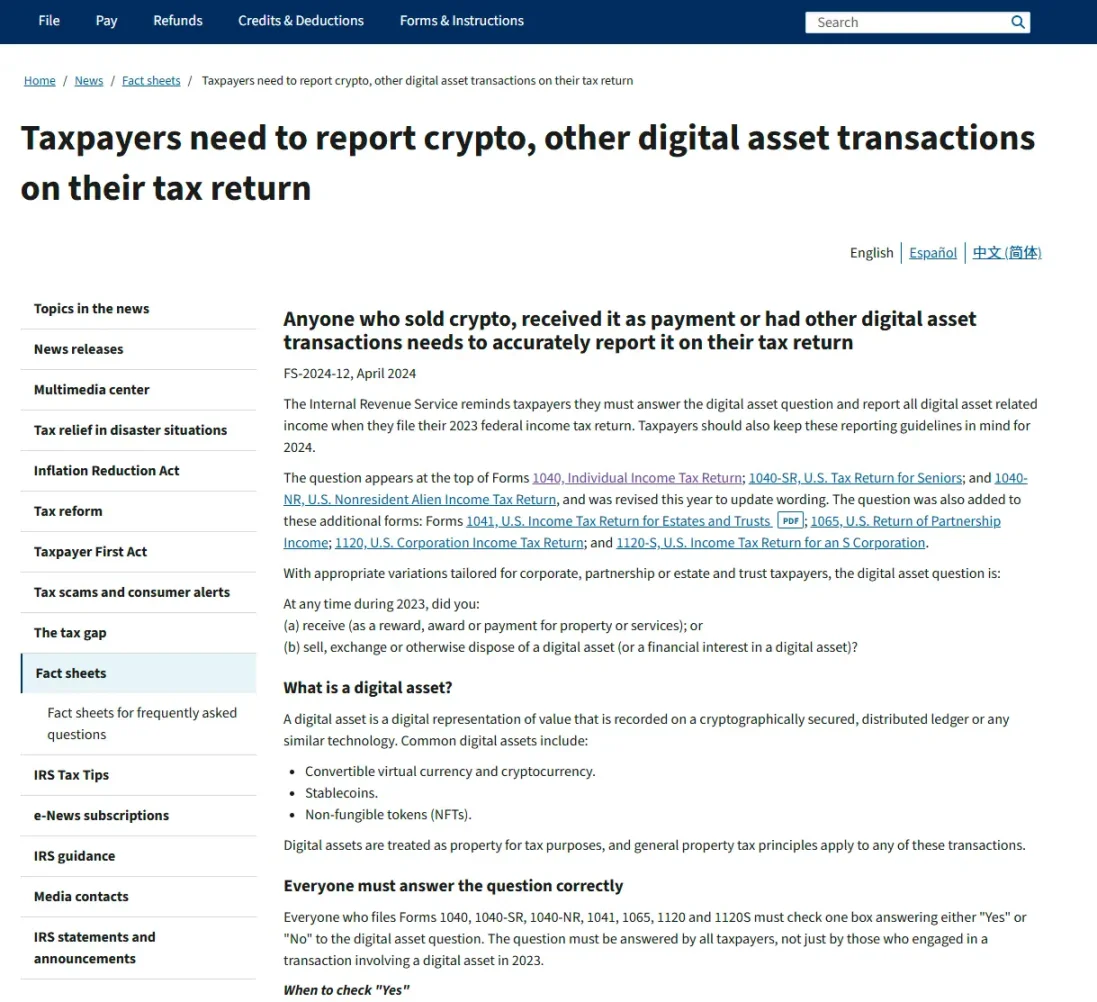
Starting January 1, 2025, the IRS officially implemented its Digital Asset Sales and Transaction Reporting Rule for brokers—commonly known as the "DeFi Broker Rule"—with core requirements including anti-money laundering (AML), user identity verification (KYC), smart contract audits, fund security, and transparency. This regulation marked an unprecedented tightening of U.S. tax oversight over digital assets.
Although, according to TaXDAO's analysis, this rule may play a constructive role in combating money laundering, terrorism financing, and tax evasion, it has drawn widespread criticism from the crypto industry. The digital asset think tank Coin Center was among the first to object, calling the proposal “technically unfeasible.” Unlike traditional financial institutions, decentralized platforms do not hold funds or store customer data. Industry analysts argue that the "DeFi Broker Rule" applies traditional finance (TradFi) regulatory logic to DeFi, overlooking its core innovations of decentralization and anonymity, imposing severe compliance burdens, and significantly increasing operational costs for crypto firms.
On February 20, 2025, the Blockchain Association joined forces with 75 participants in the cryptocurrency industry to sign an open letter urging Congress to repeal the IRS’s DeFi broker rule. Signatories included prominent names such as Coinbase, Kraken, and Uniswap Labs. The letter stated that the "DeFi Broker Rule," finalized in the final days of the Biden administration, exemplified “regulatory overreach,” fundamentally misunderstood the technology it sought to regulate, and disregarded congressional intent.
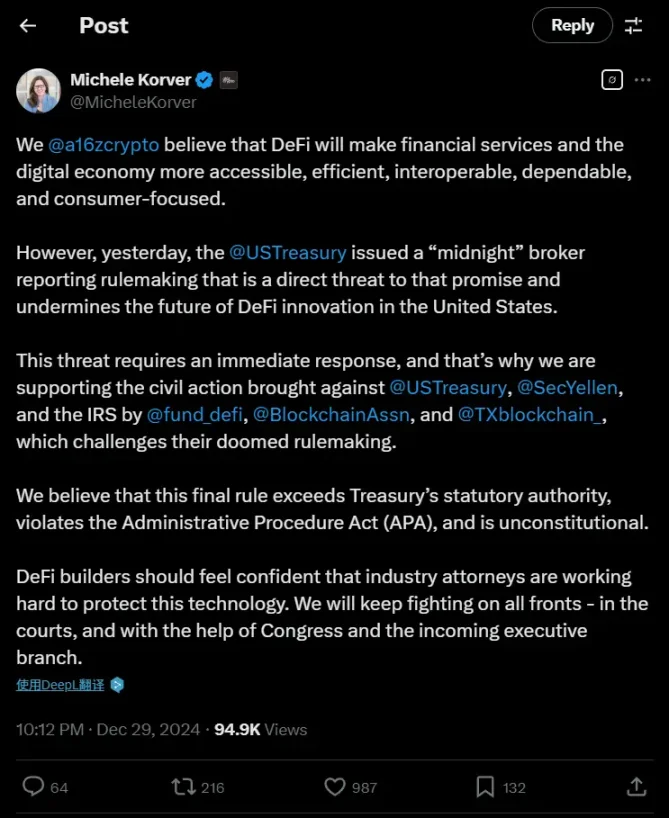
Michele Korver, Head of Regulatory Policy at a16z Crypto, also posted on X stating that the new broker reporting rules issued by the U.S. Treasury posed a direct threat to the vision of DeFi development and could hinder the future of DeFi innovation in the United States.
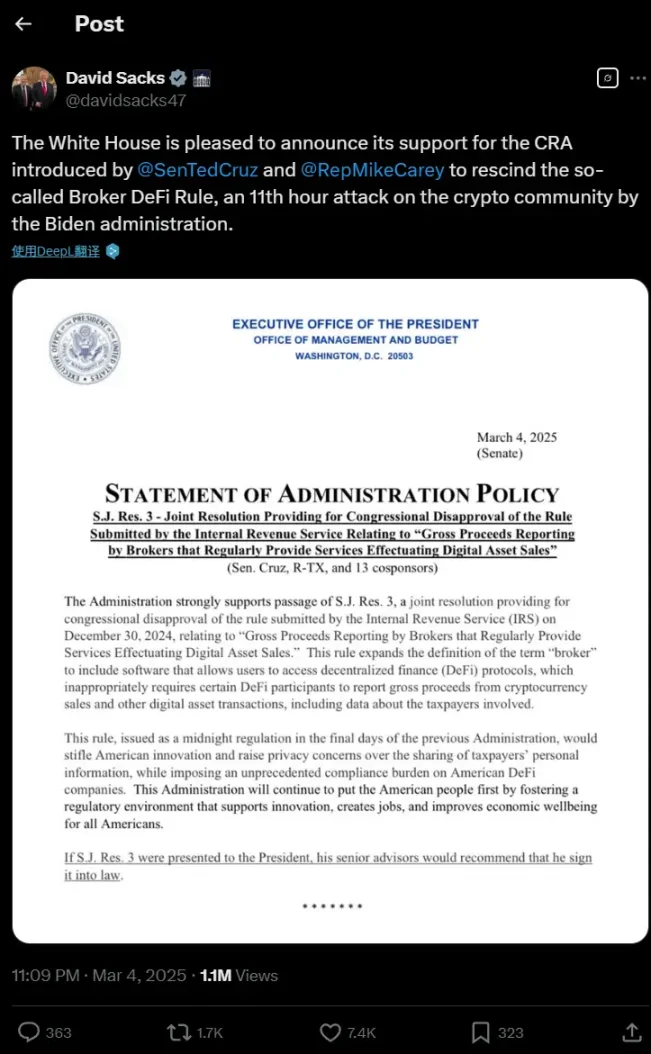
Undeniably, since Trump took office, despite negative market sentiment regarding policy follow-through, tangible breakthroughs in cryptocurrency regulation have indeed occurred. On March 4, 2025, David Sacks, dubbed the "Crypto Czar" and currently serving as White House AI and Cryptocurrency Director, posted on X: "The White House is pleased to announce support for the Congressional Review Act (CRA) resolution introduced by Senator Ted Cruz and Congressman Mike Carey to repeal the so-called 'DeFi Broker Rule'—a last-minute attack on the crypto community by the Biden administration."
Post-Rule Era: Three Potential Regulatory Variables Emerge
While the House's repeal decision lifts a burden off DeFi, the regulatory battle for the crypto industry is far from over. Based on legislative developments and policy frameworks, three key regulatory directions may dominate the next phase:
First, accelerated stablecoin legislation. The Trump administration has clearly classified stablecoins as "payment infrastructure." The Senate's GENIUS Act and the House's Stablecoin Bill are advancing in parallel, aiming to establish a federal licensing system requiring issuers to maintain 100% reserves and undergo bank-level audits. This means issuance thresholds for USD-backed stablecoins like USDC and BUSD will rise sharply, while algorithmic stablecoins may be directly categorized under securities regulation. According to the Blockchain Association, if passed, the U.S. could become the first major economy with a systematic stablecoin regulatory regime—but this might force smaller issuers out of the market.
Second, intensified jurisdictional conflict between the SEC and CFTC. Despite the repeal of the "DeFi Broker Rule," the SEC continues to strengthen its application of the Howey Test to classify tokens as securities. The recent closure of the investigation into Uniswap Labs sent a subtle signal: when a protocol achieves a high degree of decentralization (e.g., no centralized team control), the SEC tends to treat it as a "commodity"; otherwise, it may be deemed an "unregistered security." This logic—where "degree of technical decentralization determines regulatory classification"—is pushing projects toward permissionless governance models. Meanwhile, the CFTC is asserting authority over spot exchanges under the Digital Commodities Consumer Protection Act. Platforms like Coinbase have already applied for dual licenses, resulting in a 37% year-on-year increase in compliance costs.
Third, shift in on-chain tax and AML regulation toward "technical tracking." Although the IRS has lost mandatory reporting power over DeFi, it has partnered with FinCEN to expand the use of on-chain analytics tools. Data from Q1 2025 shows that the IRS tracked $1.2 billion in illicit crypto funds through platforms like Arkham and Elliptic—a 210% increase year-over-year. Notably, while Trump’s executive order bans central bank digital currencies (CBDCs), it directs the Treasury Department to study technical solutions for "Bitcoin reserve and tax transparency," leaving open the possibility of pilot programs using smart contracts to automatically withhold capital gains taxes. This trend of "regtech replacing regulatory mandates" is forcing exchanges and wallet providers to upgrade their Know Your Trade (KYT) systems.
As the fight over the "DeFi Broker Rule" nears its end, crypto firms are reallocating compliance resources toward stablecoin registration, token classification audits, and on-chain risk management systems. For example, Coinbase’s Chief Compliance Officer revealed that the company has assembled a 300-person team dedicated to applying for stablecoin licenses and is collaborating with AWS to develop a "decentralization level certification" tool.
Following the conclusion of its investigation, Uniswap Labs announced it would lower the UNI governance token proposal threshold from 10,000 to 5,000 tokens to accelerate decentralization. These moves reflect an emerging industry consensus: U.S. regulation is shifting from a "one-size-fits-all" approach to one based on "technology-specific regulatory alignment." The ability to find technological balance points between innovation and compliance will become the key competitive edge in the next phase—and perhaps, the catalyst for a new wave of growth after market deleveraging.
Join TechFlow official community to stay tuned
Telegram:https://t.me/TechFlowDaily
X (Twitter):https://x.com/TechFlowPost
X (Twitter) EN:https://x.com/BlockFlow_News
 深潮TechFlow






