The overseas AI community has started discussing Manus.
TechFlow Selected TechFlow Selected
The overseas AI community has started discussing Manus.
The discussion continues.
 Navigating Web3 tides with focused insights
Author: Lian Ran

The wind of Manus has finally reached overseas.
Last Wednesday, this general-purpose AI agent launched by Chinese startup Monica quickly became the focus of the tech world, thanks to its powerful autonomous task execution capabilities.
In China, Manus is hailed as the "world's first general-purpose AI Agent," sparking heated discussions immediately after launch. The development team demonstrated Manus’s applications in resume screening, real estate research, stock analysis, and other tasks, showcasing its potential in handling complex workflows.
However, despite its domestic popularity, Manus has also been controversial—partly because the buzz has largely remained within China, with little attention from international markets.
Starting over the weekend, that began to change. Major overseas media outlets started covering Manus, and several KOLs offered high praise.
1 How is Manus being received overseas?
Manus is a general-purpose AI agent capable of handling complex, real-world tasks across domains. The startup Monica, which developed Manus, describes this new AI agent as a “bridge connecting thought and action—a platform that doesn’t just think, but delivers results.”
According to its developers, this AI agent can autonomously reason, plan, and execute various practical tasks. From building websites to planning trips and analyzing stocks, Manus can do it all—just give it a prompt.
Following its release on Wednesday night, discussions about Manus were initially concentrated within Chinese internet circles. But starting over the weekend, overseas interest began to rise.
The product lead at Hugging Face called Manus “the most impressive AI tool I’ve ever tried.”
-
“Its agent capabilities are astonishing—they redefine what’s possible.”
-
“The user experience is what many other tools have promised before… but this time, it actually delivers.”
Jack Dorsey, co-founder of Twitter, shared the official Manus AI video on X with a brief endorsement:
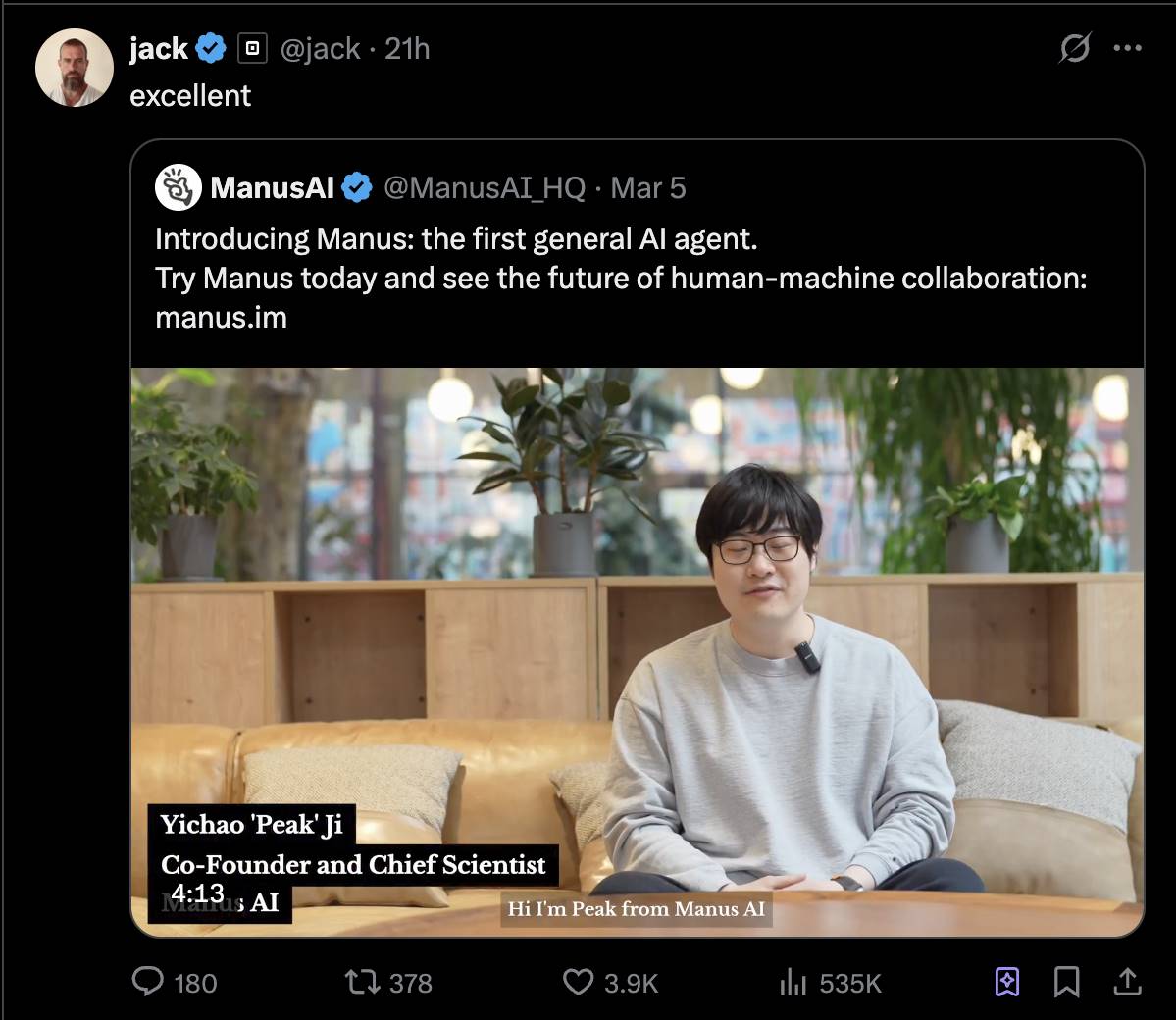
Image source: X
AI policy researcher Dean Ball described Manus as “the most sophisticated computer for using AI,” even giving it higher praise than DeepSeek: “DeepSeek is about replicating what U.S. companies have already publicly achieved. Manus is pushing forward the frontier of research.”
Mckay Wrigley, a software developer based overseas, shared a 14-minute demo of his Manus usage on X, calling it “shockingly good”:
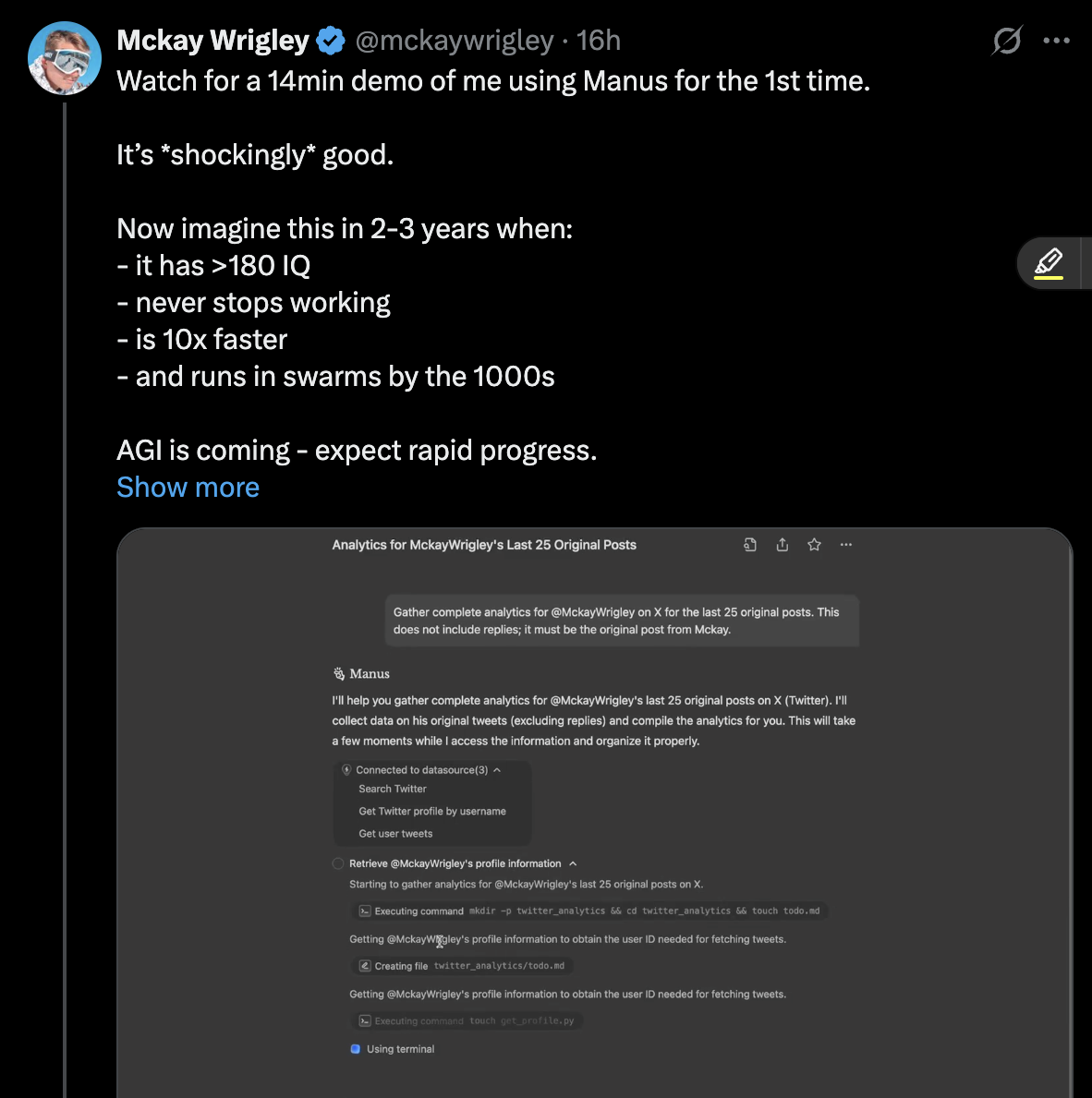
Image source: X
“Now imagine 2–3 years from now:
- IQ >180
- Never stops working
- 10x faster
AGI is coming—expect rapid progress.”
Ivan Fioravanti, Co-Founder and CTO of CoreViewHQ GenAI, posted on X after trying it: “Manus AI is really powerful”:
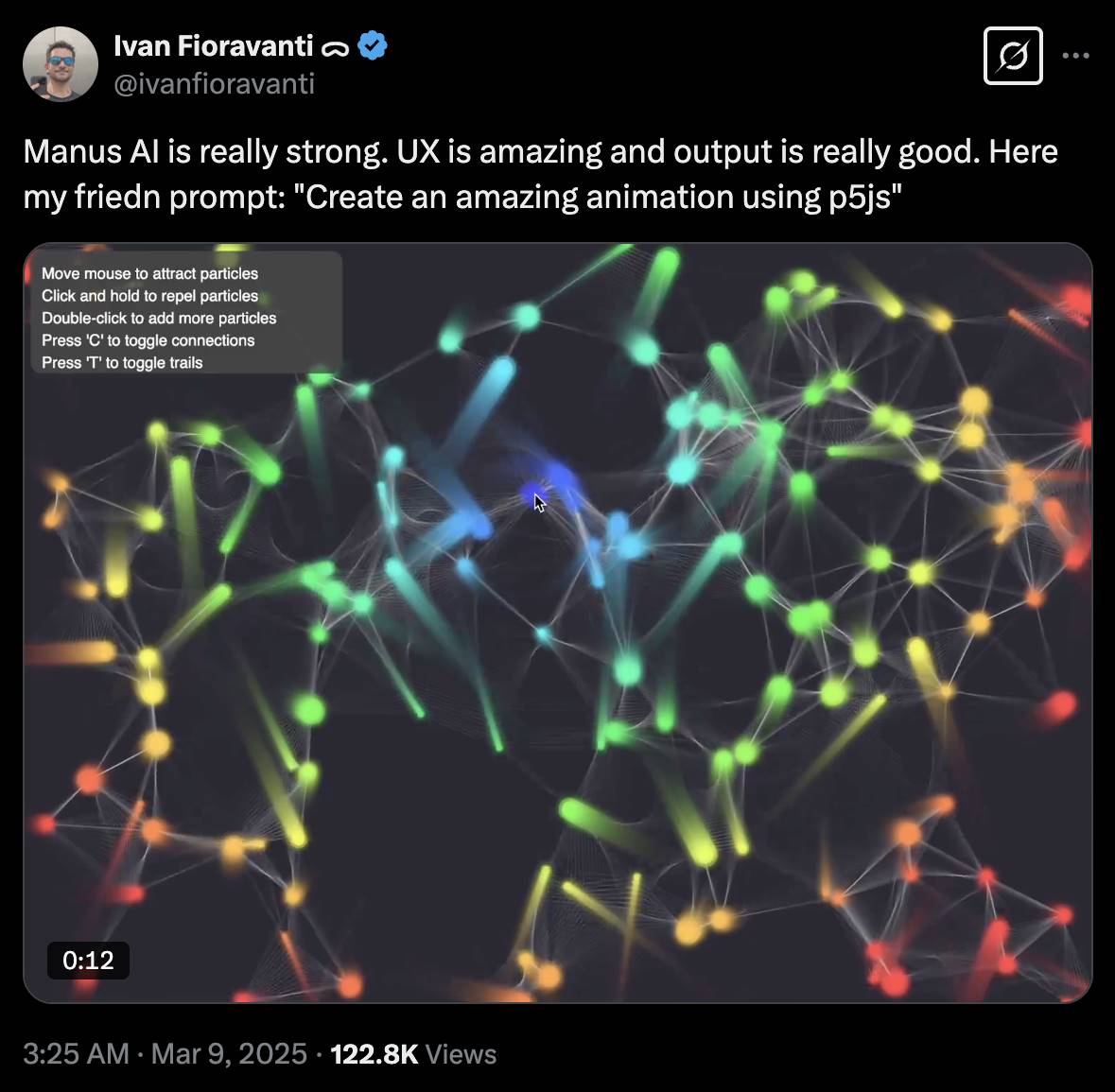
Image source: X
Deedy, a VC at Menlo Ventures, used Manus to conduct a professional-level analysis of Tesla stock. It completed roughly two weeks’ worth of expert work in about one hour:
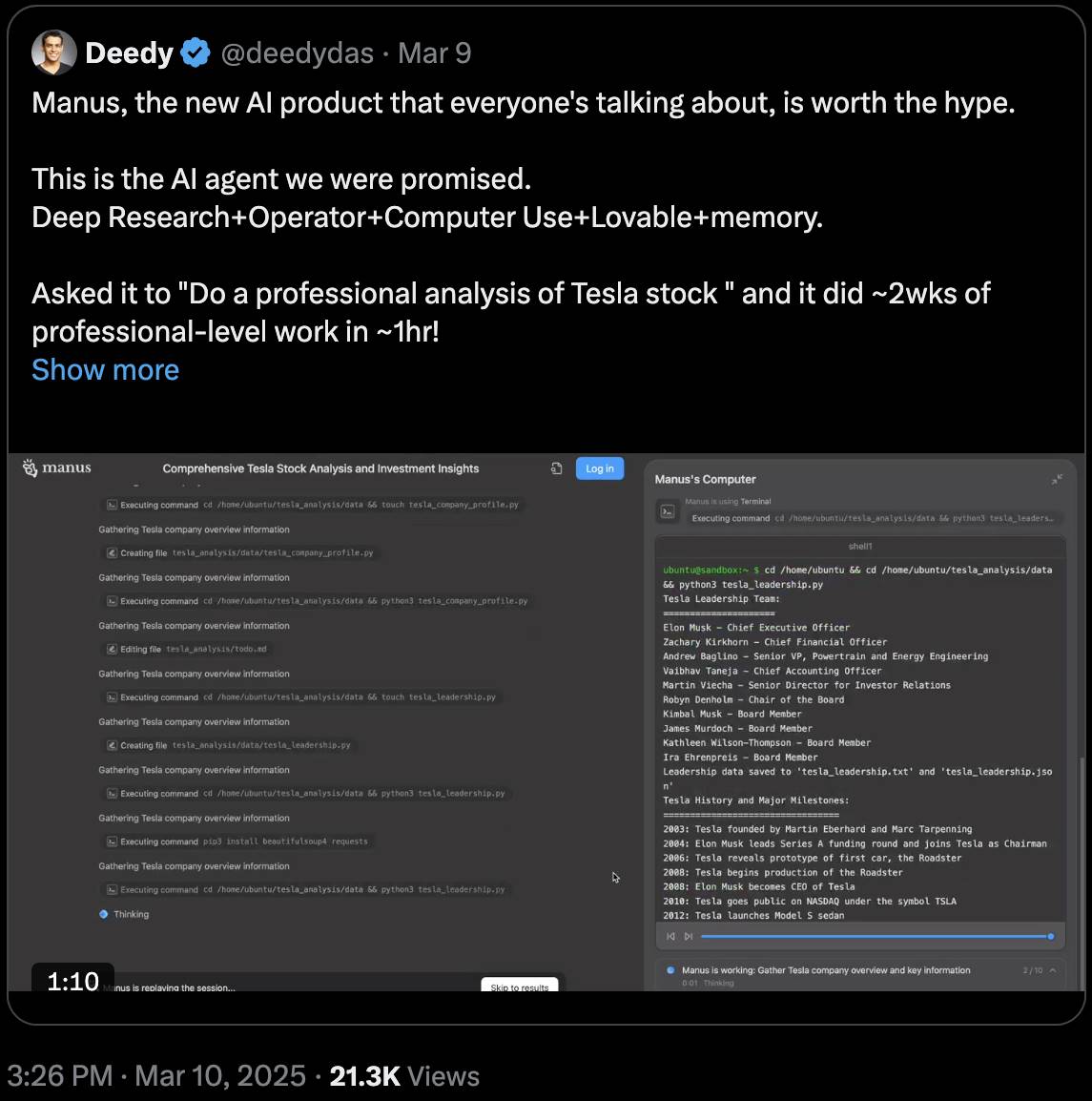
Image source: X
Alexander Doria, Co-Founder of AI startup Pleias, shifted his stance on Manus after testing it. Initially, he reported errors and infinite loops:
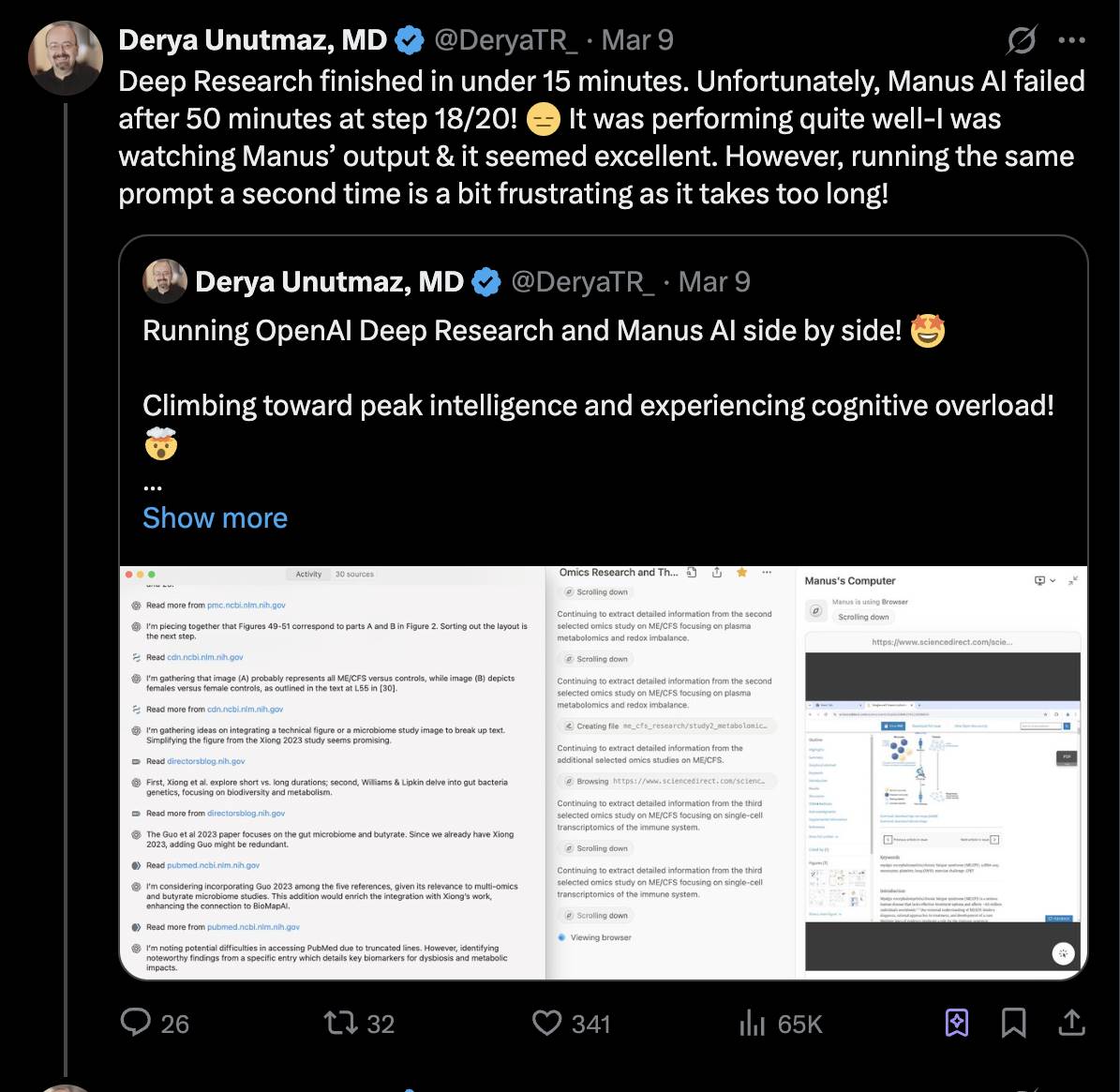
Image source: X
But after Manus produced a 75-page scientific report, he said: “This is indeed another DeepSeek moment for AI agents”:
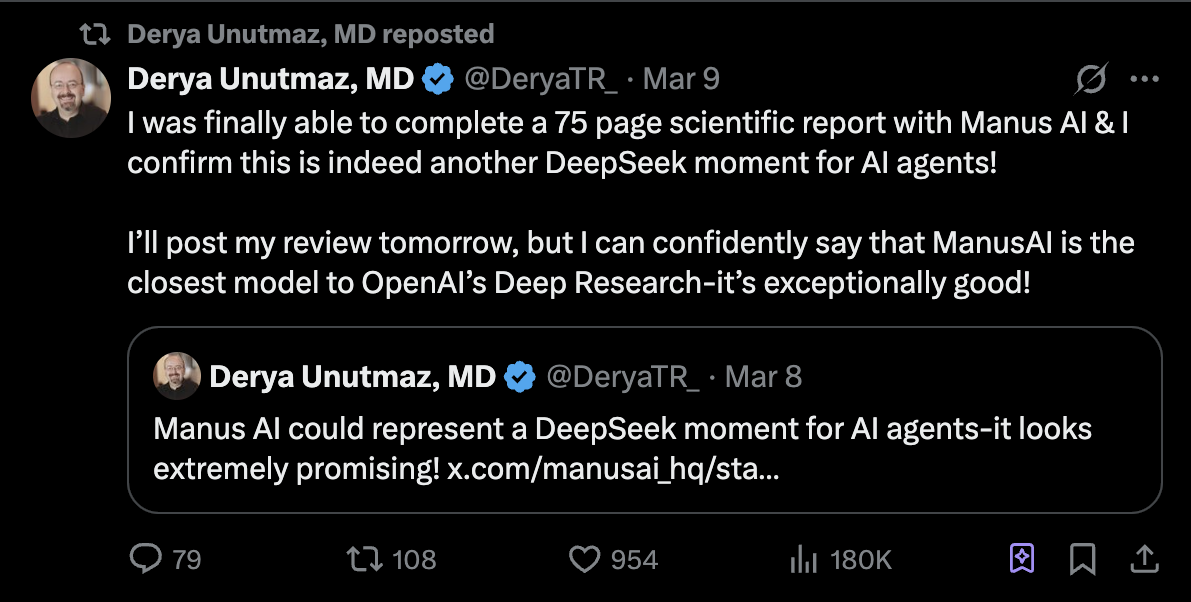
Image source: X
And added: “OpenAI’s o3 model behind Deep Research is significantly smarter, but as Simon pointed out, Manus AI somehow takes a different path and produces outputs nearly as strong. It’s somewhat similar to what DeepSeek R1 did relative to o1.”
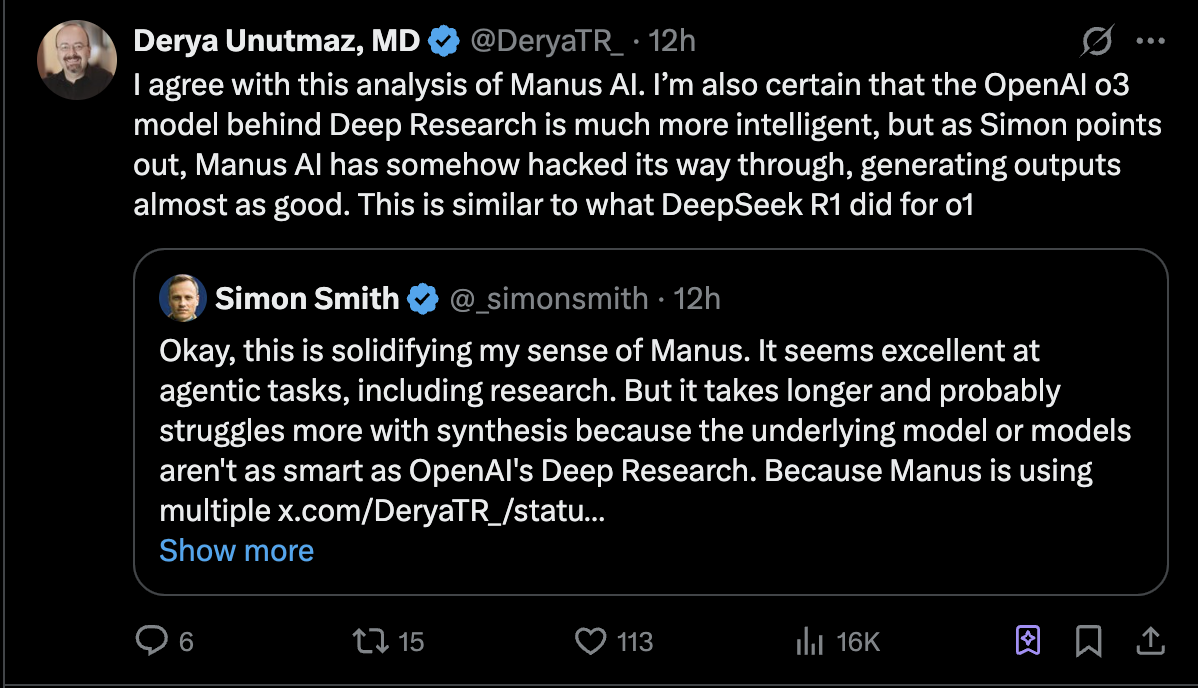
Image source: X
In a recent update, he revised his AGI forecast, raising the probability of its emergence by year-end from 90% to 95%, and stating that it will arrive no later than next year with 99.9% likelihood.
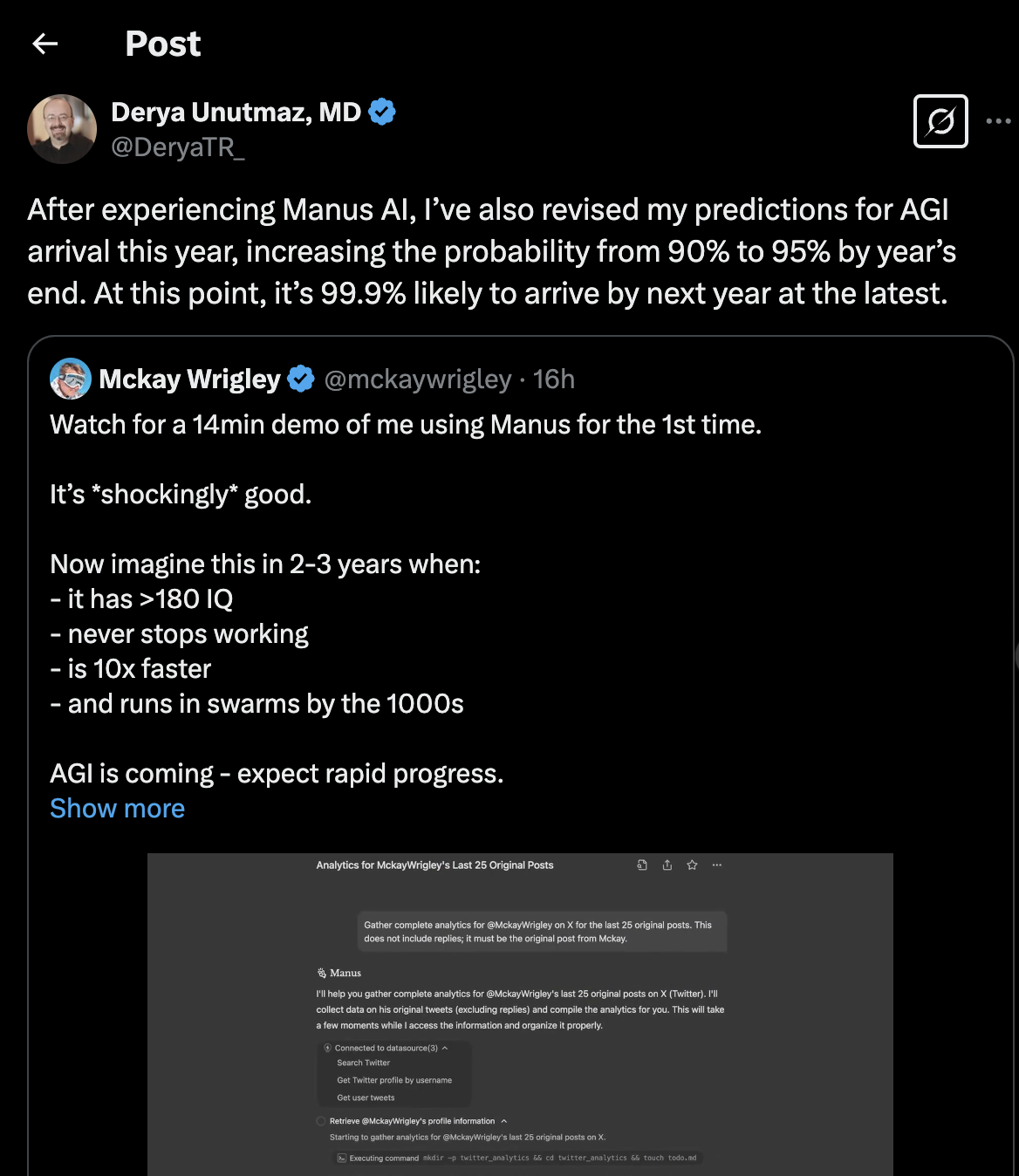
International media coverage has also begun. The Economic Times published two articles—one using sensational headlines: “Another Chinese Company Shocks Silicon Valley: Manus AI Stuns Tech World with DeepSeek-Level Performance in Complex Task Handling; Is AGI Closer Than We Thought?”
The second article, titled “Manus AI: China’s Second DeepSeek Moment,” described Manus as a leap toward autonomous AI, noting that China’s active advancements in autonomous driving systems may give it a first-mover advantage in key areas—and the emergence of Manus AI further proves such progress can be replicated.
A Forbes report stated directly: “It is the world’s first fully autonomous AI agent—capable not only of assisting humans, but replacing them… Essentially, it’s a trained polymath that can manage cross-industry tasks without the inefficiencies caused by human hesitation.”
The article highlighted how Manus differs from similar overseas products: “Unlike ChatGPT-4 or Google’s Gemini, which rely on human prompts to guide them, Manus does not wait for instructions. Instead, it aims to initiate tasks independently, assess new information, and dynamically adjust its approach. In many ways, it is the first true general-purpose AI agent.”
Of course, just as some remain skeptical in China, users on X have pointed out flaws—such as factual inaccuracies, lack of cited sources, and failure to retrieve information easily available online.
A TechCrunch journalist recounted testing Manus on seemingly simple daily tasks, only to face repeated failures. For example, when asked to order a fried chicken sandwich from a fast-food restaurant within delivery range, Manus crashed on the first attempt. On the second try, it found the right menu item but failed to complete checkout—or even provide a checkout link. Similarly, when tasked with booking a business-class flight from New York to Japan, Manus could only offer links to airlines and flight search engines, some of which were broken, failing to meet the user’s specific needs.
Yet these bugs may be forgivable—after all, Manus is still in closed beta, with limited system capacity, and ongoing optimization efforts underway.
2 Changing the Game
Discussions about Manus continue to grow, both domestically and internationally. Regardless, Manus has already changed the game.
For the past three years, artificial intelligence has revolved around AGI. From GPT-4 to DeepSeek, intelligence has seemed like the sole benchmark for evaluating AI products. And while last year’s surge in AI hardware signaled a shift, the arrival of Manus represents a broader trend: AI application deployment has reached an acceleration point.
Manus marks a transition from traditional AI’s “omniscient” mode to a “think-and-act” agent—a shift from AI as a passive assistant to an independent actor. It no longer merely answers questions or offers suggestions, but autonomously analyzes, plans, and executes complex tasks, seamlessly integrating AI “thinking” with “action.”
This is not just a technological evolution—it’s a paradigm shift. AI is no longer passively responding to commands, but making autonomous decisions, executing tasks, and continuously optimizing itself without human intervention.
For AI developers, this has long been the ultimate goal—a system that not only generates information but understands, applies, and learns from mistakes. For those relying on Manus to perform tasks, this transformation could bring profound disruption.
Moreover, Manus appears to be shifting the competitive axis of the AI industry. Until now, leadership in AI seemed firmly held by U.S. tech giants, with competition centered on who could train the most powerful large models. The emergence of Manus challenges that narrative.
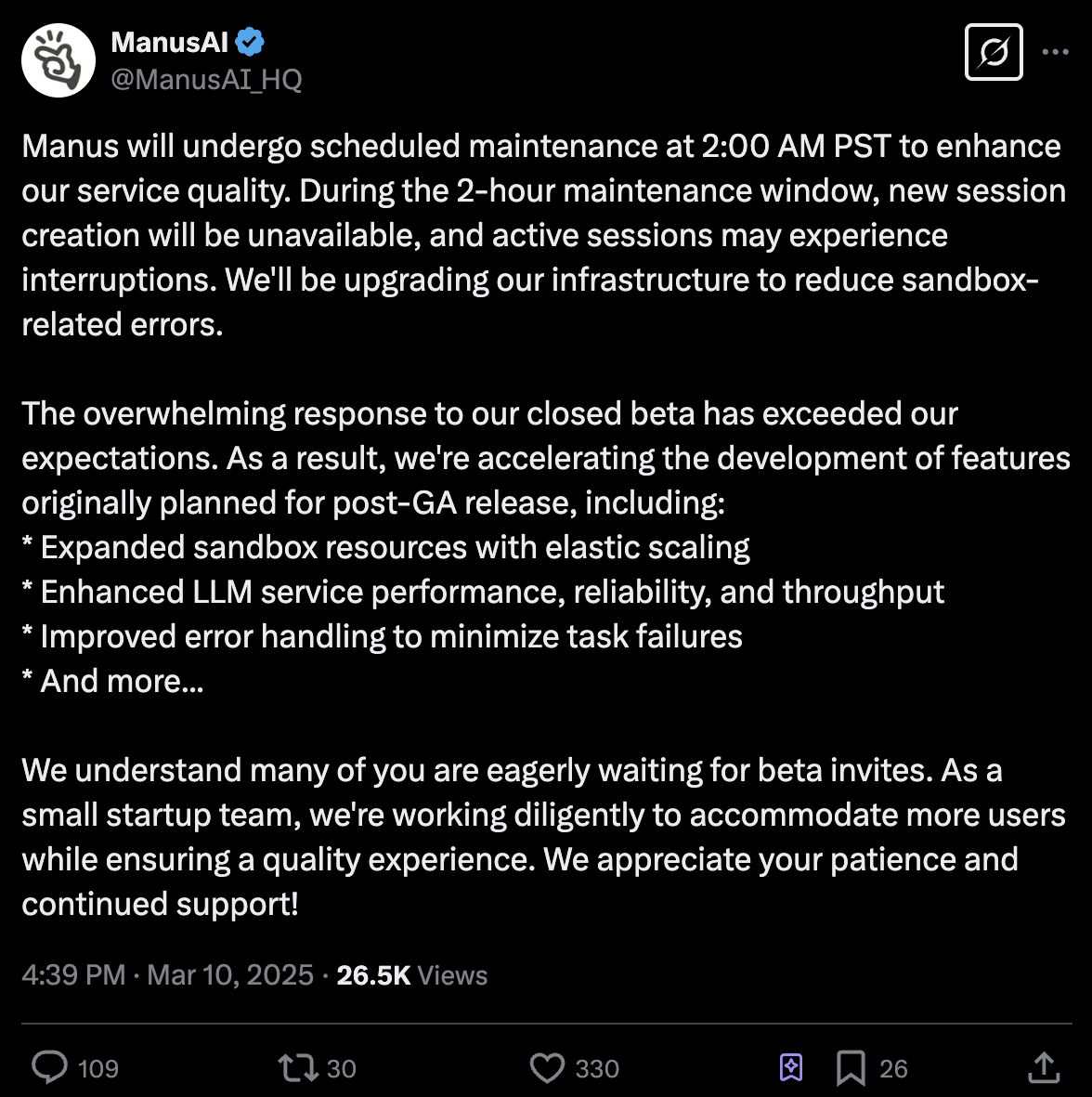
Manus AI announces scheduled maintenance at 2:00 AM Pacific Time|Image source: X
The product may not yet be mature. But more importantly, Manus—as a “think-and-act” agent—represents the industrialization of intelligence. The emergence of such a highly efficient system will quickly make enterprises realize the necessity of replacing human labor with AI. The relationship between humans and machines has once again reached a pivotal juncture.
Join TechFlow official community to stay tuned
Telegram:https://t.me/TechFlowDaily
X (Twitter):https://x.com/TechFlowPost
X (Twitter) EN:https://x.com/BlockFlow_News