Industry leaders gather to explore Prime Intellect, a rising decentralized AI project
TechFlow Selected TechFlow Selected
Industry leaders gather to explore Prime Intellect, a rising decentralized AI project
What is Prime Intellect, backed by heavyweight figures such as OpenAI founding members, Tesla's former AI director, and Stability AI's ex-CEO?
 Navigating Web3 tides with focused insights
Author: KarenZ, Foresight News
Amid rapid advancements in AI technology, centralized computing resources and high costs remain major bottlenecks for innovation and widespread adoption. Prime Intellect, a decentralized peer-to-peer compute and intelligence protocol, aims to aggregate global distributed computing power and promote collaborative AI model development, offering a new pathway for open-source intelligence.
This article introduces the project from three perspectives: investment background, team background, and protocol operations.
Prime Intellect Team Background
Prime Intellect was founded in January 2024 by co-founders Vincent Weisser and Johannes Hagemann.
CEO Vincent Weisser has extensive experience in Web3, focusing primarily on DeSci and AI. He is a co-founder of DeSci projects Bio Protocol, VitaDAO, and CryoDAO, and previously served as Head of Ecosystem & AI at DeSci Molecule. Additionally, Vincent helped launch the experimental community Zuzalu.city in 2023.
CTO Johannes Hagemann focuses on decentralized AI, semi-automation, energy optimization, explicit technological optimism, brain-computer interfaces (BCIs), longevity, and related fields. He previously worked as an AI Research Engineer at Aleph Alpha, a German AI systems developer, and served as a Strategic Advisor at VitaDAO from May 2021 to January 2023.
Funding Background: Backing from Key Figures in AI
In April 2024, Prime Intellect raised $5.5 million in seed funding led by Distributed Global and CoinFund, with participation from Compound, Collab+Currency, and Juan Benet, founder of Protocol Labs. The round also attracted notable angel investors including Clem Delangue, CEO of Hugging Face, a machine learning infrastructure provider.
In early 2025, Prime Intellect secured another $15 million in financing led by Founders Fund, with participation from Menlo Ventures and others. This round brought in prominent figures from AI and Web3, including Andrej Karpathy (EurekaAI, Tesla, OpenAI), Clem Delangue (CEO of Hugging Face), Dylan Patel (SemiAnalysis), Tri Dao (Chief Scientist at Together.AI, a generative AI cloud platform), Balaji Srinivasan (Network School), Emad Mostaque (co-founder of Stability AI), Jake Medwell (co-founder of 8VC), Brendan McCord (Cosmos Institute), and Sandeep Nailwal (co-founder of Polygon). With this latest round, total funding exceeded $20 million.
Notably, investor Andrej Karpathy is a founding member of OpenAI who previously served as a research scientist there and later as Director of AI at Tesla. Emad Mostaque formerly served as CEO of Stability AI before stepping down to focus on decentralized artificial intelligence; he also serves as an advisor to Render, a decentralized GPU rendering solutions provider.
How Does It Work?
According to official sources, Prime Intellect builds upon existing decentralized AI efforts to develop infrastructure and economic incentives that aggregate and coordinate global computing resources, enabling a truly sovereign open-source AI ecosystem. The protocol is currently operating on an internal testnet and has been fully integrated and launched on SYNTHETIC-1. Over the past year, Prime Intellect has delivered several key initiatives and products.
Compute Exchange: Aggregates, coordinates, and schedules global GPU resources, integrating computing capacity from data centers, cloud providers, and even individual GPU owners into a unified resource pool. Users can select the most cost-effective GPU resources based on chip type, quantity, and rental duration. This approach not only reduces computational costs for AI training but also democratizes AI technology through efficient supply-demand matching and improved resource utilization.
PRIME: A decentralized training framework supporting large-scale model training across globally distributed computing resources. It enables fault-tolerant training, dynamic activation/deactivation of compute resources, and optimizes communication and routing within a globally distributed GPU network.
In October 2024, Prime Intellect initiated the decentralized training of its 10-billion-parameter model, INTELLECT-1. Leading open-source AI contributors such as Hugging Face, SemiAnalysis, Arcee, Hyperbolic, Olas, Akash, and Schelling AI collectively contributed computational resources to this decentralized training run.
GENESYS: A synthetic data generation framework designed for easy expansion of open-source libraries, enabling synthetic data creation and validation, along with invocation of crowdsourced tasks and validators. In February 2025, Prime Intellect announced it would use DeepSeek-R1 to create SYNTHETIC-1—an open-source dataset of verified mathematical, coding, and scientific reasoning trajectories.
TOPLOC: Prime Intellect introduced TOPLOC, a verifiable inference method leveraging compact Locality-Sensitive Hashing (LSH) technology to accurately detect unauthorized modifications to models, prompts, or computational precision. During response generation, one prefill operation is required per input token, followed by multiple decoding steps for each newly generated token. During verification, all tokens can be passed at once with only a single prefill operation needed.
The Prime Intellect protocol acts as a coordination layer, integrating all these components and providing economic incentives to attract the computational power and capital necessary for scale.
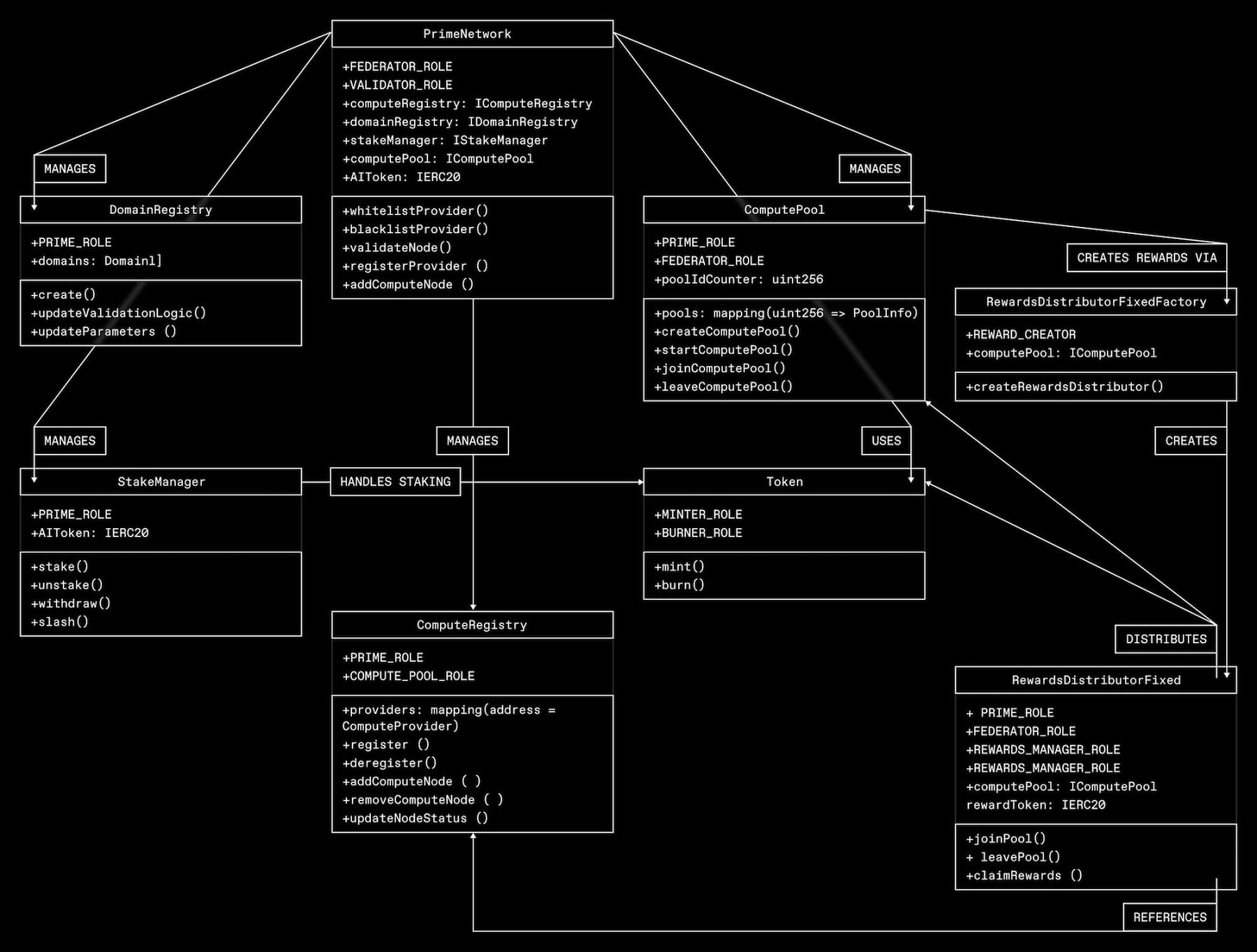
Main components of the Prime Intellect protocol include Workers (users running software to contribute computing resources), Validators, Orchestrators (servers used by compute pool creators to manage workers within the pool and coordinate current workloads), and smart contracts.
Prime Intellect's smart contracts are currently deployed on the Base Sepolia testnet, though the team plans to migrate to their own chain in the future. The RewardsDistributor component of the smart contract specifies that node rewards will be calculated based on active time within compute pools and distributed accordingly via token allocation.
This suggests that Prime Intellect may issue tokens when launching on the Base mainnet or deploying its own blockchain. The team plans to release a public testnet in the coming months, allowing anyone to permissionlessly contribute computing power and participate.
Summary
By aggregating large-scale computing power and providing a global GPU resource scheduling marketplace, Prime Intellect enables anyone to create and contribute open models, agents, datasets, and more—collectively owning the resulting outputs. This model aims to foster a sovereign, open-source AI ecosystem and encourage global participants to collaboratively build open AI models.
Prime Intellect is also exploring collective ownership models and programmable licenses for models and agents to reward contributors and establish new revenue streams for open-source AI.
As stated in its mission, Prime Intellect seeks to leverage decentralization to massively scale AI development, accelerate progress in high-impact domains such as science, agents, and code, and ultimately build an open, transparent, and increasingly inclusive intelligent ecosystem.
Join TechFlow official community to stay tuned
Telegram:https://t.me/TechFlowDaily
X (Twitter):https://x.com/TechFlowPost
X (Twitter) EN:https://x.com/BlockFlow_News
 Foresight News