"Framework" projects gain popularity: Take a quick look at Prime, another new open-source AI Agent framework
TechFlow Selected TechFlow Selected
"Framework" projects gain popularity: Take a quick look at Prime, another new open-source AI Agent framework
Framework-type projects do tend to trigger market FOMO, and infrastructure builders usually command higher valuations than application builders.
 Navigating Web3 tides with focused insights
Written by: TechFlow
GM, welcome to the first week of 2025 — a time when everyone is swept up in the AI Agent hype.
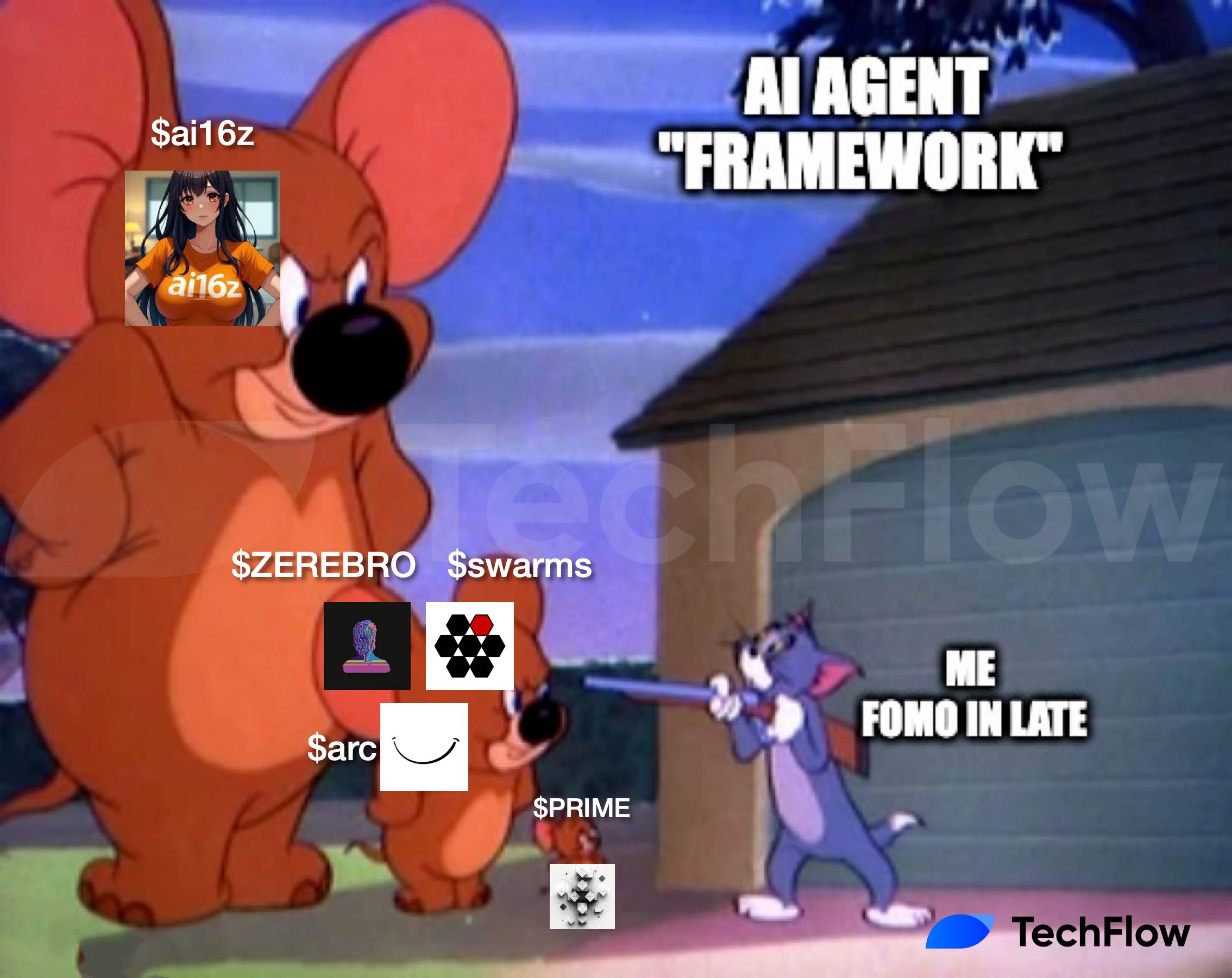
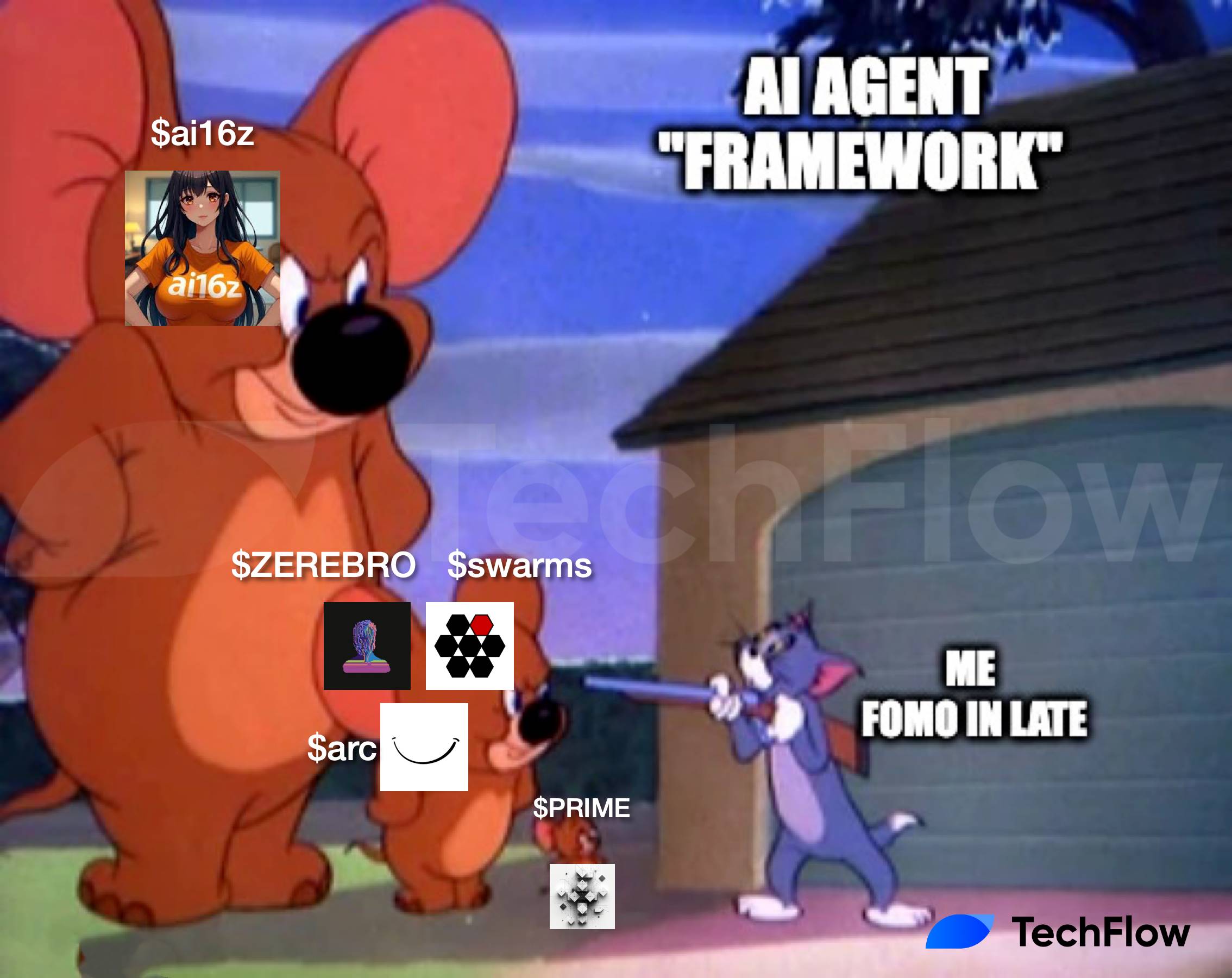
Over the past week, one clear trend has emerged: strong market FOMO toward "framework"-type projects.
First, ai16z hit new highs repeatedly, reaching a leading market cap of around $200 million. Then, enterprise-grade framework Swarms surged rapidly, becoming another AI Agent framework token with a market cap exceeding $300 million — joining ai16z (Eliza), ZEREBRO (ZerePy), and arc (RIG).
And today, a new AI Agent framework named Prime has appeared. Its token quickly rose to a peak market cap of about $20 million within two hours of launch. Since then, it has pulled back significantly and currently hovers around $11 million.
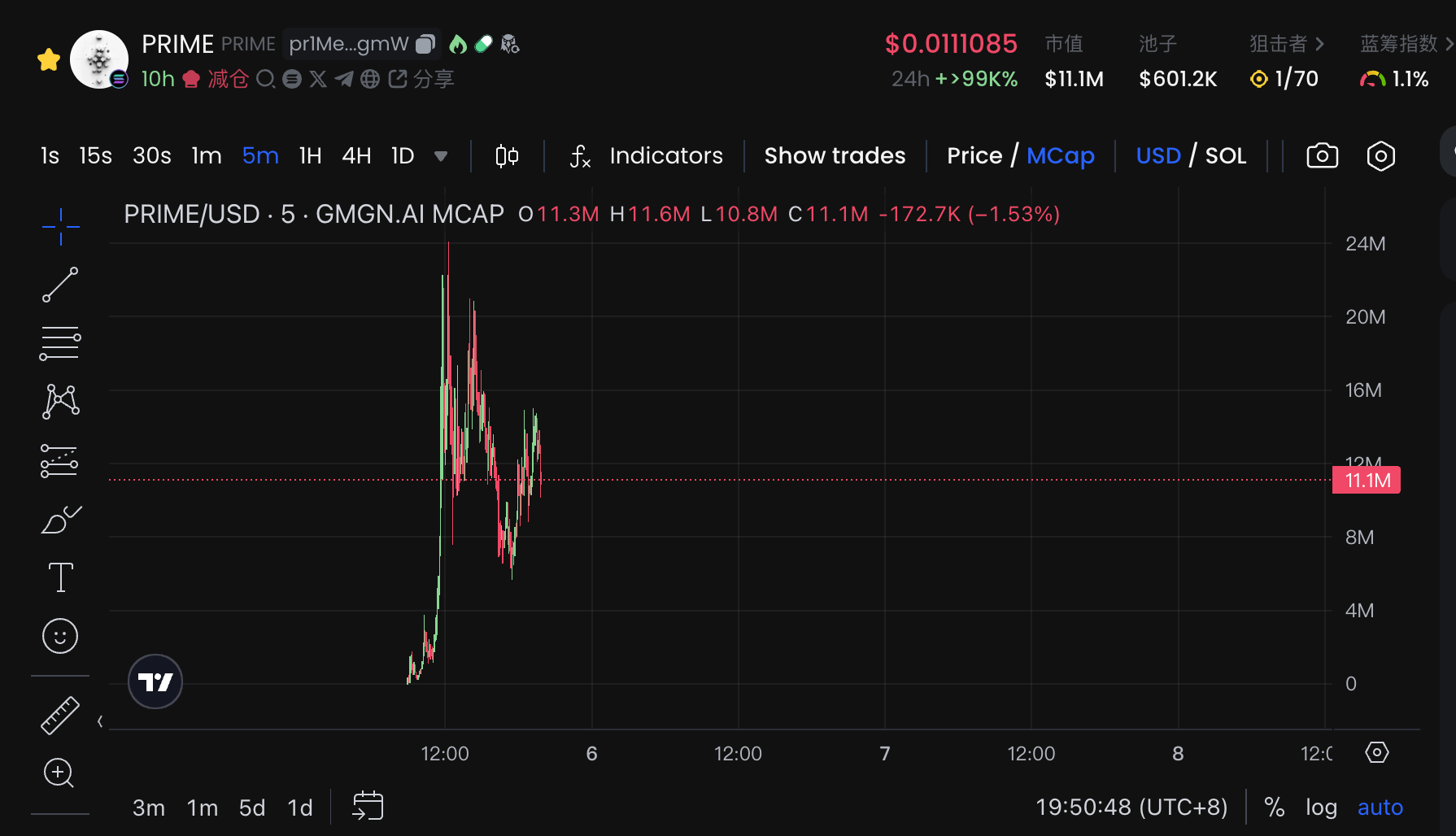
Given how easily volatile PVP dynamics can form during token launches, such price swings are understandable.
However, looking at earlier competitive projects, post-competition valuations generally stabilized above $300 million. For investors who found earlier entries too expensive, FOMO may now spill over into similar upcoming projects.
So, will this new framework project Prime follow a similar trajectory? And what sets it apart from other frameworks?
Modular Open-Source AI Agent Framework
First, let's clarify: what exactly is an AI Agent framework?
In short, it’s a toolkit designed for developers to more easily create, deploy, and manage AI agents, enabling these AIs to autonomously complete specific tasks such as trading, social interaction, or content creation.
So, how does Prime make development and deployment “easier”?
According to official project descriptions, the most immediate benefit is eliminating repetitive low-level coding work. Prime positions itself primarily as a "modular" AI Agent framework.
It offers numerous pre-built libraries containing rich toolsets, APIs, templates, and more. This means developers building an agent can simply select required components, reducing development time while keeping systems lightweight.
Moreover, modularity enables unique configurations, allowing developers to build industry-specific agents. For example, healthcare agents might prioritize patient data analysis, while retail agents focus on customer personalization.
This modularity also translates into cost savings. By using only necessary modules, developers conserve resources. PRIME aims to become a cost-effective choice for startups and enterprises alike.
According to Prime’s official tweet, using their framework accelerates development speed by 30%, and includes a dashboard feature that automatically monitors created AI Agents’ current performance and predicts future outcomes.
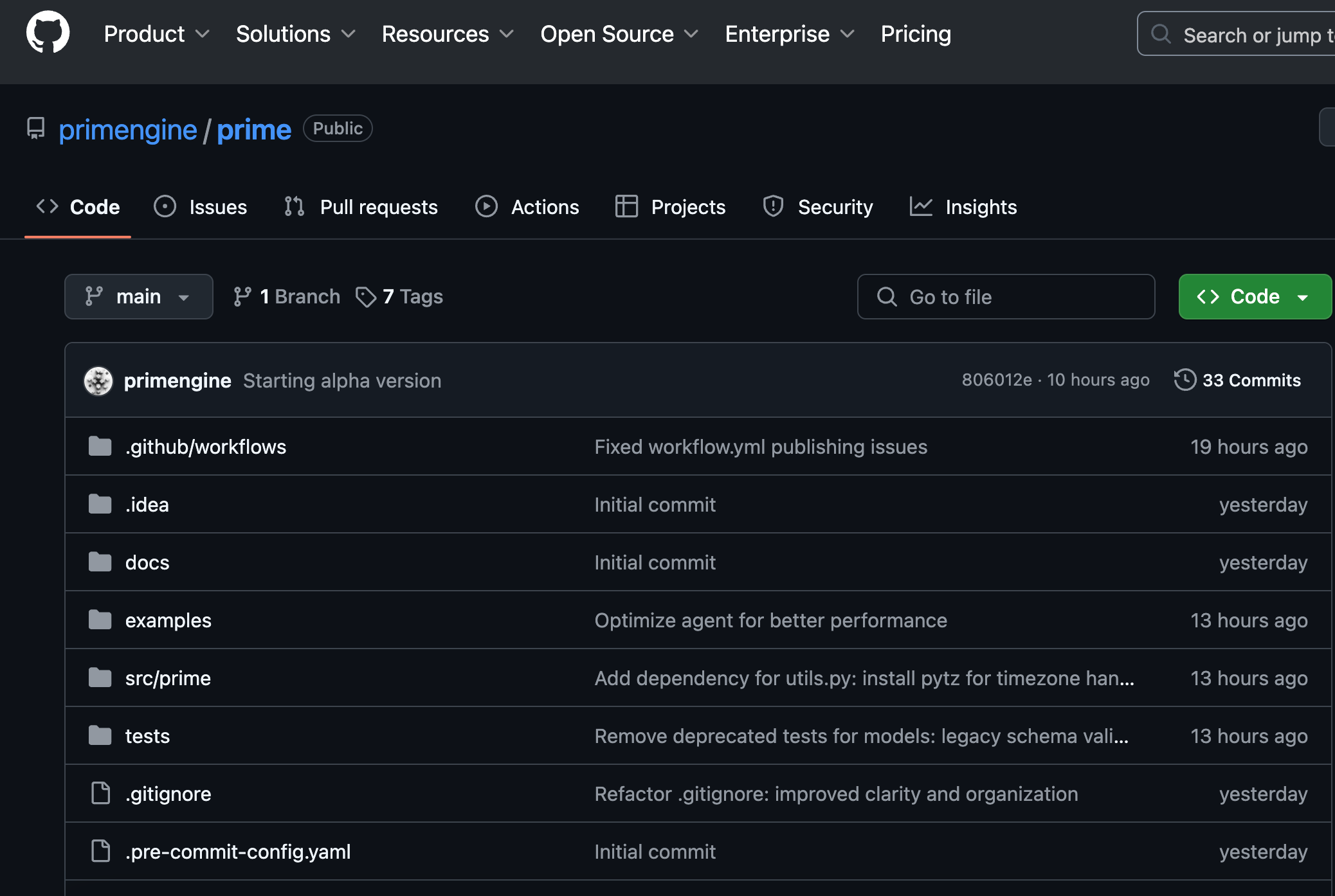
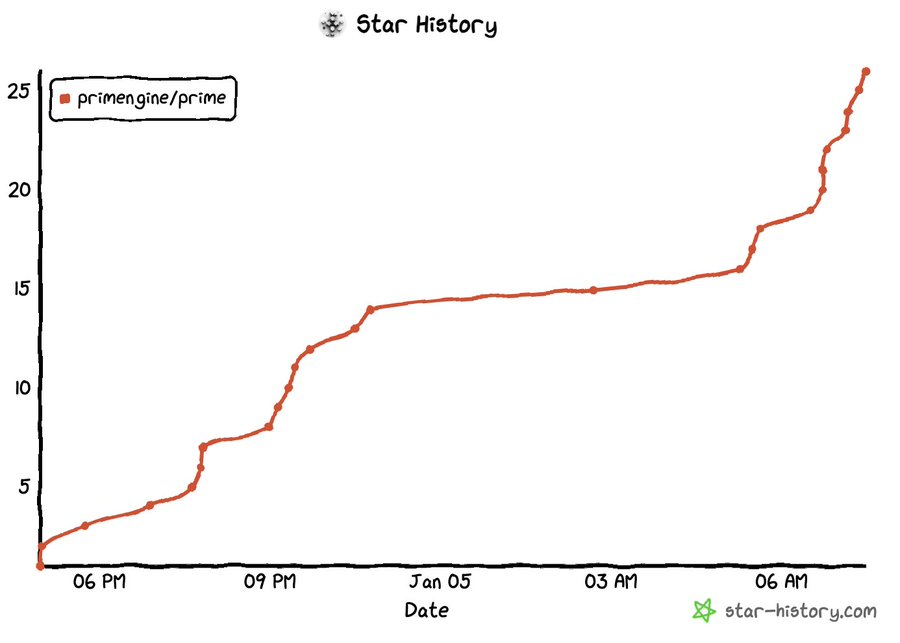
More importantly, the framework is open-source and available directly via Python installation from its GitHub repository.
In terms of popularity, Prime clearly lags behind Eliza by ai16z, but GitHub stars are steadily rising (currently at 66). The project currently gives off a small-but-beautiful vibe.
Whether the framework performs as well as advertised remains to be seen — real-world testing by technically proficient users will ultimately determine that. As PRIME’s token price fluctuates, more developers will likely join in evaluating the framework’s effectiveness. Future social media reviews and opinions from key figures will provide further clarity.
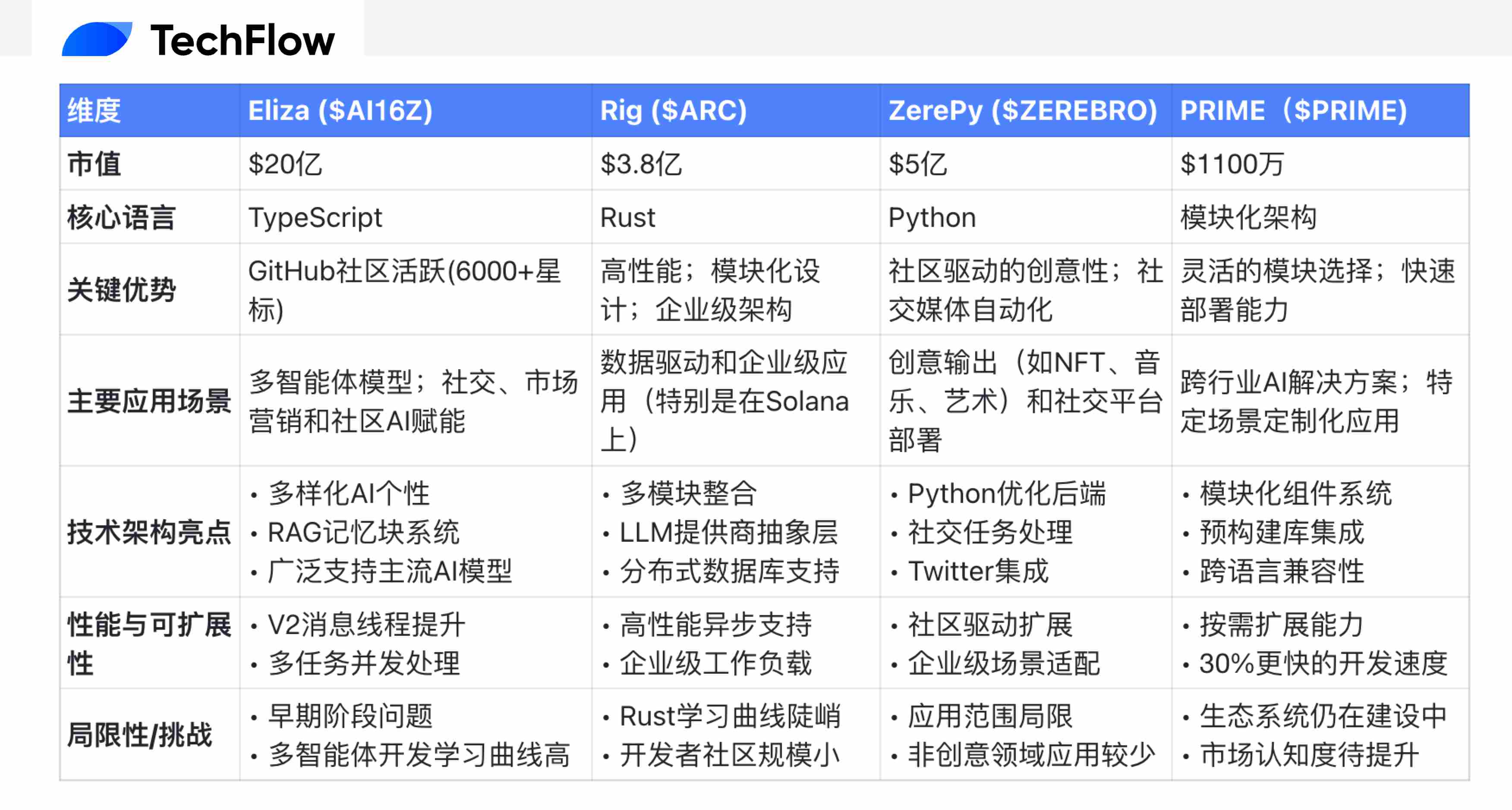
For now, based solely on available information, here's a quick comparison between Prime and several popular existing frameworks to help you grasp the overall landscape:
Rising FUD Over Alleged Plagiarism; Ecosystem Still in Early Stages
PRIME’s token briefly reached a $20 million valuation this morning but sharply dropped by half in the afternoon, currently hovering around $11 million.
One major reason: growing FUD accusing the project of plagiarism.
Some community members claim Prime isn’t an original framework but instead copied code from another project called smolagents, hosted on the well-known open-source machine learning platform Hugging Face. Smolagents is designed specifically for AI Agents, capable of invoking toolkits and orchestrating other AI Agents using Python code.

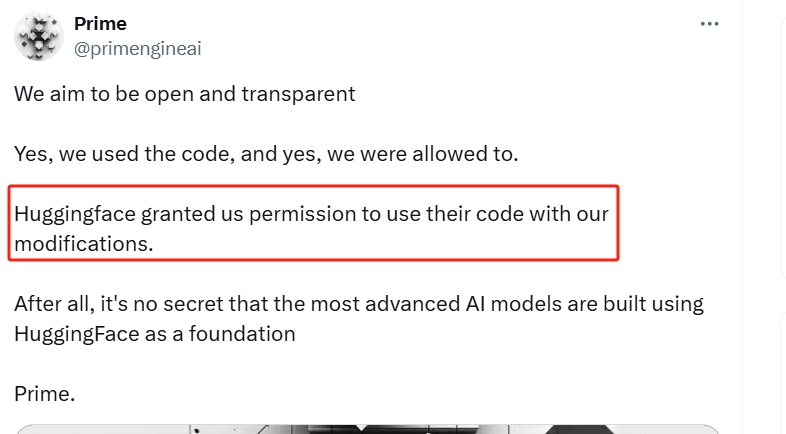
However, Prime has responded to criticism by defending its approach, stating that while they did use code from the aforementioned project, they made modifications under Hugging Face’s authorized open-source license.
Considering Hugging Face’s open-source nature, Prime may not qualify as outright “plagiarism,” though they failed to clearly disclose upfront that their code was derived and optimized from others’ work.
After the FUD wave, PRIME’s token has stabilized relatively. Meanwhile, more projects built atop this framework are beginning to emerge:
-
AURA
CA:
AuraAiXwQ61h11a9Rtktro9p3R6uBfEWo9qDGnJge3G1
Market Cap: $700K
The project claims to act as a universal coordinator and assistant for developers, aiming to simplify and optimize the development, deployment, and management of AI agents built on PRIME.
The token launched today and once spiked past $3.5 million before a significant pullback.
Notably, AURA has been acknowledged by Prime’s official team, but data shows 20% of tokens are held by the dev team.
-
SPROUT
CA:
SPRTnpcEJP9Ahr6NNi6a8mvFhgpE27yPWowjBpBfQfu
Market Cap: $160K
Still in very early stages. Prime’s official X account clarified this is not an officially launched AI Agent. The small market cap implies higher risk.
The project describes itself as an AI-powered agent built on the PRIME framework, designed to optimize trading on Solana for improved speed, cost-efficiency, and security.
Second Half: Multiple Frameworks
Overall, PRIME currently lags behind earlier popular frameworks in market cap, influence, and recognition.
Its future development depends on whether influential figures endorse it and whether the framework itself can foster stronger applications.
Nevertheless, Prime’s emergence confirms that framework-type projects tend to generate strong market FOMO — echoing the earlier VC coin logic: infrastructure projects command higher valuations than application-layer ones.
This signals that the AI Agent sector has entered its second phase — moving from single-dominant frameworks with diverse applications, toward multi-framework competition and increasingly specialized applications.
With frameworks becoming open-source and AI capabilities advancing rapidly, creating AI agents is becoming easier. Only those with distinctive features — both frameworks and apps — will survive intense competition, while undifferentiated projects may be quickly forgotten like memes.
For project teams, the barrier to entry in AI Agents will keep rising.
For retail investors, a trend of selecting only the best among strong contenders is inevitable.
Be reminded: the AI Agent craze is highly time-sensitive. Many early projects may eventually go to zero after initial hype fades. Please DYOR — do your own research and judgment. None of the above constitutes investment advice.
Join TechFlow official community to stay tuned
Telegram:https://t.me/TechFlowDaily
X (Twitter):https://x.com/TechFlowPost
X (Twitter) EN:https://x.com/BlockFlow_News
 深潮TechFlow