









Crypto Capitalism: An Asymmetric Wealth Opportunity
TechFlow Selected TechFlow Selected
Crypto Capitalism: An Asymmetric Wealth Opportunity
By the campfire in the digital jungle, grip your cognitive weapon tightly.
 Navigating Web3 tides with focused insights
By Daii
Since Trump took office, the crypto market has become a "policy-driven market" for the United States. Over the past few days, Bitcoin's price has swung wildly based on Trump’s words and actions—peaking at $95,000 and nearly dropping below $80,000 again.
This extreme price volatility inevitably puts investors on edge. Some may feel excited, chasing the thrill of short-term speculation; others may grow anxious, fearing their assets could vanish overnight. Yet, as we will explore in depth, this seemingly chaotic fluctuation is precisely the most authentic portrayal and vivid embodiment of what we call "crypto capitalism."
Cryptocurrency is not merely a technological innovation—it is a digital mirror reflecting human nature, where greed and fear intertwine. Every price movement creates ripples on this mirror, revealing the complex and subtle psychology of its participants.
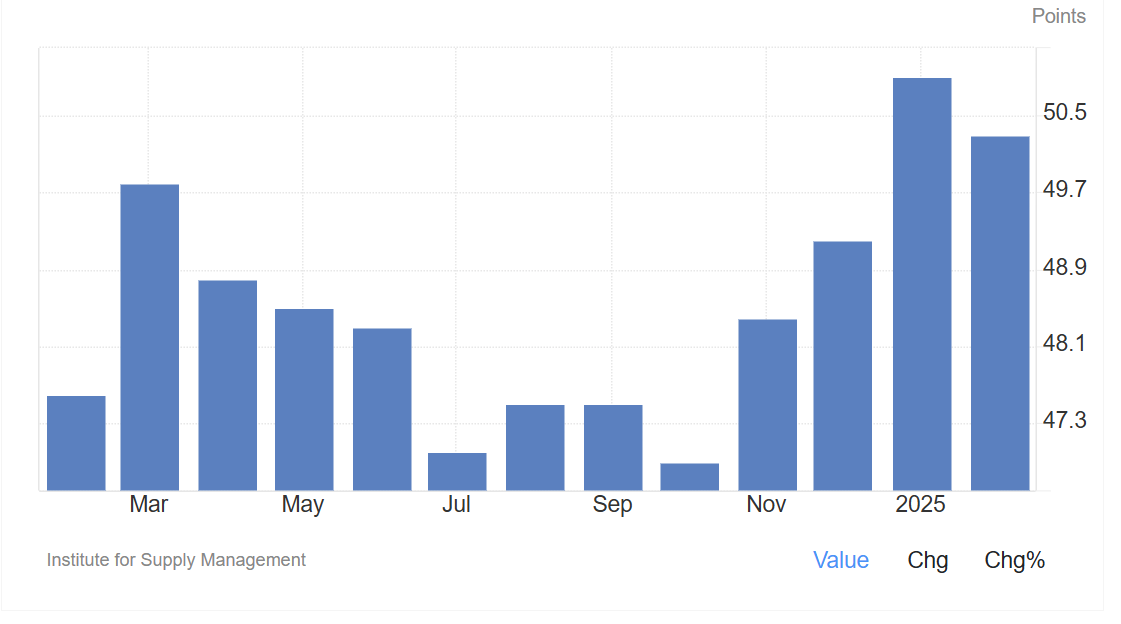
On the topic of market trends, there are two good pieces of news to share. The first is U.S. PMI (Purchasing Managers' Index), which after 26 consecutive months of contraction, has now been above 50 for two months (January and February 2025) (see chart below), signaling an economic recovery. Research shows this indicator has accurately predicted every economic turning point over the past 14 years.
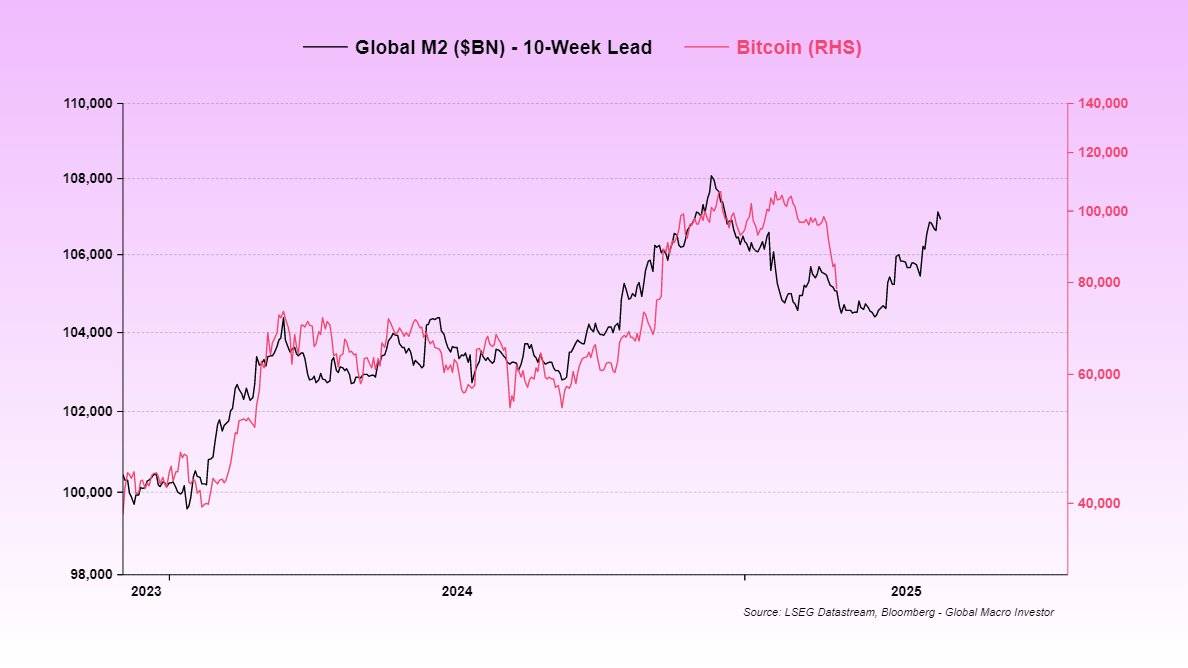
The second piece of good news is that global M2 money supply has surged since 2025 (see chart below). Real Vision’s research indicates that Bitcoin prices tend to lag behind changes in global M2 by approximately 10 weeks.
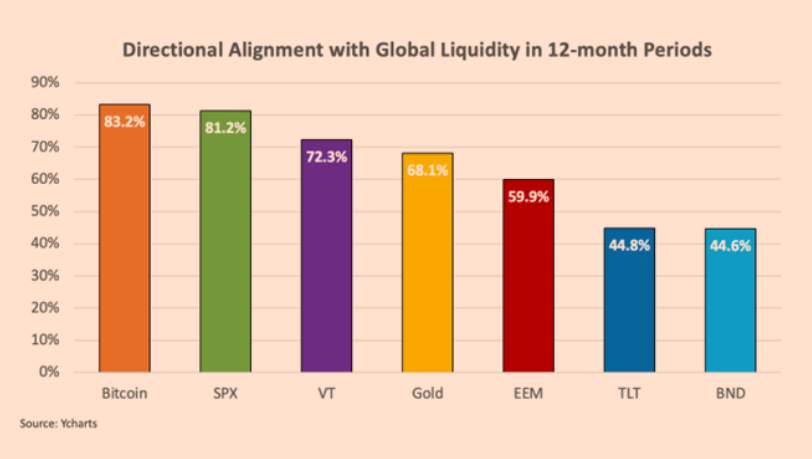
Analyst Lyn Alden further points out that over any 12-month period, Bitcoin follows the direction of global liquidity (M2) 83% of the time—a correlation higher than any other major asset class.
Whether it’s PMI or M2, both fundamental indicators suggest that Bitcoin’s golden era is drawing near. But never forget: Bitcoin’s price is not ultimately determined by fundamentals, but by centralized exchanges. If you have doubts about this, we recommend reading this article.
In fact, if you truly believe in Bitcoin’s long-term value and have confidence in its underlying technology and future potential, then short-term price fluctuations are nothing more than waves on the ocean’s surface—temporary and destined to calm down. There’s no need to panic or worry. The only thing you must do is control your own desires and avoid excessive leverage.
Now, let’s move on to today’s main subject—crypto capitalism.
In 17th-century Holland, people exchanged tulip bulbs for entire streets of property; in 19th-century America’s Wild West, gold rushes brought together prospectors and outlaws in frenzied chaos; in the 21st century, we stare at flickering K-line charts, writing a new financial gospel on blockchains. Crypto capitalism isn’t just a technological revolution—it’s also a digital reflection of human greed and fear. It wraps human uncertainty in mathematical certainty, making every participant both god and gambler in their own wealth narrative.
In this algorithm-built new world, Bitcoin is merely the first iceberg peeking above water. The real drama lies in this: when financial sovereignty shifts from national central banks to distributed ledgers, and when labor value is redefined by hash power, we are witnessing the wildest evolutionary form of capitalism.
Crypto capitalism is like Pandora’s box—once opened, wealth and risk emerge hand in hand, impossible to separate. Once opened, it can never be closed again. Here, there are no central bank governors, only smart contracts that never sleep; no roaring factory floors, only the symphonic hum of mining rigs composing odes to wealth.
Today, let’s dive deep into understanding what kind of wealth game “crypto capitalism” really is—and whether there’s still a place within it for you and me.
1. What Is Crypto Capitalism?
Imagine a currency that belongs to no nation, controlled by no bank, existing solely through code and consensus across the internet—would you dismiss it as fantasy?
Bitcoin is exactly such a cryptocurrency that defies traditional understanding.
In 2009, Bitcoin emerged out of nowhere, marking the dawn of the cryptocurrency era. This new type of digital asset, known as "cryptocurrency," is not issued by any central bank but operates via cryptography and distributed ledger technology (blockchain). Bitcoin functions like digital gold—capped in total supply, generated through complex computation (mining), and freely circulated within a decentralized network.

Crypto capitalism refers to a new form of wealth system and economic phenomenon built upon cryptocurrencies like Bitcoin. Simply put, it denotes a capitalist structure primarily carried by cryptocurrencies. In this system, wealth accumulation, growth, and distribution revolve around cryptocurrencies. While sharing similarities with traditional capitalism, its operating rules differ significantly.
Unlike traditional capitalism, where capital takes forms such as factories, land, or stocks, the core of crypto capitalism lies in digital tokens themselves. Tokens like Bitcoin and Ethereum are no longer mere payment tools—they have become vehicles for storing and increasing value. Their worth is driven entirely by market supply and demand and community consensus, rather than government-backed credit.
This means anyone holding cryptocurrency holds something akin to “digital land” or “digital gold,” potentially participating in the dividends of digital economic development. Crypto capitalism breaks down barriers of the traditional financial system, making wealth creation and accumulation more direct and decentralized.
Yet, like two sides of a coin, while presenting immense opportunities, crypto capitalism inherently carries asymmetrical traits. It is注定 not a utopia of shared prosperity, but more like a gold rush favoring only a select few.
2. What Are Asymmetric Wealth Opportunities?
To understand the "asymmetry" in crypto capitalism, we must first grasp what "asymmetric wealth opportunities" mean.
In simple terms, asymmetric wealth opportunities refer to situations during significant technological or economic shifts where a small minority leverages information, technical, or first-mover advantages to accumulate wealth at speeds and scales far beyond the norm—while the vast majority struggle to catch up, or even suffer losses. This creates a highly skewed wealth distribution pattern.
Such asymmetry isn't unique to crypto. Throughout history, every major technological revolution and industrial transformation has triggered similar wealth effects. For example:
During the Industrial Revolution, factory owners and entrepreneurs who mastered steam engines and textile machines became pioneers of their time, rapidly amassing enormous fortunes—while the working class initially faced exploitation and poverty.
During the Internet Revolution, early adopters—entrepreneurs and venture capitalists like Bill Gates and Jeff Bezos—became the new generation of tycoons, while most people remained mere users of the internet.

The core features of asymmetric wealth opportunities lie in “winner-takes-all” dynamics and “first-mover advantage.”
In the early stages of change, information and resources are often concentrated among a few. Those with foresight and swift action seize the initiative, building strong competitive moats and dominating the emerging wealth landscape. Latecomers, hindered by delayed information and scarce resources, are often forced to accept established rules—or worse, become the ones being exploited.
The emergence of cryptocurrency has once again created a classic case of asymmetric wealth opportunity. Bitcoin’s journey from “neglected code” to “digital gold” was filled with information gaps and cognitive biases.
Those who recognized its value early and dared to invest were like Columbus discovering a new continent—securing beachheads of wealth. When the concept gained mainstream attention and prices soared, latecomers rushed in only to find overcrowded mines, scrambling for dwindling gold dust—or worse, digging up worthless slag.
3. Why Is Crypto Capitalism an Asymmetric Wealth Opportunity?
This stems both from the intrinsic characteristics of cryptocurrencies and the current stage of market development.
3.1 Massive Early-Bird Advantages
The Bitcoin genesis block was mined in 2009, when it had virtually no value—one dollar could buy hundreds or even thousands of Bitcoins. Only a handful of cryptography enthusiasts and tech geeks believed in the future of this so-called “air coin.” These individuals became the “first pioneers” of crypto capitalism.
Kristoffer Koch, a Norwegian man, bought 5,000 Bitcoins for $27 back in 2009. At the time, this investment seemed trivial. But years later, when Bitcoin’s price skyrocketed, he realized his accidental purchase was worth nearly a million dollars!
Then there’s the famous “Bitcoin Pizza Day”—programmer Laszlo Hanyecz paid 10,000 Bitcoins for two pizzas. Back then, those coins were worth just $41. Today, they would be valued in hundreds of millions of dollars!
These stories of “overnight riches” aren’t myths—they’re real events experienced by early crypto adopters. Merely recognizing and embracing Bitcoin earlier than others earned them unimaginable returns. This “early-bird bonus” is magnified to an extraordinary degree in the crypto space.
As a well-known saying in investing goes: “The secret to investing isn’t running fast—it’s standing early.” In the game of crypto capitalism, this couldn’t be more true.
3.2 Powerful “Passive Income” Effect
The “coin-based” wealth model enables capital appreciation in crypto markets to vastly outpace income from labor.
In traditional economies, wealth accumulation relies mainly on creating value through work, followed by investment or business activities for growth. Crypto markets, however, present a starkly different picture.
Holding cryptocurrencies itself becomes a primary path to wealth.
Consider a regular office worker who works hard all year—their salary might increase by 5%-10%, and bank interest rates are negligible.
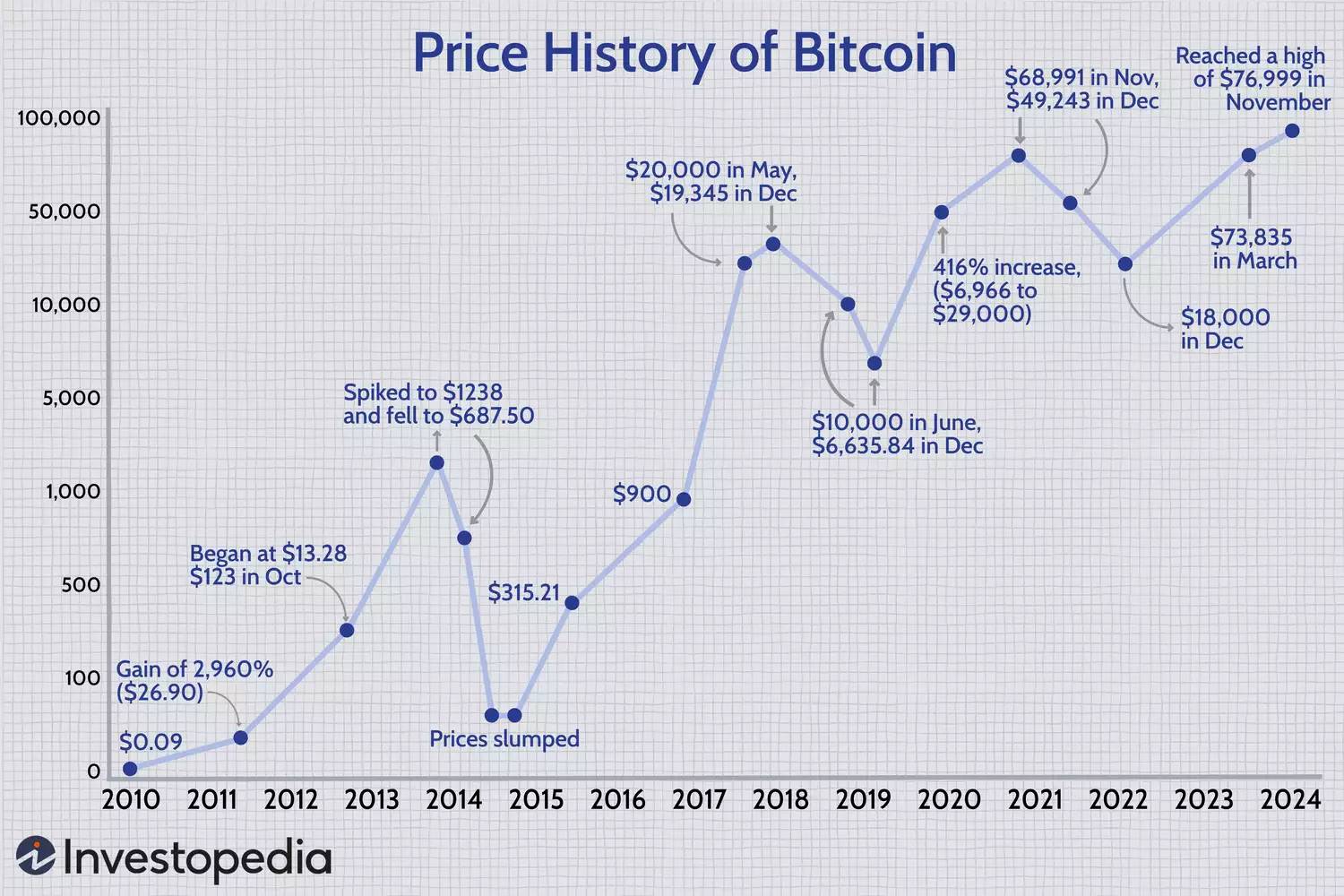
Meanwhile, Bitcoin’s price could double, triple, or even multiply many times over within a year—or even months! In 2017, Bitcoin surged from under $1,000 at the beginning of the year to nearly $20,000 by year-end—an increase of over 20x! At the end of 2020, another bull run began, lifting Bitcoin from around $20,000 to nearly $69,000 by November 2021—a rise exceeding 3x! Even though Bitcoin has pulled back from its recent high near $110,000, it still trades above $80,000.
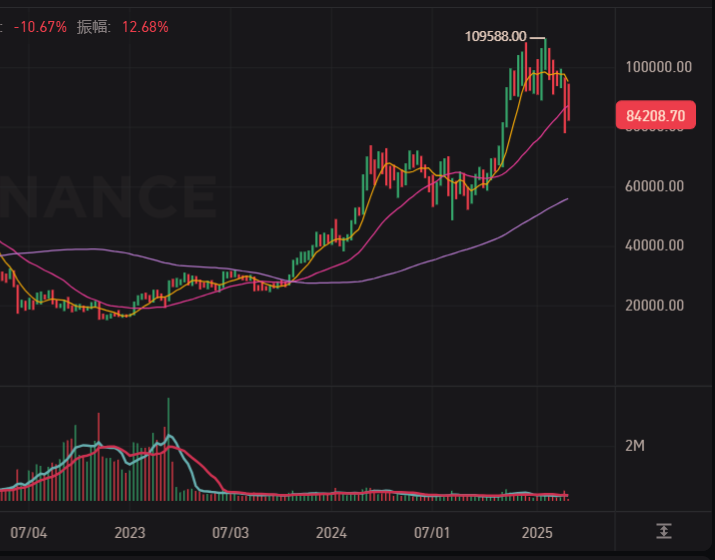
For Bitcoin holders, simply “holding” causes their wealth to rocket upward. Meanwhile, no matter how diligently non-holders work, their wealth grows too slowly to keep pace. This disparity in capital compounding speed makes wealth distribution under crypto capitalism increasingly asymmetric.
The “coin-based” wealth model allows crypto asset holders to achieve financial freedom more easily, while ordinary workers appear increasingly disadvantaged.
3.3 Severe Polarization
The high “volatility” and “risk” of the crypto market amplify wealth polarization.
The crypto market resembles a free-for-all arena without traffic lights—prices swing violently and bull/bear cycles shift rapidly. This high volatility brings not only the possibility of “getting rich overnight,” but also the danger of “wiping out instantly.”
During bull markets, early adopters and “whales” (investors holding massive amounts of crypto) benefit the most. Through strategic trading or simply holding, they enjoy exponential wealth growth. But when the market turns bearish, retail investors who bought at peak prices often suffer the most. They watch helplessly as their portfolios shrink drastically or collapse entirely—especially those who gave in to temptation and used leverage.
At the end of 2021, Bitcoin hit an all-time high, drawing a flood of late-arriving investors. But the boom didn’t last. In 2022, the crypto market crashed—Bitcoin lost nearly 80% of its value, and Ethereum and other cryptos halved. Countless investors who bought high saw their wealth decimated, some wiped out completely.
Data shows that in 2022 alone, the total market cap of the crypto industry erased $2 trillion. How much of that was ordinary people’s hard-earned savings? The answer is obvious.
Market volatility acts like a “double-edged sword”—it accelerates wealth accumulation for early entrants, while erasing gains for latecomers almost instantly.
This rapid flip between heaven and hell intensifies the asymmetry in wealth distribution under crypto capitalism.
3.4 Rampant Market Manipulation
Information asymmetry and market manipulation make it harder for newcomers to profit.
Though touted as “decentralized,” the crypto market still sees information and resources heavily concentrated among a few. Early players, project teams, exchanges, and media often possess more timely and comprehensive data, allowing them to influence market sentiment and price movements.
For instance, some project teams use false marketing and pump-and-dump schemes to fleece retail investors. Some whales collude to manipulate markets, create artificial bull runs, lure retail traders into buying high, then cash out and leave others holding the bag. Ordinary investors, limited by access to information and lacking expertise, struggle to distinguish truth from deception and easily become victims—the “cabbage” being harvested.
In a market marked by information asymmetry and immature regulations, the advantage of being “in the know” is amplified, while uninformed latecomers are more likely to be exploited. This imbalance in information and resources reinforces the “winner-takes-all” outcome in crypto capitalism.
Finally, let’s look at data confirming the asymmetry of crypto capitalism.
Blockchain analytics firms report that nearly 93% of all Bitcoins are held by fewer than 2% of addresses. Shockingly, just 0.03% of addresses control over half (60.6%) of all Bitcoin! Some analysts estimate that around 2,000 addresses hold 37.41% of the world’s Bitcoin!
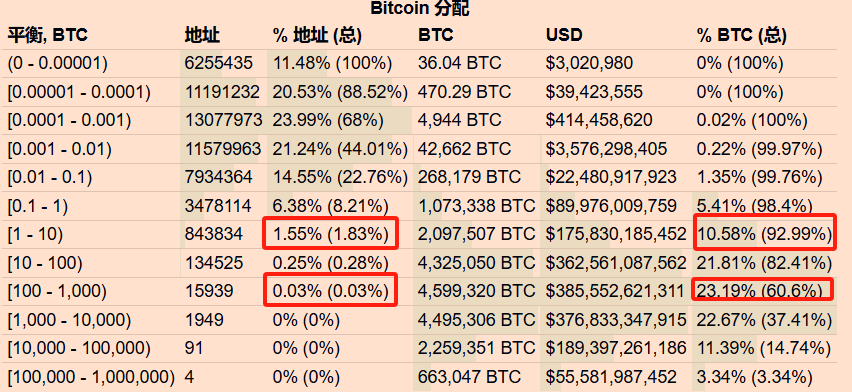
This level of wealth concentration far exceeds that seen in traditional capitalist societies!
Conclusion: By the Fire in the Digital Jungle, Hold Tight to Your Weapon of Understanding
The ultimate paradox of crypto capitalism: it promises equality through decentralized technology, yet amplifies inequality in crueler ways; it tears down the walls of traditional finance, only to build new fortresses of computing power and information.
As we gaze upon this 24-hour wealth perpetual machine, the real battle isn’t against market swings—but against the deeply rooted human instinct for speculation.
Remember, in this borderless digital gold rush, the greatest risk isn’t missing a chance to get rich, but forgetting the human cost behind sudden wealth. When everyone talks about “financial freedom,” true freedom isn’t cracking the code to riches—but seeing through the game and remaining grounded. Wealth may vanish with a lost private key, but human greed will persist eternally on the blockchain. That is the most profound revelation crypto capitalism leaves us with.
In the crypto “casino,” the most valuable chip has never been Bitcoin—it’s the ability to think independently. When the fireworks of algorithmic frenzy fade, those who retain real wealth will always be the clear-minded few who anchored themselves in self-awareness amid the digital flood.
Join TechFlow official community to stay tuned
Telegram:https://t.me/TechFlowDaily
X (Twitter):https://x.com/TechFlowPost
X (Twitter) EN:https://x.com/BlockFlow_News
 @yzdxs8











