








Progress of U.S. State Cryptocurrency Reserve Bills: Is Bitcoin Becoming a New Fiscal Anchor?
TechFlow Selected TechFlow Selected
Progress of U.S. State Cryptocurrency Reserve Bills: Is Bitcoin Becoming a New Fiscal Anchor?
The Bitcoin reserve legislation is still in the exploratory stage at the state level.
 Navigating Web3 tides with focused insights
Author: KarenZ, Foresight News
On the evening of March 2, Trump outlined his ambitious vision: "Ensure America becomes the global capital of cryptocurrency. We are making America great again and advancing a crypto strategic reserve including BTC, ETH, XRP, SOL, and ADA." This initiative not only signals strong federal-level support for cryptocurrencies but could also ignite legislative enthusiasm among U.S. states regarding digital asset reserves.
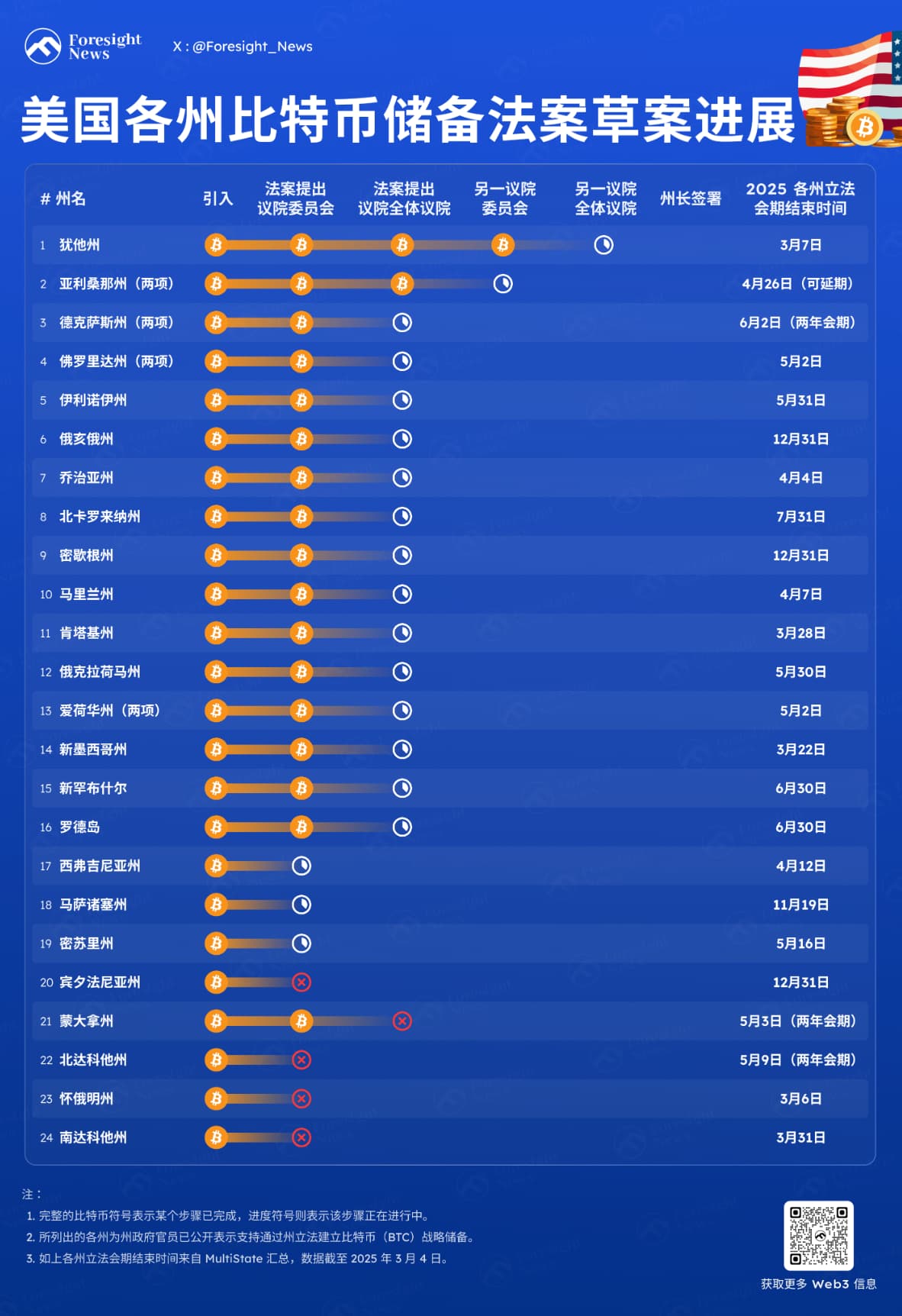
Facing the reality of inflation eroding the purchasing power of traditional assets, state governments—though unable to directly intervene in monetary policy—can explore legislation to incorporate cryptocurrencies like Bitcoin into public finances. As of March 4, 2025, 24 states have introduced draft bills proposing crypto reserves, aiming to implement Trump’s grand blueprint at the local level. These efforts reflect both a response to national strategy and proactive moves by states toward fiscal innovation and economic resilience.
This article will review the U.S. state legislative process and detail the content and progress of Bitcoin reserve proposals across these 24 states.
U.S. State Legislative Sessions and Procedures
A U.S. state legislative session refers to the period during which a state legislature (comprising the House and Senate) formally convenes each year to debate and pass bills. Due to differences in state constitutions and practices, the timing and duration vary significantly across states.
The majority of states hold annual regular legislative sessions, typically from January to May (spring), with lengths ranging from several months to half a year, as determined individually by each state. A few states—including Montana, Nevada, North Dakota, and Texas—convene every two years (in odd-numbered years), resulting in a slower legislative pace.
While there are minor variations between states, most follow a similar basic framework. Each state has its own constitution and a bicameral legislature generally composed of a State House of Representatives and a State Senate. The typical path for a bill to become law in most bicameral states is as follows:
1. **Introduction**: A representative or senator introduces a bill. Once submitted, it receives a number—"HB" for House Bill, "SB" for Senate Bill.
2. **Committee Review**: After submission, the bill is assigned to a relevant committee. The committee may hold public hearings, inviting experts, stakeholders, and the public to testify. Members discuss, amend, and vote on whether to advance the bill to the full chamber.
3. **Chamber Debate and Vote**: Second reading (debate and amendments) and third reading (final vote).
4. **Other Chamber Review**: The bill undergoes a similar committee and floor process in the other chamber (e.g., from House to Senate or vice versa).
5. If versions differ between chambers, reconciliation is required.
5. **Governor's Approval**: The governor may sign, veto, or take no action.
6. **Effective Date**: The bill usually takes effect upon signing, or on a specified date within the bill. Some states allow automatic enactment or expiration if unacted upon within a certain timeframe.
Bitcoin Reserve-Related Draft Bills Across U.S. States
To date, 24 U.S. states have introduced draft bills related to Bitcoin reserves, with some—such as Arizona, Texas, and Florida—submitting two such bills.
In terms of legislative progress, most bills remain in the proposal or initial chamber review stage. Only a few states (notably Utah) have made faster progress, while five states (Pennsylvania, Montana, North Dakota, Wyoming, and South Dakota) have already rejected their respective bills. Reasons cited include concerns over risks associated with digital assets, volatility, taxpayer exposure, high energy consumption of crypto mining, and potential use in illicit activities. Notably, Senator Cynthia Lummis—a known crypto advocate—is from Wyoming. In 2024, she proposed a bill allowing states to voluntarily hold Bitcoin in reserve and established a "Bitcoin Purchase Program" to buy up to 200,000 bitcoins annually for five years, totaling one million bitcoins.
In Utah—the furthest along—the draft bill authorizing partial public fund investment in Bitcoin has passed the House floor and a Senate committee, and now awaits second and third readings, final Senate approval, and the governor’s signature. Given that Utah’s legislative session lasts exactly 45 calendar days, the bill must be approved by the Senate and signed by the governor before March 7, 2025, to take effect on May 7; otherwise, it will expire due to session closure.
Regarding investment scope, most bills focus on Bitcoin and stablecoins, often setting market capitalization thresholds (typically $50 billion or $75 billion) ensuring only Bitcoin qualifies. Even when other cryptocurrencies are permitted, they are mostly limited to donations. A few states expand the scope to broader digital assets, including NFTs and other cryptos.
On investment limits, most states set clear caps: the majority restrict investments to within 10% of public or designated funds (e.g., Arizona, Florida, Michigan), while a few set a 5% cap (e.g., Utah, New Mexico). Wyoming previously proposed a 3% limit, but the bill was rejected.
To ensure asset security, most states require Bitcoin holdings via secure custody solutions, qualified custodians, or exchange-traded products (ETPs)—as seen in Georgia, New Mexico, and Oklahoma. Additionally, some states (e.g., Arizona, Michigan, Rhode Island) permit lending Bitcoin or digital assets without increasing financial risk, reflecting innovative approaches. Most states also establish strict security standards for custody, including multi-party governance, encrypted private key storage, and disaster recovery protocols.
Utah
The Utah Blockchain and Digital Innovation Amendments bill HB0230, introduced on January 28, 2025, authorizes the state treasurer to invest part of public funds in qualifying digital assets (those with an average market cap exceeding $500 billion over the past 12 months—currently only Bitcoin meets this criterion) or stablecoins, capped at 5% of designated accounts. Under specific conditions, the bill permits staking and lending of these digital assets. HB0230 also stipulates that state or local governments cannot prohibit accepting digital asset payments or using self-custody/hardware wallets. Running nodes, developing software, transferring assets, and participating in staking do not require money transmission licenses if fiat currency is not involved. If enacted, HB0230 would take effect on May 7, 2025.
Status: HB0230 has passed the House committee, full House vote, and Senate committee. It now awaits second and third readings, final Senate approval, and the governor’s signature.
Arizona
Arizona currently has two strategic Bitcoin reserve drafts: SB1025 and SB1373, both introduced by senators.
SB1025 authorizes public funds (state treasury and retirement systems) to allocate up to 10% of their managed public funds to virtual currencies. Additionally, if the U.S. Treasury Secretary establishes a Strategic Bitcoin Reserve for government Bitcoin holdings, public funds may deposit their virtual currencies into a secure segregated account within that reserve.
SB1373 proposes creating a Digital Asset Strategic Reserve Fund, funded by legislative appropriations and seized digital assets from within the state. State financial officials should deposit confiscated digital assets into the fund through secure custody solutions provided by qualified custodians or via ETPs issued by registered investment companies. No more than 10% of the fund’s total deposits may be invested in any fiscal year. Digital assets may be lent out for additional returns, provided no financial risk to the state is incurred. The bill defines digital assets broadly, including Bitcoin, stablecoins, NFTs, and virtual currencies.
Status: Both bills have passed the Senate third reading and have been transmitted to the House for consideration.
Texas
Texas currently has two strategic Bitcoin reserve drafts: SB21 and SB778, both introduced by Senator Charles Schwertner. While sharing similar goals, they differ significantly in detail, scope, and implementation.
SB21 aims to enhance fiscal resilience and hedge against inflation through cryptocurrency investments, accepting donations as supplementary funding. It involves establishing and managing a Texas Strategic Bitcoin Reserve Fund for investing in cryptocurrencies and grants investment authority over this reserve and certain other state funds to the Comptroller of Public Accounts (the state’s chief financial officer). The scope includes not only Bitcoin but also other cryptocurrencies (e.g., those acquired via "forks" or "airdrops"). However, a rule specifies that Bitcoin and other cryptocurrencies purchased or donated to the reserve must have had an average market cap of at least $500 billion over the preceding 12 months.
SB778 focuses specifically on Bitcoin, proposing the creation of a strategic Bitcoin reserve to enable the state to own and hold Bitcoin as a financial asset. It allows individuals, including Texas residents, to donate Bitcoin to the reserve, promoting shared ownership and community investment in the state’s financial future. This bill does not involve active investment in other assets.
Status: SB21 is awaiting a vote in a Senate committee. SB778 is under review by the Senate Finance Committee. Both bills specify that if passed by a two-thirds majority in each chamber, they will take immediate effect. Otherwise, they will become effective on September 1, 2025.
Florida
Florida currently has two Bitcoin reserve drafts—House Bill 487 and Senate Bill 550—both introduced in February 2025 and now under committee review. Both authorize the state CFO to maintain flexibility in certain investment decisions and permit investment in Bitcoin and other digital assets from certain public funds to hedge against inflation. Investment is limited to no more than 10% of any account’s total funds.
Status: Both bills are in the committee review stage.
Illinois
The Illinois Strategic Bitcoin Reserve bill HB1844 authorizes the creation of a “Strategic Bitcoin Reserve Fund” within the state treasury as a special fund to hold Bitcoin as a financial asset. It allows state financial officers to accept gifts, grants, and donations of Bitcoin from Illinois residents and government entities. All Bitcoin deposited into the fund must be held for at least five years, after which it may be transferred, sold, appropriated, or converted into another cryptocurrency.
Status: HB1844 has been referred to the House Rules Committee for review.
Ohio
Ohio has two reserve-related drafts: House Bill HB18 and Senate Bill SB57.
HB18, titled the Ohio Strategic Cryptocurrency Reserve Act, allows the state treasurer to invest certain temporary funds—from the General Revenue Fund, Budget Stabilization Fund, and the Deferred Prizes Trust Fund—into digital assets, capped at 10% of each fund’s balance. Although the bill name and provisions suggest a broad range of digital assets, it requires qualifying assets to have an average market cap exceeding $75 billion over the prior 12 months—effectively limiting eligibility to Bitcoin alone.
SB57, titled the Ohio Bitcoin Reserve Act, authorizes state funds to invest in Bitcoin and requires government entities to accept cryptocurrency payments. The state treasurer may use temporary state funds and designated donations to purchase Bitcoin, which must be held for at least five years before any transfer, sale, or conversion.
Status: HB18 was referred to the House Technology and Innovation Committee on January 28. SB57 was referred to the Senate Financial Institutions, Insurance, and Technology Committee on January 29.
Georgia
Georgia introduced its first Senate Bitcoin reserve draft SB178 on February 13, aiming to amend Chapter 17, Title 50 of the Official Code of Georgia Annotated. It authorizes the State Deposit Committee to allow state financial officers to invest in Bitcoin, limiting such investments to no more than 5% of public funds. The bill also specifies that any digital assets acquired under this provision must be held either:
1. Directly via secure custody solutions;
2. By a qualified custodian on behalf of the state;
3. In the form of exchange-traded products issued by registered investment companies.
Additionally, the committee may allow the state treasurer to lend digital assets, provided such lending does not increase the state’s financial risk.
On February 21, Georgia introduced a second Bitcoin reserve draft SB228, which amends the same section of the code. It authorizes the State Deposit Committee to allow investment in Bitcoin and requires state financial officers to develop policies and procedures for receiving, storing, and transacting Bitcoin. Notably, SB228 removes the 5% investment cap and the lending provision found in SB178.
Status: Both SB178 and SB228 are under Senate review.
North Carolina
The North Carolina Digital Asset Investment bill H92 authorizes the state treasurer to invest public funds in digital asset exchange-traded products or digital assets with an average market cap of at least $75 billion over the prior 12 months. Investments per fund are capped at 10%. Eligible public funds include the General Fund, Highway Fund, Highway Trust Fund, and special funds managed by the state treasurer—such as the Teachers’ and State Employees’ Retirement System, Consolidated Judicial Retirement System, Local Governmental Employees’ Retirement System, Heritage Fund, State Education Assistance Authority, and State Property and Fire Insurance Fund.
Status: H92 has been referred to the House Committee on Commerce and Economic Development.
Michigan
Michigan’s HB4087 authorizes the state treasurer to invest funds from the General Fund and the Countercyclical Budget and Economic Stability Fund in cryptocurrencies, capped at 10%. Additionally, the treasurer may lend cryptocurrencies for returns, provided no financial risk to the state is incurred. The bill defines cryptocurrency broadly: digital currency using cryptographic techniques to regulate unit generation and verify transfers, operating independently of central banks.
Status: HB4087 has been referred to the House Committee on Communications and Technology.
Maryland
Maryland’s Strategic Bitcoin Reserve bill HB1389 authorizes the creation of a Maryland Bitcoin Reserve Fund by investing in Bitcoin as a state reserve asset. It also authorizes the state treasurer to invest funds seized from illegal gambling operations into Bitcoin.
Status: HB1389 remains in committee review in the House, primarily under the Judiciary Committee (hearing scheduled for March 11), with possible involvement from the Appropriations Committee (initially assigned to both committees).
Kentucky
Kentucky’s HB376 authorizes the state investment council to invest in certain digital assets and precious metals, prohibits investment in central bank digital currencies (CBDCs), and allows state agencies to accept digital assets and precious metals as payment—but not CBDCs. It requires the Department of Revenue to accept digital assets and gold/silver as payment and mandates the state treasurer to deposit certain digital asset receipts into the Budget Reserve Trust Fund. For digital assets, eligible investments include those with an average market cap exceeding $75 billion over the prior fiscal year and those approved by U.S. or state regulators. The combined investment in digital assets, stablecoins, and precious metals must not exceed 10% of all excess cash investments managed by the state treasurer under subsection (9).
Status: HB376 has been referred to the House Banking and Insurance Committee.
Oklahoma
Oklahoma’s Strategic Bitcoin Reserve bill (HB1203), in its latest revised form, authorizes state financial officers to invest public funds from the following sources into Bitcoin or any digital asset with an average market cap exceeding $500 billion in the prior year, as well as stablecoins: the General Revenue Fund, Revenue Stabilization Fund, and Constitutional Reserve Fund. The bill supports staking digital assets via third-party solutions. If enacted, it would take effect on November 1, 2025. Any state retirement fund may directly hold digital assets using secure custody solutions, store them with qualified custodians, or invest in ETPs formally registered with the SEC or CFTC.
Status: Passed the House Government Oversight Committee on February 25.
Iowa
Iowa currently has two drafts—SF403 and HF246—introduced by a senator and a representative, respectively.
Both allow the state treasurer to invest public funds from the General Fund, Cash Reserve Fund, and Iowa Emergency Economic Fund in precious metals, digital assets with an average market cap exceeding $75 billion in the prior year, and stablecoins, with investments capped at 5% of each fund’s total public funds.
Status: SF403 and HF246 are pending review by the Senate State Government Committee.
New Mexico
New Mexico’s SB275 authorizes the state treasurer and Investment Council to invest in Bitcoin from the following funds: Land Grant Permanent Fund, Resource Tax Permanent Fund, Tobacco Settlement Permanent Fund, and any other state fund deemed appropriate by the Investment Council. Investment is capped at 5%. The bill allows lending assets without increasing state financial risk. Effective date: July 1, 2025.
Status: SB275 is pending review by the Senate Taxation, Business, and Transportation Committee.
New Hampshire
New Hampshire’s HB302 allows the state treasurer to invest public funds in precious metals, digital assets (with an average market cap exceeding $500 billion in the prior year), and stablecoins. The bill takes effect 60 days after passage.
Status: HB302 remains under review by the House Committee on Commerce and Consumer Affairs, currently progressing through subcommittee meetings and upcoming executive sessions.
Rhode Island
Rhode Island’s HB6007 aims to authorize the state treasurer, the State Employees' Retirement System, the Public School Employees' Retirement System, or any other state retirement system to include Bitcoin as a valuable asset to hedge against inflation and protect the purchasing power of state funds. It allows flexibility in investment decisions to adapt to changing economic conditions and emerging opportunities. The state treasurer may invest unspent, unappropriated, or uncommitted funds—from the General Fund, Budget Stabilization Reserve Fund, and other investment funds managed by the treasurer—in Bitcoin or digital assets. The bill defines digital assets as virtual currencies, cryptocurrencies, or native electronic assets, including Bitcoin, stablecoins, NFTs, or other digitally existing assets conferring economic, ownership, or access rights.
In any calendar year, the amount invested in Bitcoin or digital assets must not exceed 10% of the fund’s deposit total at the time of investment. The treasurer may lend Bitcoin or digital assets to generate additional returns, provided no financial risk to the state is incurred.
Status: HB6007 was referred to the House Finance Committee on February 28.
Missouri
Missouri lawmakers have submitted two Bitcoin reserve-related bills: HB1217 and SB614. HB1217 authorizes the creation of a Strategic Bitcoin Reserve Fund, allowing the state treasurer to invest, purchase, and hold cryptocurrencies using part of state funds, accept Bitcoin donations, and require holding for at least five years before any sale, transfer, or exchange. SB614 authorizes the state treasurer to use a portion of state funds to invest in stablecoins or qualified digital assets (those with an average market cap exceeding $500 billion over the prior 12 months), capped at 10%.
Status: Neither bill has entered committee review.
West Virginia
West Virginia’s SB465 allows the state to invest up to 10% of public funds and public retirement funds in precious metals, stablecoins, and digital assets with a market cap exceeding $75 billion.
Status: Neither bill has entered committee review.
Massachusetts
Massachusetts’ SD422 authorizes the creation of a state Bitcoin strategic reserve, permitting broad investment in Bitcoin or other digital assets. In any fiscal year, the state treasurer’s investment in Bitcoin or digital assets must not exceed 10% of the total deposits allocated by the legislature to the State Stabilization Fund. The treasurer may also deposit any Bitcoin or other digital assets seized by the state into the fund. Additionally, Bitcoin or other digital assets may be lent out to generate extra returns, provided no financial risk to the state is incurred.
Status: Neither bill has entered committee review.
Bills That Have Been Rejected
Pennsylvania
Pennsylvania’s House Strategic Bitcoin Reserve bill HB2664, introduced in November 2024, would have allowed the state treasurer to invest 10% of the General Fund, Emergency Fund, and State Investment Fund in Bitcoin and crypto-based ETPs.
Status: Rejected at the committee stage. A petition opposing the bill cited reasons including taxpayer harm, high energy consumption of crypto mining, and frequent use in illegal activities.
Montana
Montana House Bill 429, introduced on February 7, 2025, proposed creating an Inflation Protection Special Revenue Account to invest in precious metals and digital assets. The Investment Council would have been authorized to invest funds in precious metals, stablecoins, and digital assets with a market cap exceeding $75 billion (based on the prior calendar year average). Up to $50 million could have been transferred from the General Fund to this account by July 15, 2025. Notably, Bitcoin is currently the only digital asset meeting this market cap threshold.
The bill defines digital assets as virtual currencies, cryptocurrencies, native electronic assets (including stablecoins and NFTs), and other assets existing solely in digital form that confer economic, ownership, or access rights.
Status: Failed second reading vote in the House, final tally 41 in favor, 59 opposed. Reasons included concerns over digital asset volatility and its impact on taxpayer money, and reluctance to place public funds in high-risk digital investments.
North Dakota
North Dakota’s HB1184, introduced on January 31, 2025, involves investment in digital assets and precious metals. It would have allowed up to 10% investment of funds managed by the Board of University and School Lands and public funds managed by the North Dakota Investment Council in precious metals, digital assets with an average market cap exceeding $500 billion in the prior year, or stablecoins. Digital assets must be held directly via secure custody solutions by the board/state Retirement and Investment Office, or held by qualified custodians or in ETPs on behalf of the state.
The bill supports staking via third-party solutions (provided the state retains legal ownership) and lending digital assets if it increases investment returns without increasing state financial risk.
Status: Rejected in House second reading with 32 votes in favor and 57 opposed.
Wyoming
In January 2025, several Wyoming legislators introduced HB0201, authorizing state public funds to invest in Bitcoin. Specifically, it would have allowed the state treasurer to invest in Bitcoin from the following sources:
1. General Fund: Bitcoin investment capped at 3% of the fund at any time;
2. Wyoming Permanent Mineral Trust Fund: Investment capped at 3% of the fund;
3. Permanent Land Fund: Investment capped at 3% of the fund.
The bill also required the state treasurer to acquire and hold Bitcoin via one or more of the following:
1. Secure custody solutions;
2. Compliant custodians;
3. Exchange-traded products issued by investment companies or managers registered under the 1940 Investment Advisers Act.
Notably, if asset appreciation causes the investment to exceed the 3% cap, the treasurer would not be required to sell or reduce holdings. If depreciation brings the value below the cap, investment in Bitcoin could resume.
Status: Failed to pass in the House Committee on Minerals, Business, and Economic Development. It did not receive necessary reporting or advancement before the full committee deadline.
South Dakota
South Dakota’s HB1202, introduced on February 3, would have authorized state public funds to invest in Bitcoin, capped at 10% of available state investment funds. Holding methods included direct custody by the State Investment Council via secure custody solutions, custody by qualified custodians on behalf of the council, or ETPs issued by registered investment companies.
Status: On February 24, the House Business and Energy Committee voted to postpone HB1202 to the 41st legislative day. Since the state’s legislative session lasts a maximum of 40 days, this decision effectively killed the bill.
Summary
According to analyst Julian Fahrer, in Q1 2025, 12 U.S. states collectively reported holding MicroStrategy shares valued at $330 million. These investments were primarily made indirectly through pension funds or treasury instruments. Given that MicroStrategy is one of the largest Bitcoin holders, this indicates that some states have already begun indirect Bitcoin investment.
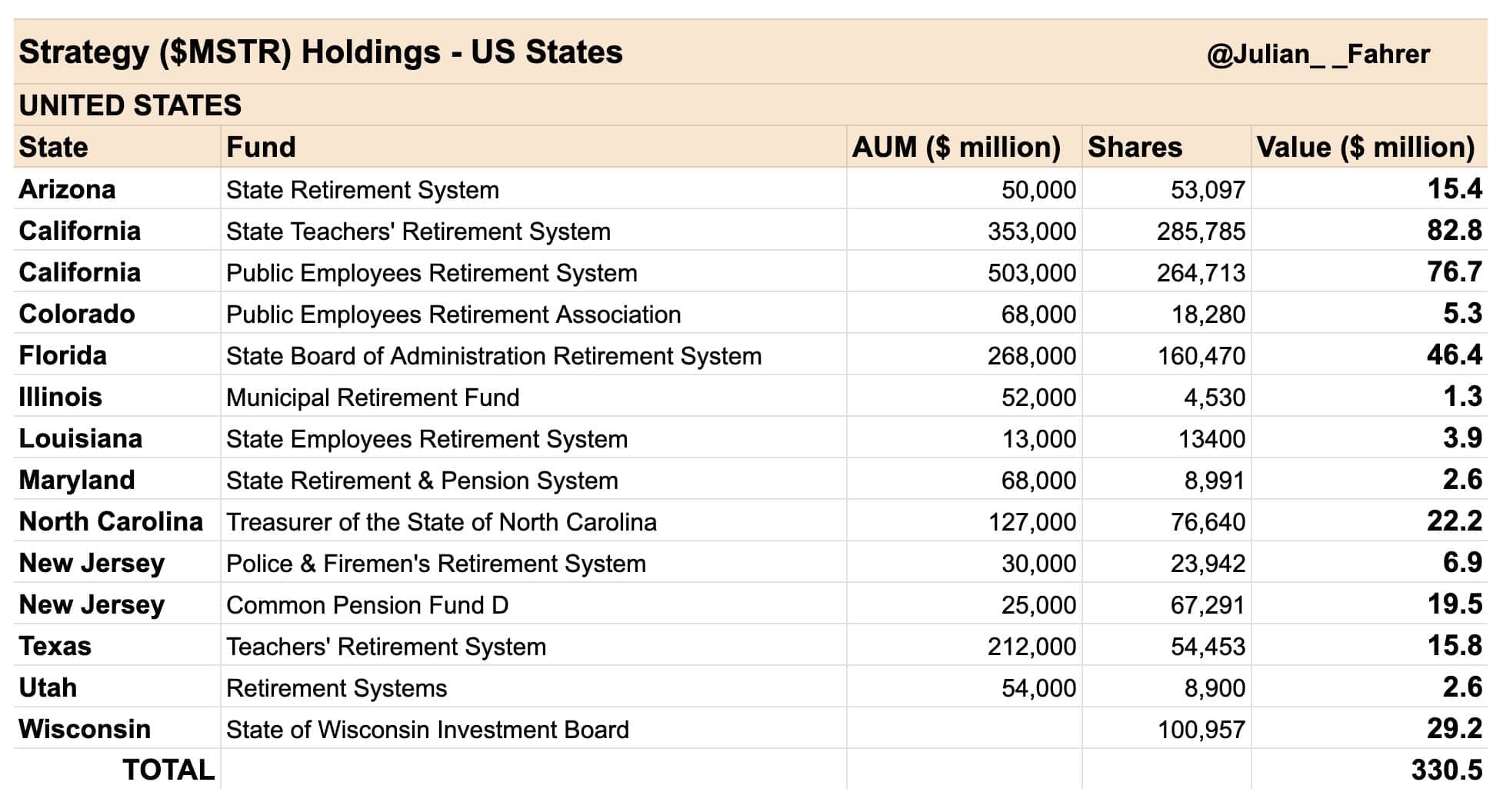
Source: Julian Fahrer
Meanwhile, the wave of crypto reserve bills at the state level represents a concrete manifestation of Trump’s vision to "build the world’s cryptocurrency capital" at the local level.
However, overall, due to legislative procedures, risk concerns, and precedent rejections, the likelihood of most bills passing remains low. 2025 may mark a turning point for crypto strategy, but it is more likely to see only a few states testing the waters rather than widespread adoption. The final outcome will depend on legislative momentum in the coming months and the specific policy direction of the Trump administration.
According to Grok analysis, Bitcoin reserve bills remain in the exploratory phase at the state level, with generally low passage rates. In the short term (1–2 years), the probability of passage in most states does not exceed 30%. However, if breakthroughs occur at the federal level (e.g., Senator Lummis’s proposed Bitcoin Strategic Reserve Act), or if Bitcoin prices stabilize and gain broader institutional acceptance, state-level legislation could gradually accelerate over the next 3–5 years.
Join TechFlow official community to stay tuned
Telegram:https://t.me/TechFlowDaily
X (Twitter):https://x.com/TechFlowPost
X (Twitter) EN:https://x.com/BlockFlow_News
 Foresight News






