Behind DeepSeek's Profit Myth: Big Tech's AI Anxiety and Self-Rescue
TechFlow Selected TechFlow Selected
Behind DeepSeek's Profit Myth: Big Tech's AI Anxiety and Self-Rescue
Open source + free is a "double-edged sword."
 Navigating Web3 tides with focused insights
Author: Wang Lu

Image source: Generated by Wujie AI
AI seems to have become the "lifeline" for tech giants.
Whether it's standout figures in financial reports or frequent positive news, everything revolves around AI.
For instance, in Baidu's mixed 2024 financial report, most of the highlights came from AI:
The daily average invocation volume of the ERNIE large model continued its rapid growth, increasing 33-fold year-on-year to 1.65 billion. Baidu Wenku has over 40 million paying users, ranking second globally and first in China.
Alibaba also kicked off the year with a triple breakthrough powered by AI:
First, under the influence of DeepSeek, Alibaba’s open-source large model Qwen attracted widespread attention; then, the newly released Qwen2.5-Max was praised as outperforming DeepSeek V3; shortly after, it announced an AI partnership with Apple, sending its stock price soaring.
However, in the nearly 40 days since DeepSeek burst onto the scene, anxiety has outweighed gains for big tech companies. After all, each has invested massive human, material, and financial resources—yet the product that made a splash came from a startup team. Recently, DeepSeek even revealed explosive data—its theoretical cost-profit margin reaches as high as 545%, with potential daily profits reaching 3.46 million yuan.
Faced with such shocks, tech giants are changing course: some adopt a “if you can’t beat them, join them” approach by announcing integration with DeepSeek, while others shift their proprietary models toward open-source, even sacrificing a commercial path by offering consumer-facing (C-end) products for free.
But can these moves truly cure the AI anxiety plaguing the tech giants?
How Is AI Progressing Among Tech Giants?
Prior to DeepSeek's emergence, the strategy of tech giants in AI was high-profile and heavily resourced, building products around their core strengths.
Large models are seen as foundational infrastructure in the AI industry. Internet giants (Baidu, Tencent, Alibaba, ByteDance, Kuaishou), consumer electronics manufacturers (led by Huawei), and intelligent speech firms (such as iFlytek) have all launched self-developed large models. Compared to startups like the “Six Little Tigers of AI,” tech giants hold advantages in capital and talent reserves.
Judging from the overall pace of technological iteration in the AI industry and public information, there is no fundamental technical difference among large models developed by tech giants. However, they differ in timing of entry, model positioning, and market strategies. The distinctions are outlined below:
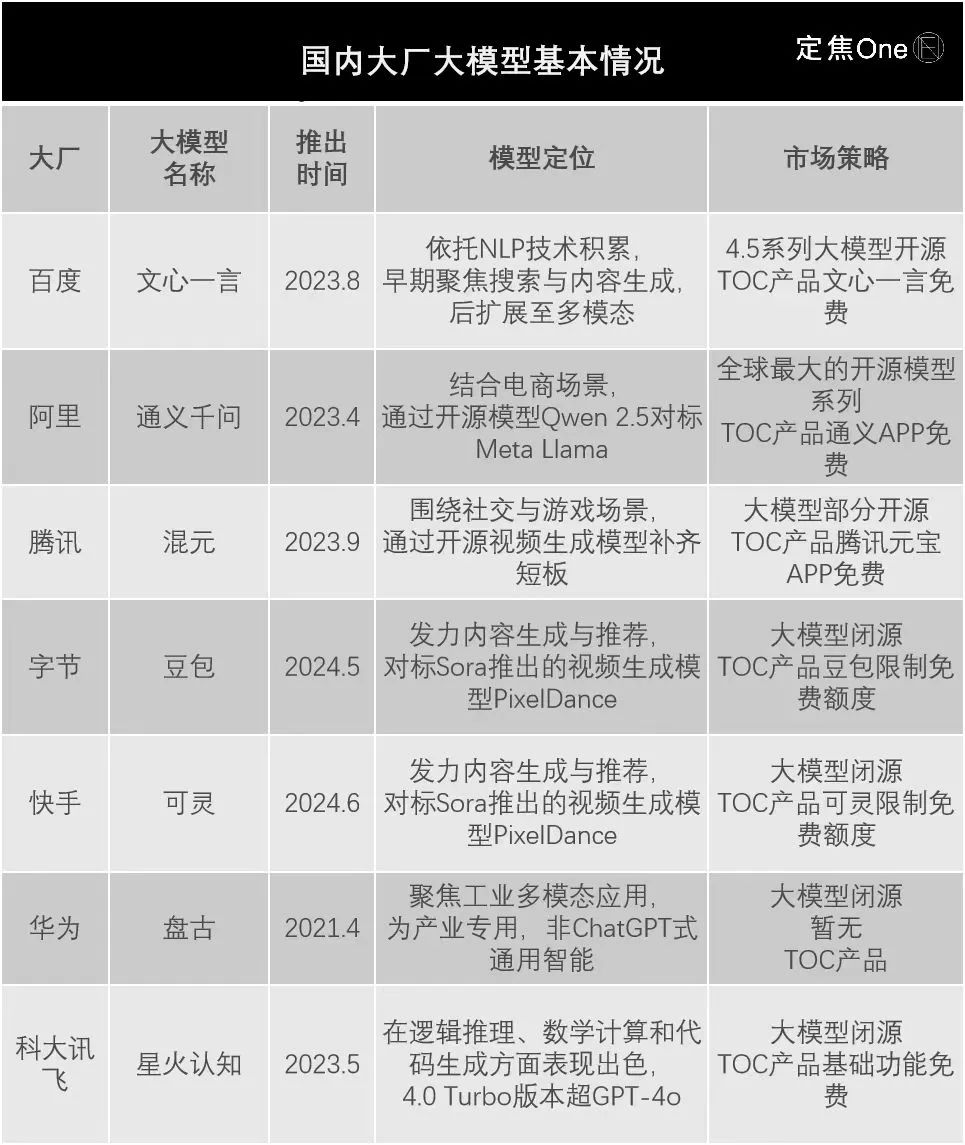
These three differences reflect, to some extent, how tech giants initially perceived and positioned AI.
For example, early launch timing indicates that a company had earlier technological investments and accumulated expertise in related fields, along with faster responsiveness. However, the risk lies in immature technology, leading to higher R&D and marketing costs.
From the table above, Huawei was the earliest entrant. However, it should be noted that although its underlying architecture is still based on Transformer, it differs entirely from ChatGPT-style dialogue systems, focusing instead on industry-specific applications (in contrast to ChatGPT’s general-purpose intelligence). If we focus solely on general-purpose large models, Baidu took the lead, initiating private testing of its ERNIE Bot in March 2023 (not fully open).
Nonetheless, launch timing isn't the key criterion for evaluating model quality.
A tech giant’s business layout determines the application direction of its large model, shaping different model positions—technically rooted in training data sources.
Baidu’s ERNIE relies primarily on internet text data; Alibaba’s Qwen uses multimodal data including text, images, and audio; Tencent’s Hunyuan leverages social network and user behavior data; ByteDance’s Doubao draws about 50%-60% of its data from internal platforms like Douyin and Toutiao; Huawei’s Pangu integrates diverse datasets covering industry, weather, text, and images.
This results in distinct strengths across models: ERNIE excels in long-text processing and multilingual conversations; Hunyuan performs better in social scenarios; Doubao leads in content generation and precise recommendations; Qwen responds faster in e-commerce recommendation contexts; Pangu stands out in execution speed and generalization ability, efficiently handling large-scale tasks.
Clearly, each model's strengths mirror its parent company's core businesses.
Finally, looking at market strategy, this reflects, to some degree, a tech giant’s assessment of its own capabilities and industry trends. Two observable aspects are openness (open vs. closed source) and whether consumer-facing (C-end) products are offered for free.
Currently, ByteDance, Kuaishou, iFlytek, and Huawei maintain closed-source models, whereas Baidu, Tencent, and Alibaba have chosen to open-source most of theirs. For C-end applications, Baidu, Tencent, and Alibaba have adopted free models, while ByteDance, Kuaishou, and iFlytek typically offer limited free usage quotas.
Alibaba has already tasted the benefits of open-sourcing: according to the latest open-source large model ranking published by Hugging Face, all top ten models are derivatives of Alibaba’s Qwen.
In C-end products, Doubao—which has stuck to a free model—has shown the strongest growth. According to AI product rankings, in January 2025, Doubao ranked first among domestic apps with over ten million monthly active users, reaching 78.61 million, far surpassing other tech giants’ offerings.
Yet many remain curious about the overall ranking of large models developed by tech giants. Industry insiders suggest that currently, top-tier large models from tech giants are mostly closed-source, making it difficult to assess their true capabilities given incomplete transparency.
Frost & Sullivan’s report *“2024 China Large Model Capability Evaluation”* states that Baidu’s ERNIE, Tencent’s Hunyuan, and Alibaba’s Qwen belong to the first echelon, citing their comprehensive technical capabilities and relatively large user bases. However, it does not clearly identify which one leads overall.
Software engineer Qin Xiang notes that differences exist across technical architectures and training data. From an architectural standpoint, model scale and parameter count are crucial indicators of complexity and capability. Generally, larger models with more parameters possess stronger learning and expressive abilities. For example, DeepSeek-R1 is dubbed a parameter behemoth with 671 billion parameters, creating a vast knowledge repository.
He adds that by this measure, among large models from tech giants, those with strong reasoning capabilities—like ERNIE—rank highly. But in vertical domain performance, ERNIE falls behind Qwen, which has developed and deployed eight specialized vertical models based on its foundation.
In short, each large model has unique strengths, making it hard for any single player to dominate across all dimensions.
40 Days After DeepSeek’s Breakout: Four Major Shifts Among Tech Giants
DeepSeek’s rise has prompted tech giants to reevaluate their AI strategies. Based on recent developments and insights from industry players, four major shifts have emerged.
First: Transition from closed-source to open-source—the most significant change.
Multiple practitioners emphasize that DeepSeek’s popularity owes much to its open-source nature.
Debates over open versus closed-source models have long persisted both domestically and internationally. Baidu Chairman Robin Li was once a staunch advocate of closed-source, arguing that it offers superior technological leadership and business model sustainability compared to open-source.
Qin Xiang explains from a technical perspective that open-sourcing means revealing core code, allowing competitors to quickly replicate technical pathways. Early choices for closed-source were mainly to protect intellectual property and commercial moats (e.g., OpenAI did not open-source GPT-3 initially).
However, he observes that under DeepSeek’s influence, tech giants have shifted direction—now favoring ecosystem lock-in (for example, Tencent open-sourced its video model to attract developers to use its cloud services) for long-term gains rather than relying solely on technical secrecy.
Baidu has now announced that its ERNIE 4.5 series will be fully open-sourced by June 2025. To date, most models from Baidu, Alibaba, and Tencent have either been open-sourced or declared so.
Second: Business focus shifting from B-end to “dual-track” B2B and B2C strategies.
Qin Xiang explains that large models generate revenue through three main channels: value-added services, data monetization, and compliance services—with value-added services being the largest contributor, driven by enterprise customization and API calls. He reveals that Baidu’s ERNIE enterprise edition charges annual fees exceeding tens of millions of yuan, while Alibaba Cloud’s Qwen secures contracts worth hundreds of millions for customized customer service systems for government and enterprises.
In other words, tech giants still rely heavily on B-end monetization. However, recently, many have begun emphasizing C-end app promotion, adopting a dual B2B and B2C strategy.

Image source / Pexels
For example, Tencent has intensified marketing for its Yuanbao app—integrating it into WeChat’s nine-grid menu for strong traffic access, and launching multi-channel advertising campaigns across Tencent ecosystems, Douyin, Bilibili, and Zhihu.
According to App Growing data, in February’s top 20 AI tools by ad spending intensity, major tech giants' AI products all made the list (Huawei excluded due to lack of C-end offerings). Tencent Yuanbao spent the most—accounting for 46% of total ad spending in February alone, nearly matching its previous nine-month total, surpassing ByteDance’s Doubao.
Additionally, Alibaba has launched large-scale hiring for C-end business roles.
Industry observers believe this may stem from increased pressure on tech giants’ B-end businesses due to DeepSeek’s open-source model and low API pricing, pushing them to explore new monetization paths via C-end expansion.
The third shift: Moving C-end applications from paid to free.
DeepSeek is powerful and free. After its surge in popularity, both Baidu’s ERNIE Bot and OpenAI’s upcoming GPT-5 announced plans to offer free access to users.
“The goal is to attract more users and increase market share,” said Qin Xiang. More user feedback helps refine model performance, thereby enhancing B-end service capabilities and justifying higher fees for enterprise-customized models.
The fourth shift: Shifting from heavy investment to cost reduction and price wars.
During the past few years of the “hundred-model war,” global AI companies have poured billions—even tens of billions—of dollars into development. Yet DeepSeek trained its DeepSeek-R1 model—comparable in capability to OpenAI o1—using only $5.576 million in GPU costs. This has forced tech giants to rethink their approaches.
Multiple insiders confirm that cost-cutting efforts began in the second half of last year, but DeepSeek’s emergence accelerated this trend.
Qin Xiang clearly feels that since last year, competition in large models has shifted from “technology-first” to “cost + ecosystem.” For example, in January, Doubao 1.5Pro slashed its API prices significantly; in December, ByteDance reduced visual model prices by up to 85%, ushering the industry into the “cent era.”
In February, two former Baidu executives reignited a public debate over pricing: Shen Du, President of Baidu Intelligent Cloud (ACG), criticized what he called “malicious price wars” in China’s large model industry during an internal meeting, directly naming Doubao. In response, Tan Dai, President of ByteDance’s Volcano Engine, posted on social media defending price cuts as an inevitable outcome of technological advancement.
DeepSeek hasn’t stayed idle either. Shortly after announcing the end of its API promotional period, on February 26 it unveiled a “limited-time discount”: from 00:30 to 08:30 daily, DeepSeek-V3 prices dropped to 50% of original, and DeepSeek-R1 to as low as 25%, marking a maximum reduction of 75%.
The pressure on tech giants grows heavier.
Can Free and Open-Source Strategies Help Tech Giants Reclaim Dominance?
Among these four changes, industry experts agree that open-sourcing and free access currently exert the greatest impact on tech giants.
Let’s first examine open-sourcing.
Liu Cong, a large model expert, points out that before DeepSeek emerged, both foreign players like OpenAI and domestic tech giants either kept everything closed-source or only open-sourced non-top-tier versions. DeepSeek, however, open-sourced its most advanced reasoning model—DeepSeek-R1—an aspect that greatly excited the developer community.
Nevertheless, open-sourcing entails certain revenue losses and technical risks.
Dr. Weiliang, an AI PhD, explains that open/closed source represents two distinct business models and development philosophies—indirect vs. direct monetization. Alibaba’s Qwen serves as a typical example of successful open-sourcing in China, where adaptation support fosters commercial partnerships—a strategic choice aligned with its ecosystem.
Yet many tech giants originally positioned large models as productivity tools led by technology—such as OpenAI, Baidu, Huawei, and iFlytek—where subscription revenue forms a critical income stream. Choosing open-source inevitably affects this revenue.
Open-sourcing also exposes companies to malicious attacks and community maintenance challenges. With code publicly available, attackers can analyze it to find vulnerabilities and exploit systems using these models.
Ongoing community maintenance is another concern. As Qin Xiang notes, open-sourcing requires continuous investment in supporting developer communities (providing documentation, technical support, version updates); otherwise, the technical ecosystem may fragment. He explains that if developers modify the code independently and create multiple forks (like Ubuntu and CentOS from Linux), unifying technical standards becomes harder, resulting in “technical fragmentation.”
Image source / Pexels
Some practitioners frankly admit that even with open-sourcing, the appeal of tech giants remains limited.
The purpose of open-sourcing is to attract developers and partner companies to build upon the model for innovation and application development. However, Dr. Weiliang believes “current open-source initiatives by various companies seem partly promotional.”
“What open-sourcing reveals includes inference methods and parameter weights, but the more crucial aspects—data filtering techniques and model training know-how—are not disclosed, making it difficult for ordinary developers to achieve real technical iteration,” he says.
It’s important to note that open-source doesn’t mean completely free. Users must comply with the provider’s open-source license, which may include “payment clauses.”
For example, Dr. Weiliang uses Alibaba’s Qwen to develop AI applications. Once he validates a solution using Qwen, further enterprise-level fine-tuning and customization require contacting official personnel. He also reveals that licenses may impose restrictions based on company size—for instance, requiring payment when employee headcount exceeds a threshold.
Now consider the impact of going free.
Tech giants adopt free strategies aiming to rapidly capture the C-end market. A prime example is Doubao, which has remained free from the start. According to QuestMobile, as of February 9, 2025, Doubao achieved a weekly average daily active user count (calculated over the week of Feb 3–9) of 18.45 million, second only to DeepSeek and ahead of Kimi, Wenxiaoyan, Tongyi, and Yuanbao.
However, the actual significance of being free remains uncertain among practitioners. This uncertainty stems from low user loyalty toward chatbot tools and weak willingness among Chinese users to pay.
“Even for paid AI video generation tools, most domestic apps rely on free credits to attract users,” said one practitioner. He believes Doubao’s success among similar general-purpose AI products stems not only from being free but also from ByteDance’s strong marketing power.
Qin Xiang argues that DeepSeek’s “catfish effect” has forced tech giants to shift from pure technological competition to a broader contest centered on cost and ecosystem. Open-source and free strategies are a “double-edged sword” for coping with competition and building ecosystems. Even though these measures may reduce short-term profits, they’ve become necessary moves.
The ripple effects triggered by DeepSeek are far from over.
Join TechFlow official community to stay tuned
Telegram:https://t.me/TechFlowDaily
X (Twitter):https://x.com/TechFlowPost
X (Twitter) EN:https://x.com/BlockFlow_News