OKX's $500 Million Settlement Reveals the Survival Rules of the Crypto Industry
TechFlow Selected TechFlow Selected
OKX's $500 Million Settlement Reveals the Survival Rules of the Crypto Industry
Analysis of the core terms of the settlement agreement and their impact on industry compliance development.
 Navigating Web3 tides with focused insights
Author: An Shouzheng Legal Services Co., Ltd.
On February 25, 2025, according to an official announcement from OKX, its Seychelles subsidiary has reached a settlement with the U.S. Department of Justice (DOJ) regarding an ongoing investigation. OKX admitted that due to past deficiencies in compliance controls, a small number of U.S. customers had previously conducted trading on its global platform.
Under the terms of the settlement agreement, OKX has agreed to pay an $84 million penalty and forfeit approximately $421 million in revenue earned from U.S. clients during the relevant period, the majority of which originated from a limited number of institutional clients. This article provides a comprehensive analysis of the incident, focusing on the core provisions of the settlement and their implications for industry-wide compliance development.
1. Incident Overview
Timeline
Since 2018, OKX Seychelles has offered cryptocurrency spot and derivatives trading services to U.S. customers via the global platform OKX.com. At that time, the cryptocurrency market was booming, with new platforms emerging rapidly. Although headquartered in Seychelles, under U.S. Bank Secrecy Act (BSA) and Money Transmitter Act regulations, any entity providing fiat exchange or asset transfer services to U.S. users must obtain licenses from FinCEN and relevant state regulators.
From 2018 to 2019, OKX Seychelles failed to adequately assess the complexity of U.S. financial regulation and prematurely expanded into U.S.-facing operations. During this period, global crypto regulation remained in a gray area, and compliance was generally overlooked across the industry—including by OKX Seychelles.
Between 2019 and 2023, these issues became increasingly apparent. OKX Seychelles operated without money transmission licenses from any U.S. state—such as New York’s BitLicense or Florida’s money transmitter license. Due to technical vulnerabilities like insufficient IP address blocking, approximately 32,000 U.S. users were able to trade, involving $4.21 billion in transactions, accounting for 5% of OKX's global revenue—an operationally significant volume of non-compliant business.
Specific Violations
1. Licensing Deficiencies and Regulatory Violations: Failure to register as a Money Services Business (MSB) with FinCEN meant OKX could not meet mandatory anti-money laundering (AML) and Know Your Customer (KYC) requirements, lacking legal authorization to conduct money transmission activities.
The absence of state-level money transmitter licenses (e.g., in California) violated state regulations concerning fund security, financial soundness, and risk management, casting serious doubt on the legality of its operations.
2. AML Mechanism Failures: Enhanced Due Diligence (EDD) was not applied to high-risk U.S. customers (e.g., those linked to sensitive regions or industries). The company failed to trace sources of funds or transaction purposes, creating loopholes for illicit funds to be laundered. This contravenes the core principles of the Bank Secrecy Act and potentially enabled cross-border criminal proceeds to flow through its systems.
3. Geographic Blocking Technology Deficiencies: Technical flaws—including outdated IP databases and algorithmic weaknesses—prevented effective blocking of access from U.S. IP addresses, allowing U.S. users to continue using the service in violation of regulations. This directly breaches Section 5330 of the BSA and Title 18, Section 1960 of the U.S. Code (prohibiting unlicensed money transmitting), constituting systemic compliance failure.
Investigation and Settlement Process
In 2022, the U.S. Department of Justice (DOJ), Department of Homeland Security (DHS), and Commodity Futures Trading Commission (CFTC) jointly launched an investigation into OKX Seychelles, with responsibilities divided among them:
DOJ: Assessed legal gaps and operational compliance; DHS: Tracked fund flows and user data; CFTC: Specifically reviewed violations related to cryptocurrency futures trading.
Key Terms of the Settlement Agreement (December 2023)
1. Financial Penalties: OKX Seychelles is required to pay an $84 million fine, with $60 million going to the DOJ and $24 million to the CFTC.
2. Operational Restrictions: In addition to forfeiting $4.21 billion in revenue from U.S. customers, OKX Seychelles is mandated to permanently exit the U.S. market. This severs all business ties between OKX Seychelles and the U.S., eliminating any possibility of future unauthorized operations in the country. The decision to permanently withdraw from the U.S. market significantly impacts OKX Seychelles’ global business strategy.
3. Compliance Remediation: OKX must undergo oversight by an independent compliance monitor for the next three years. The monitor will comprehensively supervise all aspects of its operations, including implementation of AML measures, customer identification procedures, and transaction recordkeeping. By introducing external third-party supervision, this ensures OKX Seychelles establishes a genuinely effective compliance framework, transitioning from non-compliant to compliant operations.
2. Legal Analysis
Core Logic of U.S. Crypto Regulation
U.S. regulation of the crypto industry centers on “functional regulation,” a highly targeted and systematic approach.
1. Securities Law (Led by SEC): Tokens meeting the "Howey Test" are classified as securities. The Howey Test evaluates four criteria: (1) investment of money; (2) in a common enterprise; (3) with a reasonable expectation of profits; (4) derived primarily from the efforts of others.
For example, certain initial coin offering (ICO) projects may constitute securities if investors purchase tokens expecting returns generated by the project team’s efforts, and if token value depends substantially on such efforts. Once deemed a security, issuers must comply with securities laws, including registration and disclosure obligations.
2. Commodities Law (CFTC Jurisdiction): Bitcoin and Ethereum are categorized as commodities. The CFTC regulates commodity futures trading to ensure fair, transparent, and orderly markets. For crypto futures, the CFTC requires exchanges to implement robust risk management frameworks to prevent market manipulation and fraud. For instance, it strictly enforces position limits and large trader reporting rules to maintain market stability.
3. Anti-Money Laundering Laws (Enforced by FinCEN): All entities involved in fiat-to-crypto conversion must register as MSBs. This requirement aims to prevent money laundering and terrorist financing at the source. Registered MSBs must establish rigorous AML programs, including customer identification, transaction monitoring, and suspicious activity reporting.
For example, when a crypto exchange facilitates fiat transactions, it must verify each customer’s identity, authenticate personal information, monitor transaction behavior in real-time, and promptly report any suspicious activity to FinCEN.
In the OKX case, the DOJ pursued charges based on “unlicensed money transmitting” rather than “securities fraud,” indicating a preference for applying established financial regulations to combat cross-border violations. OKX Seychelles' primary misconduct involved operating unlicensed remittance services, directly violating U.S. regulatory requirements for money transmission. Compared to securities fraud allegations, unlicensed money transmission charges are more straightforward and allow for quicker enforcement action.
Comparison with Similar Cases
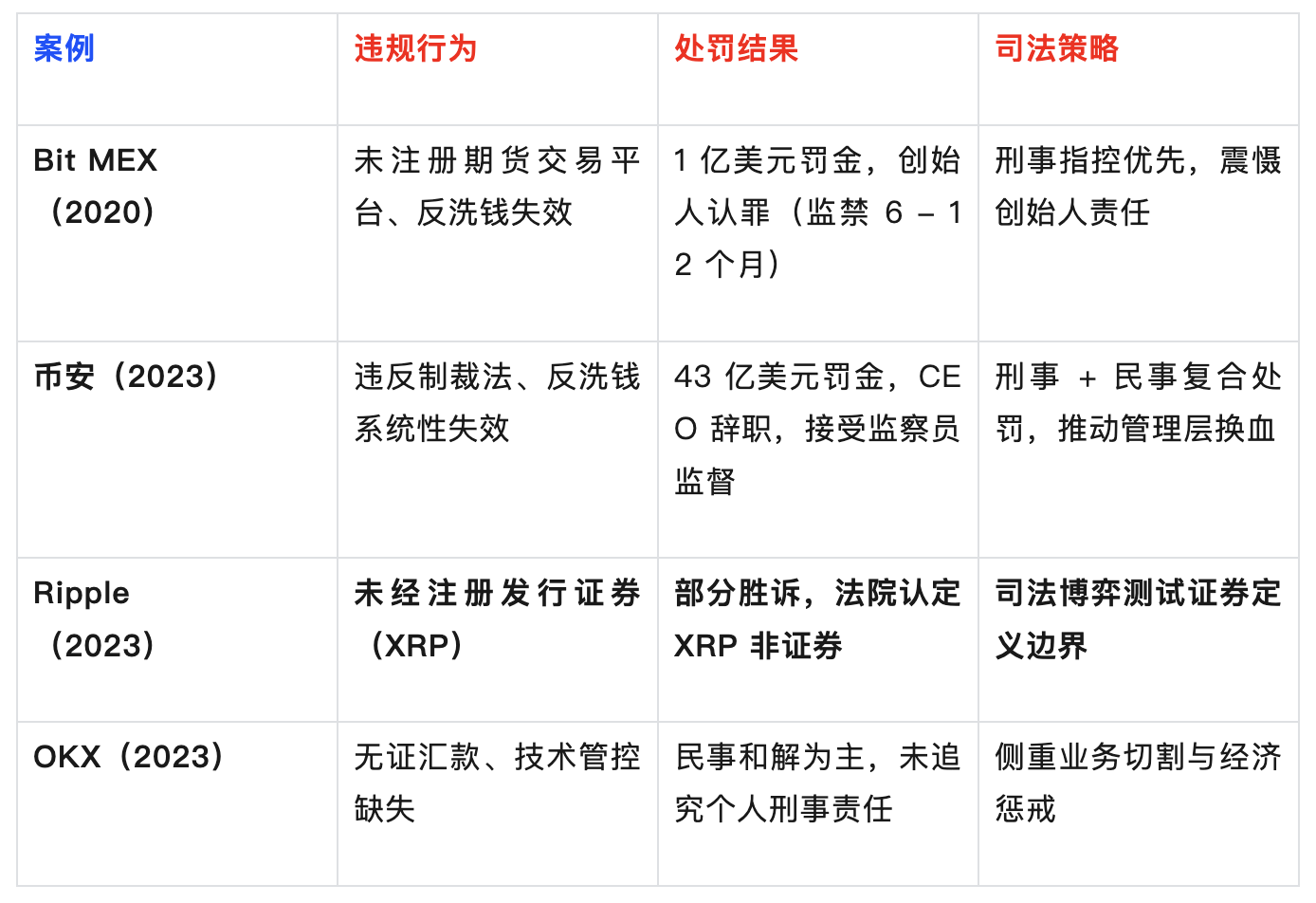
1. Sentencing Gradient: From a penalty perspective, Binance faced the harshest consequences—$4.3 billion in fines, CEO resignation, and acceptance of monitorship—due to violations involving sanctions evasion, crossing international red lines.
BitMEX was fined $100 million, with founders facing potential imprisonment, due to operating an unregistered futures platform and failing AML obligations, causing significant disruption to market integrity. In contrast, OKX received a relatively lighter treatment through civil settlement, paying $84 million, largely because its misconduct was confined to unlicensed money transmission and technological control failures.
2. Judicial Innovation: The OKX case marks the first time that “deficient geoblocking technology” has been explicitly cited as a legal violation, setting a precedent for future cross-border enforcement. While prior crypto regulatory cases have acknowledged the role of technology in compliance, none previously singled out geoblocking deficiencies as a distinct element of illegality.
This ruling gives regulators clearer legal grounding and direction when handling similar cross-border compliance breaches, further refining the regulatory framework for the crypto industry.
Legal Significance of the Settlement Agreement
1. Efficiency First: The settlement avoids protracted litigation. As seen in the Ripple case, which lasted three years and consumed substantial judicial and corporate resources, prolonged trials can hinder enforcement. The OKX settlement concluded within just over a year, enabling swift recovery of penalties and removal of a non-compliant actor from the market. This significantly improves regulatory efficiency, freeing up resources for other critical oversight tasks.
2. Balanced Deterrence: The substantial fine—equivalent to about 20% of annual revenue—serves as a strong deterrent across the crypto industry, making clear the severe financial consequences of non-compliance. However, avoiding criminal prosecution preserves the company’s viability, allowing room for reform and re-entry into compliant operations. This balanced approach deters misconduct while supporting industry sustainability, preventing excessive punishment from destabilizing the broader ecosystem.
3. Compliance Guidance: Mandating an independent monitor pushes the company to build a “verifiable compliance system.” With external expert oversight, OKX must ensure its compliance measures are not only implemented but also demonstrably effective. This not only facilitates OKX’s own transformation toward compliance but also sets a replicable model for the wider industry, promoting higher overall compliance standards.
3. Global Regulatory Trend Outlook
Global regulation of digital assets has intensified across multiple dimensions in recent years. The EU’s Markets in Crypto-Assets Regulation (MiCA) took effect in 2024, requiring exchanges to submit whitepapers and prove reserve adequacy. The U.S. has established the National Cryptocurrency Enforcement Team (NCET) to strengthen interagency coordination. FATF’s “Travel Rule” now extends to DeFi, obliging DApp developers to attach user information to on-chain transactions. Meanwhile, jurisdictions like the UAE and Singapore attract compliant firms with “light-touch licensing,” creating a competitive regulatory landscape alongside stricter regimes in Europe and North America.
The OKX settlement underscores that within the dominant U.S.-EU regulatory framework, crypto firms must internalize compliance as a core competitive advantage. Contrasting Binance’s strategy of “expand first, fix later” with Coinbase’s early heavy investment in compliance—which led to broad licensing coverage and positioned it as the preferred partner for traditional institutions—the future belongs to companies that embed compliance into their technology architecture, organizational culture, and business strategy, enabling them to lead through the regulatory reshaping of the industry.
Join TechFlow official community to stay tuned
Telegram:https://t.me/TechFlowDaily
X (Twitter):https://x.com/TechFlowPost
X (Twitter) EN:https://x.com/BlockFlow_News
 @anzhengsecurity