








Swallowing the World: The Real Connection Between Cryptocurrency and the World
TechFlow Selected TechFlow Selected
Swallowing the World: The Real Connection Between Cryptocurrency and the World
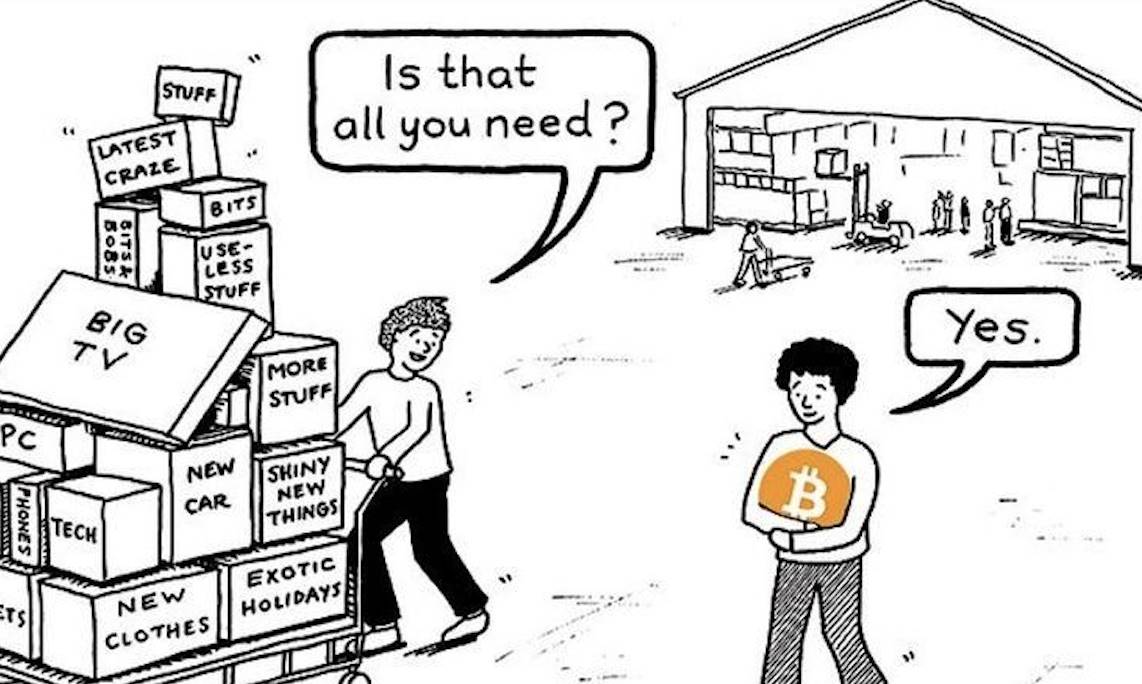
Bitcoin is time, the first DePIN product, and the first to demonstrate the network effect of cryptocurrency.
 Navigating Web3 tides with focused insights
By Zuo Yeye Waishe Mountain
With David Sacks pushing hard, the White House crypto summit is imminent.
Yet the Eastern crypto industry isn't happy. Many believe Trump is treating crypto purely as an ATM, continuously draining internal liquidity and driving prices further down. Against this backdrop, cries of "crypto for crypto's sake" are rising—not outwardly rejecting users, but implicitly urging distance from political whirlpools.
Undeniably, cryptocurrency has become part of the real world;
Inevitably, blockchain’s economic returns and purity have declined.
Looking at the current state of crypto, PVP (player-versus-player speculation) is clearly a dead end. Meanwhile, innovations like DeFi and NFTs from the 2021 cycle remain nowhere in sight. If you don’t participate in PVP, both Trump and ETFs will extract value, while Pump Fun and Four Meme will take your USDT anyway—so why not just join the PVP circus and enjoy the moment?
Of course, I’m referring specifically to the crypto space.
On this matter, Western scholars long ago documented the dynamics through *The Wealth of Nations* and the Prisoner’s Dilemma:
The two paths originating from individual self-interest are:
-
The Wealth of Nations: Individual profit-seeking → Market exchange → Resource optimization → Economic growth
-
Game Theory: Individual rationality → Short-term博弈 → Resource competition → Collective suboptimal outcome

In other words, the core issue today is that the crypto industry fails to generate or retain meaningful value, ultimately reducing everything to a USD-denominated mindset, where no one wants to hold any crypto assets.
In reality, both the FOMO and FUD surrounding Trump’s engagement with crypto represent emotional cleansings. From $TRUMP to metaverse and NFT mania, these movements clearly exceed Trump’s personal operational capacity—otherwise it would be absurd to imagine him simultaneously confronting Zelenskyy while orchestrating a crypto masterplan.
The only real question is who the connecting KOL agencies are. They’ve replaced K Street lobbyists, proving that crypto’s lobbying power now rivals that of the traditional military-industrial complex.
Nothing is real; Bitcoin is value.
At this pivotal moment for the industry, revisiting Bitcoin’s journey reveals that it was never meant to be an exclusive private asset, but rather a gift to all humanity. It was precisely because of its extreme inclusivity that Bitcoin evolved—from a tool for money laundering and a toy for tech enthusiasts—into a globally recognized synonym for value.
If you believe in the compounding power of time, you will be rewarded in life.
Looking Beyond the Snow Line: Crypto’s Continuous Evolution
High temperature corresponds to disorganization; low temperature corresponds to high order.
The crypto market is currently extremely hot, meaning entropy and disorder are exceptionally high. After Hong Kong’s consensus conference, the years-long trend of viral blog posts and memes vanished overnight—signaling that insiders can no longer find common ground, leaving only KOL agents staring blankly at each other, seeing one another as mere downlines.
A crypto subculture is forming. Group consciousness within our little crypto world is stirring beneath the surface. He Yi’s appearance on BOSS Zhipin reflects the industry’s self-organization. The outside world remains oblivious—but such moments of accumulating strength often precede breakout moments.
In this cycle, BTC/ETH/SOL have sequentially underperformed. A $100K BTC has become a gatekeeper guarded by fate, ETH has been sleepwalking throughout, only beginning internal restructuring. In contrast, SOL appears relatively normal—merely replacing the FTX and Jump conspiracy groups with new token-launch cartels.
The true future clearly doesn’t lie in the battle between L1s and L2s, but in stablecoins’ gradual replacement of cash. The only real question is: To what extent can stablecoins + public chains like SOL/Tron/EVM replace small financial systems across countries?
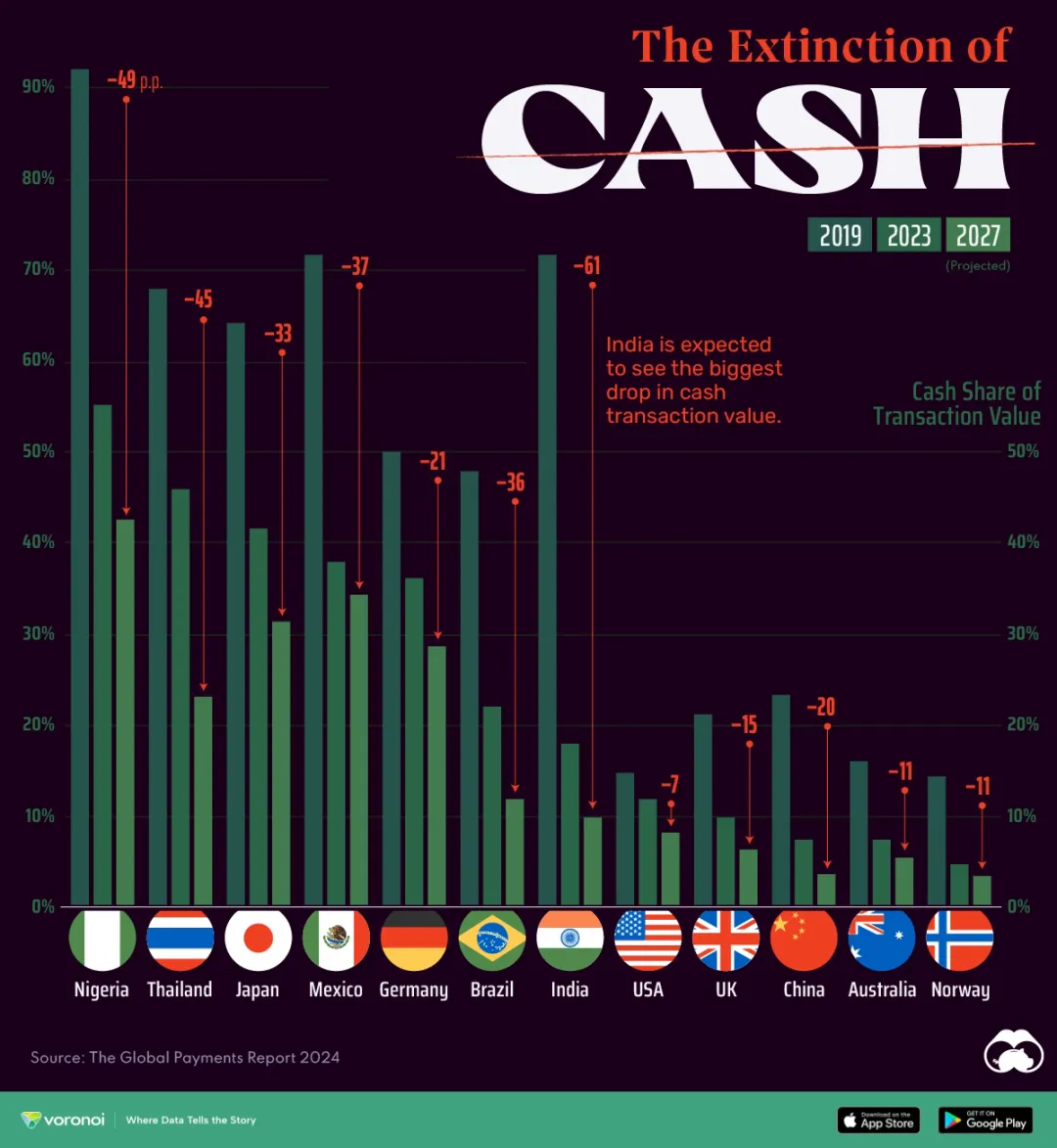
Caption: Predicted timeline for cash extinction in various countries
Source: Voronoi
Cash has already disappeared in China, yet WeChat Pay and Alipay dominate. U-cards like Infini cannot obtain domestic UnionPay issuance rights and must comply with personal foreign exchange quotas. Even products like HyperCard, which launched UnionPay U-cards via Laos, cannot be treated equally with domestic banking services.
Meanwhile, populous nations like India, Brazil, and Nigeria are rapidly going cashless—but not due to stablecoins. These markets are quickly being captured by local central banks, commercial banks, and fintech firms, leaving stablecoins with only scraps.
The root cause? Stablecoins touch on national sovereignty. Today’s stablecoins are essentially variants of the U.S. dollar—an external manifestation of U.S. Treasuries. Any nation with ambitions will resist dollar-based stablecoins, unless they’re small countries like El Salvador or Cambodia, which are either de facto or legally dollarized.
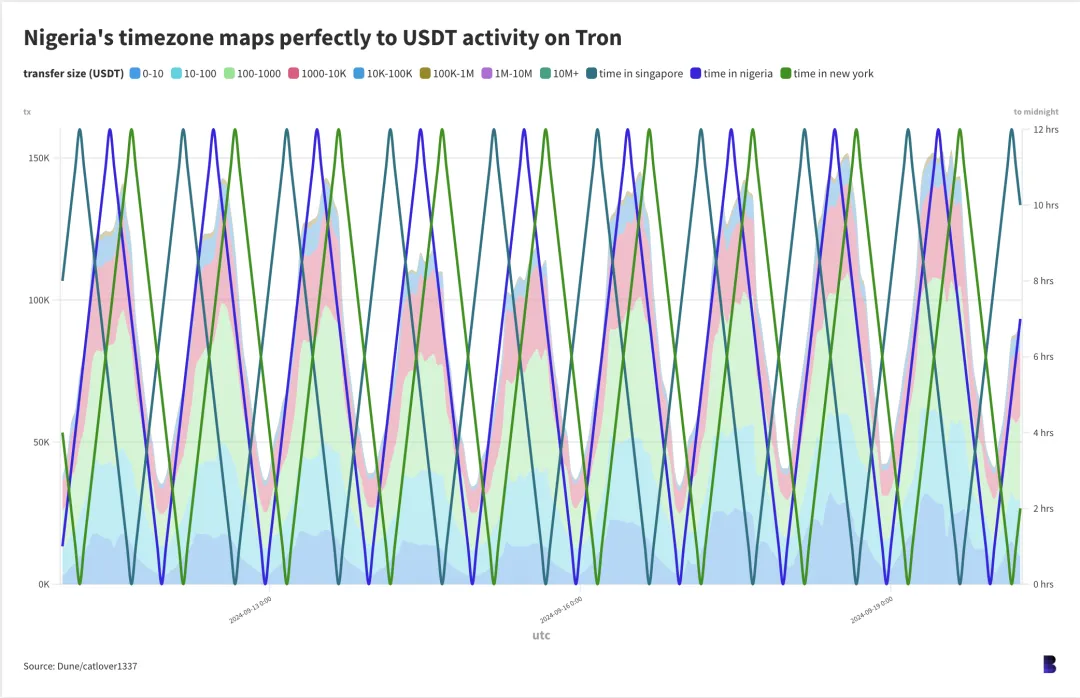
Caption: Nigeria’s timezone maps perfectly to USDT activity on Tron
Source: Dune/catlover1337
To put it clearly, stablecoin markets fall into three categories: First, large economies like China, the U.S., India, and Brazil, where stablecoins remain marginal financial tools. Second, dollarized microstates where stablecoins offer more convenience than physical dollars, though full market access remains limited and still requires indirect entry via Visa/MasterCard rails. Third, mid-sized nations like Nigeria and Turkey—countries with monetary instability, high inflation, yet some degree of institutional capacity. Here, stablecoins face strong real demand and practical use cases, but struggle to achieve mainstream adoption or regulatory legitimacy.
Just as Trump manipulates both positive and negative sentiment, the greatest advantage of stablecoins lies in their stability. Compared to cryptocurrencies whose value must be proven through price appreciation, stablecoin demand is already deeply rooted in reality.
Like PayPal’s early 2000s playbook—first lower barriers to entry, then secure existing users, finally achieve compliance and legitimacy—crypto is undergoing a similar three-stage assault on traditional finance.
BTC and ETH have already completed the initial phase of user education. BTC proved the feasibility of network effects from nothing; ETH scaled those effects to millions of real users. TRC-20 USDT already serves genuine daily users worldwide.
It’s inevitable: shouting about mass adoption before billions globally use crypto is meaningless. Otherwise, we wouldn’t have seen the dot-com bubble of the early 2000s. Back then, Web2 speculation was no less intense than today’s crypto frenzy. Only when Google built its ad system did the entire industry gain a realistic foundation for value.
Escape Singular Concepts, Embrace Collective Intelligence
The reason for focusing so much on stablecoins is that public blockchains and DeFi have reached a bottleneck. Once Solana completes its Firedancer upgrade, Solana 2.0 and Ethereum 2.0 will stand as the fastest and most stable chains available—sufficient to meet nearly all user and developer needs.
Only stablecoins can push crypto’s network effects to their maximum potential. Blockchain doesn’t need to debate how to create externalities—once enough people adopt it, collective application paradigms will naturally emerge. Ant colonies, bee swarms, human tribes, and urban civilizations—all demonstrate the reality of swarm intelligence.
There is a paradox here: we cannot explore every possibility of stablecoin mainstreaming, yet if we don’t explore them, we won’t know which ones are worth pursuing. Right now, this boils down to the debate between purely on-chain adoption versus real-world off-chain applications.
This question cannot be resolved through discussion alone, but one principle holds strong: only by treating products as services can optimal results be achieved. Take Deepseek, for example—the sharpest observation I’ve heard is: “Deepseek is a feature, not a product.”
Here’s my blockchain version: we shouldn’t obsess over the latest moves of public chains, Uniswap, or Binance. Instead, focus on how they connect with every person on Earth. Why has Binance achieved such massive commercial success? Because it genuinely serves over 100 million crypto users—many of whom may not be active on-chain, but whose presence brings Binance’s network effects close to those of traditional internet giants.
The key challenge is that we must discover viable promotion strategies and practical use cases for stablecoins—even while lacking clarity on exactly how they should expand.
For instance, within regulatory gray zones, stablecoins must achieve primitive accumulation through antifragility—leveraging chaos in unregulated spaces to dismantle the arrogant order of traditional finance. Underground flows always find infiltration routes around high-pressure barriers. Compliance should not be the primary breakthrough point, nor a marketing gimmick.
To rebuild payment ecosystems in regulated spaces, however, one must confront entrenched interests head-on. Technical efficiency is merely the entry ticket. The real contest lies in patience within institutional博弈. When regulatory costs themselves become moats, disruptors must either wait for cracks in the old order—or use capillary-like penetration from the periphery, disguising revolution as reform. Just as PayPal challenged card networks, today’s battle is stablecoins versus banks.
Stablecoins now stand at this crossroads. Their original sin—success in illicit markets—must now be washed away, perhaps even at the cost of bowing to rules set by the setting sun in the West: Trump’s regime.
In every era, certain modes of thinking gradually become the shared measure of cultural life. Cryptocurrency, along with its technology and philosophy, will undoubtedly become defining characteristics of our age.
May we, within the world of cryptocurrency, find our own Strawberry Fields of this era.
Join TechFlow official community to stay tuned
Telegram:https://t.me/TechFlowDaily
X (Twitter):https://x.com/TechFlowPost
X (Twitter) EN:https://x.com/BlockFlow_News
 @zuoyeweb3






