Solana's Inflation Revolution: SIMD-0228 Proposal Sparks Community Controversy, 80% Emission Cut Hides "Death Spiral" Risk Behind
TechFlow Selected TechFlow Selected
Solana's Inflation Revolution: SIMD-0228 Proposal Sparks Community Controversy, 80% Emission Cut Hides "Death Spiral" Risk Behind
A blueprint that appears to be "smart issuance" has sparked intense controversy within the community over "inflation spirals" and利益博弈.
 Navigating Web3 tides with focused insights
Author: Frank, PANews
Recently, a proposal named SIMD-0228 was launched on the Solana governance forum, aiming to cut SOL's annual issuance by 80% through dynamically adjusting the inflation rate and redirecting capital from staking to DeFi. However, this seemingly "smart issuance" blueprint has sparked intense controversy within the community over an "inflation spiral" and利益博弈—when the staking ratio falls below a critical threshold, higher inflation could backfire on market confidence. Meanwhile, validators' income structure and the distribution of benefits among ecosystem participants have become hidden explosives in this tokenomics experiment.
New Proposal Could Reduce Inflation by 80%, Cutting Annual SOL Issuance by 22 Million
Solana’s token SOL has long followed a fixed schedule for issuance: the inflation rate starts at 8% and declines annually by 15% until it reaches the target of 1.5%. The current inflation rate stands at 4.694%. Under this model, approximately 27.93 million tokens will be issued this year, with a staking ratio of around 64%.
In contrast, Ethereum currently has an inflation rate of about 0%, with a staking ratio of roughly 30%. Clearly, SOL’s inflation model is less favorable for token preservation. The relatively high inflation rate drives many holders to stake their tokens in pursuit of higher yields, which hinders the development of the DeFi ecosystem.
The proposal argues that MEV revenue has already become the primary income source for validators, so reducing staking yields would not significantly impact their earnings. "Simply put, it's 'dumb issuance.' Given Solana's thriving economic activity, evolving the network's monetary policy toward 'smart issuance' makes sense."
The proposal initially suggested a threshold of 50%: when the staking ratio exceeds 50%, the inflation rate decreases, reducing staking rewards across the network. When the staking ratio drops below 50%, the inflation rate increases to expand rewards and incentivize more capital into staking.
Later, forum users questioned whether the 50% threshold was based on rigorous calculations, calling the setting too arbitrary. In response, the proposer introduced a new algorithmic curve, setting 33% as the threshold—whenever the staking ratio exceeds 33%, the annual inflation rate would fall below the current level.
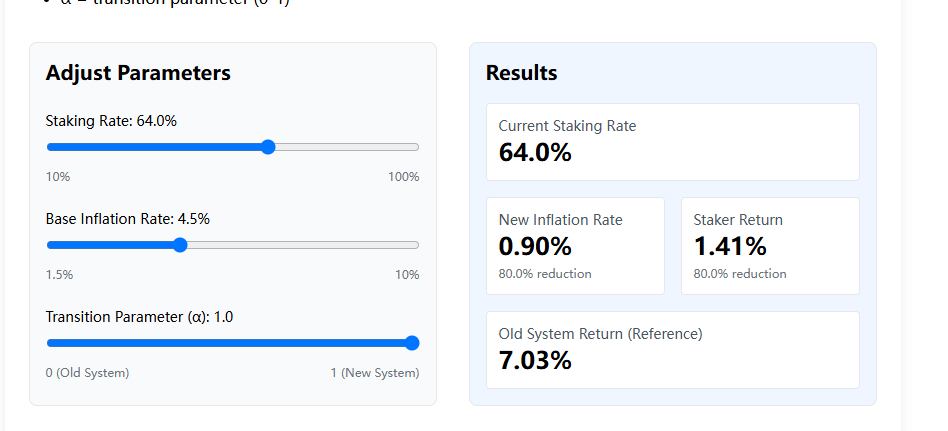
According to PANews’ calculations, using the current 64% staking ratio as an example, under the new issuance curve, the annual inflation rate would drop from 4.694% to 0.939%, a reduction of about 80%.
If the proposal passes, maintaining the current staking ratio, SOL’s annual issuance would decrease from 27.93 million to 5.59 million tokens.
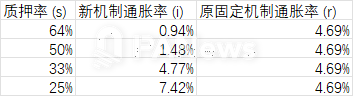
Revised Staking and Inflation Rates in the Proposal
However, consensus has not been reached in the forum regarding this approach. Many comments suggest that if implemented, reality might deviate significantly from expectations. For instance, when the staking ratio declines, rising inflation could further dampen market expectations for the token, potentially prompting non-staked token holders to sell off, triggering greater uncertainty.
PANews calculated that if the staking ratio drops to just 25%, inflation would generate 44.13 million tokens—far exceeding the current inflation level.
If such an inflationary vortex truly emerges, the outcome could be counterproductive. As the proposal notes, validators currently rely heavily on MEV income. This is mainly due to Solana’s active transaction volume, where numerous meme traders demand fast execution and protection against sandwich attacks, making MEV a significant portion of revenue. If overall network transaction volume declines in the future, MEV income may no longer sustain validators’ primary earnings. Combined with falling prices and increased inflation, this could further discourage staking, leading instead to a reverse spiral of rising inflation and declining staking.
Silence from Validator Giants Hints at Power Struggles Among Large Holders
The proposal was initiated by Vishal Kankani, an investor at Multicoin Capital, one of Solana’s early backers, which led a $20 million Series A round in 2019. Multicoin holds substantial amounts of SOL tokens, having chosen early investment payouts in SOL rather than equity. Given this background, Vishal Kankani represents large SOL holders who are particularly sensitive to how inflation affects token market value.
Interestingly, as of February 26, major Solana validators such as Helius, Binance Staking, and Galaxy have remained silent on the proposal. Helius’ founder, normally vocal about Solana’s ecosystem development, only shared related content and commented that selling SOL now would be foolish.
In fact, if this proposal passes, it may not bode well for validators like Helius, which return 100% of MEV revenue to stakers. Currently, since Helius does not profit from MEV, it likely depends more on staking rewards themselves.
Overall, this proposal reflects the interests of large SOL holders who prefer reduced inflation for greater value stability. Moreover, Solana’s current staking yield is around 7.03%; under the new plan, the same staking ratio would see yields drop to 1.41%, nearly an 80% decline. This is clearly unfavorable for large validator nodes relying on staking for risk-free returns.
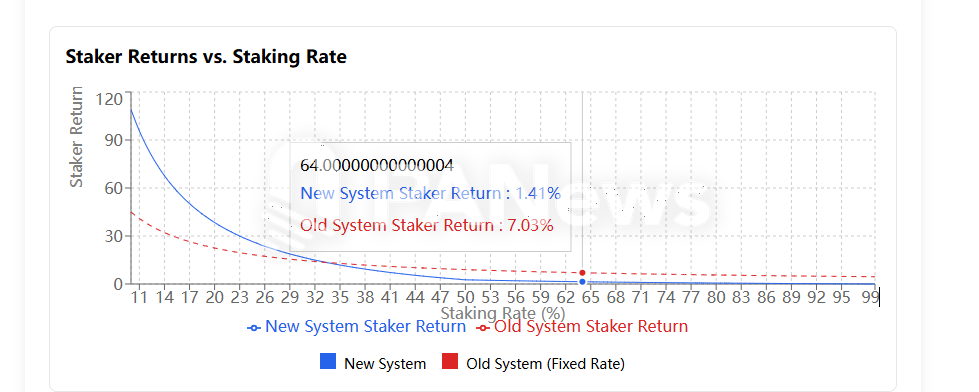
Of course, the proposal suggests that lower staking yields will encourage these validators to deploy their tokens more actively into the DeFi ecosystem, thereby boosting Solana’s DeFi growth.
At its core, Solana’s token economy reform represents a power rebalancing between large holders, validators, and ecosystem builders. After the proposal passes, the 7.03% staking yield could plummet to 1.41%, forcing validators to shift from reliance on inflation rewards to focusing on MEV and transaction fees—this is both an opportunity and a gamble.
If DeFi can absorb billions in idle liquidity as a result, Solana might witness explosive innovation akin to Uniswap and Aave; but if the market sells off due to lower yields, the massive issuance of 44.13 million tokens at a 25% staking ratio could drag the network into a “inflation–sell-off–more inflation” death spiral.
Currently, the silence from top validators like Helius hints at delicate tensions in the利益 chain—when a business model based on 100% MEV redistribution faces a halving of base income, the ecosystem’s narrative of “decentralization” may face harsh reality checks. Meanwhile, Multicoin Capital’s stance as an early whale reveals the deeper logic behind this博弈: in institutional investors’ eyes, SOL’s store-of-value attribute now takes precedence over network security needs. In the coming months, as the March 7 vote approaches, Solana’s fate will no longer be dictated solely by code, but by whether the community can find that precarious balance between idealism and capital rationality.
Join TechFlow official community to stay tuned
Telegram:https://t.me/TechFlowDaily
X (Twitter):https://x.com/TechFlowPost
X (Twitter) EN:https://x.com/BlockFlow_News
 PANews