From Tradition to the Future: The Virtual Asset Journey of Hong Kong Family Offices
TechFlow Selected TechFlow Selected
From Tradition to the Future: The Virtual Asset Journey of Hong Kong Family Offices
In the future, Hong Kong's leading position in the global family office competition will depend on its ability to effectively balance innovation and compliance while continuously improving the infrastructure of its financial markets.
 Navigating Web3 tides with focused insights
Bitcoin, once a concept confined to geek communities and white papers, has undergone a remarkable transformation over just sixteen years, officially surpassing $100,000 and ranking as the 12th largest economy by market value—a new financial asset worth $2 trillion.
This ripple of change has spread to the forefront of global wealth management. As core institutions symbolizing wealth accumulation and inheritance, family offices are redefining their strategic directions amid this transformative tide.
With policy support, family offices are exploring virtual assets as a new frontier for wealth preservation and appreciation. Hong Kong, leveraging its mature financial infrastructure and favorable regulatory environment, is gradually becoming a hub where traditional wealth converges with virtual assets. This dual-driven dynamic is reshaping Hong Kong’s role as a key center for global wealth management and virtual assets.
New "Strategic Reserve Asset" for Traditional Financial Institutions
At the 2024 Bitcoin Conference, Trump stated that if elected, he would 100% preserve all Bitcoin currently held or acquired in the future by the U.S. government, pledging to maintain a "National Strategic Bitcoin Reserve." U.S. Senator Cynthia Lummis also introduced the 2024 Bitcoin Act, proposing that the U.S. Treasury establish a national Bitcoin reserve, aiming to acquire one million Bitcoins within five years—200,000 annually.
Following Trump's election victory, optimistic market sentiment pushed Bitcoin past multiple price thresholds, prompting more traditional institutions and even nations to reassess Bitcoin's potential, triggering global competition over virtual asset reserves.
According to data from BitcoinTreasuries.com, as of December 13, 2024, 94 large entities (including companies and countries) publicly hold over 2.9 million Bitcoins—13.81% of Bitcoin’s total supply. Global BTC ETFs collectively hold over 1.294 million, listed companies hold over 553,000, and private enterprises hold over 366,000.
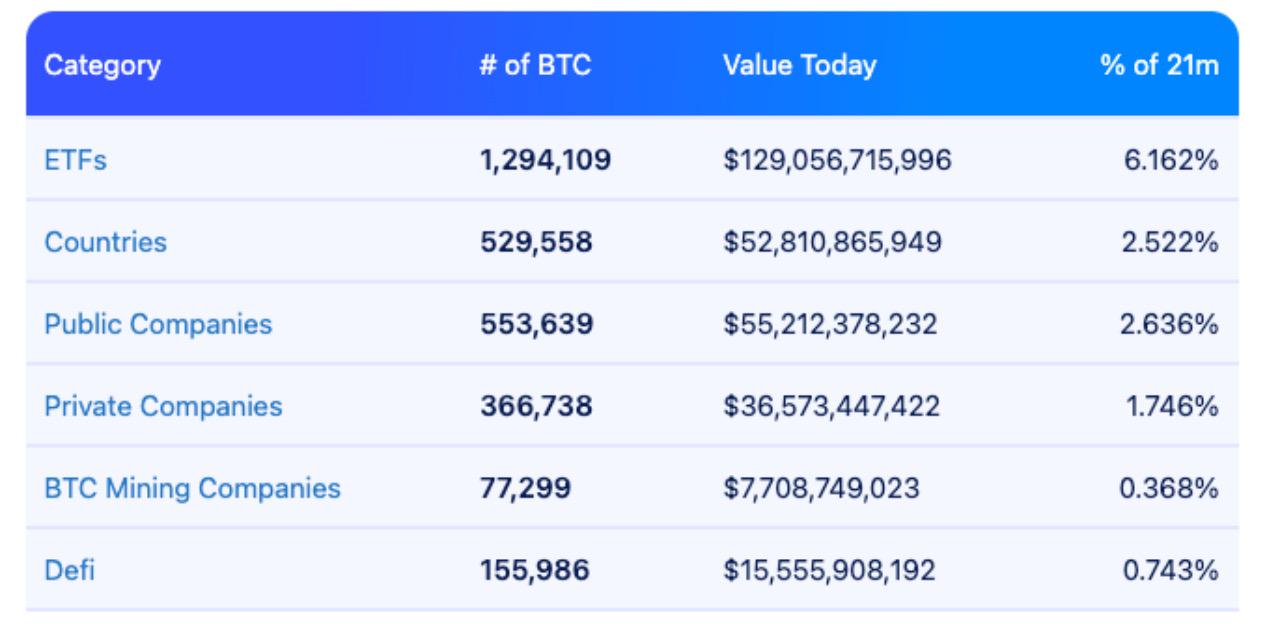
Compared to directly adding Bitcoin to balance sheets, more institutions invest via Bitcoin ETFs. The approval of spot Bitcoin ETFs in the U.S. has particularly drawn traditional investment institutions into this emerging space. U.S. BTC ETFs now hold over 1.116 million Bitcoins—86.92% of all global BTC ETF holdings.
In terms of institutional ownership structure in ETFs, hedge funds and investment advisors are the primary participants, while banks, quantitative funds, and state government investment funds have also included Bitcoin ETFs in their portfolios.
The latest SEC 13F filings show that as of Q3, nearly 700 institutional owners and shareholders collectively held 160.2 million shares of BlackRock’s IBIT. Millennium Management increased its stake by 12.6 million shares in Q3, Goldman Sachs added 5.77 million shares of IBIT, and JPMorgan Chase purchased 387 shares of IBIT ($13,982) and 213 shares of FBTC ($11,877). Other traditional institutions including the Wisconsin State Investment Fund, Michigan Public Pension Fund, Morgan Stanley, Wells Fargo, UBS, BNP Paribas, Royal Bank of Canada, and Schonfeld Strategy Advisors have also entered Bitcoin ETFs.
The new direction of global portfolios is increasingly clear—Bitcoin and virtual assets are rapidly becoming essential components of capital allocation, reflecting institutional market transformation. While we’ve seen public companies and major financial institutions openly embracing virtual assets, what’s even more noteworthy is that traditionally low-key family offices are quietly moving too. Their positioning may be more resilient than visible markets, as they prioritize long-term stability and flexibility in capital allocation, often identifying suitable investment opportunities in volatile environments.
Unaffected by short-term market pressures, family offices can engage in deeper virtual asset deployments with greater composure. Their implicit capital flows are becoming a significant force driving the development of this emerging market.
The "Urgency" of Family Offices
Prior to this, Wanfang Family Office announced a partnership with Huobi Technology to build a digital family office platform—bridging traditional investors and asset investments—offering high-net-worth individuals basic advisory services, virtual asset investment guidance, wallet integration, and inheritance and family governance solutions.
This year, Avenir Capital—the family office founded by Huobi’s Li Lin—announced it purchased $383 million worth of Bitcoin ETF products (IBIT and FBTC) in Q2, and launched a virtual asset quantified master fund, Avenir Crypto, with an initial size of $500 million. In October, family office Lennertz announced fundraising of $165 million for its third blockchain fund. Oksana Tiedt, Investment Director at Lennertz, said in an interview that the fund had completed its first transaction but declined to disclose the amount.
Virtual assets are becoming a new pivot in family office wealth management, offering partial inflation hedging and safe-haven functions while enhancing portfolio growth potential and diversification. Thus, family offices are no longer passively accepting virtual assets but actively seeking and accelerating their allocation weight.
Moreover, the core mission of family offices is succession. From a generational perspective, younger heirs are typically digital natives with natural affinity toward technology and innovation—virtual assets align with their values and investment preferences. The decentralized nature of virtual assets also enables them to transcend geographical boundaries, better navigating future economic fluctuations and intergenerational shifts, ensuring sustained wealth growth and transfer over the long term.
In other words, family office investments in virtual assets now go beyond traditional asset management—they carry dual missions of wealth succession, innovation, and adaptability.
According to a September report by Citibank, the proportion of family offices holding optimistic views on virtual assets rose from 8% to 17%, with direct investment remaining their preferred method. Compared to small family offices managing less than $500 million in assets, larger family offices show greater interest in tokenized real-world assets (RWA)—11% of large family offices hold virtual asset exposure versus only 3% among smaller ones. Smaller family offices exhibit higher demand for derivatives, with 8% holding exposure to these products.
From a global trend perspective, while European and American markets advanced quickly, Hong Kong’s virtual asset ecosystem remained largely experimental in previous years. However, with the formal implementation of the Virtual Asset Service Provider (VASP) regime in 2023 and the launch of spot Bitcoin ETFs in 2024, Hong Kong is rapidly emerging as a core hub in the Asia-Pacific region for family offices allocating to virtual assets. The demonstration effect of spot Bitcoin ETFs globally has triggered a chain reaction in Hong Kong—more family offices are gradually entering the virtual asset market through Hong Kong-based platforms and services.
Hong Kong: A New Hotspot for Family Office Investment in Virtual Assets
Hong Kong’s characteristics as an “institutional” market are highly distinctive, with its financial system emphasizing institutional investor participation and efficient capital flows. As a leading global hub for wealth management and cross-border finance, Hong Kong offers a robust financial ecosystem, rigorous regulatory framework, and excellent legal service networks. Compared to other emerging family office destinations like Dubai and Singapore, Hong Kong possesses deeper investment management expertise and broader global financial connectivity, providing unique geographic advantages for family offices.
In 2023, Hong Kong released its "Policy Statement on Developing the Family Office Business," outlining eight key measures, including widely anticipated tax incentives and the "Capital Investors Entry Scheme." According to a report commissioned by the Hong Kong Investment Promotion Agency and conducted by Deloitte, over 2,300 single-family offices had been established in Hong Kong by the end of 2023. Notably, this figure does not include multi-family offices, so the actual number is undoubtedly higher. By May this year, the agency had assisted 83 single-family offices in setting up or expanding operations in Hong Kong, with another 130 indicating they have decided or are preparing to establish offices there. The agency remains confident in exceeding its target of attracting 200 family offices to Hong Kong by 2025.
The rise of virtual assets further strengthens Hong Kong’s appeal to family offices. According to a survey by the Hong Kong Private Wealth Management Association, last year and this year saw an 85.6% increase in Hong Kong’s virtual asset trading volume—the highest growth rate in East Asia. Approximately one-third of surveyed private wealth management firms expect virtual asset allocations to range between 6% and 10% within five years—up from just 2% today—indicating substantial growth potential.
Recently, Hong Kong authorities proposed new initiatives to attract capital, suggesting expansion of capital gains tax exemptions to cover overseas real estate, carbon credits, private credit, and virtual assets—applicable to private funds and qualifying single-family office investment vehicles.
This move reduces tax burdens on family offices while motivating international capital to explore virtual assets more actively. With dual support from tax incentives and legal safeguards, Hong Kong aims to build a stable investment environment. Compared to Singapore’s flexible policies and Dubai’s innovative experiments, Hong Kong’s strategic planning demonstrates greater sustainability and long-term impact. On this foundation, Hong Kong will inevitably attract increasing inflows of international capital—especially in the virtual asset sector—becoming a critical node in global capital allocation.
Meanwhile, Hong Kong’s infrastructure continues to improve, offering strong support to participants in the virtual asset market. In this process, local virtual asset service providers like HashKey Exchange play a vital role. As Hong Kong’s largest licensed virtual asset exchange, HashKey Exchange has partnered with over ten financial institutions including ZA Bank and Victory Securities, while dozens of mid-to-large enterprises have completed proprietary virtual asset services on the platform, receiving comprehensive solutions covering account opening, investment, and trade settlement. HashKey Exchange now has over 100 partners, further solidifying its central position in Hong Kong’s virtual asset market.
Notably, HashKey Exchange’s accumulated asset deposits have surpassed HK$9.8 billion and are expected to soon exceed HK$10 billion—this rapid growth reflects surging market demand for compliant virtual asset services. Particularly this year, companies from the traditional financial services industry—including securities firms, banks, asset managers, listed companies, and family offices—have opened virtual asset accounts en masse. Many brokers, after upgrading to Type 1 licenses, have partnered with HashKey Exchange to offer omnibus brokerage services, enabling users to deposit and withdraw virtual assets. This means traders and investors behind these brokers—especially Hong Kong stock investors—can now access BTC, ETH, and other virtual assets directly through compliant channels.
With such infrastructure support, Hong Kong provides strong assurance for family offices to smoothly participate in virtual asset investments, significantly reducing complexity and barriers related to technology, compliance, and risk.
A New Order of Virtual Assets and Family Offices
Whether it’s the institutional pathway formed in the U.S. market following the launch of spot Bitcoin ETFs, or the dividend unleashed in Hong Kong due to policy support and geographic advantage, virtual assets are progressively securing a more prominent place in family office asset allocation. Driven by both the institutionalization of financial markets and the vigorous development of virtual assets, this shift represents not only an update in wealth management strategies but also a profound reevaluation of the global economic landscape.
Going forward, Hong Kong’s leading position in the global family office race will depend on its ability to effectively balance innovation and compliance while continuously improving financial market infrastructure. Professional virtual asset platforms represented by HashKey Exchange can provide family offices with regulatory compliance support and technical safeguards for virtual asset investments, lowering complexity and risks associated with market entry and offering high-net-worth clients a more secure pathway. The further evolution of this ecosystem will help Hong Kong secure a more strategically significant position in the global wealth management landscape.
Join TechFlow official community to stay tuned
Telegram:https://t.me/TechFlowDaily
X (Twitter):https://x.com/TechFlowPost
X (Twitter) EN:https://x.com/BlockFlow_News
 PANews