








Crypto Morning Brief: U.S. Plans to Release 172 Million Barrels of Oil Reserves Within 120 Days; Binance Sues The Wall Street Journal
TechFlow Selected TechFlow Selected
Crypto Morning Brief: U.S. Plans to Release 172 Million Barrels of Oil Reserves Within 120 Days; Binance Sues The Wall Street Journal
Ripple launches a share repurchase program of up to $750 million, valuing the company at $50 billion.
 Navigating Web3 tides with focused insights
Author: TechFlow
Yesterday’s Market Highlights
U.S. February Unadjusted CPI Annual Rate at 2.4%, in Line with Expectations
The U.S. February unadjusted CPI annual rate stood at 2.4%, matching both expectations and the prior reading of 2.40%.
U.S. Department of Energy to Release 172 Million Barrels of Crude Oil from Strategic Petroleum Reserve Within 120 Days
According to JIN10 Data, U.S. Secretary of Energy Chris Wright announced that all 32 member countries of the International Energy Agency (IEA) have unanimously agreed to former President Trump’s request to coordinate the release of 400 million barrels of crude oil and refined products from their national reserves to curb energy prices. As part of this coordinated effort, Trump has authorized the Department of Energy to begin releasing 172 million barrels of crude oil from the U.S. Strategic Petroleum Reserve (SPR) starting next week. At the planned release pace, delivery is expected to be completed within approximately 120 days. Trump also pledged to safeguard U.S. energy security through responsible management of the SPR. The U.S. has scheduled the replenishment of roughly 200 million barrels into the SPR over the next year—20% more than the amount slated for withdrawal—with no cost to taxpayers.
SEC and CFTC Sign MOU to Jointly Advance Cryptocurrency Regulatory Framework
According to The Block, the U.S. Securities and Exchange Commission (SEC) and the Commodity Futures Trading Commission (CFTC) formally signed a Memorandum of Understanding (MOU) on March 11, committing to enhanced coordination and cooperation in supporting legitimate innovation, preserving market integrity, and protecting investor interests.
The agencies stated that one key area of collaboration will be jointly developing federal policy to build an “adaptive regulatory framework” for digital assets and other emerging technologies, and pledged to coordinate efforts to facilitate the lawful introduction of digital asset products and eliminate related barriers.
SEC Chair Paul Atkins noted that longstanding jurisdictional disputes between the two agencies, overlapping registration requirements, and divergent rules have stifled innovation and driven market participants to other jurisdictions. CFTC Chair Michael Selig added that the MOU aims to harmonize the regulatory frameworks of both agencies to achieve comprehensive, seamless oversight of financial markets.
Binance Files Defamation Lawsuit Against The Wall Street Journal Over False Reporting
According to Binance’s official blog, Binance filed a formal defamation lawsuit against The Wall Street Journal on March 11, stemming from a report published by the newspaper on February 23, 2026, concerning Iranian sanctions. Binance alleges the article contained false and defamatory statements, which triggered unwarranted government investigations. Dugan Bliss, Binance’s Global Head of Litigation, stated the lawsuit seeks to hold The Wall Street Journal accountable for prioritizing traffic over journalistic integrity.
Ethereum Researchers Demonstrate “Native Rollups” Prototype, Potentially Simplifying Layer 2 Verification
According to The Block, Ethereum ecosystem developers have released a proof-of-concept prototype for “Native Rollups,” enabling Ethereum to directly verify Layer 2 state transitions at the base layer—without relying on external verification systems such as zero-knowledge proofs or fraud proofs.
The proposal introduces the EXECUTE precompile via EIP-8079, allowing Ethereum’s base layer to replay Layer 2 blocks to confirm their validity. Participating teams include Ethrex client developers, Ethereum Foundation contributors, and L2BEAT researchers. Developers say this design enables Layer 2 networks to directly inherit Ethereum’s security properties and protocol upgrades, reducing long-term maintenance costs. The proposal remains in its early exploratory phase and has not yet entered production.
Across Protocol Proposes Transition from DAO to C-Corp; ACX Holders May Exchange Tokens for Equity or Redeem for USDC
According to The Block, Across Protocol—a cross-chain interoperability protocol backed by Paradigm—has published a temperature-check proposal exploring a transition from its current DAO structure to a U.S. C-corporation named AcrossCo.
Token holders will have two options:
- Equity Exchange: Exchange ACX tokens for AcrossCo equity on a 1:1 basis
- Redemption: Redeem ACX tokens for USDC at the 30-day volume-weighted average price; the redemption window will last six months
The team explained that the existing DAO structure presents bottlenecks when entering into enforceable contracts with institutional partners, and transitioning to a corporate structure would help drive the protocol’s next phase of growth. If community sentiment is positive, the team plans to launch a formal governance vote in two weeks, with the outcome determined by majority vote.
Sources: Hong Kong to Issue Stablecoin Licenses to HSBC, Standard Chartered, and OSL
According to Sing Tao Daily, citing multiple sources, HSBC, Standard Chartered Bank, and Hong Kong-based virtual asset trading platform OSL are expected to be among the first companies granted stablecoin licenses by Hong Kong. The list could be announced as early as next week, though it remains subject to change. The Hong Kong Monetary Authority (HKMA) declined to comment on market rumors.
Market Report: Binance, PayPal, and Ripple Join Mastercard’s New Blockchain Payments Initiative
According to market reports, Binance, PayPal, and Ripple have joined Mastercard’s newly launched blockchain-based payments initiative.
VanEck Announces Integration of Select Crypto ETFs into Basic Capital’s 401(k) Plans
According to Cointelegraph, asset management firm VanEck announced that select digital asset exchange-traded products (ETPs) will become available to U.S. 401(k) retirement account holders via fintech platform Basic Capital—marking the first formal integration of crypto assets into traditional employer-sponsored pension plans.
VanEck’s key crypto offerings include the spot Bitcoin ETF VanEck Bitcoin Trust (HODL), the spot Ethereum ETF VanEck Ethereum Trust (ETHV), and the VanEck Digital Transformation ETF (DAPP), which invests in companies building infrastructure for the digital asset ecosystem. Earlier this year, VanEck also launched a spot Avalanche ETF in the U.S. Specific product listings have not yet been disclosed.
Founded in 2021, Basic Capital raised $25 million in Series A funding last year, led by Forerunner and Lux Capital. Its 401(k) platform supports alternative asset allocations beyond traditional stocks and bonds.
Metaplanet to Establish Wholly Owned Subsidiaries in Japan and the U.S., Allocating ¥4 Billion to Japanese Bitcoin Financial Infrastructure
According to Metaplanet CEO Simon Gerovich, the Japanese-listed company Metaplanet has approved the establishment of two wholly owned subsidiaries: Metaplanet Ventures Co., Ltd. (Japan) and Metaplanet Asset Management Inc. (U.S.).
Metaplanet Ventures plans to invest ¥4 billion over the coming years into Japanese companies building Bitcoin financial infrastructure—including lending, payments, custody, stablecoins, derivatives, and compliance—and will concurrently launch an incubator program for Japanese startups, as well as grant programs for open-source developers, educators, and researchers. As its first investment, Metaplanet Ventures has signed a memorandum of understanding with JPYC Co., Ltd.—Japan’s first registered yen-pegged stablecoin project—to invest up to ¥400 million.
Metaplanet Asset Management Inc. will be headquartered in Miami and positioned as a digital credit and Bitcoin capital markets platform connecting Asian and Western capital markets. It plans to offer yield, equity, credit, and volatility strategies, with specific products to be announced in due course.
Ripple Launches Up to $750 Million Share Repurchase Program; Company Valuation Hits $50 Billion
According to The Block, Ripple has launched a share repurchase program valued at up to $750 million, valuing the company at $50 billion. The repurchase will be conducted via a tender offer, permitting investors and employees to sell their shares back to the company, and is expected to run through April.
Ripple President Monica Long previously stated that the company has no immediate plans for an IPO and prefers private-sector expansion through mergers and acquisitions and product development. Ripple has already acquired institutional broker-dealer Hidden Road (for ~$1.25 billion) and stablecoin platform Rail ($200 million), and recently announced plans to acquire BC Payments to obtain an Australian financial services license.
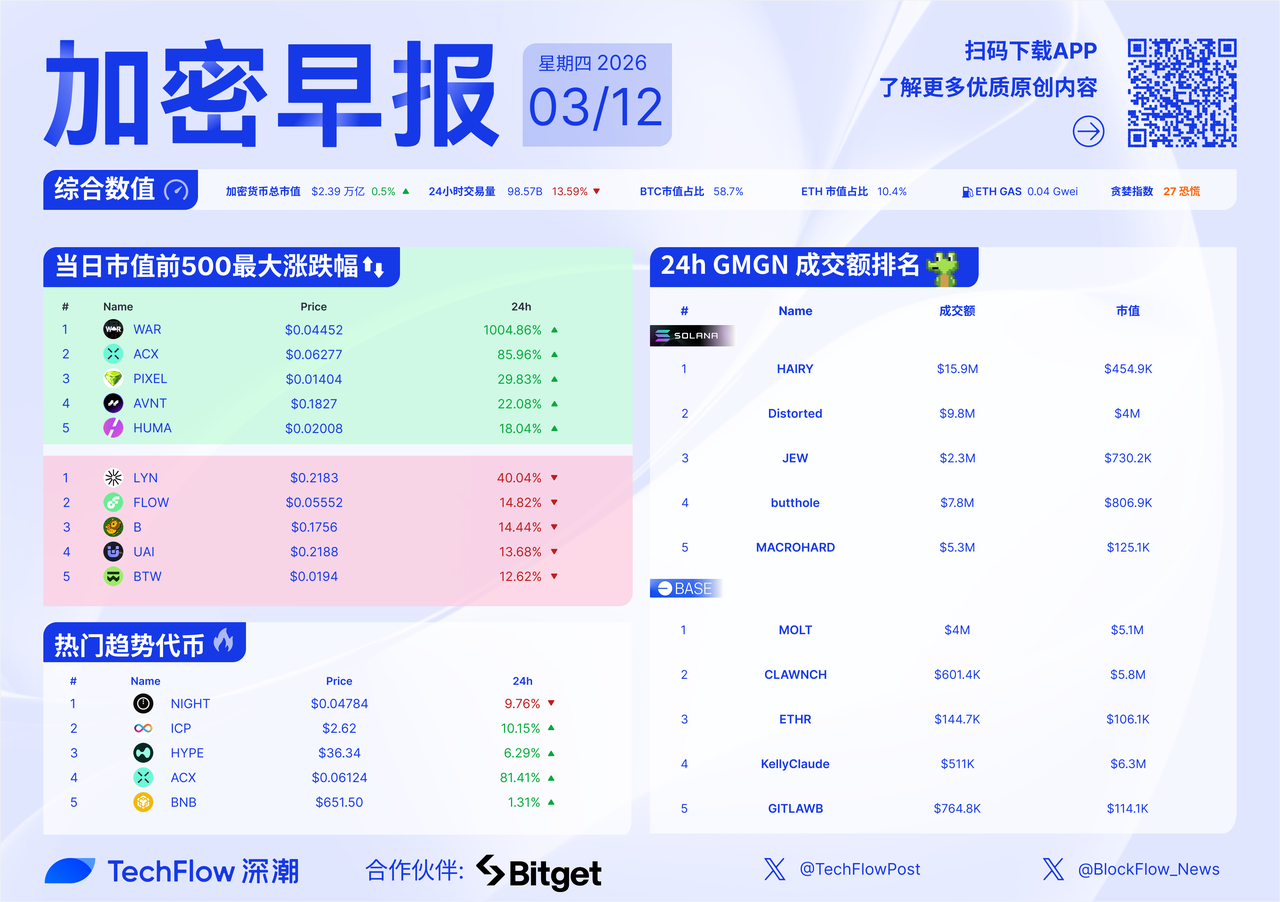
Market Data
Recommended Reading
The OpenClaw Gold Rush: Who’s Getting Rich?
This article examines the industrial chain dynamics behind the OpenClaw wave, analyzing its monetization models across hardware, data, and information arbitrage. Through multiple case studies, it illustrates how profitability is achieved by lowering technical barriers, leveraging user anxiety, and exploiting information asymmetries—while revealing the operational logic and rapid boom-and-bust cycles inherent in this business model.
March 11 Market Recap: War Isn’t Over Yet—Oil Plunges 15%
This article details how, despite Trump’s claim that the war is nearing conclusion, statements from the White House and the Pentagon indicate hostilities continue. Markets remain caught between optimism and reality, resulting in volatile U.S. equities, a sharp drop in oil prices, and heightened volatility in gold and cryptocurrency markets.
Jensen Huang’s Latest Essay: AI’s “Five-Layer Cake”
This article discusses AI’s role as modern infrastructure and its profound impact across five interdependent layers: energy, chips, infrastructure, models, and applications. It further explores AI’s influence on the economy, labor markets, and industry transformation—and highlights the unprecedented infrastructure investment demands driven by AI’s rapid advancement.
Sequoia Capital: The Next Trillion-Dollar Company Won’t Sell Software—It’ll Sell Outcomes
This article explores AI’s application in service industries and its future trajectory, proposing that the next trillion-dollar company may be a software company disguised as a service provider—one that sells results, not tools. It analyzes automation opportunities across multiple sectors and compares the Copilot and Autopilot paradigms of AI deployment.
a16z: The Best Technology Doesn’t Always Win in Enterprise Markets
This article discusses the challenges of deploying blockchain technology in enterprise settings, noting that enterprises prioritize compatibility with existing systems and risk management over technological purity or peak performance. It also offers practical guidance for blockchain founders targeting enterprise clients.
Join TechFlow official community to stay tuned
Telegram:https://t.me/TechFlowDaily
X (Twitter):https://x.com/TechFlowPost
X (Twitter) EN:https://x.com/BlockFlow_News
 深潮TechFlow











