








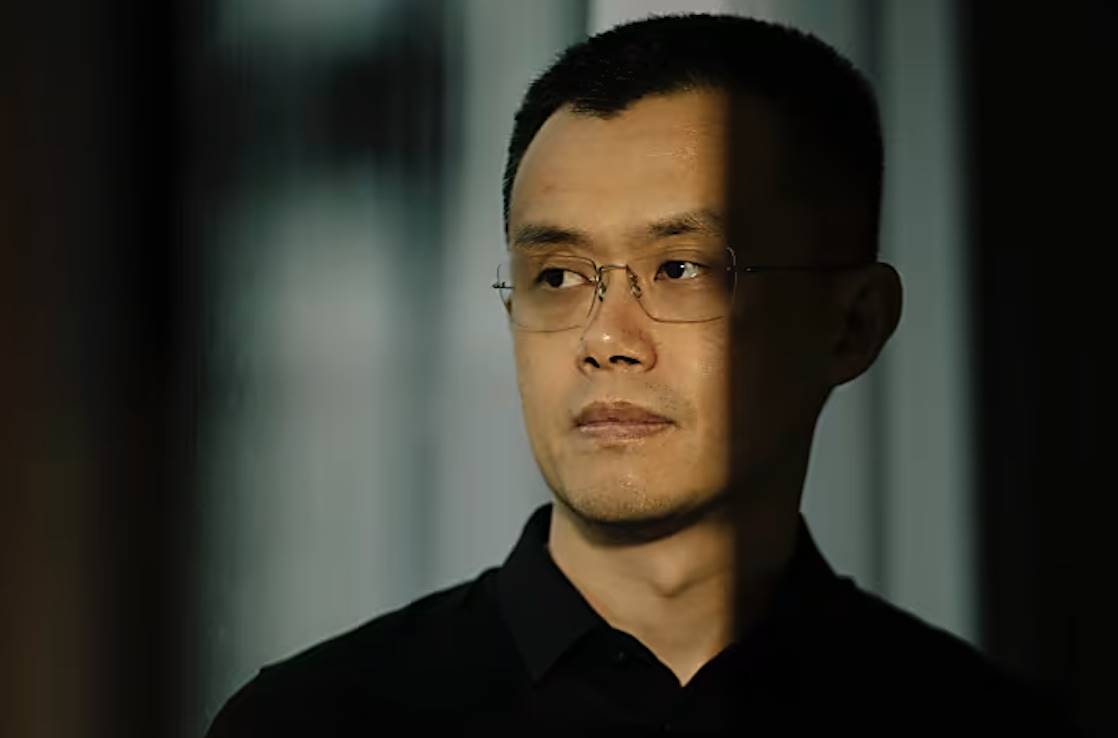
From Crypto Pioneer to Old Money: Zhao Changpeng
TechFlow Selected TechFlow Selected
From Crypto Pioneer to Old Money: Zhao Changpeng
Use the West's opposition to crypto to fight the West.
 Navigating Web3 tides with focused insights
By: Zuoye
Half Devil, Half Child
19th-century formalist thinking was built upon atomistic individualism;
20th-century globalist thinking was built upon collectivist liberalism;
21st-century isolationist thinking is built upon fragmented Westernism.
In 2021, Zhao Changpeng gave an exclusive interview to LatePost. Amid the complex intersection of Binance’s de facto global dominance and its relative obscurity among Chinese nationals, the LatePost team delivered what remains the most objective portrayal of the crypto industry and Binance by traditional business and financial media. It was through this that the public came to know Binance and Zhao Changpeng. Shortly after, I left ByteDance and began my Web3 journey, which continues to this day.
When discussing Zhao Changpeng personally, the greatest contrast lies in his difference from Sun Yuchen. If Sun Yuchen has become increasingly personified against the backdrop of figures like Bao Er Ye, Li Xiaolai, and Xue Manzi, then Zhao Changpeng's counterparts should be Coinbase's Armstrong and FTX's SBF. However, neither Sun nor Zhao are peers of Satoshi Nakamoto or Vitalik—neither can truly be said to believe in the ideology behind blockchain. Decentralization, for them, is merely a technical facade; in reality, it reflects neoliberalism and anarchism.
Just as suggested by LatePost’s 2021 headline “Interview with Binance’s Zhao Changpeng: In the Middle Ground of Cryptocurrency,” Zhao Changpeng himself exists between decentralization and centralization, CEX and DEX, East and West. When asked about his life achievements, the answer might be Bloomberg, OK, Binance—the final destination perhaps the Middle East, perhaps He Yi.
Let us together indulge in this night of possibilities.
Life Arbitrage
Individualism is not today’s mainstream. Nationalism and deglobalization have gradually revived since 2018.
Yet individualism was precisely the spiritual banner for old Europe’s migration to the New World, the only viable path for impoverished lower classes to restart their lives. The wave of Chinese emigration beginning in the 1980s served as its spiritual sequel. Unlike the survival-driven migration to Southeast Asia or the trafficking of late-Qing laborers, starting with the Lee-Tsung-Dao Scholarship in 1979,赴美润欧 (going to the U.S. and Europe) under the guise of studying physics became the defining ethos of the intellectual class at the time—akin to today’s pursuit of CS degrees at top American undergraduate and graduate schools.
Zhao Changpeng’s father was but a grain of sand swept along by these tides. After enduring the classic three-act trajectory of being labeled a rightist, sent down to the countryside, and returning to the city, he entered a PhD program in geophysics at UBC. In 1989, 12-year-old Zhao Changpeng began his life in Vancouver—one of the earliest "little overseas students."
At this time, the future multi-billionaire Chinese tycoon was working at fast-food restaurants, experiencing the hardships of life.
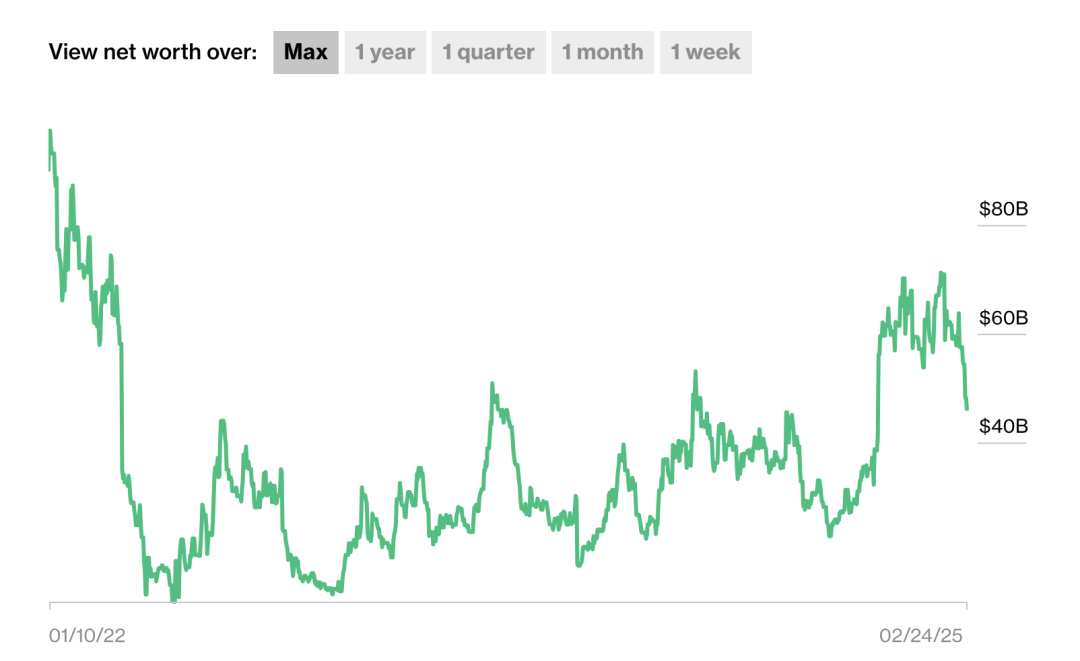
Caption: CZ's wealth changes, Image source: Bloomberg Billionaires Index
The unpleasant 20th century ended quickly. WWI and WWII shaped a Western world order centered on the United States; Cold War victory established a global order likewise centered on America. Yet all of this rested on a stark contrast: freedom for the West, no freedom for non-Western and Third World nations.
Zhao Changpeng ultimately chose to conform to America—perhaps driven by childhood memories. Pay the price of becoming part of the West, and freedom naturally follows.
Thus, after six years in materially modest but spiritually rich Vancouver, he enrolled at McGill University in 1995, initially studying biology before switching to computer science. Around age 18, one’s mental state tends to be exceptionally active—perhaps explaining Zhao Changpeng’s current strong interest in the DeSci paradigm led by biotechnology.
In 1997, 20-year-old Zhao Changpeng arrived at the Tokyo Stock Exchange for an unremarkable summer development internship. But here emerged the billionaire’s familiar choice—to emulate Bill Gates, drop out, and go all-in on code.
If university helps, attend; if coding is fun, do it. Undeniably, Zhao Changpeng did it well. Four years later, in 2001, he joined Bloomberg developing trading software. In 2005, at age 28, Zhao Changpeng left Bloomberg. Influenced by the gradual return of overseas Chinese entrepreneurs, he naturally chose to relocate to Shanghai.
Years of accumulated experience in trading systems now shaped his entrepreneurial direction—founding Fusion Systems. In short, a SaaS platform offering high-frequency trading solutions. Remember this: it is actually the origin of Binance—delivering premium trading services.
And then nothing happened. Everything quieted down. Clearly, Zhao Changpeng was not the chosen one of that era. This was the age of Li Yanhong, Ma Huateng, and Jack Ma—the golden age of Copy-to-China, when Alipay was still weak, and China had yet to produce a large middle class through real estate and internet booms.
With few speculators, ordinary individuals had no connection to high-frequency trading. For SaaS platforms, 2B and 2G were dominant. I suspect it was during this period that Zhao Changpeng formed his memory of Shanghai and China—memories requiring alcohol to endure. Yet he never explicitly complained. Much like his current stance toward TST: no direct endorsements, just concept surfing.
So things remained flat—until the collapse. After turning 35, Zhao Changpeng, now a homeowner and boss in Shanghai, gradually evolved into CZ, meeting He Yi—the other half who would co-create Binance—and marking the shift from arbitrage to long-term Buidl-ing Binance.
One note: during this time, Zhao Changpeng experienced his first and only “marriage.” Xu Mingxing once questioned aspects of his personal history. Truth and fiction blend as usual in life—let’s assume everything is true.
Isomers
How to evaluate Zhao Changpeng’s life before age 35? Certainly less flamboyant than Sun Yuchen. Unlike Sun’s explosive, drum-beating rise, Zhao Changpeng’s growth was more organic, quietly accumulating solid foundations. His personal emphasis on opportunity over credentials or wealth, and the resilience forged amid sweeping historical tides—all that remained was an industry, a partner, and a chance.
His experiences in Canada and Tokyo, buying property as a returnee, escaping the grind of ordinary labor—叠加 (stacked) with China and internet advantages—after the 2008 real estate liquidity surge, the fiscal frenzy era of P2P and blockchain arrived. 2013–2018 approached.
Occidentalism—long present from the early 21st century until Sino-U.S. comparisons on Xiaohongshu—imbued all things Western, material and ideological, with an aura. Revisiting the “self-Orientalization” narrative in crypto: regardless of merit, the world always offered them greater leniency. But not forever. Binance’s 2017 exodus, FTX’s 2022 collapse—both East and West were shedding the elements of the old era.
In 2013, during a late-night poker game, Li Qiyuan introduced Zhao Changpeng to Bitcoin. It’s hard to believe he immediately sold his house to bet $1 million on Bitcoin. A more plausible guess: he saw a potential entrepreneurial opportunity in trading. The image of selling his home to go all-in, like Chen Sheng Wang in fish bellies, stone men in the Yellow River, or red light at Zhu Yuanzhang’s birth, belongs to post-success mythmaking. Just take it as folklore.
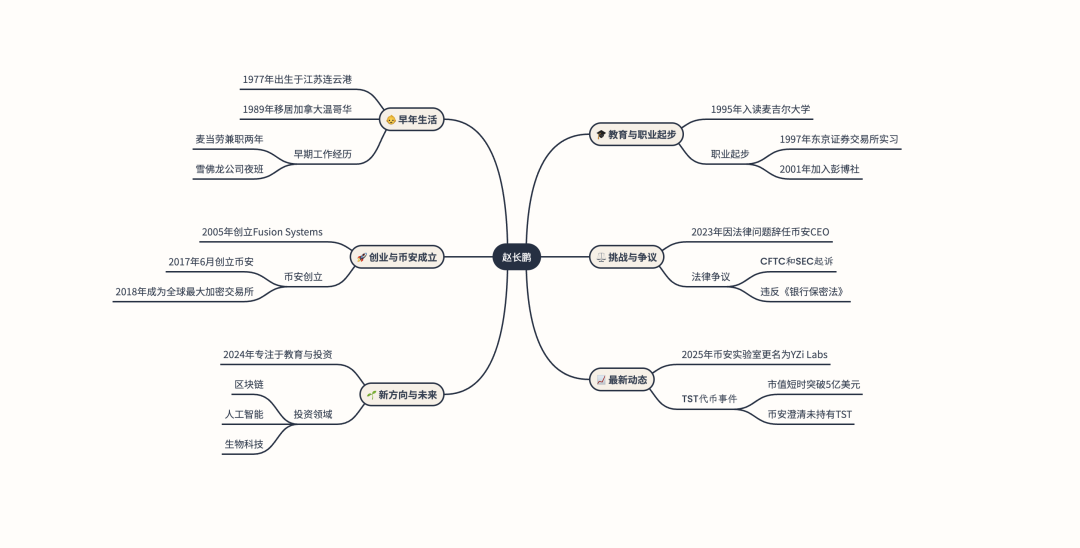
Caption: Blocks of Zhao Changpeng’s life, Image source: @zuoyeweb3
Zhao Changpeng then left Fusion Systems and joined Blockchain.info. Like Ripple’s role for Sun Yuchen, Zhao Changpeng, as a technologist, stepped directly into the arena.
Past experiences were merely life chapters, not burdens to carry. Extracting himself from entrepreneurship to learn new, unfamiliar fields, Zhao Changpeng once again altered his life course, continuing his drift across companies.
The real turning point: Zhao Changpeng met He Yi. And thus, CZ was born.
In 2014, the two Binance co-founders formally met. Invited enthusiastically by He Yi, Zhao Changpeng resigned to join what was then OKex (now OKX) as tech lead. At the time, Reddit became his primary battlefield, passionately promoting OKX and all things crypto. Whether social media obsession affected development—well, who knows.
In 2015, CZ left OKX to start a venture. The relationship between CZ and Xu Mingxing, Binance and OKX, is clouded by too much personal sentiment, less interesting than pure business rivalry—no further probing.
Then Bijie was founded. Strictly speaking, Bijie fueled the first bubble in China’s crypto industry, as it was another SaaS company selling exchange “white-label” systems. The later “thousand exchanges war” essentially generated profits solely for such white-label SaaS firms.
This was likely Zhao Changpeng’s real wealth inflection point—not earlier BTC bets or startups.
“The most vibrant successful enterprises are those standing at the edge of chaos, unbound by order.”
Contrary to common knowledge that Binance originated in 2017, Bijie’s two pillars upon founding were cryptocurrency exchange operations and stamp-coin-card (邮币卡) trading—the latter even larger. Stamp-coin-card (stamps, coins, phone cards) platforms, likened to physical NFTs mixed with tulips and tokens, were inherently unsustainable.
Thus, in January 2017, one leg of Bijie broke. By August, stamp-coin-card exchanges had nearly vanished. Meanwhile, cryptocurrencies seized the moment. CZ now faced two paths: build a 2C exchange, though he’d never run one; or continue with 2B SaaS, though far less ambitious than running an exchange.
He needed someone—a person guaranteed to win in the thousand-exchange war.
After leaving OKX, He Yi joined Yizhibo, signing hot property Song Joong-ki. Admittedly, whether praised or criticized, He Yi was one of the best CMOS in China at the time—not limited to crypto.
Binance was founded in June 2017. Fortune rotated. In July, it was He Yi joining CZ’s company. Urgency grew. After September 4, following Sun Yuchen’s footsteps, Binance migrated from Alibaba Cloud to AWS, and CZ moved back from China to Tokyo.
In the U.S., Armstrong’s Coinbase was also growing into a giant. But clearly, Chinese purchasing power was emerging for the first time. Binance’s offshore structure was more flexible. Dual domestic-international strategy enabled the miracle of becoming the world’s largest exchange within 165 days.
In 2018, CZ entered the Forbes Crypto Rich List with a peak valuation of $2 billion—about 2% of the $96 billion on Bloomberg’s 2021 Billionaires Index.
From 2017 to 2021, two bull markets propelled Binance and CZ to unparalleled heights in crypto—no longer scrambling in legal battles with investors or struggling to sell platform tokens.
Throughout the history of disruptive technologies, dominant players in one era rarely maintain supremacy in the next.
SBF thought so too. In 2022, FTX was at its peak. Its American background made it stand out. Temasek, Middle Eastern sovereign funds, Silicon Valley, and Wall Street all strongly backed SBF—an effective altruist, son of Stanford law professors, bearer of Old Glory. In contrast: globally nomadic Binance, fence-sitting CZ, and He Yi with poor English. On paper, FTX was destined to win.
Two titans clashed—resulting in mutual destruction. In 2022, FTX collapsed due to misappropriation of user assets and insolvency. SBF finished his game and went to prison. In March 2023, CZ was sued by the U.S., and after prolonged legal battles, resigned as CEO, went to prison, ceased managing Binance, and paid over $4 billion in fines.
Sentenced in April 2024, released by late September, the charge was everyone’s familiar anti-money laundering clause.
In sum: pay the fine, serve the sentence, successfully make shore for a second life. Fine bombardment! What was the cost for Binance to come ashore?
At 47, Zhao Changpeng is now father to three children. He Yi is mother to three. After decades of wavering, he finally found his place—the billionaire expatriate in the UAE.
CZ’s Comeback, BNB’s Revival?
In 2024, CZ reappeared in Dubai, relaunching at Binance Blockchain Week, announcing focus on the Giggle education platform serving K12 populations in impoverished regions worldwide, followed by investment—mainly in blockchain, biotech, and AI.
Rome conquered the world by military force, Greece by intellectual force, or the three religions by emotional force—it’s all the same.
The key is how to conquer the world. CZ gives his answer: revitalize the BNB ecosystem. Whether investing or building public chains, all must empower BNB. CZ revealed his portfolio: 98% in BNB. Seems the story of betting $1 million on BTC might be true—but only $1 million.
Now, it’s mainly dual-driven by BNB Chain and YZi (formerly Binance Labs), empowering BNB Chain via Meme and AI Agent, educating global P-lings through investments in Vana and advisory roles, while casually researching longevity-focused DeSci with Vitalik.
I’ve always believed crypto is a content and creative industry. You rarely see Tencent’s Ma Huateng chatting with QQ users, or an intern’s private message to Ma becoming a trending topic. Bureaucracy is standard in modern society, regardless of capitalism or socialism, East or West.
But in crypto, endless creativity transforms into DAG/BFT/ZK/FHE/AI Agent, monetized via tokens, NFTs, Memes—born and dying rapidly, awaiting the next “more alive” figure to lead for a few fleeting years.
We must admit: before CZ and Armstrong, crypto trading was constrained by traditional technological hedonism—merely a toy for a small group of geeks. It was only after CZ’s Binance that crypto expanded to today’s scale. He may not be the creator, but he is undoubtedly the accelerator.
Yet the more successful one becomes, the harder it is to find meaning in existence. Perhaps success isolates people from real society.
The CZ we see—unable to use wallets, unfamiliar with Memes—is suffering from the side effects of success, exuding a certain “old money” vibe. He doesn’t inhabit the same class as ordinary crypto users. His attitude toward wealth and life overall preserves the temperament of a barbarian—only now refined, replaced by shrewdness or managerial skill instead of the earlier barbarian’s delight in bodily harm.
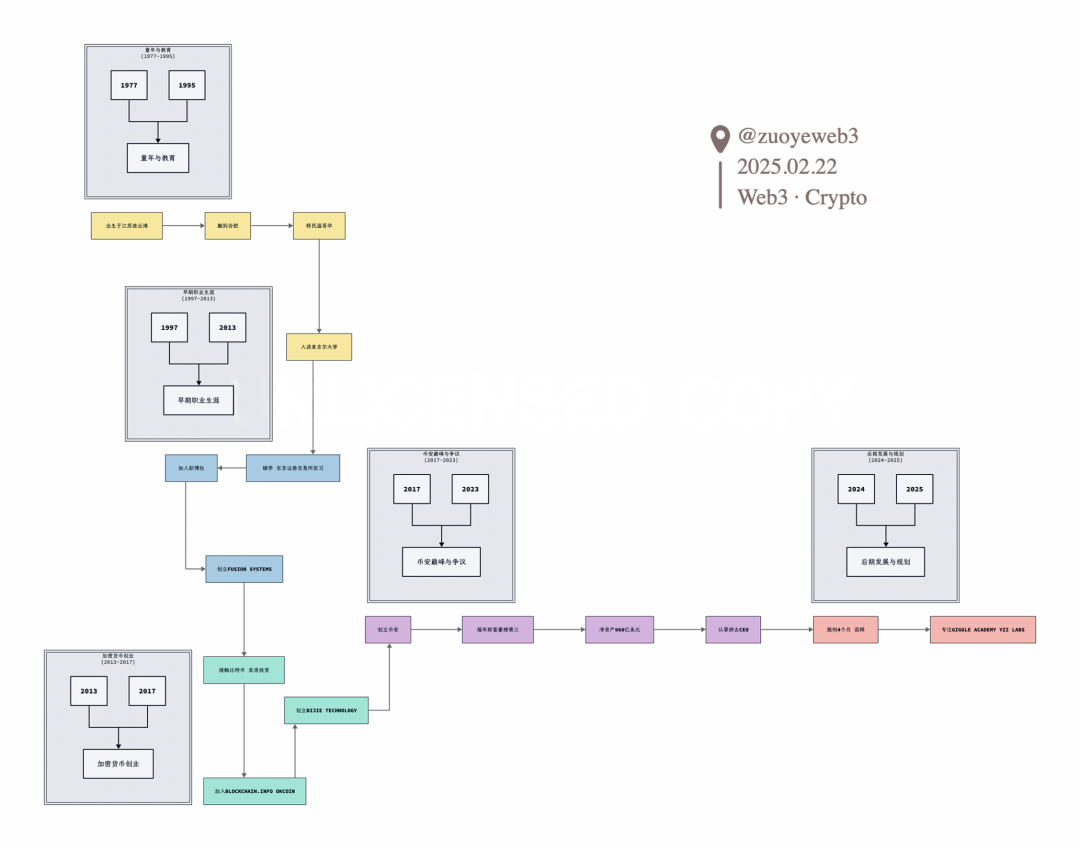
Caption: CZ’s Timeline, Image source: @zuoyeweb3
CZ’s brilliance lies in “using the West to oppose crypto, using crypto to resist the West.” Using decentralization as bait, he ultimately achieved wealth accumulation through CEX, leaving OKX’s $500 million fine flapping in the wind.
According to Bloomberg, CZ personally holds 90% of Binance’s shares. Amid rumors of selling partial equity, converting shares into real cash flow might better serve BNB holders—but these are outsiders’ perspectives.
Forget about those BNB holders. P-lings should be friends of cycles, not old money. Before a new cycle, volatile markets swiftly erase the experiential advantage of old money—that’s the charm of Web3.
Join TechFlow official community to stay tuned
Telegram:https://t.me/TechFlowDaily
X (Twitter):https://x.com/TechFlowPost
X (Twitter) EN:https://x.com/BlockFlow_News
 @zuoyeweb3






