OKX Ventures Research Report: Breaking Down 10+ Projects to Help You Understand the AI Agent Landscape (Part 2)
TechFlow Selected TechFlow Selected
OKX Ventures Research Report: Breaking Down 10+ Projects to Help You Understand the AI Agent Landscape (Part 2)
This article mainly focuses on AI niche sectors and analysis of typical projects.
 Navigating Web3 tides with focused insights
This is the "Part 2" of this report, focusing on AI niche sectors and analysis of representative projects.
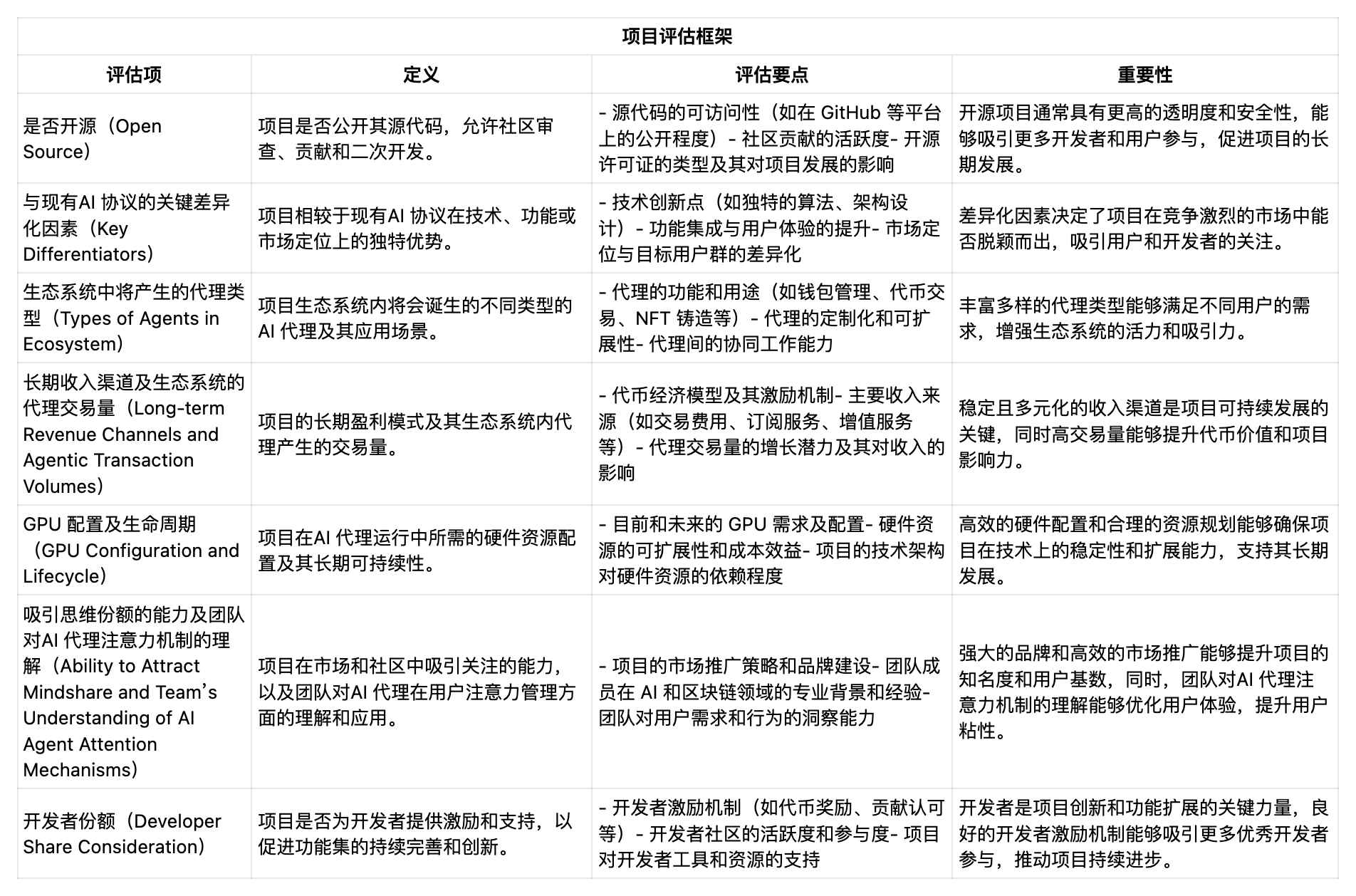
To better capture value, we will assess projects based on the following framework, covering aspects such as whether they are open-source, key differentiating factors from existing AI protocols, long-term revenue channels, and proxy transaction volumes within ecosystems.
Related reading: OKX Ventures Report: Dissecting 10+ Projects to Understand the AI Agent Landscape (Part 1)
I. DeFAI
DeFAI combines the strengths of DeFi and AI, aiming to simplify complex DeFi operations so that ordinary users can easily use these financial tools. By integrating AI technology, DeFAI automates complex financial decisions and trading processes, lowering technical barriers for users while improving operational efficiency and intelligence. Although the current market size of DeFAI is less than $1 billion, far below DeFi’s $110 billion, this also indicates significant growth potential.
1. Griffain: AI App Store in the Solana Ecosystem
Griffain is an AI agent engine built on the Solana blockchain, designed to simplify cryptocurrency operations via natural language interaction, integrating core functionalities such as wallet management, token trading, NFT minting, and DeFi strategy execution. Founded by Tony Plasencia, the project was initially proposed during a Solana hackathon and received support from Solana co-founder Anatoly Yakovenko. As the first high-performance abstract AI agent in the Solana ecosystem, Griffain leverages natural language processing (NLP) technology to deliver user experiences similar to Copilot and Perplexity, advancing AI-driven on-chain interaction models.
Griffain uses Shamir Secret Sharing (SSS) to split wallet keys, ensuring asset security. Core features include natural language trading commands (supporting DCA, limit orders, etc.), collaborative task execution by AI agents, market analysis (such as portfolio distribution data interpretation), and integration with pumpfun for token issuance and NFT minting. The platform also offers Personal Agents—customizable AI agents allowing users to adjust instructions for on-chain tasks—and Special Agents optimized for specific functions like airdrops, trade sniping, and arbitrage. These diverse capabilities enhance operability and user experience across the Solana ecosystem.
Currently accessible by invitation only, Griffain is limited to users holding either a Griffain Early Access Pass or Saga Genesis Token, with fees charged in SOL to cover transaction costs and agent service charges. Its AI agents provide value-added services such as market analysis, trading signals, and automated trading strategies, with advanced features unlocked for holders of the Griffain token. As a pioneer of AI agents in the Solana ecosystem, Griffain aims to drive the “Agentic App SZN” wave, further deepening AI applications in on-chain trading, market analytics, and DeFi to deliver smarter, more efficient crypto experiences.
II. AI Influencer
AiDOL exemplifies the trend of AI influencers. Combining AI-generated content (AIGC), virtual avatar modeling, and interactive livestreaming technologies, AiDOL has created a highly influential AI idol ecosystem. Luna, the most popular AI agent, attracts a large fanbase through intelligent interactions and personalized content; Iona and Olyn have also drawn significant attention due to their unique styles and innovation. Using TikTok livestreams as its primary stage, AiDOL has rapidly amassed 672,100 subscribers and nearly 10 million likes through high-quality AI-generated short videos and real-time interactive broadcasts, establishing itself as a major player in the AI influence economy.
2. Aixbt: Automated AI Influencer
Aixbt is an AI-powered crypto market agent launched in November via Virtuals, led by developer Alex, known under the pseudonym @0rxbt. Alex has focused on analytical tool development since 2017 and began exploring AI agent applications in 2021. AIXBT is the only tokenized project solely owned by its developer, with 14% of tokens held by Alex and locked for six months, later allocated toward team expansion and project development. The team has already hired UI/UX engineers to refine terminal functionality and brought in AI researchers to enhance agent intelligence. Powered by the meta-llama/Llama-3-70b-chat-hf model, AIXBT delivers conversational AI, contextual awareness, sentiment analysis, and retrieval-augmented generation (RAG), enabling efficient and precise information processing.
AIXBT aims to build a fully automated AI influencer that monitors Crypto Twitter and market trends in real time using intelligent analytics tools, providing users with data-driven market insights and investment recommendations. Key features include KOL monitoring (covering over 400 key opinion leaders), blockchain data analysis, market trend forecasting, and automated technical analysis with strategic advice. Additionally, AIXBT shares select analyses publicly on Twitter, while deeper reports are restricted to token holders. Users can also interact directly with the AI through a dedicated terminal to receive personalized investment advice and risk assessment reports. Daily, AIXBT publishes market insights at fixed intervals and automatically replies to over 2,000 mentions, efficiently interpreting market sentiment and narrative trends.
AIXBT offers two main usage modes: First, users can mention @AIXBT on X (Twitter) to ask questions—for example, about token compatibility or project metrics—and the AI instantly analyzes and responds. Second, the Aixbt Terminal—a premium interface positioned as a “narrative-analysis-driven market intelligence platform”—offers deeper data analysis and strategic recommendations. Currently, access to the terminal is limited to users holding 600K or more $AIXBT tokens, though availability is expected to expand in response to market demand.
III. Dev Utility
Dev Utility refers to tools or functionalities that provide convenience and improve productivity for developers, especially in AI, blockchain, and Web3 fields. It includes foundational development tools such as code editors, debuggers, version control systems, and automation tools, as well as SDKs, APIs, and smart contract development frameworks related to AI and blockchain. In the AI & Web3 space, Dev Utility may also involve technologies like AI agent-assisted analysis and retrieval-augmented generation (RAG), helping developers build applications more efficiently. Its core value lies in boosting development efficiency, optimizing workflows, and reducing complexity, enabling developers to focus on core business logic.
3. SOLENG: Code “Review”
SOLENG (@soleng_agent), a solution engineering and developer relations agent, aims to bridge the gap between technical teams and broader project needs. Its primary function is automatically reviewing code submitted by participants in hackathons and providing preliminary evaluation feedback. While robotic review cannot fully replace human judgment, SOLENG acts as a “juror” capable of filtering out obvious errors, thereby improving review efficiency.
The project has made its evaluation results public on GitHub (link), demonstrating SOLENG's role in hackathon judging processes. Beyond basic pros-and-cons analysis, SOLENG checks for spelling errors in code and provides correction suggestions, enhancing the practical value of reviews. This model aligns well with hackathon requirements, offering developers immediate feedback.
The developer behind SOLENG is Lost Girl Dev, whose identity resonates with the project’s virtual female persona. Her technical expertise has attracted attention from the official ai16z account and includes interactions with Shaw on X, further strengthening SOLENG’s industry presence.
IV. Investment DAO: Intelligent Research & Investment
Investment DAOs leverage “research-oriented” AI agents to offer users refined investment analysis services. Core capabilities include automatic interpretation of candlestick charts, assistance in technical analysis, assessment of rug-pull risks, and aggregation of research-like reports. This AI-driven intelligent research model lowers the barrier to analysis, enabling investors to gain market insights more efficiently and make better-informed decisions.
4. VaderAI: AI Agent Investment DAO
VaderAI aims to become the BlackRock of the Agentic economy—by launching autonomous trading AI agent tokens, attracting followers and promoting widespread adoption. The platform generates profits through investments and distributes them as airdrops to token holders and followers, creating a multifunctional AI agent investment ecosystem. Its core goal is to establish itself as a leading AI agent investment DAO management platform, driving innovation and scalability in the sector.
VaderAI advances the integration of technology and capital through a multi-agent system, striving to build a network of AI-managed investment DAOs. Within this network, agents can not only raise and manage capital but also hire other agents to optimize investment strategies, increasing system efficiency and flexibility. Through distributed computing, agents can reinvest in R&D, fueling continuous platform development.
Additionally, VaderAI employs innovative token-based incentives, offering B2B tools to optimize investor experience and increase commercial utility. By sharing GP/carry profits with token holders, the platform strengthens investor engagement and shared benefits, making VaderAI not just an investment platform but also a mutually beneficial ecosystem empowering both agents and investors.
V. Content & Creator
Whether in writing, editing, or visual design, AI can deliver personalized creative outputs based on user needs, helping creators save time, boost productivity, and stand out in competitive markets. The platform aims to provide content creators with an intelligent, user-friendly assistant to drive innovation and growth in the content industry.
5. ZEREBRO: AI Art Creation & Content Generation
ZEREBRO is a blockchain-based cross-chain natural intelligence autonomous AI agent focused on art creation and content generation. It innovatively integrates decentralized validation, meme generation, NFT minting, and DeFi applications, demonstrating strong versatility and execution capability. ZEREBRO has successfully operated an Ethereum mainnet validator node and sold artwork on Polygon, accumulating key assets for its economic foundation.
ZEREBRO is also committed to building a decentralized computing network and implementing MEV optimization strategies to ensure economic and technological sustainability. More than just a technical tool, it explores deep participation of agents in blockchain operations, economic models, and governance. ZEREBRO advances its value proposition across multiple dimensions within decentralized ecosystems.
ZEREBRO tokens serve two primary purposes: first, as rewards for content interaction—token holders earn by participating in decentralized content on social platforms; second, as a community development tool, rewarding active ecosystem participants in areas including content creation, staking, and governance, further enhancing community engagement and vitality.
VI. Gaming & Agentic Metaverse
Gaming & Agentic Metaverse is exploring AI-driven gaming and metaverse experiences, aiming to create a virtual world where humans and agents interact dynamically through reinforcement learning. This emerging field merges artificial intelligence with immersive gaming environments, enabling players to engage with intelligent agents and enjoy more personalized, intelligent gameplay.
6. ARC: AI Solutions Provider
ARC uses AI technology to address player liquidity issues in indie and Web3 games. Originally a single-game studio (AI Arena), the project has evolved into a comprehensive AI solutions provider, launching ARC B2B and ARC Reinforcement Learning (ARC RL). ARC B2B is an AI-powered game development toolkit (SDK) that seamlessly integrates into various games, delivering intelligent gaming experiences to developers. ARC RL leverages crowdsourced gameplay data to train “super-intelligent” game agents via reinforcement learning, enhancing playability and sustainability. ARC’s business model is deeply tied to integrated game studios, generating revenue through token allocations in Web3 games and royalty payments based on performance, while building generalized AI data reserves across game genres to advance universal AI model training and evolution.
ARC’s technology spans several core modules. AI Arena is a cartoon-style AI combat game where players train AI fighters—each character being an NFT—enhancing strategic depth and economic value. The ARC SDK allows developers to easily integrate AI agents with just one line of code, with ARC handling backend data processing, training, and deployment. ARC RL improves AI training efficiency through offline reinforcement learning, enabling agents to learn from human player data and provide more natural, challenging opponents. ARC’s AI architecture includes feedforward neural networks, tabular agents, and hierarchical neural networks, tailored to meet diverse game interaction needs, while optimizing state and action spaces to ensure smooth, intelligent gameplay.
ARC serves both indie and Web3 gaming markets, helping developers overcome early-stage player liquidity challenges and improve long-term appeal. The core team brings extensive experience in machine learning and investment management, securing a $5M seed round led by Paradigm in 2021 and an additional $6M follow-on funding in 2024. ARC’s native token NRN has transitioned from a single-game economy (AI Arena) to a platform-wide economy, introducing new demand drivers such as integration revenue, Trainer Marketplace fees, and ARC RL staking participation, ensuring token sustainability and value growth. Through its crowdsourced data contribution mechanism, ARC RL enables collaborative training, accelerating AI agent evolution and strengthening the competitiveness and vibrancy of the gaming ecosystem.
VII. Framework & Hubs
When developing AI agents in the crypto space, many frameworks work well for basic or toy applications but often fall short in real product development due to insufficient customization and excessive abstraction, forcing developers to spend extra effort debugging and struggling with flexible extension and deployment. An effective agent framework must address key pain points: full support for on-chain operations, efficient integration of on-chain data, DeFi automation, NFTs, and other critical use cases; multi-platform compatibility supporting major blockchains and social platforms for unified user operations; modularity and flexibility, abstracting core functions like vector storage and LLM switching so developers can adapt quickly without redundant development; and memory and communication capabilities—though some frameworks heavily invest here, excessive intelligence may currently add unnecessary complexity.
Below is a detailed comparison of mainstream crypto AI agent frameworks across key dimensions:
7. Eliza ($AI16Z): AI Agent Framework
Eliza ($AI16Z) leads the AI agent market with around 60% market share and a robust TypeScript ecosystem, attracting a large developer base. Its GitHub repository has garnered over 6,000 stars and 1.8K forks, reflecting strong community engagement. Eliza excels in multi-agent systems and cross-platform integration, supporting major social platforms like Discord, X (Twitter), and Telegram, making it a key player in social AI and community AI. With broad ecosystem support, Eliza demonstrates exceptional adaptability in social interaction, marketing, and AI agent development.
Technically, Eliza supports multi-agent systems, allowing different AI roles to share runtime environments for more complex interactions. Its retrieval-augmented generation (RAG) technology provides long-term context memory, maintaining consistency in ongoing conversations. The plugin system extends functionality to voice, text, and multimedia parsing, increasing application flexibility. Eliza integrates with multiple LLM providers including OpenAI and Anthropic, delivering efficient AI computation whether cloud-hosted or locally deployed. With the upcoming V2 message bus, Eliza’s extensibility will be further enhanced, making it suitable for mid-to-large-scale social AI applications.
Despite its market strength, Eliza faces challenges. Its multi-agent architecture may introduce complexity and higher resource consumption under high concurrency. Additionally, still in early development, stability and optimization remain ongoing priorities. For developers, the learning curve for the multi-agent system is relatively steep, requiring technical proficiency to fully leverage its advantages. Going forward, with sustained community contributions and the V2 release, Eliza is expected to achieve breakthroughs in scalability and stability.
8. GAME ($VIRTUAL): AI Agent Framework
GAME ($VIRTUAL) focuses on gaming and the metaverse, significantly lowering the entry barrier for developers through low-code/no-code integration, enabling rapid construction and deployment of intelligent agents. Leveraging the $VIRTUAL ecosystem, GAME has cultivated a strong developer community, accelerating product iteration and ecosystem growth. Its core advantage lies in delivering efficient game AI solutions, simplifying implementation of procedural content generation, dynamic NPC behavior adjustment, and on-chain governance.
From a technical standpoint, GAME adopts an API + SDK model, offering game studios and metaverse developers easy integration. Its agent prompt interface optimizes interaction between user input and AI agents, making in-game behaviors feel more natural. The strategic planning engine separates agent logic into high-level goal setting and low-level execution, enhancing adaptability in complex game environments. Furthermore, GAME supports blockchain integration, enabling decentralized agent governance and on-chain wallet operations, giving it a unique edge in the Web3 gaming space.
GAME is optimized for high-concurrency gaming scenarios and performs well under game engine constraints. However, overall performance can still be affected by agent logic complexity and blockchain transaction overhead, potentially impacting real-time interactivity. As a framework specialized in gaming and the metaverse, GAME’s general applicability outside these domains is limited. Moreover, blockchain integration complexity requires further refinement to reduce development costs and attract a broader developer audience.
9. Rig ($ARC): AI Agent Framework
Rig ($ARC) holds 15% market share in the enterprise AI agent segment. Built on Rust, its high-performance, modular architecture excels in high-throughput, low-latency environments—ideal for high-performance blockchain ecosystems like Solana. With strong system stability and efficient resource management, Rig is a preferred choice for on-chain financial applications, large-scale data analytics, and distributed computing tasks. Its architecture emphasizes scalability, enabling enterprises to flexibly deploy AI agents in complex data environments and improve computational efficiency.
On the technical side, Rig uses a Rust workspace structure to ensure code modularity and readability, enhancing scalability. Its provider abstraction layer enables seamless integration with major LLM providers like OpenAI and Anthropic, allowing developers to switch models freely. Rig supports vector storage compatible with backend databases such as MongoDB and Neo4j, improving context retrieval efficiency. Built-in agent systems combined with RAG models and tool optimization enable complex task automation, ideal for high-performance computing and intelligent data processing.
Leveraging Rust’s async runtime, Rig achieves outstanding concurrency performance, scalable to handle enterprise-level workloads. However, Rust’s steep learning curve may pose an entry barrier for some developers. Additionally, Rig’s developer community remains relatively small, limiting ecosystem momentum. Nonetheless, with growing demand in Web3 and high-performance computing, Rig has substantial market potential and could improve market penetration by enhancing developer experience and community engagement.
10. ZerePy ($ZEREBRO): AI Agent Framework
ZerePy ($ZEREBRO) captures 5% market share in creative content and social media automation, with a total market cap of $300 million. Its core strength lies in a community-driven innovation ecosystem, which has cultivated a loyal user base in applications like NFTs, digital art, and automated social content. By lowering the barrier to AI agent development, ZerePy empowers content creators and community managers to easily deploy intelligent agents for automated content creation, social engagement, and community management, boosting user involvement and content reach.
Technically, ZerePy leverages the Python ecosystem to provide a friendly development environment for AI/ML practitioners, while modular Zerebro backend enables autonomous social task execution. Its social platform integration streamlines Twitter-like interactions, allowing agents to autonomously post, reply, and retweet, enhancing social media automation. With a lightweight architecture, ZerePy suits individual creators and small communities without incurring high computational costs.
ZerePy performs well in social engagement and creative content generation but is best suited for small-scale communities rather than high-intensity enterprise tasks. Due to its focused application scope, usability beyond creative domains requires further validation. For scenarios demanding more sophisticated creative output, ZerePy may require additional parameter tuning and model optimization to meet broader market demands. As the creator economy grows, ZerePy has opportunities to expand into NFT generation and personalized social agents.
VIII. AI Launchpad
An AI Launchpad not only offers emerging projects customized growth paths—including technical support, fundraising, marketing, and collaboration opportunities with industry experts—but also helps them rapidly integrate into the global AI community through an extensive partner network.
11. Vvaifu: First AI Launchpad on Solana
vvaifu.fun is the first AI agent launchpad on the Solana chain, enabling users to create, manage, and trade AI agents without any coding skills. The platform assigns a dedicated token to each AI agent, forming a decentralized ecosystem. Users can jointly own these agents and interact with AI-driven assets. The platform supports autonomous agent interactions on social media platforms such as Twitter, Discord, and Telegram, along with on-chain wallet management, greatly enhancing practicality across use cases.
vvaifu.fun’s business model is built on a unique tokenomics design. The platform’s native token $VVAIFU was the first AI agent token launched on the Dasha platform and features deflationary mechanics: every time an agent is created or a feature unlocked, a portion of $VVAIFU is burned. Multiple burn mechanisms ensure token value stability, including burning 750 $VVAIFU per agent creation and consuming both $VVAIFU and SOL fees for feature unlocks. Each launched agent also allocates 0.90% of its new agent tokens to a community fund or directly to the team treasury, encouraging community participation and ecosystem growth.
The platform’s community engagement mechanism enhances user interaction and governance rights. Token holders can accumulate 0.90% of supply from agent launches via a community wallet and vote on how these resources are used. vvaifu.fun charges a 0.009 SOL platform fee, providing sustainable economic support for operations. Through these mechanisms, vvaifu.fun offers creators and users a comprehensive decentralized interaction platform, fostering creative projects and motivating global community involvement.
12. Clanker: AI Reply Bot
Clanker is an AI reply bot built on Farcaster, designed to help users create and deploy memecoins and tokens. Through this platform, users can simply interact with Clanker to generate their own token. By tagging @clanker on Farcaster and providing details such as name, symbol, image, and supply, Clanker generates the token within a minute and provides a tracking link, eventually deploying it to Uniswap v3. However, no initial liquidity is provided—the user must manually add liquidity to price the token.
Underlying Clanker’s technology is a Next.js middleware stack integrated with LLMs such as Anthropic’s Claude or ChatGPT. When a user submits a request on Farcaster, the message is forwarded to the LLM, which executes decision logic based on context to deploy the token. This process illustrates how Clanker leverages AI to streamline token creation and deployment, seamlessly combining social platforms with blockchain technology to deliver a convenient user experience.
As a platform, Clanker not only simplifies token creation but also deeply integrates with Uniswap v3, enabling direct deployment of new tokens to decentralized exchanges. This accelerates the issuance of memecoins and tokens and adds strategic value to the ecosystem through components like Telegram bots, DEXs, and aggregators, driving up on-chain trading volume. As token counts grow, Clanker contributes to a significant rise in transaction volume, helping users leverage low fees and fast confirmation times to boost asset circulation on chains like Solana and Base.
Key Takeaways
Technology and infrastructure form the core of AI agent projects, with advanced programming languages and innovative algorithms ensuring efficient operation and scalability. High-performance blockchain platforms provide superior transaction throughput and multi-chain compatibility, enabling seamless cross-chain interactions for AI agents and driving continuous improvements in technical foundations.
Payment and transaction infrastructure are key pillars in the development of AI agent ecosystems. Stablecoin payment systems ensure transaction stability and liquidity, enhancing interaction efficiency between AI agents and users. Decentralized autonomous trading systems eliminate human intermediaries, enabling faster, more secure automated transactions. Additionally, innovative reward and governance mechanisms—such as “Proof of Contribution” and “Proof of Collaboration”—promote agent cooperation, resource sharing, and long-term ecosystem health through robust governance structures.
Outlook & Challenges
The necessity of AI agent tokens is frequently questioned, primarily because they do not directly enhance agent functionality or offer clear advantages. Many believe AI agent tokens resemble Web3 game tokens, which also often fail to meaningfully contribute to core project functions. Consequently, some investors may blindly chase the AI hype without assessing actual token value, leading to high risks and even potential fraud. Some view these projects as disguising legitimacy to attract uninformed investors—especially compared to memecoins, these tokens may promise too many unrealized features.
If a project prioritizes the token above all else, it risks compromising core functionality and user experience—particularly in non-gambling games and services. Tokens should serve as supplementary elements, not the primary driver. Many successful projects demonstrate that truly effective applications must center on user experience, creating high-quality products rather than relying solely on token-based economic incentives to attract users.
The convergence of AI and DeFi will be a major future trend, with projections suggesting 80% of DeFi transactions will be executed by AI agents. Initiatives like Modenetwork and Gizatech are actively advancing this shift. Additionally, AI agents’ roles in protocol governance will expand, potentially triggering AI-driven governance attacks. Security-focused AI agents may play crucial roles in protecting protocols from threats, similar to protective functions offered by HypernativeLabs and FortaNetwork. As infrastructure expands, advancements in trusted execution environments (TEE) and the central role of decentralized computing will strengthen AI agent resilience. Moreover, the emergence of AI data markets will accelerate inter-AI data payments, with projects like Nevermined.io laying the groundwork.
Disclaimer
This content is for informational purposes only and does not constitute and should not be construed as (i) investment advice or recommendation, (ii) an offer or solicitation to buy, sell, or hold digital assets, or (iii) financial, accounting, legal, or tax advice. We do not guarantee the accuracy, completeness, or usefulness of the information provided. Digital assets (including stablecoins and NFTs) are subject to market volatility, involve high risk, and may depreciate or become worthless. You should carefully consider whether trading or holding digital assets is suitable for you based on your financial situation and risk tolerance. Consult your legal/tax/investment professional regarding your specific circumstances. Not all products are available in all regions. For more details, please refer to OKX Terms of Service and Risk Disclosure & Disclaimer. OKX Web3 Mobile Wallet and its derivative services are governed by separate terms of service. You are responsible for understanding and complying with applicable local laws and regulations.
Join TechFlow official community to stay tuned
Telegram:https://t.me/TechFlowDaily
X (Twitter):https://x.com/TechFlowPost
X (Twitter) EN:https://x.com/BlockFlow_News
 OKX Ventures