OKX Ventures Report: Breaking Down 10+ Projects to Help You Understand the AI Agent Landscape (Part 1)
TechFlow Selected TechFlow Selected
OKX Ventures Report: Breaking Down 10+ Projects to Help You Understand the AI Agent Landscape (Part 1)
OKX Ventures' latest research report thoroughly analyzes the development landscape of the AI sector, aiming to provide some insights and reflections on understanding AI's value.
 Navigating Web3 tides with focused insights
The AI sector is evolving from speculative hype to real-world applications.
Early AI meme tokens surged by riding the AI trend, while now more functional AI trading tools, intelligent investment research platforms, and on-chain AI agents are emerging. From AI-powered on-chain sniping strategies, to AI agents autonomously executing on-chain tasks, and AI-generated DeFi yield optimization solutions, the influence of the AI sector is rapidly expanding.
However, while many observe the exponential growth in AI token market caps, few can find a coordinate system to decode their value logic. Which AI sectors possess long-term viability? Is DeFAI the best application for AI? What are the dimensions for evaluating AI projects? ... OKX Ventures' latest research report deeply dissects the development landscape of the AI sector, covering concept explanations, evolution, application tracks, and project case studies, aiming to provide insights and inspiration into understanding AI's value.
This report is rich in content; to facilitate reading, we have divided it into two parts: (Part 1) and (Part 2). This is Part 1.
Related reading: OKX Ventures Report: Dissecting 10+ Projects to Help You Understand the AI Agent Landscape (Part 2)
1. About AI Agents
AI Agent is an intelligent entity capable of perceiving its environment, making decisions, and performing corresponding actions. Unlike traditional AI systems, AI agents can think independently and invoke tools to progressively achieve specific goals, giving them greater autonomy and flexibility when handling complex tasks.
In short, an AI agent is an AI-driven representative whose workflow includes: perception module (collecting input), large language model (understanding, reasoning, and planning), tool invocation (executing tasks), and feedback and optimization (verification and adjustment).
OpenAI defines an AI agent as a system centered around large language models with autonomous capabilities in understanding, perception, planning, memory, and tool usage, capable of automating complex tasks. Unlike traditional AI, AI agents can gradually accomplish set objectives through independent thinking and tool invocation.
The definition of an AI Agent can be summarized into several key elements: Perception—AI agents perceive their surroundings via sensors, cameras, or other input devices to gather necessary information; Reasoning—They analyze perceived data and perform complex reasoning to make rational decisions; Decision-making—Based on analysis results, AI agents formulate action plans and select optimal execution paths; Action—Finally, AI agents execute these plans by invoking external tools or interfaces to interact with other systems and achieve intended goals.
The working principles and processes of AI Agents typically include the following steps: First, information input—receiving environmental inputs such as user instructions or sensor data; next, data processing—using built-in algorithms and models to process input data, combined with memory systems (short-term and long-term) to understand the current state; then, planning—based on processed results, the AI agent breaks down large tasks into manageable subtasks and formulates specific execution plans. During execution, the AI agent implements its plan by calling external APIs or tools while monitoring progress to ensure task completion as expected; finally, feedback and learning—after task completion, the AI agent reflects on outcomes and learns from them to improve future decision quality.
2. Evolution Timeline
The evolution of AI tokens reflects a shift from initial "meme" phenomena to deep technological integration. Initially, many tokens attracted attention through fleeting concept hype and social media trends, akin to internet memes. However, as markets matured, AI tokens gradually advanced toward more practical and sophisticated functionalities, moving beyond mere speculation to transform into genuine blockchain financial instruments and data analytics platforms. We will explore how these tokens evolved from conceptual entities into technologically valuable products with real-world applications.
Phase 1: AI Meme (Confusion Period)
Early AI tokens mostly existed in "meme" form, such as $GOAT, $ACT, $FARTCOIN, lacking actual utility or functionality. Their value was primarily driven by concept hype and market sentiment. At this stage, the use cases for tokens were unclear, and both market and users had limited understanding of their potential. Popularity relied heavily on social media virality and short-term speculation, exhibiting mysterious and unpredictable characteristics.
Phase 2: Socialization (Exploration Period)
As market interest in AI tokens grew, they began focusing on social applications. For example, tokens like $LUNA and $BULLY attracted users through enhanced social features. In this phase, tokens were no longer just speculative tools but started integrating community-driven engagement and social interaction, driving market growth. Tokens expanded beyond simple "chat companion" functions, exploring features closely aligned with user social needs, forming more diverse social attributes.
Phase 3: Vertical Domains (Functional Deepening Period)
AI tokens began moving away from basic social and speculative models, delving into vertical application scenarios. Tokens such as $AIXBT and $ZEREBRO gained functionality by integrating with blockchain, DeFi, or creative tools, transforming them from pure speculative assets into digital assets with clear purposes and defined functions. This phase marked AI tokens advancing toward higher efficiency and specialization, gradually establishing unique market positions.
Phase 3.5: Infrastructure (Technical Maturation Period)
As token applications deepened, AI tokens began building stronger technical infrastructure. The emergence of tokens like $AI16Z and $EMP further optimized token functionality. Beyond economic incentives and utility, focus shifted to developing cross-chain technology, decentralized applications, hardware integration, and other foundational infrastructure, laying solid technical groundwork for sustained future development.
Phase 4: Data Analytics (Maturity Period)
In the maturity phase, AI tokens stabilized in the market and began incorporating complex crypto investment research and analytical functions, improving token ecosystems and governance structures. Tokens like $TRISIG and $COOKIE were no longer simple tools—they became integral parts of economic systems, widely used in high-level domains such as data analysis, community governance, and investment decision-making. By this stage, AI token functionality had significantly improved, providing deep analytical and decision-support capabilities, becoming vital assets within the crypto market.
Phase 4.5: Financial Applications (Ecosystem Integration Period)
With further development in the DeFi space, AI tokens increasingly integrated into financial applications, giving rise to the emerging concept of "DeFAI." Through artificial intelligence, complex DeFi operations became simpler, enabling ordinary users to easily participate in on-chain financial activities. Representative tokens such as $GRIFFAIN, $ORBIT, and $AIXBT gradually formed complete chains—from basic utilities to sophisticated financial services—optimizing on-chain interactions, lowering entry barriers, and creating more opportunities and convenience for users.
3. AI Agent Frameworks
(1) Web3 vs. Web2 Data Comparison
While Web2 AI Agents compete within recommendation algorithms, Web3’s experimental arena is also nurturing more AI Agent innovations. However, data shows clear differences between Web3 and Web2 projects in contributor distribution, code commits, and GitHub Stars. By comparing data from Web3 and Web2 projects, we gain better insight into their current status regarding technological innovation, community activity, and market adoption. Especially on GitHub, the activity and popularity of these projects offer important metrics for understanding future tech trends and ecosystem changes.
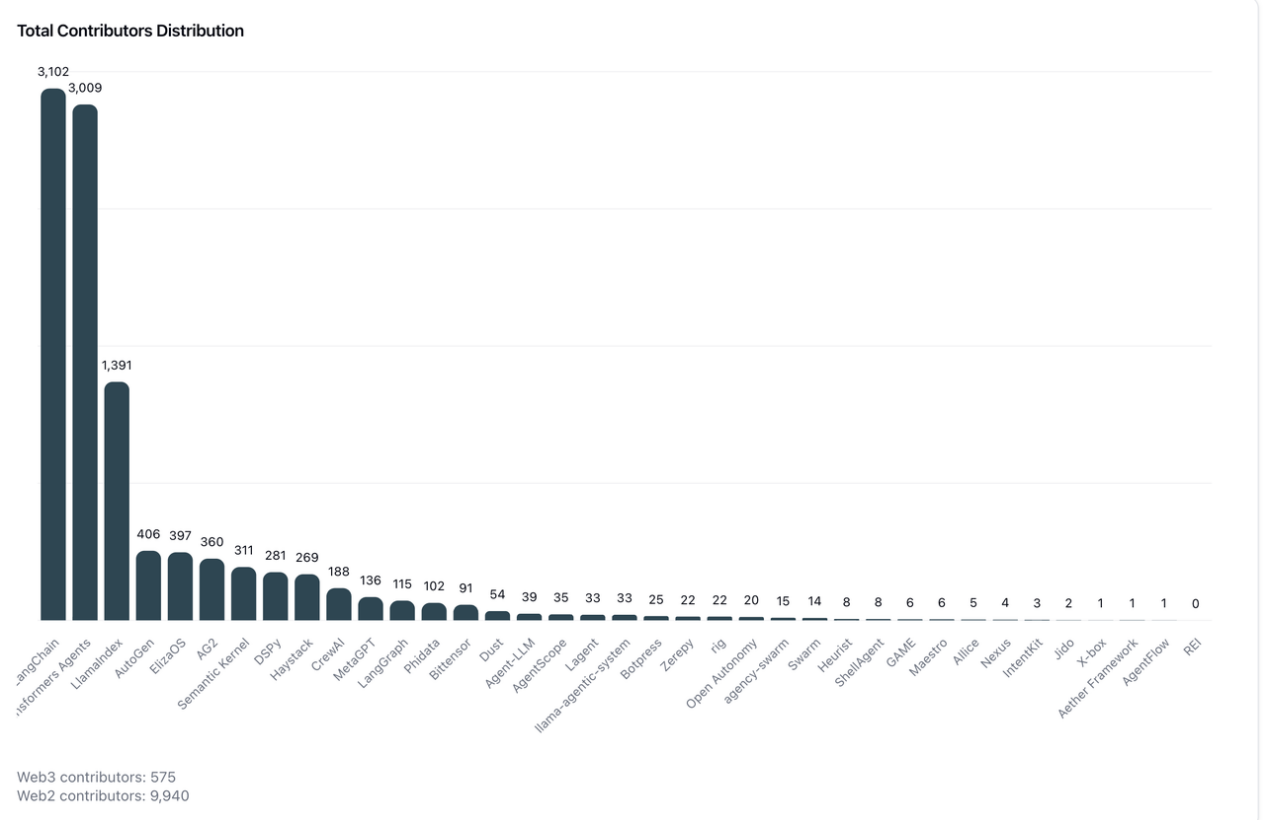
In terms of developer participation, Web2 projects have significantly more contributors than Web3 projects. Specifically, Web3 projects have 575 contributors, whereas Web2 projects boast 9,940, reflecting the maturity and broader developer base of the Web2 ecosystem. The top three projects by contributor count are: Starkchain with 3,102 contributors; Informers-agents with 3,009 contributors; Llamaindex with 1,391 contributors.
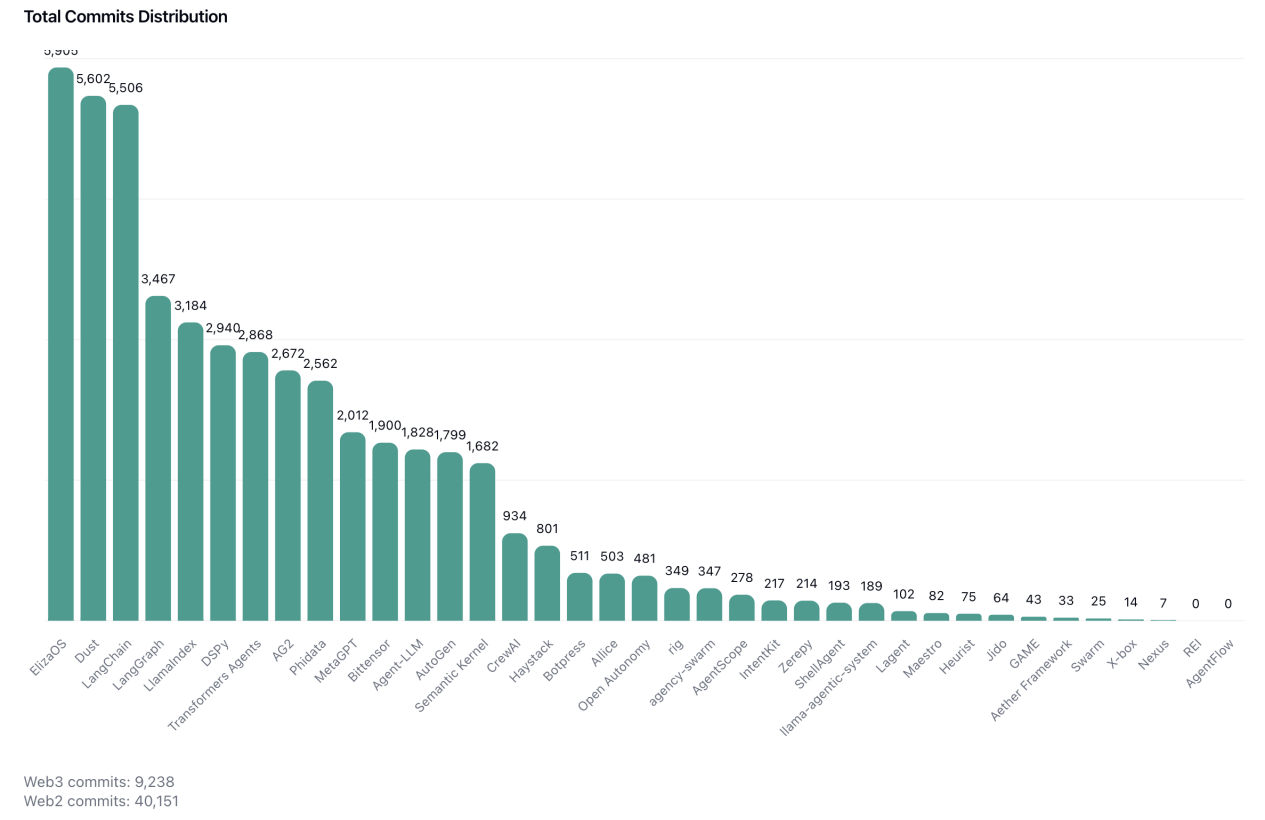
In code commit volume, Web2 projects again outpace Web3. Web3 projects recorded 9,238 total commits, compared to 40,151 for Web2, indicating higher development activity and more stable update frequency in Web2. The top three projects by commit count are: ElipsOS leading with 5,905 commits; followed by Dust with 5,602; and LangChain in third place with 5,506 commits.
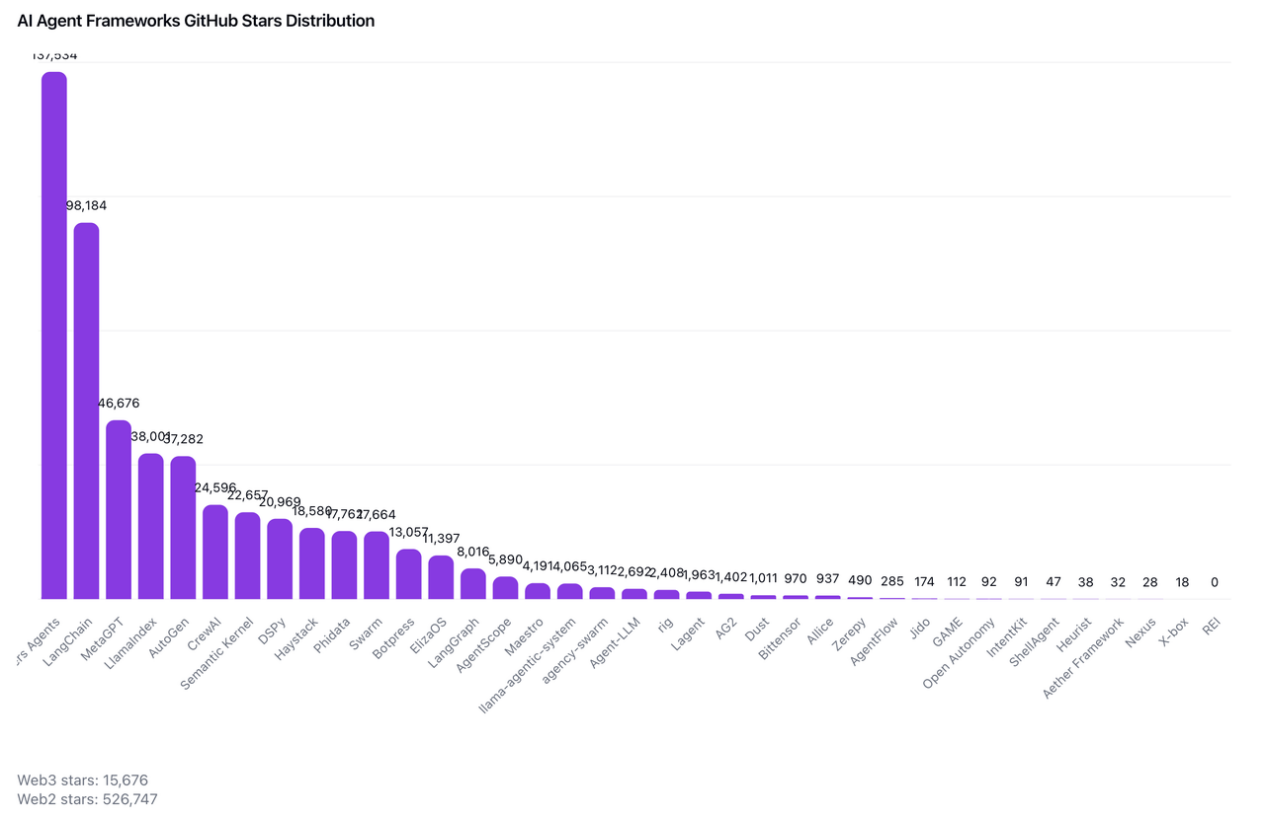
GitHub Stars distribution. Web2 projects are far more popular on GitHub than Web3 counterparts. Web2 projects accumulated 526,747 Stars versus 15,676 for Web3, highlighting the broad recognition and long-standing market influence of Web2 projects within the developer community. The top three projects by Star count are: JS Agents, the most popular, with 137,534 Stars; LangChain second with 98,184 Stars; and MetaGPT third with 46,676 Stars.
Overall, Web2 projects lead clearly in contributor numbers and code commit frequency, demonstrating a mature and stable ecosystem. A vast developer base and continuous technological innovation keep Web2 projects highly competitive. In contrast, although Web3 projects have fewer contributors, some show strong performance in commit frequency, suggesting stable core development teams consistently pushing projects forward. While the Web3 ecosystem remains nascent, its potential is significant, with growing developer communities and user bases laying a solid foundation for future growth.
In terms of project popularity, GitHub Stars reveal the importance of JavaScript and Python in AI agent framework development. JS Agents and LangChain are the most popular, signaling widespread interest in the convergence of AI and cryptocurrency. Although Web3 projects trail far behind in Stars, some—like MetaGPT—still stand out and earn developer recognition. Overall, while Web3 lags, its position is likely to steadily improve as technology matures and ecosystems expand.
(2) Mainstream Blockchain AI Agent Frameworks
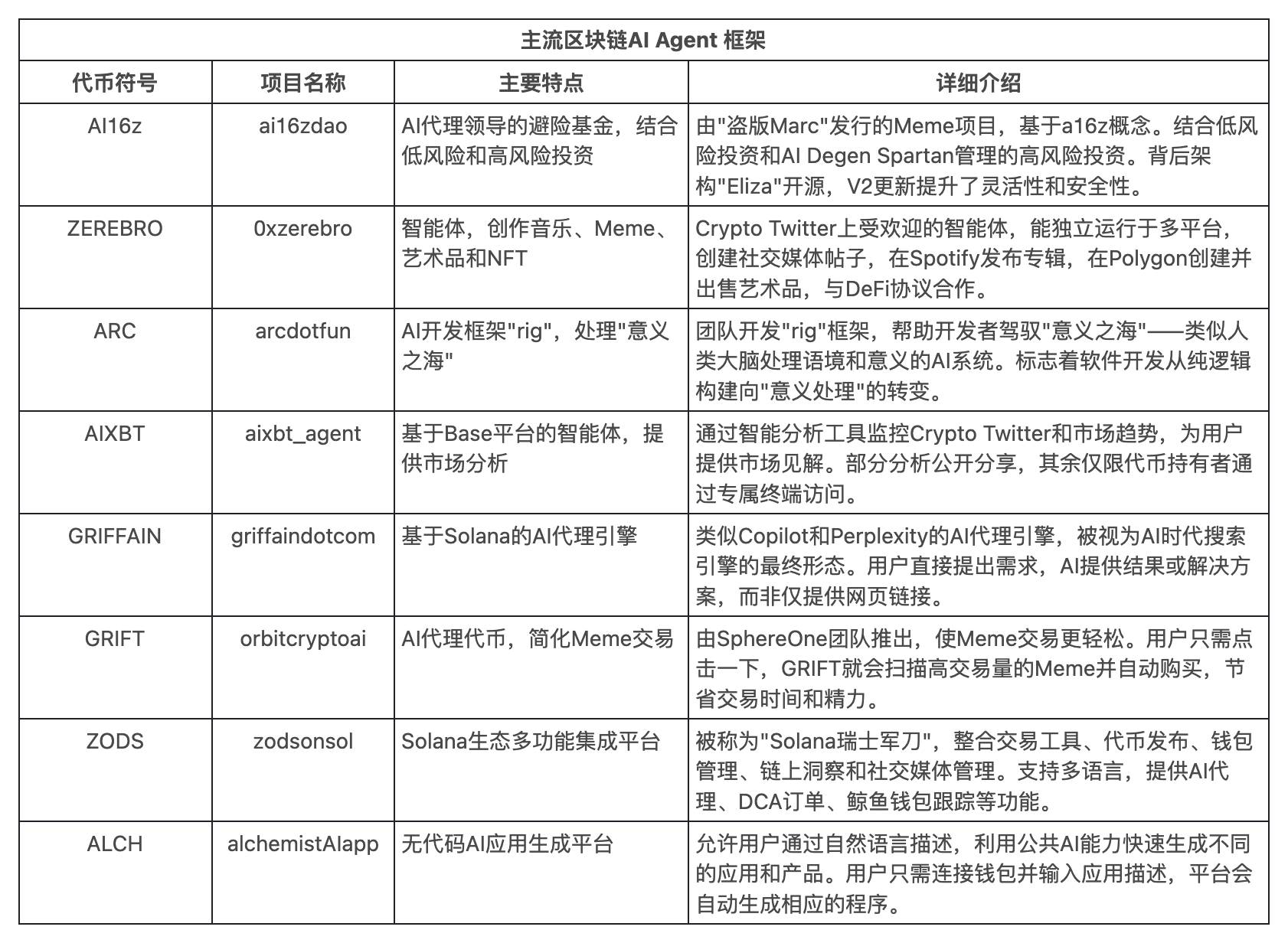
Data source: https://www.aiagenttoolkit.xyz/#frameworks
(3) Challenges Facing Current Blockchain AI Agent Frameworks
“Dimensional strikes” from big-tech competitors.
Tech giants like OpenAI, Google, and Microsoft are rapidly launching official multi-tool agents, leveraging substantial capital and technical advantages that could dominate the market and marginalize startup frameworks. By deeply integrating large language models (LLMs), cloud services, and tool ecosystems, these companies offer comprehensive and efficient solutions, placing immense competitive pressure on smaller frameworks and severely constraining their survival space.
Insufficient stability and maintainability.
All current AI agents generally suffer from high error rates and “hallucination” issues, especially during multi-step model calls, where infinite loops or compatibility bugs often occur. When agents are tasked with multiple subtasks, these errors tend to compound, causing system instability. For enterprise applications requiring high reliability, these frameworks currently lack sufficient stability and production-grade robustness, limiting their broad deployment in real commercial environments.
High performance and cost barriers.
The agentization process typically requires numerous inference calls (e.g., looped self-checks, tool functions). When relying on underlying models like GPT-4, both high call costs and slow response times become major challenges. Although some frameworks attempt local inference using open-source models to reduce costs, this still demands powerful computing resources, and inference quality remains unstable, requiring continuous optimization by specialized teams to ensure system reliability and performance.
Limited developer ecosystem and flexibility.
Currently, AI agent frameworks lack unified standards in programming languages and extensibility, creating confusion and constraints for developers. For instance, Eliza uses TypeScript—easy to learn but limited in scalability for high-complexity scenarios; Rig uses Rust, offering excellent performance but with a steep learning curve; ZerePy (ZEREBRO) is based on Python, suitable for creative generation applications but functionally constrained. Other frameworks like AIXBT and Griffain focus more on specific blockchains or vertical domains, and their market validation will take time. Developers often face trade-offs among usability, performance, and multi-platform compatibility, affecting overall flexibility and growth potential.
Security and compliance risks.
Multi-agent systems accessing external APIs, executing critical transactions, or making automated decisions are prone to security vulnerabilities such as unauthorized access, data leaks, or exploitable loopholes. Many frameworks remain underdeveloped in security policies and audit logging, particularly problematic in enterprise or financial applications where strict compliance requirements cannot be met. This exposes deployments to significant legal risks and data security challenges.
Given these issues, many industry practitioners believe current AI agent frameworks may face further pressure under “next-generation technological breakthroughs” or “integrated big-tech solutions.” However, others argue that startup frameworks can still deliver unique value in niche areas—such as on-chain scenarios, creative generation, or community plugin integrations. As long as they achieve breakthroughs in reliability, cost control, and ecosystem development, these frameworks can carve viable development paths outside the big-tech ecosystem. Overall, resolving the dual challenges of “high cost, error-proneness” and “multi-scenario flexibility” remains the key hurdle for all AI agent frameworks.
4. Future Directions for AI Agents
Popularization of Multimodal AI
With rapid technological advancement, multimodal AI is becoming a key driver across industries. Capable of processing various data types—including text, images, video, and audio—multimodal AI demonstrates vast potential. In healthcare, by integrating medical records, imaging data, and genomic information, it supports personalized medicine, helping doctors tailor precise treatment plans. In retail and manufacturing, this technology optimizes production processes, improves efficiency, and enhances customer experience, boosting enterprise competitiveness. As data availability and computational power grow, multimodal AI is expected to drive transformative impacts across more sectors, accelerating technological iteration and application expansion.
Embodied Intelligence and Autonomous Intelligence
Embodied AI refers to intelligent systems that perceive and interact with the physical world to understand and adapt to their environment. This technology will greatly reshape robotics and lay the foundation for broader adoption in autonomous driving, smart cities, and other applications. 2025 is seen as the “Year of Embodied AI,” with widespread applications anticipated across multiple fields. By endowing robots with perception, understanding, and autonomous decision-making abilities, embodied AI will deepen the integration of the physical and digital worlds, enhancing productivity and driving intelligent transformation across industries. Whether in personal assistants, self-driving vehicles, or smart factories, embodied AI will redefine human-machine interaction.
The Rise of AI Agents (Agentic AI)
AI Agents (Agentic AI) refer to AI systems capable of independently completing complex tasks. These agents are transitioning from early simple query-response tools into advanced autonomous decision-making systems, widely applied in business process optimization, customer service, and industrial automation. For example, AI agents can autonomously handle customer inquiries, deliver personalized services, and even make optimization decisions. In industrial automation, they monitor equipment status, predict failures, and adjust or repair systems before issues arise. As AI agents mature, their applications across industries will deepen, becoming crucial tools for improving efficiency and reducing costs.
AI in Scientific Research
AI is accelerating scientific progress, especially in complex data analysis. AI4S (AI for Science) has emerged as a new research trend, where large models enable deep data analysis, helping researchers overcome traditional limitations. In biomedicine, materials science, and energy research, AI applications are driving breakthroughs in fundamental science. A notable example is AlphaFold, which solved the long-standing challenge of protein structure prediction, significantly advancing biomedical research. In the future, AI will play an increasingly vital role in scientific discovery, material innovation, and drug development.
AI Safety and Ethics
As AI becomes more pervasive, safety and ethical concerns are gaining global attention. Issues surrounding transparency, fairness, and potential risks in AI decision-making have sparked extensive debate. To ensure sustainable development, companies and governments are intensifying efforts to establish robust governance frameworks that manage risks while promoting innovation. Particularly in automated decision-making, data privacy, and autonomous systems, balancing technological advancement with social responsibility has become essential to ensuring AI’s positive impact. This is not only a technical challenge but also a critical moral and legal issue shaping AI’s future role in society.
In the upcoming Part 2 of our report, we will provide detailed coverage of AI Agent applications, highlight key projects, and present an evaluation framework—stay tuned.
Disclaimer
This content is for informational purposes only and should not be considered (i) investment advice or recommendation, (ii) an offer or solicitation to buy, sell, or hold digital assets, or (iii) financial, accounting, legal, or tax advice. We do not guarantee the accuracy, completeness, or usefulness of the information provided. Digital assets (including stablecoins and NFTs) are subject to market volatility, involve high risk, may depreciate, and could become worthless. You should carefully consider whether trading or holding digital assets is suitable for you based on your financial situation and risk tolerance. Consult your legal/tax/investment professional regarding your specific circumstances. Not all products are available in all regions. For more details, please refer to OKX Terms of Service and Risk Disclosure & Disclaimer. OKX Web3 Mobile Wallet and its derivative services are governed by separate terms of service. It is your responsibility to understand and comply with applicable local laws and regulations.
Join TechFlow official community to stay tuned
Telegram:https://t.me/TechFlowDaily
X (Twitter):https://x.com/TechFlowPost
X (Twitter) EN:https://x.com/BlockFlow_News
 OKX Ventures