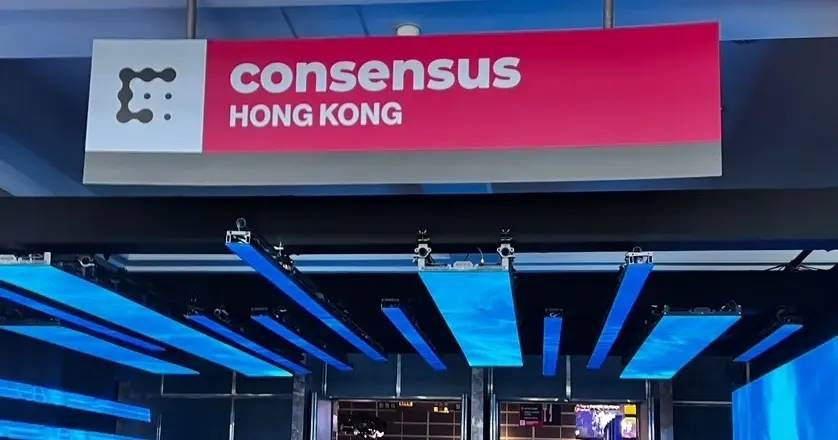
From consensus to fragmentation, Hong Kong summit reflects crypto world's "fight of trapped beasts"
TechFlow Selected TechFlow Selected
From consensus to fragmentation, Hong Kong summit reflects crypto world's "fight of trapped beasts"
The entire industry's "consensus" is being severely torn apart, with the technical narrative PVE consensus overshadowed by the meme narrative PVP consensus, and the diamond-handed Holder's diamond-hand consensus rendered speechless in the face of the younger generation of traders' Trader consensus.
 Navigating Web3 tides with focused insights
Author: Haotian
Sharing some thoughts after attending the Hong Kong Consensus conference:
1) As usual with such events, many people were rushing between main sessions and side events. Combined with unfamiliarity with Hong Kong's layout, constantly running around to attend meetings and dinners left me physically exhausted beyond words. But that’s nothing compared to the mental fatigue—markets keep falling, and there’s no end in sight.
2) Despite the overall environment, large crowds still packed every event. From a sentiment perspective, it didn’t feel bearish at all—perhaps most attendees came for the "emotional value." The clear crowd favorite was the Solana ecosystem, with every event completely sold out, sometimes even drawing police attention. In contrast, Ethereum and BTC layer2-related events felt much quieter. It’s truly chaotic—everyone takes their turn on stage; they too once had their moment of glory.
3) Although named Consensus, after talking to many attendees, I felt this was the least “consensual” Consensus ever. Industry-wide consensus is severely fractured. PVE technical narratives are overshadowed by PVP meme-driven ones. Diamond-handed holders hesitate to speak of their conviction amid the aggressive trading mindset of young “P generals.” Longtime builders’ commitment to technical development feels out of place when flashy marketing and tokenomics dominate trending projects. This fragmentation reflects the collapse of a unified industry value system. After Consensus, perhaps Polarization will become the norm.
4) Many crypto veterans say “the market environment has changed.” Markets are never wrong—it’s just that old-timers’ past “empiricism” no longer applies. Veterans applied bull-bear cycle logic from previous four-year cycles, only to find that timing no longer works. Now, markets define bull runs based on hot narratives—sudden and fleeting. By the time you confidently declare the bull market has just begun, it’s already over.
5) Don’t complain that making money is harder now—it’s simply that the audience and logic have changed. Today’s market offers endless assets, and liquidity wealth is controlled by mindshare. Young, energetic Gen-Z “P generals” who can pull all-nighters take bold risks, profit quickly, and exit fast—full of energy and courage—becoming lucky winners in this PVP era. In comparison, old-school diamond-hand PVE strategies stand little chance. Yet each PVP feast eventually sees massive liquidity drain. It’s unclear how long this squid game can last.
6) I sense the disappointment of idealistic builders committed to technical narratives—a unique kind of disillusionment. As one veteran put it: we’ve executed our technical roadmap step by step, conducted TGE as required, nurtured communities, and kept narratives updated with trending topics—but the token price remains stubbornly lifeless. When idealists consistently receive no market reward, does this signal an exhaustion of innovation? If crypto loses its idealistic hacker spirit, what ethos will counteract its casino-like reputation? Are we not even pretending anymore?
7) Most people riding the AI Agent wave are deeply trapped, yet the majority still firmly believe in the future of AI + Crypto. I’ve always emphasized that aside from short-term application value of AI Agents, their real significance lies in revitalizing outdated narratives like layer2, ZK, modularity, and chain abstraction. They offer renewed directions for legacy narratives and enable infrastructure without current use cases to anticipate future applications. Overall, the sacrifices from the current AI Agent bubble burst are negligible compared to its long-term value in restructuring and renewing the industry.
8) The logic of the secondary market has completely changed. BTC stands alone at the top, supported by ETF-driven off-exchange capital. Internally, ETH, SOL, and BSC are fiercely competing for ecosystem dominance. Yet regardless of the battle, the market unanimously agrees: there will be no more broad altseason rallies. Choosing the right locomotive determines your returns. Pick wrong, and the outcome becomes embarrassing—for example, if you backed layer2.
9) On-chain ecosystems represent most people’s hope within crypto. But compared to the difficulty of profiting on CEX spot markets, the pure, high-speed PVP environment on-chain poses immense challenges for most users. After this chaotic era, the on-chain world must rebuild across the entire chain—from asset issuance and community cohesion to CEX integration and real-world tech adoption. Clearly, an on-chain story without barriers to asset issuance or sustained technological innovation cannot truly transform the Crypto world.
Join TechFlow official community to stay tuned
Telegram:https://t.me/TechFlowDaily
X (Twitter):https://x.com/TechFlowPost
X (Twitter) EN:https://x.com/BlockFlow_News
 Haotian | CryptoInsight