Animoca's Yat Siu: 2025 will be the year cryptocurrency goes mainstream
TechFlow Selected TechFlow Selected
Animoca's Yat Siu: 2025 will be the year cryptocurrency goes mainstream
It will reach a turning point when cryptocurrency becomes as useful to businesses as the internet was in the 1990s.
 Navigating Web3 tides with focused insights
By: Sam Reynolds, CoinDesk
Translation: Catherine
As a venture capitalist, Yat Siu has been in the crypto investment space for a decade and has seen it all.
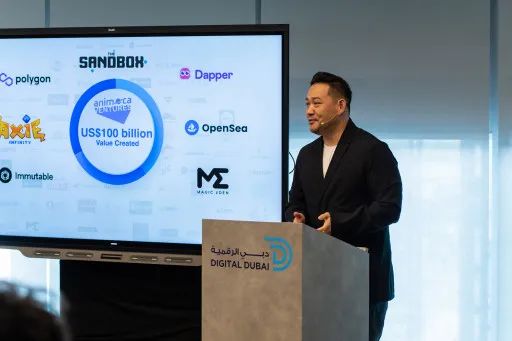
Animoca Brands, the Hong Kong-based venture studio and game developer co-founded by Siu, has grown into one of the most influential brands in Web3 culture, with data provider CoinGecko estimating the market capitalization of tokens issued by Animoca's portfolio companies at over $45 billion.
But the 2022-23 crypto winter was a severe test for Animoca, with tokens from many of its portfolio companies dropping nearly 90%, and at the darkest point in February 2023, the Financial Times even questioned whether Animoca could survive.
Times have changed, though. In 2024, Bitcoin’s price surged over 120%, a U.S. president-elect supportive of crypto is about to take office, and Animoca recently expanded its office space in Hong Kong by nearly four times despite a shrinking traditional financial market in the region.
This series is brought to you by Consensus Hong Kong—experience the most influential event in Web3 and digital assets, register now and use code ICPCHINA15 for 15% off.
Siu now believes the crypto industry stands at an inflection point similar to what he observed in the 1990s when the internet first began transforming business.
Back then, Hong Kong’s garment industry (now a relic of the city) relied on shipping physical samples to customers for approval—a process that took days and cost some companies up to $80,000 per month. There was no Slack, Dropbox, or FTP, and fax machines didn’t offer sufficient resolution.
"People used to design patterns and ship them via DHL to the U.S.," Siu recalled in a recent interview at Animoca’s Hong Kong headquarters. "It took days, and some companies were spending tens of thousands monthly."
Siu offered a solution through one of the first broadband internet service providers, enabling garment factories to perform high-resolution scans (previously difficult due to limited bandwidth) and send them electronically to Western clients.
Broadband made the customer review process "infinitely cheaper" and far more efficient, eliminating what Siu called the "crazy" reliance on physical delivery for design approvals.
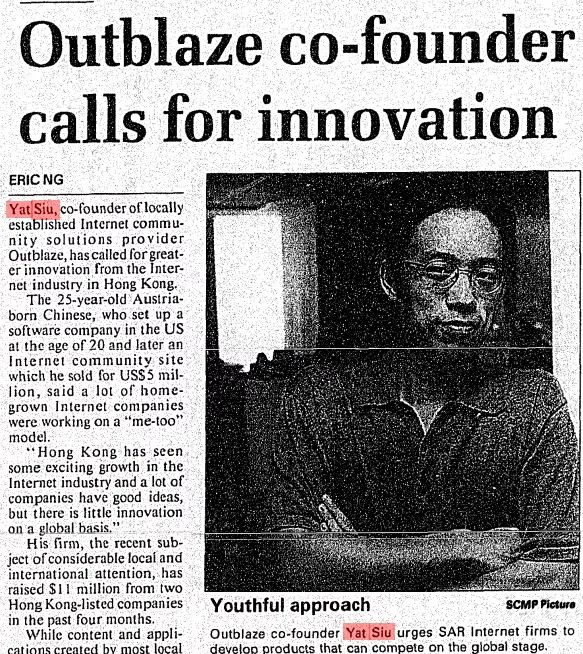
South China Morning Post clipping from 2000 interviewing Yat Siu about his work at a previous internet startup (SCMP archives).
Siu equates this innovation to the emergence of stablecoins and predicts traditional financial institutions will eventually adopt stablecoins en masse.
"If you want to do business with the U.S., you’ll need a crypto rail," he predicted.
"Over time, this becomes a business friction… If someone says, 'I want to send you some Tether or USDC,' and the other side says, 'I only accept wire transfers,' that won't work," said Siu.
In Asia, stablecoin usage is already widespread in areas like supply chain finance, Siu explained, noting that profit margins in industries like fashion are shrinking, making it illogical to use wire transfers to pay supply chain partners when stablecoins suffice.
"Stablecoins are becoming indispensable for reducing transaction costs and speeding up payments," he pointed out.
In Siu’s view, this marks the first phase of mass crypto adoption in 2025.
Memecoins Build Communities
The next step, according to Siu, is the broader expansion of memecoins across the entire blockchain ecosystem.
"I expect memecoins to launch their own L1s or L2s. They’re no longer just tokens—they’re building communities and ecosystems," Siu said. "Memecoins are essentially cultural symbols. They capture attention and build narratives that resonate beyond financial speculation."
Siu said NFTs are following a similar trajectory, evolving from standalone assets into components of broader ecosystems.
"NFT projects are no longer just about issuing tokens—they aim to create ecosystems with cultural and symbolic value," Siu said, citing Solana’s growing collection of memecoins, some of which are now launching NFTs to boost engagement and deepen community ties.
Siu emphasized that for memecoins and NFTs to achieve lasting success, they must evolve into platforms where communities can "build games, apps, and other experiences—not just speculate."

Crypto Gaming Gains Momentum
Web3 gaming isn’t new, but past efforts haven’t resonated with consumers. During the 2021 bull run, major studios integrating NFTs into AAA franchises like Ubisoft’s Ghost Recon were met with lukewarm market responses.
Likewise, Web3-native games like Decentraland failed to attract player bases matching their multi-billion dollar token valuations.
Other titles, such as Off the Grid, promised to bridge Web2 and Web3 gaming with high-end visuals and a focus on gameplay first, crypto second—but seemed to vanish after just weeks.
Yet Siu remains optimistic about crypto gaming.
He sees gaming as a powerful entry point for Web3, where culture, community, and ownership converge to create something greater. In this ecosystem, in-game asset trading becomes an integral part of the experience—naturally evolving from concepts like skin trading in familiar games such as Counter-Strike.
"To attract Web2 gamers, the focus must be on building network effects—creating a fun, engaging game and adding the benefits of ownership and tradability," Siu said. "By 2025, Web2 gamers won’t even distinguish whether a game is Web3—they’ll love it for what it is, and the blockchain benefits will be a bonus."
"They just want to play," he added.

Reputation as Currency
No economy functions without trust between parties and counterparties. While blockchain transparency helps create a more trustworthy environment, Siu says a system for measuring reputation is also needed.
"Reputation is a currency—it’s not just about rewards, but how the network evaluates you and your contributions," Siu said.
He explained that reputation networks like Animoca’s Moca ID can fulfill this role, allowing a unified yet decentralized identification method across all companies in Animoca’s portfolio.
Theoretically, this would resemble Equifax in traditional finance, enabling services like uncollateralized crypto lending—a stark contrast to today’s over-collateralized loan systems.
"If you don’t have reputation, I can’t trust you," Siu said. "Imagine the reputation you’ve built over years—would you risk losing it all with one wrong move?"

More Than Profit
As a venture capitalist, Siu naturally seeks returns and is a staunch advocate of capitalism and its benefits. In past interviews, he has said that much of people’s despair and sense of inequality stems from a lack of financial literacy, which leads to inequity.
Those without access to property ownership and income-generating assets cannot understand capitalism, Siu said—even if imperfect, it remains society’s best option.
He previously stated, "Web3 can save the narrative of capitalism by turning users into stakeholders and co-owners," and warned that "the roots of communism come from a sense of inequality."
For Siu, Web3 represents an opportunity to build a better form of capitalism—one that is more inclusive and participatory. He urges the industry to focus on blockchain’s transformative potential rather than short-term profits, warning against "FOMO" mentalities.
"Let’s remind ourselves that crypto is actually helping us build something bigger. We’re all making money—the industry is great, that’s fine—but let’s remember why we’re really here," Siu said.
Join TechFlow official community to stay tuned
Telegram:https://t.me/TechFlowDaily
X (Twitter):https://x.com/TechFlowPost
X (Twitter) EN:https://x.com/BlockFlow_News
 CoinDesk