At the Hangzhou AI Computing Center, listen to the tide of artificial intelligence by the Qiantang River
TechFlow Selected TechFlow Selected
At the Hangzhou AI Computing Center, listen to the tide of artificial intelligence by the Qiantang River
Today's gentle spring breeze of AI in Hangzhou may become tomorrow's vast harvest of new-quality productive forces.
 Navigating Web3 tides with focused insights
In 2024, accompanied by the rollout of the "AI+" initiative, the AI development experience of "leading cities" has become extremely important. Among them, Hangzhou's AI story may be particularly worth learning from and referencing.
The Hangzhou Municipal Artificial Intelligence Industry Development "14th Five-Year" Plan clearly sets forth the goal of making Hangzhou a globally influential leading city in artificial intelligence. In July last year, Hangzhou released the Several Measures to Support High-Quality Development of the Full Artificial Intelligence Industry Chain, proposing 14 specific initiatives across five areas—computing power infrastructure construction, open model ecosystems, empowering the real economy, full industry chain development, and talent team support—to promote AI industry growth. Of particular emphasis are breakthroughs in computing power technology and the construction of computing power infrastructure.
Hangzhou treats AI computing power as the starting point for its AI industry, leveraging computing power development to empower AI enterprises, enrich the AI ecosystem, and cultivate AI talent.
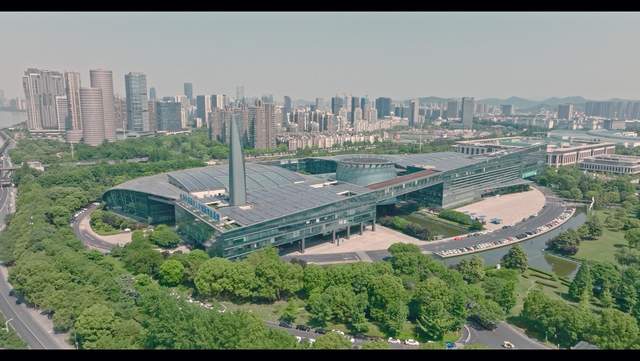
To understand this, we can begin with the Hangzhou Artificial Intelligence Computing Center and dive into the stories of Hangzhou’s AI enterprises and entrepreneurs.
Computing power is reflecting Hangzhou’s flourishing AI spring breeze.

The story begins in Hangzhou High-Tech Industrial Development Zone (Binjiang). Located on the southern bank of the Qiantang River downstream, Binjiang borders Xiaoshan District to the southeast and faces Xihu and Shangcheng districts across the river to the northwest. For thousands of years, residents here have listened to the Qiantang tidal bore. Today, AI developers and entrepreneurs in Binjiang hear instead the echoes of AI computing power along the banks of the Qiantang River.
Binjiang is the core area of Hangzhou’s National New-Generation Artificial Intelligence Innovation and Development Pilot Zone and Innovation Application Pioneer Zone. How can AI industry development be driven at its source? The construction of AI computing power is the definitive answer given by the times.
Today, pre-trained large models dominate AI technology. These large models require massive-scale AI computing power. Data shows that AI computing power demand has grown more than 150,000-fold over the past four years. Additionally, the characteristics of large models result in elastic computing demands—high during training and relatively low during inference deployment. Under these conditions, building proprietary computing pools is uneconomical for most enterprises. Public, inclusive, and intensive AI computing power is becoming the mainstream choice. Meanwhile, computing power represents new-quality productive forces in the digital economy era. It is estimated that every 1 yuan invested in computing power generates an average of 3–4 yuan in economic output.
Facing the pronounced mismatch between supply and demand in AI computing power, Binjiang decided to turn this challenge into an opportunity for local AI industry growth. As early as 2021, Binjiang launched the Hangzhou Intelligent Computing Center project, establishing Hangzhou’s first public-service AI computing infrastructure. The Hangzhou Intelligent Computing Center firmly chose an independent computing foundation, adopting Ascend AI clusters to provide public, inclusive computing power for government agencies, enterprises, research institutions, universities, and others. Another key principle in its construction was not only to supply computing power but also to empower AI industry growth through diverse means, offering services such as AI model training and inference, application incubation, industrial promotion, and talent cultivation to enterprises.
On May 20, 2022, the first phase of the Hangzhou Intelligent Computing Center project was completed, with 40P of computing power officially launched. To date, the center’s computing capacity has expanded to 240P. Operating under a “one center, four platforms” model, the Hangzhou Intelligent Computing Center integrates government, industry, academia, research, finance, intermediaries, and end-users, helping establish a commercial closed-loop model and driving the clustering of the local computing industry chain.
Meanwhile, by the end of 2022, global attention turned to AI large models, ushering in a new wave of AI industry explosion. By then, the Hangzhou Intelligent Computing Center was already operational, fully meeting the development needs of local AI enterprises.
The intelligent tides echoing along the Qiantang River demonstrate the precision and foresight of the "Binjiang strategy."

The aggregation of an emerging industrial chain requires alignment of timing, location, and human factors. This holds true for Hangzhou’s AI industry development as well. First, regarding timing: AI computing power is an essential requirement of the new round of technological revolution—an unavoidable first hurdle for all AI enterprises.
At the onset of the large model wave, when AI industries and companies needed computing power the most, providing abundant and inclusive AI computing power became the mission of the Hangzhou Intelligent Computing Center. Especially for large-parameter models, delivering large-scale AI computing power represented the center’s primary challenge. In the story of InstaAI, we can see how the Hangzhou Intelligent Computing Center accomplished this task.
InstaAI is a leading enterprise in intelligent agents and RPA, a national-level specialized, refined, unique, and innovative “Little Giant,” winner of the National Excellent Patent Award, provincial high-tech R&D center, and recognized as an AI quasi-unicorn for four consecutive years. The company focuses on providing digital employee solutions for enterprises and governments, accelerating digital transformation and enabling customers to achieve leapfrog growth. Its developed InstaTARS (Tars) series of large models serves as the core technical backbone in the company’s AI endeavors.
In InstaAI’s plans, the most advanced version of the TARS large model will reach 70B parameters—a very large scale even by global AI industry standards. To achieve this, InstaAI required 120P of AI computing power. However, the company found that high-end AI computing hardware was extremely scarce at the time, with strong market speculation driving up prices, resulting in significant cost pressures.
At this critical juncture, the Hangzhou Intelligent Computing Center stepped in to solve the problem. After communication and investigation, InstaAI learned that the center had 150P of computing power available—precisely matching the large-scale requirements for large model training. After careful consideration and extensive technical preparation, InstaAI ultimately completed training of its 70B-parameter large model within just two months using the public computing resources provided by the Hangzhou Intelligent Computing Center.
In fact, for an AI startup like InstaAI, abandoning previous technical paths and choosing the independent AI foundation represented by the Hangzhou Intelligent Computing Center required courage. Would the model train successfully? Would the final performance meet expectations? Were the time and labor costs justified? Questions about cost-effectiveness are ones every AI enterprise must confront.
Luckily, the Hangzhou Intelligent Computing Center undertook extensive efforts during this period, engaging in deep technical consultations and clarifications to help InstaAI resolve its concerns. These repeated interactions also allowed the enterprise to witness the sincerity of the emerging intelligent computing ecosystem, ultimately making it impossible to refuse.
Sun Linjun, chairman of InstaAI, said: "Our previous large models were built on traditional AI computing architectures. Migrating involves significant changes in our tech stack and underlying frameworks. Our algorithm engineers had some doubts—the shift in dependent frameworks carries potential costs. But after thorough evaluation, we concluded it was worthwhile. It would greatly improve controllability later on. Taking this step has indeed validated our initial assumptions. Though there appeared to be barriers, it proved highly worthwhile."
Notably, through its collaboration with the Hangzhou Intelligent Computing Center, InstaAI not only effectively resolved its computing power challenges but also witnessed Binjiang’s determination and potential in developing the AI industry, prompting the company to establish a subsidiary in Binjiang. During this process, according to policy documents such as the Several Policies on Promoting New-Generation Artificial Intelligence Innovation Development and Industrial Ecosystem Construction (Hang Gao Xin [2023] No. 5), InstaAI enjoyed tailored arrangements, tax reductions, talent policies, and other industrial supports. This both reduced the company’s core AI computing costs and secured a long-term path for growing alongside the local AI industry.
As of September 2024, the Hangzhou Intelligent Computing Center has conducted surveys with over 800 universities, enterprises, and research institutions, revealing cumulative demand exceeding 5,000P. Through inclusive computing services provided to 190 enterprises and organizations, it has empowered ten major sectors including smart IoT, fintech, smart healthcare, intelligent manufacturing, and enterprise services.
The Hangzhou Intelligent Computing Center is becoming a central hub, continuously expanding the boundaries of Hangzhou’s AI industry and ecosystem, drawing ever-larger circles.

The aggregation and development of emerging industrial clusters depend on the combined influence of local policies, economy, business environment, and cultural atmosphere. These factors collectively define the geographical advantages of an industrial ecosystem from multiple dimensions. To promote comprehensive growth of Hangzhou’s AI industry, the Hangzhou Intelligent Computing Center cannot merely provide AI computing power; it must offer complementary services across multiple dimensions, working with enterprises to extend the radius of AI applications in specific fields and jointly grow the AI pie.
Quanzhen Medicine has clear insights on this matter.
Hangzhou Quanzhen Medical Technology Co., Ltd. is a national high-tech enterprise primarily focused on AI-driven medical products and information technology services. The company’s Quanzhen AI Medical Assistant, powered by a large language model, is currently China’s first-of-its-kind medical AI product and the only enterprise whose AI medical assistant has been deployed hospital-wide in nearly one hundred large tertiary hospitals nationwide.
In clinical settings, persistent challenges include complex patient visit procedures, excessive time spent by doctors writing medical records, and inadequate follow-up care. The deployment of large models in healthcare can assist in patient triage, medical documentation, and remote consultations, playing a crucial role in improving healthcare efficiency. Seizing this opportunity, Quanzhen Medicine became one of the first companies in China to implement large model technology in clinical environments.
During this process, Quanzhen Medicine discovered a common need among hospitals undergoing digital transformation: whether opting for public cloud services or building localized digital systems, they strongly prefer independent AI computing foundations. This preference is vital for the long-term digitalization of the healthcare industry and aligns with the broader trend toward technological self-reliance.
Hospitals need computing power and intelligent services, Quanzhen Medicine possesses AI capabilities, and the Hangzhou Intelligent Computing Center provides computing power—each party complements the others across multiple levels. Based on this synergy, Quanzhen Medicine and the computing center have initiated diverse ecological collaborations. Their partnership enables mutual customer access and shared success. Collaboration with the computing center has become a powerful catalyst for Quanzhen Medicine’s market expansion, while Quanzhen’s advances in healthcare bring the value and influence of the computing center into the medical field. Through multi-party cooperation, independent AI computing power and large AI models are taking root in healthcare scenarios, broadening the industry’s reach.
When more enterprises, empowered by the comprehensive support of the Hangzhou Intelligent Computing Center, engage in robust exchanges, collaborations, and industrial chain coordination, AI will transform from a technological opportunity into a genuine industrial ecosystem, allowing independent AI computing power to take root across more vertical industries.

All competitions in AI technology development ultimately come down to talent. The "human factor"—the ability to cultivate and support talent—is also the core pillar enabling long-term development of the AI industrial ecosystem.
To this end, Hangzhou issued policies such as the Notice on Supporting High-Quality Development of the Full Artificial Intelligence Industry Chain, emphasizing the need to strengthen independent cultivation of composite AI talent. The development of the Hangzhou Intelligent Computing Center also reflects the growth of talent within the independent AI ecosystem. Wang Chao, founder of Kuangwei Jurui, exemplifies composite AI talent in Hangzhou.
Hangzhou Kuangwei Jurui Technology Co., Ltd. is a leading provider of AIoT development platforms and hardware-software solutions, specializing in an integrated AIoT service system encompassing data collection, computing and control devices, and access platforms. Its MegaFlow platform is a full-stack cloud development platform for the AIoT industry, covering the entire AIoT application development process through no-code, modular approaches.
Wang Chao, its founder and CEO, is both a participant and witness to Hangzhou’s AI industry and the Ascend ecosystem. From undergraduate to doctoral studies, Wang chose high-performance computing as his research focus, paying close attention to issues of computing autonomy. Starting in 2018, he began following the Ascend ecosystem. At the time, he and his lab mates were among the first developers to migrate to Ascend.
Over the years, Wang has remained an active Ascend developer, creating numerous related applications. In 2022, he won the gold award at the first Ascend Innovation Competition.
This experience naturally led him to choose the Ascend direction when starting his entrepreneurial journey, seamlessly integrating into the Hangzhou Intelligent Computing Center built on Ascend technology. From the initial planning meeting in 2021 to its official launch in 2023, Wang Chao and Kuangwei Jurui have witnessed every stage of the computing center’s growth, naturally evolving into both users and ecosystem builders.
In Wang’s words, Kuangwei Jurui and the computing center share a childhood friendship. He has witnessed the growth of both the computing center and the Ascend ecosystem, while the center has supported his startup from zero to one.
The deep essence of Hangzhou’s “independent cultivation of composite AI talent” is vividly illustrated in Wang Chao’s story.
It becomes evident that the growth of the Ascend ecosystem, Hangzhou’s local AI industry, and the new generation of composite AI talent are highly synchronized: A promising and future-oriented endeavor attracts talented individuals to join and advance together, and their creativity and contributions, in turn, accelerate the maturity and development of the AI industry and talent cultivation system.
Currently, the Hangzhou Intelligent Computing Center has hosted numerous competitions and talent development programs. In October 2024, the Zhejiang Kunpeng-Ascend Industry and Talent Innovation Forum and the Kunpeng & Ascend Innovation Competition 2024 Zhejiang Final Awards Ceremony were held in Hangzhou, serving as a key platform for AI talent to engage with the Ascend ecosystem and seize AI opportunities.
In March 2024, the Hangzhou Intelligent Computing Center hosted the 2024 Ascend AI Golden Seed Training Program focusing on the pan-internet industry (Hangzhou session); in October 2024, it hosted the “2024 Ascend CANN Tech Tour—Operator Development Special Session (Zhejiang University of Technology session),” providing critical support for cultivating local composite AI talent.
Today, Wang Chao encourages his peers and colleagues to actively adopt Ascend and join the Ascend ecosystem. The blossoms of talent within the Ascend ecosystem are now in full bloom.

From these firsthand accounts, we can summarize the multifaceted value brought by the Hangzhou Intelligent Computing Center:
For enterprises, the computing center solves problems and drives growth. Its demonstrative effect makes AI companies realize it can reduce their cost burdens and provide diversified support, encouraging them to choose the center—and by extension, the city of Hangzhou.
Further, for Hangzhou’s AI ecosystem, the computing center serves as a stage and a bridge. Through events, exhibitions, and competitions, it connects Hangzhou’s AI enterprises with clients, forming a vibrant industrial circle and positioning Hangzhou’s AI industry as an origin and hub of new-quality productive forces.
Moreover, for technological self-reliance, the computing center acts as a spark and a lighthouse. Enterprises can enter the independent AI ecosystem via the center’s platform, setting a course and building momentum for technological self-reliance in the AI era.
Wang Chao says that for AI application enterprises, computing power is the foundation of everything.
Hangzhou’s AI industry, built upon and starting from the intelligent computing center, has chosen a development path characterized by solid foundations, proactive operations, and strong demonstration effects.
The ten miles of spring breeze in today’s Hangzhou AI may well blossom into ten thousand miles of autumn harvest in tomorrow’s new-quality productive forces.
Join TechFlow official community to stay tuned
Telegram:https://t.me/TechFlowDaily
X (Twitter):https://x.com/TechFlowPost
X (Twitter) EN:https://x.com/BlockFlow_News