









Harsh Reality: Analyzing the Three Major Contradictions in the Current Airdrop Market
TechFlow Selected TechFlow Selected
Harsh Reality: Analyzing the Three Major Contradictions in the Current Airdrop Market
Revealing the latest airdrop trends and behind-the-scenes rules: Who is reaping, and who is being reaped?
 Navigating Web3 tides with focused insights
Author: 0x Laodong
2024 Airdrop Data Sheet:
https://docs.google.com/spreadsheets/d/10l-dsjtrFiFAPBGmUNqwVZSviJ4O0lRypEd4Oc9tCZU/edit?gid=0#gid=0
Preface
The current airdrop market has become an outright battle for interests. On one side, projects tacitly allow data manipulation to attract funding; on the other, they conduct large-scale address purges before airdrops. Meanwhile, airdrop farmers are trapped in the dilemma of "you won't get anything if you don't farm, but farming doesn't guarantee rewards either," desperately playing the odds. This referee-less game exposes the sharpest contradiction in the airdrop market—the split between data bubbles and real value, and the conflict between short-term gains and long-term ecosystem health.
Laodong uses data from 100 projects' airdrops in 2024 to reveal the latest trends and hidden rules of airdrops—who is reaping rewards, and who is being exploited?
1. Conflicting Goals of Project Teams 💡
Core Conflict: Demand for data growth (creating bubbles) vs controlling token distribution (eliminating bubbles)
"We know over 80% of addresses are from studios, but we rely on them for cold-starting our ecosystem."
— CTO of an L2 protocol
Project teams face a dilemma before TGE:
-
Left hand creates bubbles: Tolerate studio-driven volume farming to generate the appearance of on-chain prosperity (TVL/transaction volume/user count) and attract investment;
-
Right hand clears bubbles: Filter addresses and conduct large-scale purges prior to airdrops;
-
Airdrop Type Analysis
Laodong compiled airdrop rules from 100 projects in 2024 and mapped out the proportion of each airdrop type:
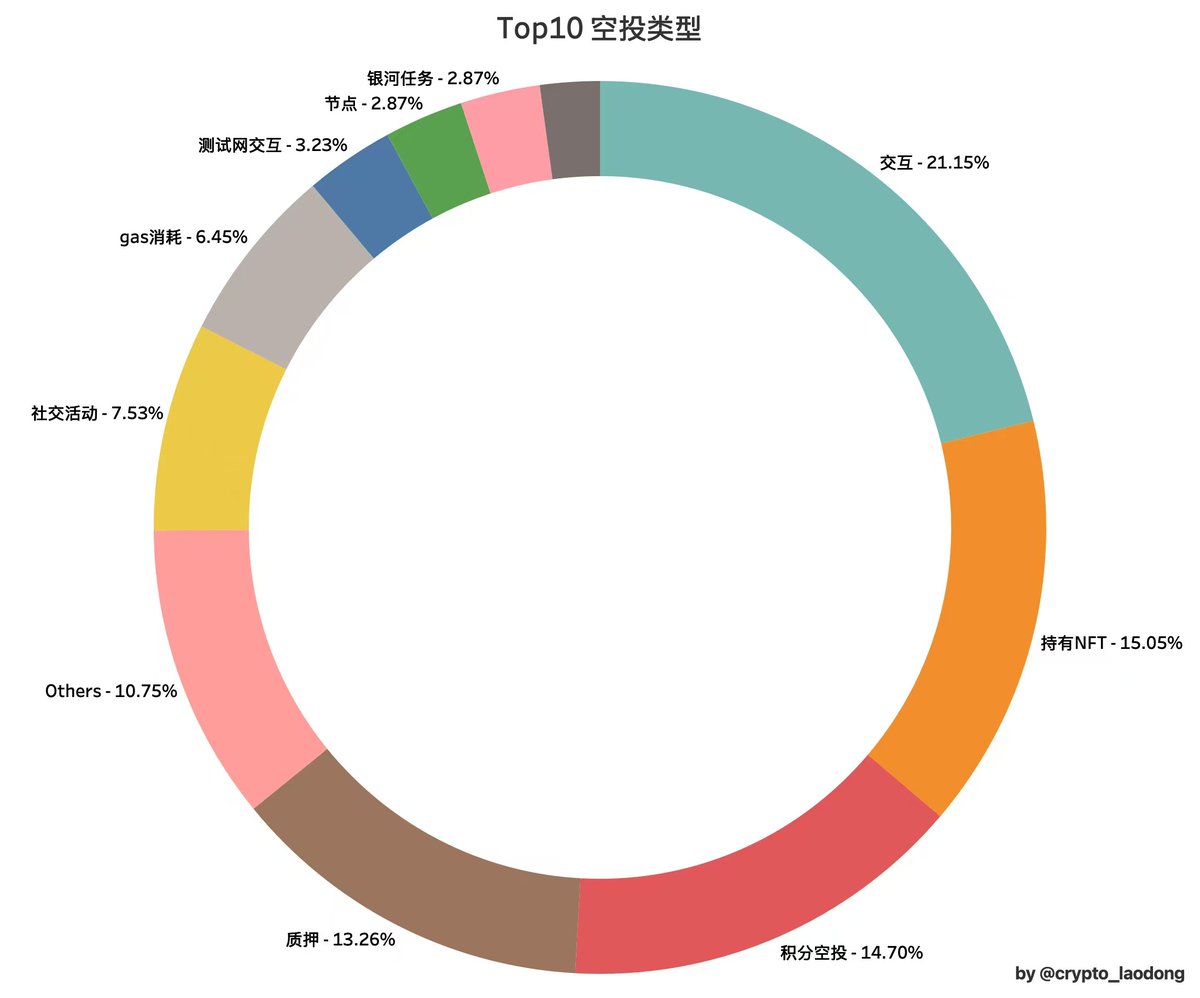
Based on project data analysis, interaction-based, NFT-holding, and points-based airdrops constitute the three dominant mechanisms in today's market.
-
Interaction-based airdrops: The most common method, primarily focused on testnets and mainnets. Projects run tasks—such as Odyssey campaigns—to boost on-chain interaction data and TVL for fundraising purposes. However, excessive interactions often lead to aggressive address purges. For example, LayerZero flagged 803,000 addresses as Sybils; Linea deemed 40% of addresses as Sybils; StarkNet labeled high-frequency interacting users as bots;
-
NFT-holding airdrops: NFTs or OATs often serve as airdrop eligibility tokens. Most require completing various tasks or paying funds to mint via whitelist. These NFTs are typically tradable on-chain, creating potential insider allocation risks that are hard to detect, leading to concentrated, controllable token supplies (e.g., FUEL and Berachain NFTs with unfair airdrop allocations);
-
Points-based airdrops: A current mainstream approach. Unlike tokens, points are centralized, mutable, opaque, infinitely inflatable, and subject to arbitrary rule changes, casting doubt on fairness. Examples include ME (Sybil addresses had points zeroed out, with varying redemption rates), and Linea (LXP is an SBT—another form of points—where holding it doesn’t guarantee an airdrop). Points systems also raise serious suspicions of insider allocations (EigenLayer’s snapshot controversy, Blast’s points inflation, and IO’s “points shrinkage and stolen points” disputes all suggest possible insider advantages);
Other airdrop types such as staking, developer rewards, and voting are alternative methods for project teams to filter recipients. However, lack of transparency, insider allocations, and privileged information undermine the perceived fairness of airdrops.
-
Market Dynamics and Project Strategy Choices
The current market operates on fixed supply dynamics—limited pie, impossible to satisfy everyone. Projects cannot simultaneously meet the interests of themselves, VCs, users, and exchanges. They must dynamically allocate benefits and extract value through博弈 (strategic competition). Faced with airdrop incentive conflicts, projects usually adopt two typical strategies:
-
Universal Distribution Model: Suitable for smaller projects or those offering generous rewards, such as HYPT, with minimal filtering—every address gets something. These are typically blind-farming opportunities without clear airdrop rules, uncertain payout ratios, and thus less attractive to large-scale studios;
-
Strict Filtering Model: Used by major projects, which apply filters based on points, interaction frequency, rankings, or Sybil detection. Often follows a bottom-elimination system. Examples include SCR (only addresses with 200+ points qualify), Runes (filters via inscriptions and NFT holdings), ZKsync and StarkNet (multi-condition screening), and LayerZero (Sybil reporting system). While these improve targeting accuracy, they increase uncertainty for farmers, leaving them at a disadvantage during rule-based博弈;
2. Participants’ Psychological Dilemma 🤔
Core Conflict: Not farming guarantees nothing vs farming doesn’t guarantee rewards
Participants also face a tough choice:
-
Not farming guarantees nothing: If users don’t participate at all, they definitely won’t receive any airdrop. To pursue potential gains, many feel compelled to engage in numerous tasks and activities, investing significant time and resources—intensifying market competition and anxiety;
-
Farming doesn’t guarantee rewards: Despite heavy investment, there’s no assurance of receiving anything. Input rarely matches output, as projects use various methods to filter addresses. Complex and opaque selection mechanisms cause many participants to lose eligibility due to strategic errors or being misclassified as Sybils;
Overcompetition and Risk of Overinvestment
To compete for limited rewards, users are forced to generate massive amounts of activity data. Yet, due to complex, non-transparent rules and strict filters, actual returns remain unpredictable.
Among the 100 projects in 2024, 32 explicitly conducted Sybil checks. Most projects do not disclose their filtering criteria, and the review process is entirely opaque—controlled solely by the team. Users are like lambs awaiting slaughter, arbitrarily judged. The chart below shows Sybil classification analysis:
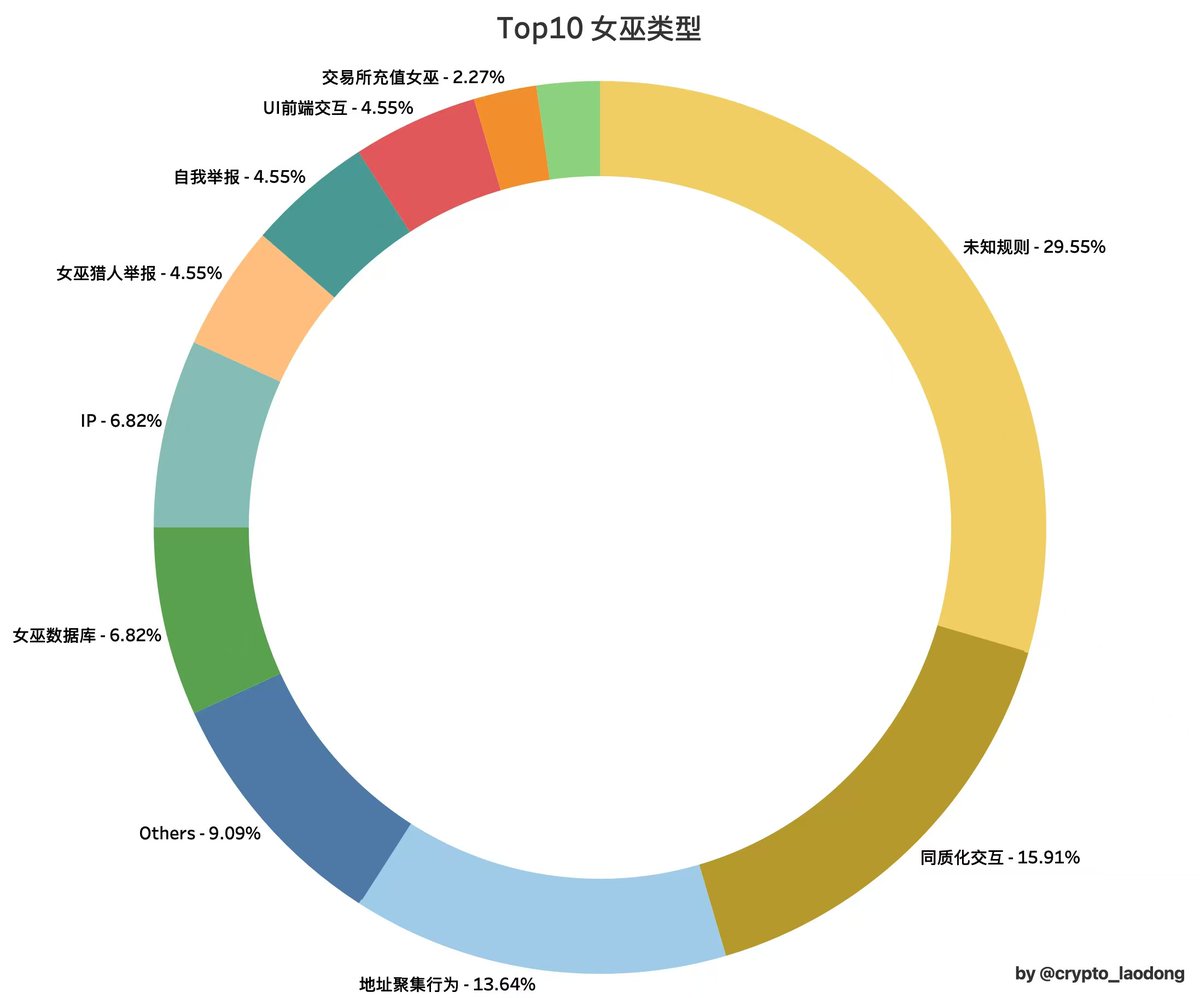
Key factors used by projects to identify Sybils include:
-
Homogeneous interactions: Repetitive, identical operation patterns are the primary reason for being flagged as Sybil;
-
Address clustering behavior: Multiple addresses performing similar actions simultaneously or under the same environment are easily detected and purged;
-
IP, device, and frontend interaction: An increasing number of projects analyze user behavior through frontend data, making simple countermeasures like changing IPs or devices ineffective;
To survive this airdrop博弈, capital and luck alone are insufficient. Success requires finer interaction strategies, stronger technical support, better anti-detection capabilities, and sustained commitment.
3. Conflict Between Projects and Farmers 🤝
Core Conflict: Lose together vs Win together
In the airdrop incentive博弈, a symbiotic relationship forms between project teams and farmers—each party’s fate closely tied to the other:
-
Win together: When both sides achieve a relatively balanced incentive mechanism, sufficient active data can be attracted while maintaining ecosystem quality, allowing mutual benefit;
-
Lose together: If either side becomes unbalanced—whether due to poor airdrop design by the project or excessive farming—the entire ecosystem suffers negative consequences, and neither side escapes unscathed.
Dynamic博弈:
-
Projects usually set certain thresholds during airdrop participation. For example, Linea’s POH verification or IP-based faucet limits. When thresholds are low, farmers flood in, causing a short-term spike in data. But once stringent filtering kicks in, the bubble bursts, leaving actual user activity far behind reported numbers. For instance, after LayerZero announced its snapshot completion, on-chain active addresses plummeted;
-
Conversely, when projects raise entry barriers to ensure only genuinely active and value-contributing users receive rewards, participant growth may be slower, but on-chain active addresses grow healthily and steadily, avoiding data bubbles.
The essence of airdrops is a dynamic博弈 of interests between projects and users. For farmers, securing stable returns requires refined strategies, improved interaction quality, and even building long-term value. For projects, the focus should not be on chasing funding rounds or listings on top exchanges. Their core mission should not be manipulating users into short-term hype, but building sustainable ecosystems that deliver real, lasting value.
Join TechFlow official community to stay tuned
Telegram:https://t.me/TechFlowDaily
X (Twitter):https://x.com/TechFlowPost
X (Twitter) EN:https://x.com/BlockFlow_News
 @crypto_laodong






