








Getting rich quickly doesn't equal success; the real winner is the one who can keep their chips when exiting
TechFlow Selected TechFlow Selected
Getting rich quickly doesn't equal success; the real winner is the one who can keep their chips when exiting
Getting rich is just the first step.
 Navigating Web3 tides with focused insights
Author: Loopify
Compiled by: TechFlow

In the pursuit of wealth, the final outcome is what truly matters.
One can earn millions of dollars in a short period, yet lose that wealth even faster than it was gained.
If you compare the situation before and after these events, you'll find that in most cases, the only difference is that the money earned has been lost again—losses which are often tens or even hundreds of times their original net worth. Many people become addicted to the "casino" game and forget to walk away in time, ultimately gambling away all their funds.
In another scenario, when most people achieve substantial gains, the problem may be even more severe. Many withdraw large sums of money, begin overspending, and fall into what's known as "lifestyle inflation." This phenomenon typically manifests in material consumption, especially when their primary income comes from the "casino" (such as speculative markets). They often overestimate future earnings and assume they can sustain a luxurious lifestyle indefinitely based on those projected returns.
If you're unfamiliar with the concept of "lifestyle inflation," it refers to how, as net worth or income increases, spending on one’s standard of living rises accordingly, eventually turning past luxuries into daily necessities. For example, someone with a net worth of $50,000 in 2023 might spend $100,000 annually renting a penthouse apartment in Miami in 2024.
I entered the cryptocurrency space months after the Covid crash through the NFT industry. If you're not familiar with NFTs, they were as popular during the 2021 crypto cycle as meme coins are today.
In the following two years, I witnessed two extremes: some successfully cashed out, earning eight-figure pure profits; while others suffered seven- to eight-figure losses holding onto NFTs, many of which remain in their wallets to this day.
During bull markets, when everything is rising, people feel frustrated if they made only 2x while others made 5x. In bear markets, everyone faces losses of -50%, -75%, or even -99%, leading to low morale.
These two vastly different market environments shape your trading habits, holding patterns, and mindset toward money. This is why people often say you need to go through three market cycles to truly be "successful":
-
First cycle: You might make a lot of money—but then lose it all back.
-
Second cycle: You become extremely cautious, but in doing so miss many opportunities.
-
Third cycle: You find balance between caution and boldness, adapting flexibly to market changes.
If lucky, two cycles might suffice. But very few succeed during their first bull market cycle.
This applies regardless of portfolio size, especially when dealing with million-dollar gains.
"Holding an investment from $1,000 to $1,000,000 is called 'poor risk management.'"
In reality, nearly 99% of people can grow $1,000 into $1,000,000—but will also let it fall back from $1,000,000 to $1,000.
When you succeed in the "casino game," especially with high-risk speculative assets like Memes, you may feel there's no need to learn anything else. No matter what phase of the market you think we’re in now, I’ve already seen many Meme players try applying their skills to leveraged trading—and end up losing all their prior gains. This suggests we are closer to the end than the beginning of the market cycle.
Similar to what happened in 2021, when many NFT players started shifting into crypto trading.
This isn't to say you shouldn't try—adapting to market changes is actually very important. Memes won’t stay popular forever. In fact, from recent project launches and the fleeting 24-hour attention spans toward them, we’re already seeing signs that the meme coin hype is fading.
However, you should enter this space slowly, learning as much as possible. Treat yourself as a beginner, not trade with arrogance.
I explore the concept of "levels" more deeply in this article, which I believe offers a useful framework for anyone who unexpectedly becomes wealthy for the first time.

(Original image by Loopify , compiled by TechFlow)
In the process of wealth accumulation, we can divide life into different "levels." If the gap between levels feels too wide, you can add ".5" states in between. For example, "2.5" might mean having a stable job and some savings, but not yet owning a home. This layering helps you clearly understand your current position and set goals for improving your quality of life.
While still in the "casino"—whether in the cryptocurrency market or other speculative arenas—remember to regularly cash out chips to improve your life. Each withdrawal represents an "upgrade" in your life.
@Loopifyyy: "A reminder: once you've become wealthy—you must plan carefully how to preserve your wealth.
The NFT market will produce many millionaires over the coming decades and will evolve into a massive industry. But remember, as with any market, there will always be losers. Keep that in mind."
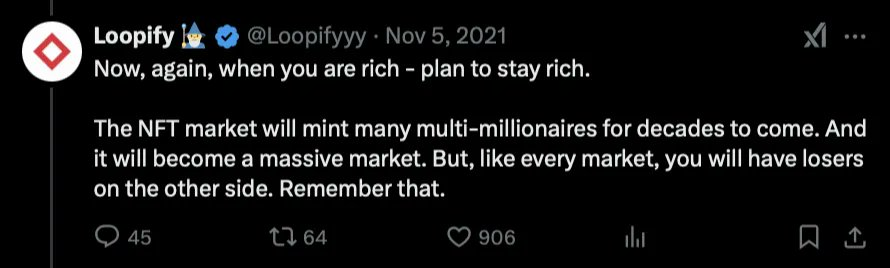
This insight stems from a tweet in November 2021, at the peak of the cryptocurrency market, when the NFT craze lasted nearly a year.
These lessons apply not just to cryptocurrency, but to all areas of wealth building. Getting rich is only the first step—what matters more is how you keep that wealth.
How to Preserve Wealth: Practical Advice
-
Regularly take profits: Whether the market is rising or falling, consistently realize gains.
-
Turn profits into real money: Money only becomes real profit when it’s in your bank account. Otherwise, you might reinvest it trying to catch bottoms or jump into new "hot investments," only to find it never makes it back into savings.
-
Don’t be fooled by peaks: The highest point of your portfolio is just a "paper number"—you almost certainly won’t fully capture it, so don’t make decisions based on it.
-
Avoid lifestyle inflation: As income grows, strive to stay frugal and avoid turning past luxuries into everyday necessities.
-
Pay off debt first: Whether credit card debt or mortgages, paying them off quickly significantly elevates your financial level.
-
Distinguish luck from skill: Clearly assess how much of your gains come from luck versus actual investment ability. Without humility, the market will eventually teach you a harsh lesson.
-
Avoid revenge trading: Attempting to recover losses through aggressive trades often leads to greater failure, potentially wiping out your entire portfolio.
Survival is the prerequisite for success—only by staying in the game can you succeed.
"Not trading" is also a trading strategy.
You don’t need to chase every shiny opportunity, nor feel anxious about others’ huge wins or losses.
There’s a scenario in markets: even if Bitcoin (BTC) reaches $1 million, many people go bankrupt before the cycle ends due to poor decisions. Do you want to be one of them? Of course not—nobody wants that.
Therefore, make sure to walk away from the "casino" with your chips, truly adding value to your life.
Join TechFlow official community to stay tuned
Telegram:https://t.me/TechFlowDaily
X (Twitter):https://x.com/TechFlowPost
X (Twitter) EN:https://x.com/BlockFlow_News
 @Loopifyyy


