The dark forest of MEME coins: industrialized harvesting assembly lines earn millions daily, with retail investors struggling to profit amid a 0.01% retention rate
TechFlow Selected TechFlow Selected
The dark forest of MEME coins: industrialized harvesting assembly lines earn millions daily, with retail investors struggling to profit amid a 0.01% retention rate
3 days, 11 tokens launched, 100% win rate, $25,000 profit. This might be the ideal version of themselves for countless MEME players. But in reality, this is just one of thousands of addresses operated by an industrialized RUG team.
 Navigating Web3 tides with focused insights
Author: Frank, PANews
Issuing 11 tokens in 3 days, with a 100% win rate and $25,000 in profit. This might be the ideal version of countless MEME investors. But in reality, this is just one of thousands of addresses used by industrialized RUG teams. While retail investors are still rushing headlong into "thousand-fold myths," professional teams have already transformed the MEME sector into a 24-hour harvesting machine using bots, multi-sig contracts, and sentiment engines. On-chain data shows that such industrialized RUG operations are not isolated cases.
From tracing funds back to initial exchange deposit addresses to hundreds of derived linked wallets, a "dark game" co-created by technology, capital, and human greed is devouring speculators' wallets.
Single Address Earns $25K in 3 Days: Hundreds of Addresses Forming a RUG Assembly Line
PANews dissects the complete on-chain harvesting chain using blockchain data, attempting to reveal a harsh truth: when MEME issuance becomes a mathematical probability game and "community consensus" is mass-forged by industrialized bot armies, the endgame of this carnival may have been decided long ago.
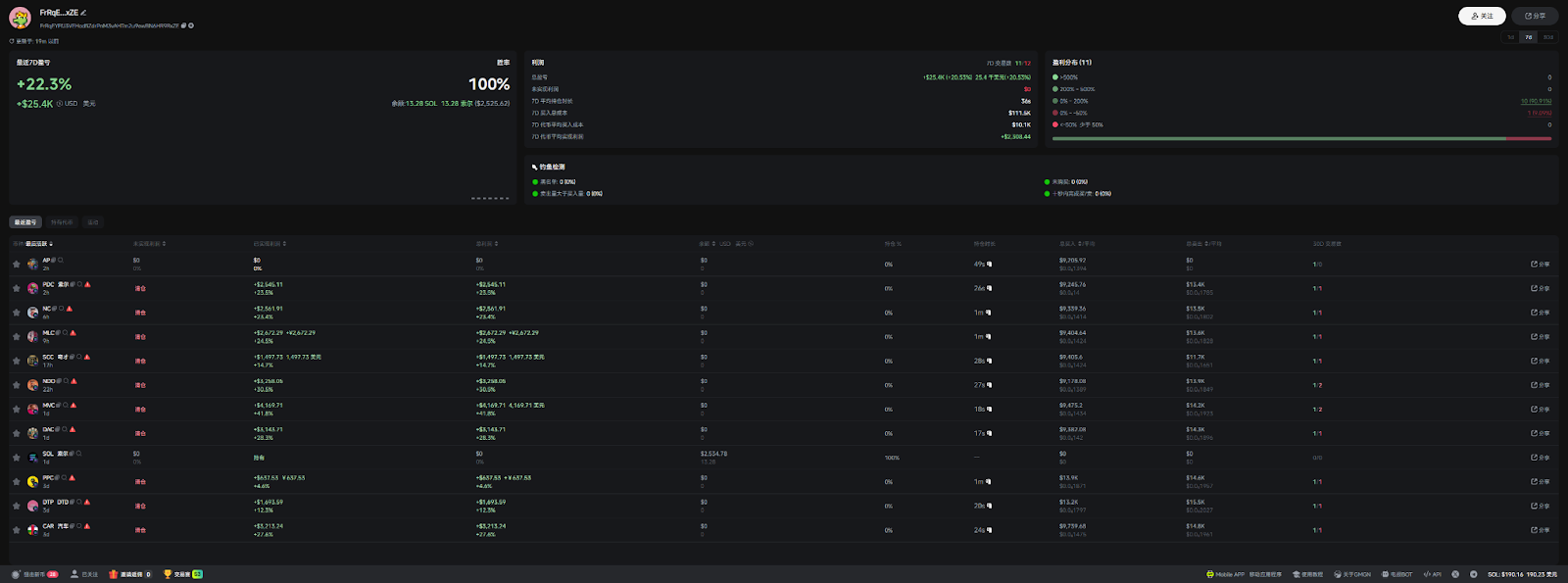
Take this address as an example: FrRqEYFfJ3VEHodfiZdrPnM3vAHTm2u9ewBN6HR9RxZE (hereinafter referred to as "FrRqE"). In the past three days, it issued 11 MEMEs, generating total profits of $25,000, with a 100% success rate.
How exactly was this achieved? Looking at holding times, each time FrRqE buys in, the interval before selling is only tens of seconds—never exceeding one minute. First, after launch, FrRqE makes a large self-purchase of approximately 48 SOL worth of the token, creating the appearance on the market that big players are buying in, prompting others to quickly follow suit. By this point, FrRqE’s holdings already exceed 70%. Then, within tens of seconds, all tokens are dumped in one go. The average return per trade is around 20–30%, yielding roughly $2,500 in profit each time.
Of course, today's monitoring tools are highly advanced; experienced traders often avoid blindly jumping in when developer holdings are too high.
Therefore, immediately after buying, FrRqE rapidly distributes these tokens across 400 wallet addresses to evade detection by on-chain robots. As more addresses begin purchasing and the internal pool amount nears capacity, FrRqE repeats the trick—consolidating all tokens back into a single address and dumping them all at once, instantly crashing the token to zero.
Interestingly, the source of funds for this address appears deliberately obscured. After conducting over a hundred on-chain explorations, PANews ultimately traced the initial funding back to OKX exchange, with the original receiving address being 3SrXcoKQ97xwFAwELnraHtpuycjGvmG82E9SBGs6UcQd.
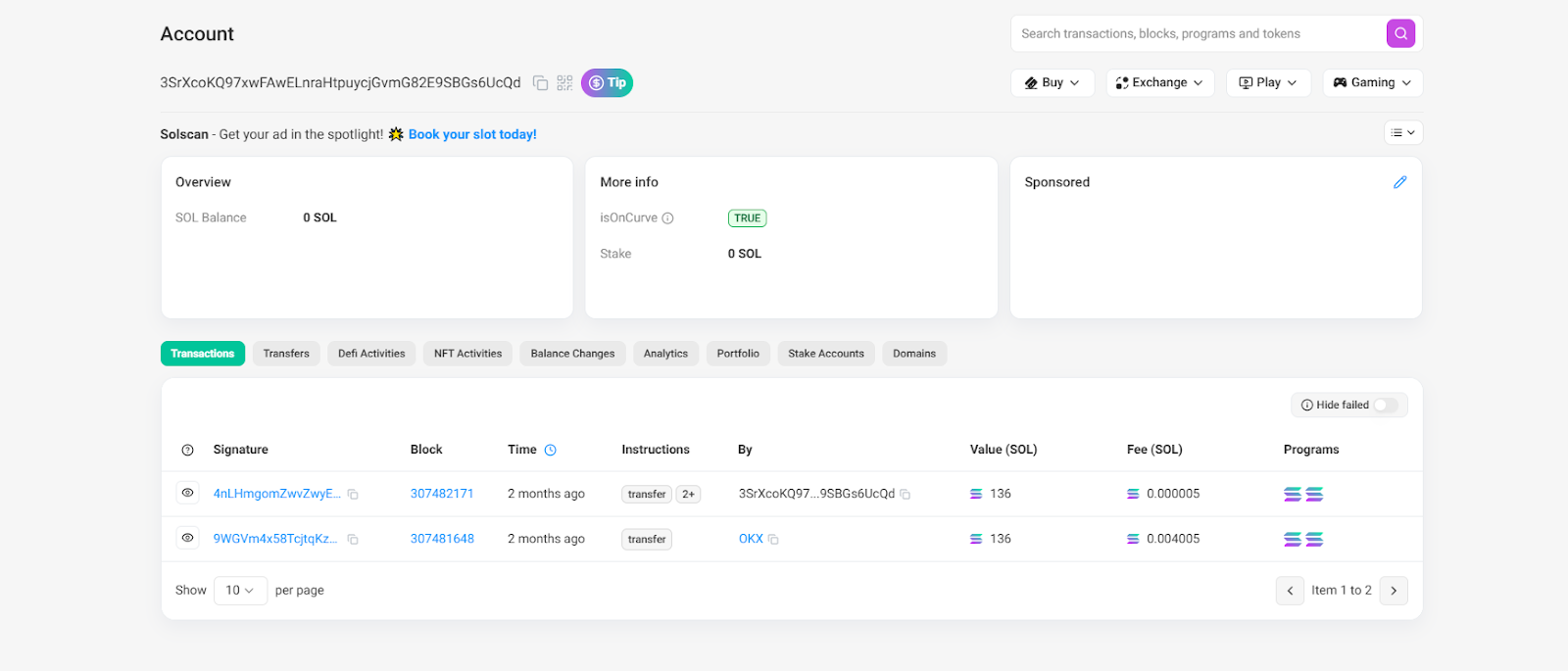
Judging from operational timing, this address has been active for over two months. Each time an address issues about ten tokens, it transfers funds to a new address to start another round of RUGging. To date, hundreds of derivative RUG addresses have emerged.
Beyond on-chain actions, completing a successful RUG requires much more. For instance, these tokens listed on Pump.fun typically feature dozens or even hundreds of comments, and early signs clearly show massive bot purchases. Both trading volume and discussion levels create the illusion of a legitimate MEME project.
Even more chilling is that this particular token wasn’t specially selected by PANews—it was discovered randomly by clicking through tokens on Pump.fun. Users who frequently participate in MEME investments likely encounter similar RUG schemes regularly.
This type of RUG operation cannot be executed by ordinary users. First, specialized address distribution and consolidation tools are needed to flexibly yet uniformly transfer tokens. Second, real-time social media trend monitoring tools are required so every token launch aligns with current hot topics. Third, extensive use of Pump.fun shills and social media bots is essential—for example, the X account @r999d999z, created in January 2025, has repeatedly promoted FrRqE’s tokens, suggesting close ties between the two. Fourth, dedicated transaction bots are needed for hype generation and bundled transaction submissions. Executing all these steps likely requires a robust technical and operational team.
One-in-Ten-Thousand Survival Rate: No Room Left for Retail Investors in the MEME Jungle
According to dexscreener data, over the past six months, only 1,987 tokens issued on Pump.fun maintain a market cap above $50,000. Of these, only 27 have remained active for over a month, and 72 have lasted longer than one day. The remaining 1,915 were issued within the last 24 hours, including six launched yesterday. Based on these figures, on February 13 alone, 49,153 tokens were launched on Pump.fun, with a graduation rate of 1.23%—606 tokens graduated. Among those, only 0.9% maintained a market cap above $50,000 for at least one day post-graduation. Overall, the probability of a token maintaining a $50,000 market cap one day after issuance on Pump.fun is approximately one in ten thousand.
We examined the six surviving tokens launched on February 13 as case studies (though during observation, the sample dropped from six to four).

Analyzing these four tokens reveals several common traits. First, they are backed either by actual projects or identifiable public figures—three are related to AI projects, and one is a personal token launched by an internet celebrity. Notably, none were randomly issued by individual retail users.
Second, their LP lock-up ratios are extremely high, generally above 95%, with locked amounts exceeding $100,000. Third, their social media follower counts are all above 2,000. Although some accounts were recently created, active engagement from KOLs gives them strong social scores.
In summary, the era of pure player-versus-player (PVP) dynamics seems to be over. Individually issued tokens now stand almost no chance of breaking out or achieving significant market caps—a reality many experienced issuers already understand. Against this backdrop, developers continuing to flood the platform daily clearly have their own unique business models. And this dark forest-style gameplay continues to thrive in a completely unregulated environment.
Draining the Pond: Mass Exodus of Players in Pain
The MEME coin space is transforming from a public gambling ground into a hunting field where technologically equipped insiders prey on ordinary retail investors. While users may sometimes struggle to recognize RUG tactics, as actual losses mount, more and more are painfully exiting this dark forest.
According to The Block, trading volume on Solana's Pump.fun has cooled recently, averaging just $560 million daily over the past week—the lowest since Christmas 2024—down 82% from the peak of $3.13 billion three weeks earlier.
Solana's on-chain data shows a similar trend. Active wallet counts peaked at 7.22 million on November 16 but had fallen to 3.18 million by February 1—a decline of over half. Even platforms like Meteora and Jupiter, which briefly surged in popularity due to the TRUMP token frenzy, saw rapid drops in active users once the hype faded.
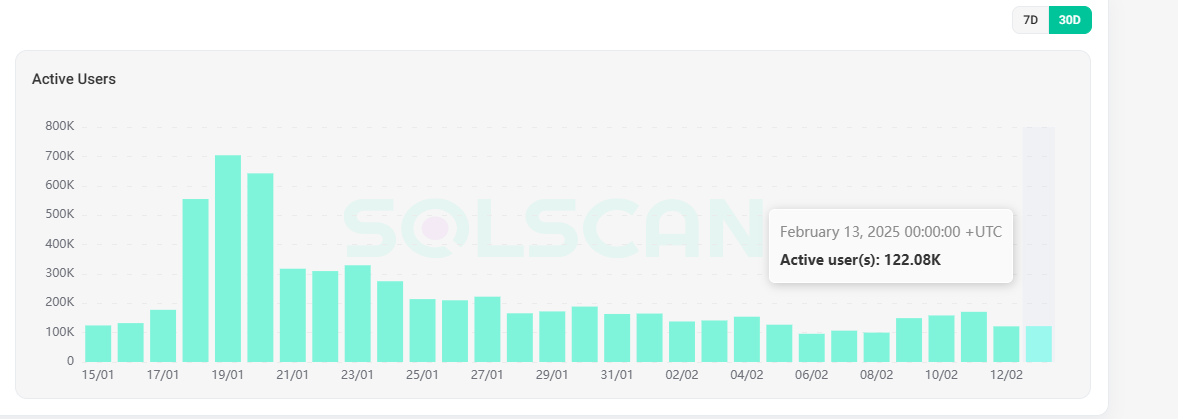
Even many KOLs whose main content revolves around MEMEs now claim the current environment is no longer suitable for "pumping random low-cap coins." Blogger Laughing stated: "I’ve completely given up on betting on meme openings—lottery buyers can never beat lottery sellers."
Paradigm researcher Arjun Balaji put it bluntly: "Memecoins used to be fun and innocent, but industrialization has turned a harmless PvP game into a predatory one dominated by insider advantages."
Although the market is becoming increasingly harsh, we might still draw some insights from the dual nature of blockchain. On one hand, the lack of regulation enables malicious developers to act recklessly. On the other hand, precisely because blockchains are traceable, no matter how well-hidden the perpetrators are, we can always uncover clues from on-chain data. For diligent investors who study these patterns, recognizing these malicious tactics allows them to avoid falling into similar traps.
Moreover, although Pump.fun’s token survival rate has plummeted to one in ten thousand, players could instead skip early-stage scattershot attempts and wait—letting things play out while focusing on tokens that remain active beyond 24 hours. Time itself may become the most effective filtering tool. And for teams hoping to launch project tokens via MEMEs, sincerity becomes a simple yet powerful narrative: bad money is destroying the market, while good money will strike back against it.
Join TechFlow official community to stay tuned
Telegram:https://t.me/TechFlowDaily
X (Twitter):https://x.com/TechFlowPost
X (Twitter) EN:https://x.com/BlockFlow_News
 PANews