Interview with Dragonfly Partner: Bitcoin Dominance, Altcoins Sluggish, but the Meme Cycle Isn't Over Yet
TechFlow Selected TechFlow Selected
Interview with Dragonfly Partner: Bitcoin Dominance, Altcoins Sluggish, but the Meme Cycle Isn't Over Yet
In the short term, the market is a popularity contest; in the long run, it is a mechanism for weighing value.
 Navigating Web3 tides with focused insights
Compiled & Translated: TechFlow
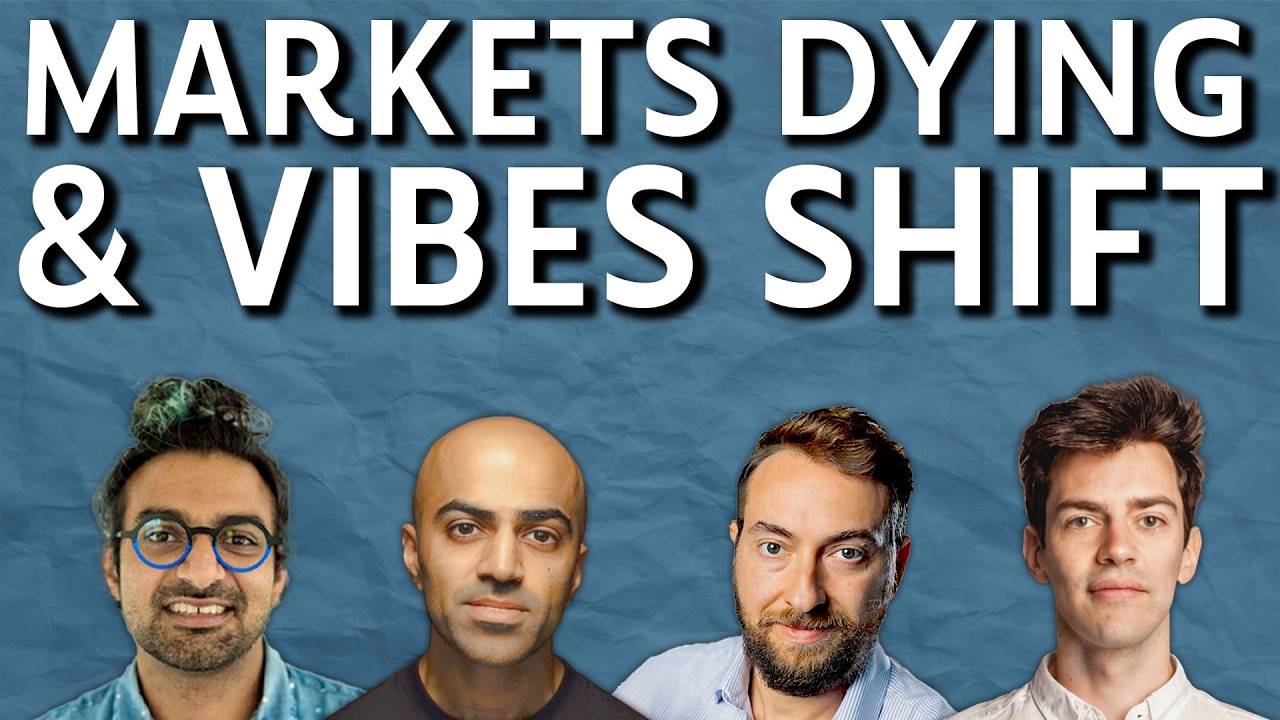
Guests:
-
Haseeb Qureshi, Managing Partner at Dragonfly
-
Robert Leshner, CEO & Co-Founder of Superstate
-
Tarun Chitra, Managing Partner at Robot Ventures
-
Tom Schmidt, General Partner at Dragonfly
Podcast Source: Unchained
Original Title: The LA Vape Cabal vs. Millennials - The Chopping Block
Release Date: February 7, 2025
Background Information
Welcome to The Chopping Block, a show hosted by crypto experts Haseeb Qureshi, Tom Schmidt, Tarun Chitra, and Robert Leshner, focusing on the latest developments in the crypto industry. In this episode, we analyze the market turmoil triggered by Trump's trade war, which caused Ethereum and altcoins (cryptocurrencies other than Bitcoin) to plummet while Bitcoin remained strong. Why are altcoins underperforming? Is this simply capital flowing into higher-quality assets, or is there a deeper reason?
We also explore the unique cultural impact of the Los Angeles Vape cabal on meme culture, discuss whether the new leadership at the U.S. Securities and Exchange Commission (SEC) will truly change the rules for crypto, examine Binance’s scandals, and assess whether the meme cycle has truly ended—or if this is just another phase in crypto’s endless “casino.”
Market Volatility and Trade War
Haseeb:
Trump's trade war against both U.S. allies and China included a 30-day pause targeting allies. However, the crypto market dropped sharply due to tariff policies. Ethereum fell as low as $2,100, down over 20% in a single day. Bitcoin dipped to $91,000, marking the largest daily liquidation in cryptocurrency history.
What do you think about the current market situation? Will this be temporary? Have we entered a new phase? Does this shift your view on the trajectory of crypto under President Trump?
Robert:
I don’t think the trajectory of crypto under the Trump administration has significantly changed. David O. Sacks held a press conference clearly stating that the crypto industry will continue moving forward at full speed. Meanwhile, Hester Peirce issued an important policy statement at the SEC outlining the future role of the SEC as a crypto regulator.
The only surprise was the unexpected tariff policy, which triggered massive speculation and a wave of liquidations. But overall, the macro environment hasn't fundamentally shifted. Trump's tariffs are largely seen as a negotiating tactic rather than a long-term policy.
Bitcoin Dominance and Altcoin Weakness
Haseeb:
But altcoins remain weak. By comparison, the NASDAQ index dropped 2% that day due to tariffs but quickly recovered most losses after tariffs on Canada and Mexico were lifted. Crypto only rebounded about 50% of its losses, indicating fragile market sentiment.
Robert: I'm not sure tech-driven cryptocurrencies have actually collapsed. Much of the decline happened in memes—those holding memes are panicking.
Tarun: People holding Ethereum are panicking too.
Haseeb: Bitcoin reached $103,000 when Ethereum was near $4,000. Every time Bitcoin retests its highs, Ethereum performs worse. Now Ethereum is back to $2,500, yet the market seems to comfort itself saying "it’s fine, Ethereum is okay."
Robert: Right now, most capital is flowing into Bitcoin. The prevailing market mood is that investors are selling underperforming assets and rotating into Bitcoin. Bitcoin’s macro narrative is very compelling. Today’s press conference even mentioned the possibility of the U.S. establishing a sovereign fund to invest in Bitcoin—potentially a key path toward mainstream adoption of Bitcoin as a significant asset.
Memes and Market Sentiment
Haseeb: Tom, what’s your take on overall market sentiment?
Tom: I feel the market is generally subdued, and uncertainty amplifies this mood. If you look at Polymarket’s predictions on tariffs, volatility is high. This isn’t just a standard liquidation wave—it’s a broader sense of unease. While you mentioned equities recovering, they’re still concentrated in MEG7 stocks. In this context, investors are choosing “quality assets.” Under such uncertainty, risk tolerance is lower.
Haseeb: Do you think this is the new normal? Will conditions only improve once macroeconomic stability returns? I thought current government policies were favorable for Bitcoin, but now all assets seem to be falling.
Robert:
So why are they falling? There’s a huge tailwind—markets are so driven by momentum, random and inexplicable, that yes, there should be a major tailwind from policy. After the election, nearly every asset rose—everything went up post-election except Ethereum. You know, Bitcoin hit $100,000, Solana rose to around $215. That’s mostly been the case.
Haseeb: But even strong tokens like Solana haven’t performed well since the election. Right now, it really feels like only Bitcoin is holding up the entire market.
Robert: Almost everything is now priced relative to Bitcoin.
Haseeb:
I think we can all agree on the current market condition—ongoing decline. Tom’s point about a “flight to quality” is spot-on. This phenomenon isn’t limited to crypto; it’s visible in equities too. If you only look at aggregate data, you might mistakenly think the market isn’t doing badly. In reality, total crypto market cap appears stable, but daily movements hide the fact that Bitcoin’s performance masks steep declines in many altcoins—for example, Bitcoin may only drop 1%, while many altcoins fall 15%.
Maybe my thinking is that once the macro story stabilizes—perhaps after we get strategic Bitcoin reserves—we’ll see a shift in sentiment toward higher risk tolerance and more interest in tech cryptos. Because in a way, the market is waiting for strategic Bitcoin reserves—a major development everyone is holding their breath for. Every summit, every announcement from Trump or David Sacks, is watched for clarity on this event. Once we get that news, it’ll feel like, oh, now there aren’t any other big events coming.
Tarun: I’ve noticed an interesting trend—there are so many altcoins available now that it’s hard to see any single token surge dramatically.
Haseeb:
I disagree. There have always been many tokens—that’s not new. Good tokens attract capital, while bad ones get淘汰 by the market.
If the theory that “too many altcoins weaken the market” were true, then tokens on CoinMarketCap’s front page (top market cap projects) should perform well, while lower-ranked tokens underperform. That would be the “dilution effect” you're describing. But in reality, we see Bitcoin performing strongly while all altcoins broadly underperform. In previous cycles, most tokens tended to move together—unlike now, where we see clear divergence.
In fact, the idea that “there are too many tokens” has always existed. Crypto markets have never lacked tokens, and I’ve never seen token quantity as the issue. Just like stock markets don’t limit gains to good stocks because “there are too many stocks,” this theory fails to explain how markets actually work.
Tarun: A possible reason is that many new users entering chains prefer meme trading because meme turnover is extremely fast.
Haseeb:
Completely agree. Some believe Pump.fun’s emergence worsened market performance. A chart circulating online shows the market started declining after Pump.fun entered.
Normally, when Bitcoin performs well, altcoins follow after some delay. We've had “Bitcoin seasons” and “alt seasons” before. But in this cycle, there hasn’t really been a true “alt season”—except for a brief altcoin rally after last year’s Bitcoin ETF launch, which quickly faded.
I think this is a more plausible theory—at least, this phenomenon is new, unlike past cycles. The scale of Pump.fun and memes far exceeds speculative activity in prior cycles. While there was an NFT craze in 2021, in absolute terms, NFT complexity and impact didn’t match today’s memes. In terms of total capital and profits extracted from the market, looking at Pump.fun and Photon revenues and the entire meme supply chain reveals massive value extraction.
Robert:
This is also why I believe infrastructure tools hold more value than other investable asset classes. As you said, the list of tradable assets is infinite—and will remain infinite even 100 years from now.
The infrastructure supporting these asset trades accumulates substantial value, while the assets themselves have random value. That is, how assets accumulate value is unpredictable. With an infinite list of assets, some will gain value, be traded, and become speculative instruments. But long-term, the median or average value of these assets won’t be high. Therefore, infrastructure holds greater long-term value.
Haseeb:
Still, I’ve noticed many people think memes are outdated—nearly all recent memes have underperformed. The perception is that profitable meme trading opportunities are rapidly shrinking. When the market’s “casino effect” shifts—say, people suddenly feel “slot machines aren’t fun anymore”—this emotional shift can happen very quickly.
Tom:
The increasing professionalization of memes. Memes used to be creative and community-driven—a good idea could launch a successful meme and build a community around it. But now, it feels highly organized and industrialized, which may contribute to meme fatigue.
That said, similar critiques apply to centralized exchanges—they slowly extract value from the system too. Yet people rarely criticize exchanges the same way, except for things like listing fees. I think exchanges do reinvest some value into the ecosystem—through incubation or investments—but the scale pales in comparison to what they extract.
Robert:
This reminds me of Warren Buffett’s famous quote: In the short term, the market is a popularity contest; in the long term, it’s a weighing machine. In crypto, the popularity contest aspect is especially pronounced. People often speculate based on how cute an icon looks or how novel a meme is—relying entirely on short-term mimetic social consensus rather than assessing underlying asset value.
Yet in the long run, the market reverts to being a weighing machine. Bitcoin, for instance, consistently attracts massive capital inflows and dominates the market, showing that people increasingly recognize its intrinsic value over time. Thus, in crypto, short-term popularity effects and long-term value orientation form extreme polar opposites.
Cultural Phenomena in Crypto
Tarun: I want to approach this differently. When discussing meme users, you seem to assume their sole goal is profit.
But I think being the first to launch a certain meme brings cultural recognition. This reminds me of one of crypto’s biggest failures: blockchain gaming. These games can go viral quickly but lose users and fade away shortly after. I think memes may start financialized, then add gamified elements through live streams. Watching LA Vape cabal livestreams shows this is nothing like traditional investing. Many buy memes not to profit, but to join a group—to belong. It’s a strange subculture; some don’t even mind losing money.
In the context of rapidly growing asset counts, there’s a peculiar phenomenon: the value of “being first on this asset.” This differs from other parts of token economics. I think the significance here goes beyond “can I profit from this coin,” though I can’t quite articulate it yet.
Watching these streams, you see people laughing despite huge losses, seemingly enjoying themselves.
Haseeb: This reminds me of drunk people playing blackjack in casinos—there’s definitely a similarity.
Robert: Yeah, they’re cheering—but only as long as they still have money.
Haseeb: As long as you have funds, you can enjoy the casino, right? But eventually, you’ll be “asked to leave,” and even free drinks stop.
Tarun: I think your casino analogy misses one thing: the rate of new slot machines introduced doesn’t match the growth rate of participants. It’s odd because as user numbers grow, the number of playable games seems to grow too.
Haseeb: It’s like games getting new skins. You walk up to a slot machine themed on Robin Hood, another with a different theme. Fundamentally, it’s the same game, just reskinned.
Tarun:
Recently, the LA Vape cabal has been launching memes during livestreams, creating and trading tokens. People actually buy them, even while saying “I’m losing money, I will lose money,” because the group tells them to. I think people participate not just to profit, but for other motivations.
I’ve been trying to understand this. Clearly, there’s strong social dynamics—like “you have to stream for me” or “make a TikTok”—completely different from other crypto promotion methods. I think that might be the key.
Haseeb:
This happened during the NFT boom too—a larger cultural phenomenon emerged, not just “NFT traders who only care about profit.” Certain cultural symbols made NFT collections highly tribal, creating strong belonging. In any large mania, cultural byproducts emerge. But I don’t think these cultural aspects are the root cause of the current meme craze. The fundamental driver is still the desire to make money.
Data I’ve seen shows about 60% of traders lose money during meme booms, and only around 3% ever earn more than $1,000. So most don’t profit in this “casino.” Like real casinos, it’s just math. But subjectively, most don’t experience it that way. By the end of the NFT boom, the common feeling was “I can’t make money from this.” Once memes evoke similarly low expected value, your subconscious starts adjusting its evaluation.
Robert:
This reminds me of the 2017 ICO boom. Everyone was making money from ICOs, so ICO numbers grew exponentially. But when the market shifted and buyers couldn’t support sellers, ICOs collapsed rapidly. The same happened with NFTs. Each cycle repeats. Memes will end similarly—when there are more sellers than buyers, the whole system collapses.
Tarun: This contradicts the economic assumption of rational agents. Participants aren’t rational. And you’ll see comment sections openly discussing “pump and dump”—they even admit it.
Haseeb: If someone deliberately buys a pump-and-dump coin just for fun, they’ll quickly lose their money. It’s a kind of primitive jungle law—eventually, they’ll burn out.
Tarun:
I don’t disagree. But when you enter these livestreams, the participant dynamic is completely different from NFT scenes. NFT people try to convince you it’s art or the future of culture—here, there’s no pretense. They simply say: “Oh, a KOL said X, so I’ll try it.”
Haseeb: Sounds like a culture, a subculture. Most people don’t认同 it or understand how it works. But those who do find it hilarious. It’s a way to show you’re an alpha in this new economy.
Tom: Sounds like Gen Z version of Wall Street gamblers. Why do people share screenshots of losing $50,000 on options? It’s a kind of voyeuristic thrill—you find enjoyment in it.
Tarun: Exactly. This phenomenon feels more like social network interaction. Losing money can bring a strange satisfaction—like showcasing your “painful experiences” on social media.
The Los Angeles Vape Cabal
Tarun: Everyone talks about their process of discovering memes via livestreams—this culture is entirely different from before.
Tom: I see your point, but I think meme mania has unique elements. How many VCs are buying memes or discussing memes as community launch tools? They’re trying to use memes to build great products. Everyone’s trying to “intellectualize” this market, but it’s reverse causality—people equate “price” with “product.” Maybe I’m wrong.
Tarun: Memes have certain unique traits that let them last longer. I think the pace and volume of asset growth are closely tied to this phenomenon.
Haseeb: We seem to agree we’re in the late stage of the meme cycle. But I’m unsure—meme market sentiment is indeed low. Actually, sentiment across the entire alt market is weak. Except for Bitcoin maximalists, everyone seems pessimistic. So if the macro picture reverses and alts rebound, memes might bounce back too. Then we might forget all this negativity. Do you think that could happen, or is the meme cycle over—do we need to find the next trend?
Robert: I don’t think it’s over. New memes still surge to $500 million, even $1 billion market caps daily. As long as something with no intrinsic value can reach a $1 billion valuation quickly, the phenomenon continues.
Tom:
I feel Trump has almost become the “ceiling” for memes—like punk was for NFTs. As trends evolve, people’s mental models shift. To me, this is a key indicator. But in crypto, the only constant is endless hunger for new games. I believe someone will always create new games to draw people in.
Tarun:
Memes differ from past crypto assets in some ways. Memes are easier to exit, while NFTs’ complex structures are unfriendly to new users. Still, I agree with Tom—there are market indicators everything ties into. If this key metric drops, the whole market follows. But it’s different from NFTs. NFT volatility is higher—if a key asset drops 20%, others might drop 40%.
In contrast, meme markets now have higher liquidity and easier exits. So I think meme markets won’t crash as abruptly as NFTs but will gradually fade. At least that’s how it looks now.
Haseeb: That makes sense. I don’t think the meme cycle is over either. If the market rebounds, the game remains attractive to those unconcerned with technical details. I don’t feel we’ve reached the end. People say memes are dead, but that’s not how markets end. The real sign a market ends is when people stop participating altogether.
Millennials and the Meme Craze
Haseeb: Can anyone explain the JellyJelly story?
Tarun:
Sam Lessin is a partner at Slow Ventures. They tried using memes to promote a new video chat app. But the app barely worked—the gap between expectations and reality was huge. Their marketing was awkward, seeming designed for older people, incapable of attracting meme traders. I think it was a complete failure.
Regarding JellyJelly, when prices fell, Sam Lessin—an early Facebook employee and prominent VC partner—clearly couldn’t handle the pressure. He even tried hosting an audio livestream board meeting to prop up the price. The whole thing was one of the most cringe moments I’ve seen.
Robert: He eventually had to apologize, saying, “Oh, I launched a meme, but I had no idea how it works.”
Tarun: I must admit, one of the most embarrassing VC moments in history. But it shows Silicon Valley VCs can’t withstand battle pressure—they just collapse on the battlefield.
Binance and Chinese Community Engagement
Haseeb:
Recently, the Chinese community has focused on Binance, particularly Binance Labs. Binance Labs rebranded to YZI, which is clearly CZ’s (Binance founder Changpeng Zhao) family office. Many accuse Binance of insider trading, kickbacks, and high listing fees. Claims suggest that to list a token on Binance, you must pay a fee—and if the token price falls below its launch price, the fee acts as a “security deposit.” Additionally, Binance Labs’ inner circle—including employees, affiliates, and family friends—appears to profit quickly from low-quality projects. Even with Binance’s supposedly high listing bar, these projects easily pass review.
Hence, widespread anger exists in the Chinese community. They’re furious because most projects listed on Binance over the past year have dropped 80–90%. These projects not only underperformed but became worthless. Worse, project teams disappeared, failing to deliver on promises. Many were random gamified projects popular in Asian communities—but now the situation is dire.
The core of the story reflects this anger. From what I understand, Binance Labs may indeed have questionable practices. Whether these allegations are true or false, I’m not sure. But overall sentiment in crypto is turning negative. Criticism of Pump.fun, frustration with Sam Lessin, and now anger toward Binance—all reflect this shift.
Haseeb: Robert, what’s your take?
Robert: I’m not surprised offshore entities have more freedom interacting with ecosystems. The real question is whether this model will work going forward. I doubt it.
Haseeb:
My observation is Binance’s executive team usually ignores rumors unless it’s a major event like FTX. Their stance is typically “keep building, ignore the noise.” But this time, CZ and his team responded to these allegations on Twitter Spaces.
I can’t judge the truth of these claims, but it reflects a shift in industry sentiment. Now it feels like the party lights turned on—people suddenly realize how much money they spent and start complaining, “What the hell? Where did my money go? This is terrible.” But once prices rebound, complaints may fade. When markets are up, people feel less exploited. Now that markets are down, everyone is upset.
Fairness issues always exist, but pressure feels greater now. I think that’s good—pressure forces behavioral cleanup. For Binance, as one of the world’s largest crypto companies, this is clearly undesirable.
New Developments in Crypto Regulation
Haseeb: Finally, let’s discuss the latest in crypto regulation. Hester Peirce published a blog titled “The Journey Begins,” detailing the SEC’s new crypto policy platform. The post sends positive signals, conveying: “We’re ready—details aren’t perfect, but we’ll be more supportive of crypto.”
Key changes we know so far include: First, the SEC now requires committee approval to initiate any new investigation; second, the SEC’s enforcement legal team has been reassigned.
In her post, Hester Peirce made key points like: “We won’t tolerate fraud and deception, but if someone wants to buy tokens lacking clear long-term value, they should be free to do so. Of course, they shouldn’t be surprised if prices crash. In the U.S., people have the right to be responsible for their choices—not rely on government to tell them what to do, nor expect bailouts when things go bad.”
She also mentioned the return of No-Action Letters. Simply put, a No-Action Letter is an official SEC statement that if a project follows certain requirements, the SEC won’t take enforcement action.
Under previous SEC leadership, No-Action Letters were rarely granted. It felt more like a trap—they’d say, “If you want a No-Action Letter, contact us.” Then you submit all your information, only for them to use it against you in investigations.
But now, Hester implies No-Action Letters will actually function. Not every application will succeed, but she encourages people to try.
Another major change: The SEC may offer retroactive relief to projects that honestly issued tokens. She said: “If certain projects provide transparent information—like disclosing token ownership, open-sourcing code—and agree to SEC oversight, we may acknowledge their tokens aren’t securities and allow continued trading.”
Overall, these policies offer crypto more flexibility and clarity—the very thing the industry has long awaited.
The post also covers lending, staking policies, and even proposes a Cross-Border Sandbox to address how many crypto activities span multiple jurisdictions. To me, this reads like a long-awaited industry roadmap. Robert, what do you think?
Robert:
I agree. It’s an excellent roadmap outlining the SEC’s regulatory direction for the next four years. It addresses many long-debated but previously unimplemented issues. But during Hester Peirce’s tenure, the committee was led by Gensler, limiting her actual power. Concepts like “safe harbor” were proposed long ago—to create clear rule frameworks for well-behaved tokens—yet society kept debating whether legislation was needed.
Before, there always felt like a threat in the background. I think this statement calls for direct engagement with SEC staff to figure out rules together. The most encouraging part is the 180-degree mindset shift. Previously, engaging the SEC meant huge risk—even existential threats to projects. Now, interaction may reduce risk, even becoming something teams look forward to. That’s a huge change.
I think the most significant shift is the SEC moving from “we’re holding a gun forcing you to register” to “we’re holding a pen, wanting to solve problems with you.” This shift is healthy, and I welcome it.
Haseeb:
This statement makes me think that in six months or a year, we might stop talking about the SEC so much. Our industry was once overshadowed by the SEC—I think that will change. Before, approaching the SEC felt like “don’t talk to them,” following the old saying “better not stir up trouble.” You feared speaking up would land you in hot water. So everyone avoided the SEC, afraid to ask for opinions or advice.
But now it could be different. You could directly consult the SEC: “I want to do this project—is this okay?” They might give you an answer, like getting free legal advice from lawmakers. That’s genuinely positive. Of course, the SEC will still file cases, enforce rules, and fraud will persist—along with some counterexamples.
These are normal parts of market functioning. I believe the SEC is no longer a “terrifying presence” looming over the entire industry, but a more normalized regulator. In the end, we may just need to pay some legal fees, fill out forms, disclose information—and as long as we don’t break rules, we won’t need to fear the SEC excessively.
Tom:
I think Hester set the tone well in her first sentence. We’re not the first line of defense, but should move toward more disclosure-based systems—people should freely trade the assets they want. This reminds me of Matt Levine’s concept of a “certificate of stupid investment.” Matt Levine, a Bloomberg writer, suggests the SEC could issue such certificates. After signing, the SEC clearly states: “You might lose all your money—do you still want to proceed?” If you say “yes,” they symbolically “warn” you and issue the certificate, allowing high-risk investments. If you later complain, the SEC “ruthlessly rejects you.” The core idea is granting investor freedom and responsibility, not excessive protection.
Haseeb:
Speaking of freedom, I actually admire memes. Many criticize Binance for charging listing fees as gatekeepers. But if you’re going to be a gatekeeper, you should do it properly. If you do it poorly and still charge, you deserve criticism. The appeal of memes is that there are no gatekeepers. Everyone knows the rules: no one protects you—if you get scammed, no one to complain to. That’s the zero-gatekeeper philosophy.
I hope the current market slump is temporary. But overall, I’m actually very optimistic about this year’s trends. Fundamentally, many things are moving in the right direction. External issues like Trump or tariffs will cause fluctuations and chaos, but they’ll eventually resolve. For our industry, the things we truly want are essentially already in place.
Join TechFlow official community to stay tuned
Telegram:https://t.me/TechFlowDaily
X (Twitter):https://x.com/TechFlowPost
X (Twitter) EN:https://x.com/BlockFlow_News
 深潮TechFlow