








Understanding DAWN: Dragonfly Leads $18 Million to Solve the "Last Mile" Wireless Coverage Problem (How to Participate Included)
TechFlow Selected TechFlow Selected
Understanding DAWN: Dragonfly Leads $18 Million to Solve the "Last Mile" Wireless Coverage Problem (How to Participate Included)
DAWN provides decentralized broadband services, breaking the monopoly of traditional centralized internet service providers (ISPs).
 Navigating Web3 tides with focused insights
Written by: TechFlow
The Solana ecosystem welcomes another new entrant in the DePIN space.
On August 7, DAWN—a project dedicated to providing distributed bandwidth—announced it has raised $18 million in a funding round led by Dragonfly, with participation from CMT Digital, Castle Island Ventures, Wintermute Ventures, 6th Man Ventures, and ParaFi.

While retail investors are gradually becoming disillusioned with VC-backed tokens and hyped narratives, massive funding rounds for DePIN projects continue to emerge.
With previous fundraising successes from fellow DePIN projects like IO.NET and Peaq, and similar decentralized bandwidth initiatives such as Grass overlapping in functionality, is DAWN worth participating in?
Decentralized Broadband Service: Deploying Hardware to Solve the "Last Mile" of Wireless Connectivity
Let’s first examine DAWN’s core business.
DAWN means “dawn” in English, but it's actually an acronym for “Decentralized Autonomous Wireless Network,” which clearly indicates its mission:
Providing decentralized broadband services to break the monopoly of traditional centralized internet service providers (ISPs).
As noted on DAWN’s official X account, 52% of Americans have only one high-speed internet provider option. In some cases, users pay up to 100 times more than others for the same internet service due to factors like geographic location, infrastructure costs, and population density.
So how does DAWN plan to address this? Clues can be found in its project whitepaper.
Firstly, DAWN is not purely a software-based project. While one might assume contributing bandwidth simply involves installing a plugin or running background software, DAWN also requires physical hardware.
The primary hardware used in the DAWN network is called the "Robotic Antenna System" (RAS), an intelligent wireless device installed on building rooftops.
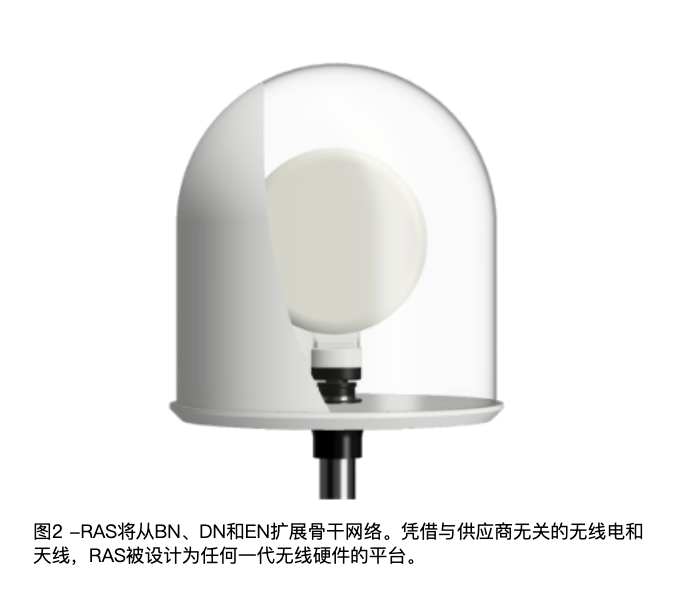
Main functions of RAS:
a) Automatic alignment: The RAS can automatically adjust its direction to achieve optimal signal strength and quality.
b) Multi-band support: Supports multiple wireless frequency bands, including high-frequency technologies such as 5G millimeter wave.
c) Network node: Acts as a node within the DAWN network, capable of receiving and transmitting data.
We aren’t experts in wireless transmission technology or hardware, but you can think of these devices as signal transceivers that relay and broadcast network signals.
This then raises the question: which nodes should install this equipment so that wireless networks can reach end users?
In DAWN’s design, network nodes are divided into three categories:
-
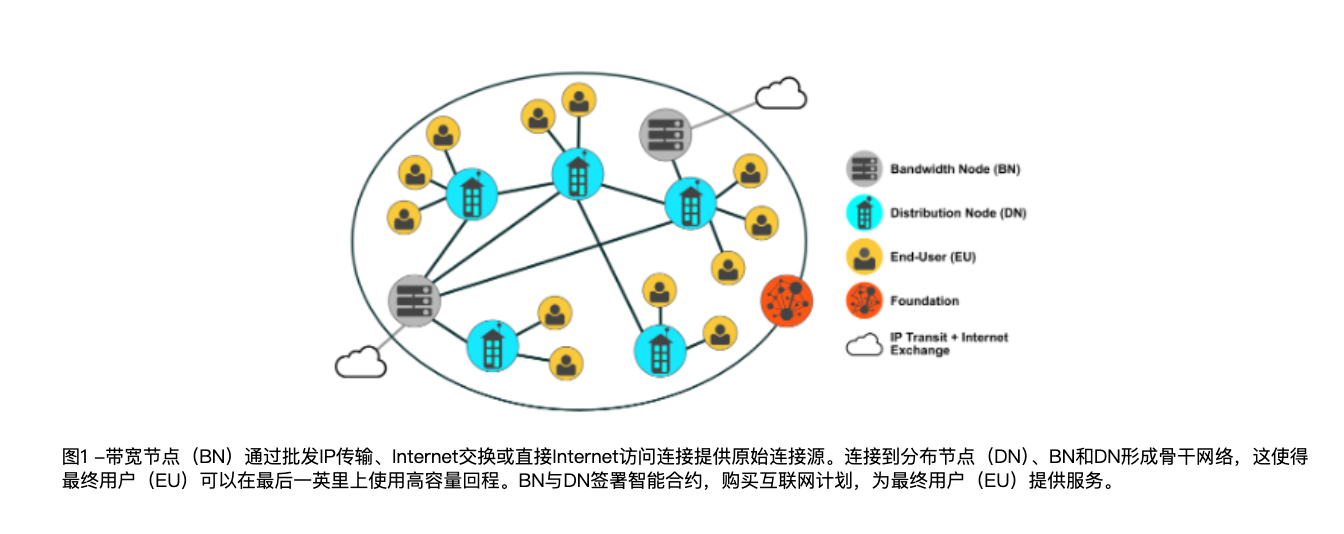
Bandwidth Nodes (BN): Large-scale RAS devices typically installed on data centers or tall buildings, providing primary internet connectivity.
-
Distribution Nodes (DN): Medium-sized RAS devices installed on commercial or residential buildings, receiving signals from BNs and relaying them to other DNs or end users.
-
End Users (EU): Small RAS devices installed on individual users’ premises, receiving internet service from DNs.
Thus, Bandwidth Nodes (BNs) provide wholesale internet capacity for resale; Distribution Nodes (DNs) connect to BNs and further share bandwidth. End Users (EUs) consume bandwidth from DNs—forming a complete “last-mile” wireless network loop.
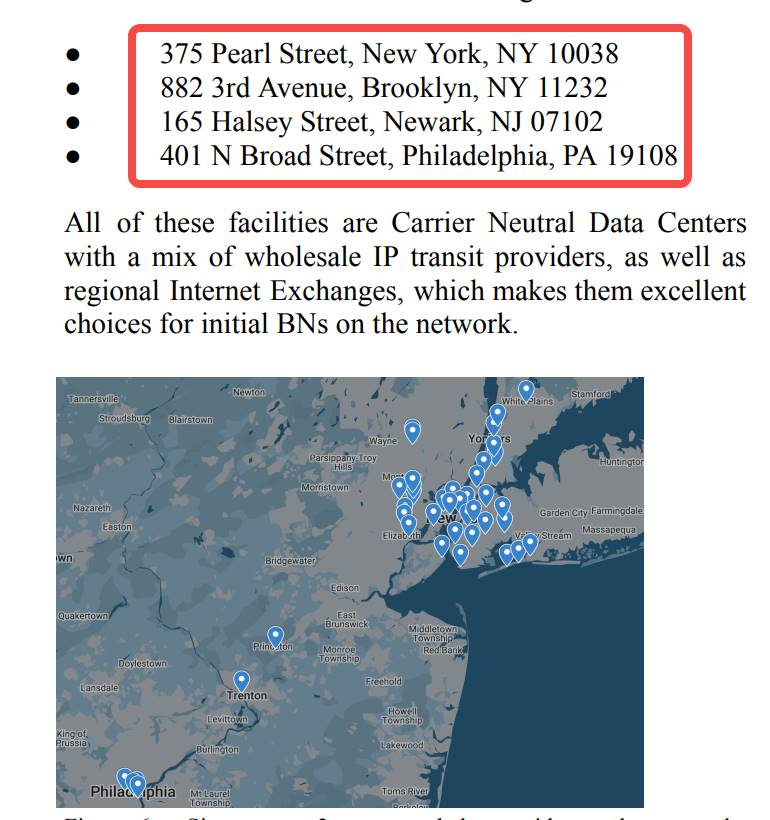
According to the whitepaper, this service is currently being piloted in areas like New York City, aiming to cover over 3 million households across the U.S., with plans to expand globally to Asia, Europe, and Latin America.
Become a Validator Using a Browser Extension
From a service perspective, DAWN’s offering may seem distant to most users. So how can ordinary users participate at this stage?
DAWN offers general users the opportunity to act as validators.
Since different nodes in the actual network deploy hardware to transmit wireless signals, certain parameters need verification:
For example, does your provided network signal cover a certain range? What is the signal quality like?
Therefore, validators in the DAWN network allow others to verify key parameters—such as bandwidth, service quality, and node location—in a decentralized manner, ensuring network reliability and performance.
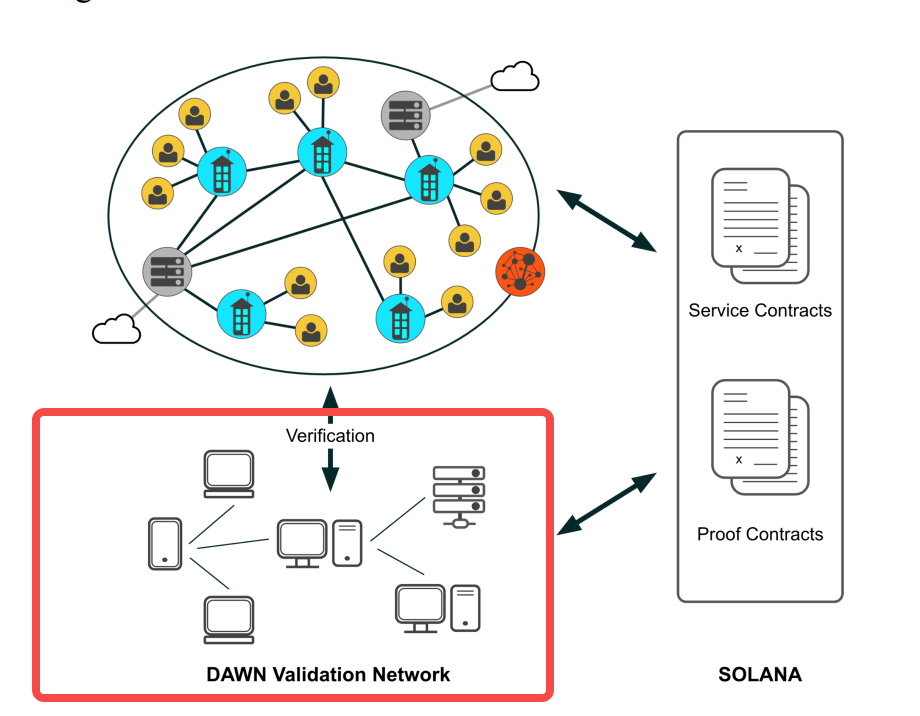
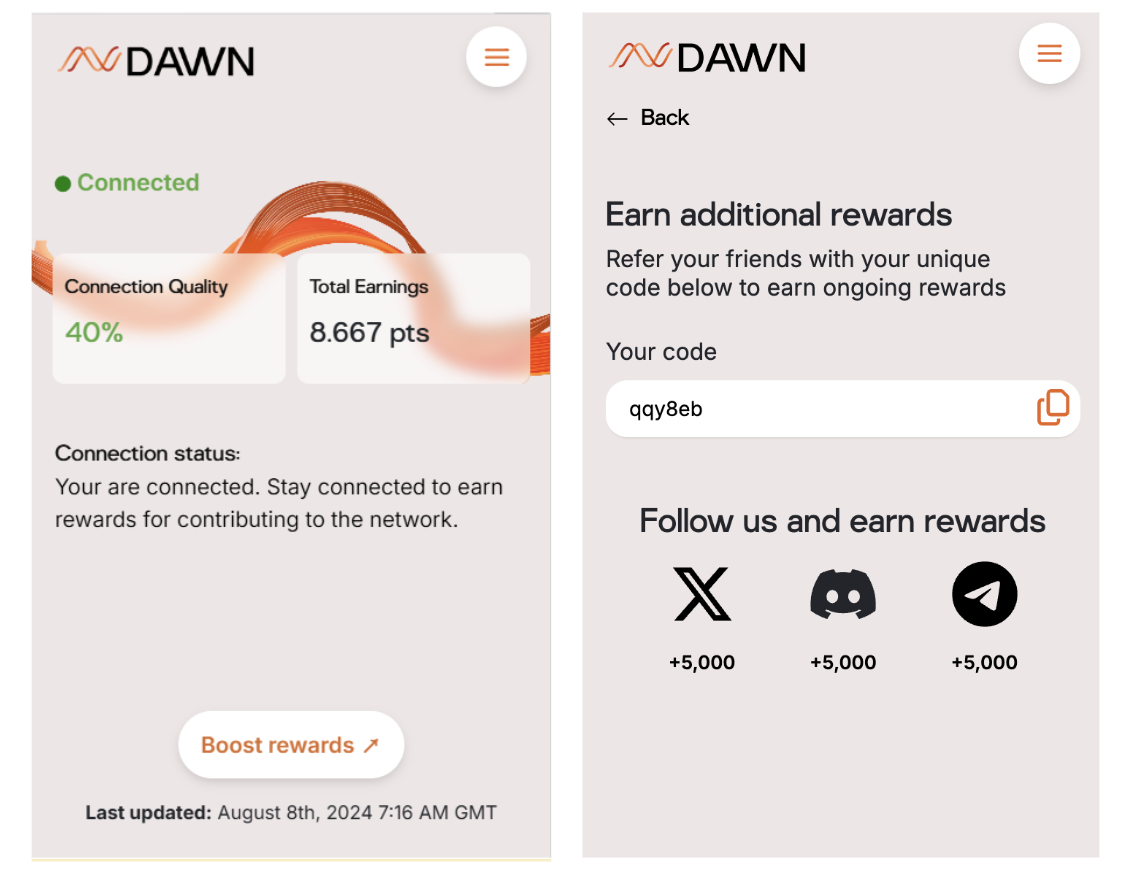
To facilitate this, DAWN has designed a system called the Witness Chain specifically for validation. Currently, becoming a validator involves downloading a browser extension, registering an account, and maintaining connection. Users earn rewards by staying connected, referring others, and participating as randomly selected validators.
Additionally, following DAWN’s social media accounts grants an extra 5,000 points. Interested participants who require an invite code during registration can use qqy8eb to complete the sign-up process and view their reward balance.
Economic Model
DAWN is currently live on testnet and will soon launch on Solana. However, the co-founders have not yet disclosed the timeline for migrating to mainnet or the token launch date.
That said, public information indicates that Neil Chatterjee (@neilc_dawn), DAWN’s co-founder, stated that this funding round significantly exceeded the initial target of 5 million SOL, accelerating plans for a Token Generation Event (TGE).
This has heightened expectations and potential enthusiasm around the upcoming token launch.
Based on current designs, DAWN employs a flexible token supply model, meaning the total supply is not fixed but adjustable according to network development needs.
The whitepaper explains this is intended to support ongoing technological innovation and adapt to fluctuations in telecom investment cycles; however, the actual impact of such a dynamic model on token price remains to be seen.
Meanwhile, the DAWN token serves multiple roles within the network, including:
-
Incentivizing early adopters to deploy network infrastructure
-
Serving as the internal transaction medium for buying and selling bandwidth
-
Accessing network resources such as frequencies and IP address space
Moreover, DAWN introduces a unique “Badge” system: users can obtain a badge by staking 100,000 DAWN tokens. Badge holders can designate specific geographic regions and technologies, increasing reward multipliers in those areas.
Badge holders receive 12% of bandwidth transaction revenues generated within their designated region, incentivizing expansion into high-potential areas.
Regarding token distribution, network nodes (BNs, DNs, and EUs mentioned earlier) will receive 25% of the total token supply as rewards. Third-party validators (i.e., browser extension users) and ecosystem partners will collectively receive 10%. The project treasury, team, and investors each hold 20%, though unlock schedules remain undisclosed.
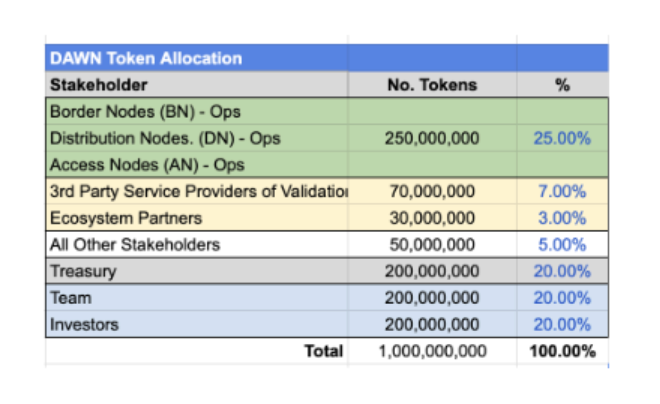
For more details about the tokenomics and economic model, refer to the project whitepaper.
Founders and Team Background
Co-founder Neil Chatterjee was drawn to computer science from a young age. His father worked at Bell Labs, opening the door to the world of technology for him. Neil later attended Princeton University, focusing on robotics.
In 2014, he made a bold decision—to drop out and join a startup as Vice President of Engineering. This move became a turning point in his career.
During a brief stint at Facebook, Neil developed a phone case enabling short-range mobile data sharing. This project gave him deep insight into how collective efforts can solve connectivity challenges. Inspired, he returned to Princeton to build a wireless network covering the entire campus and surrounding towns.
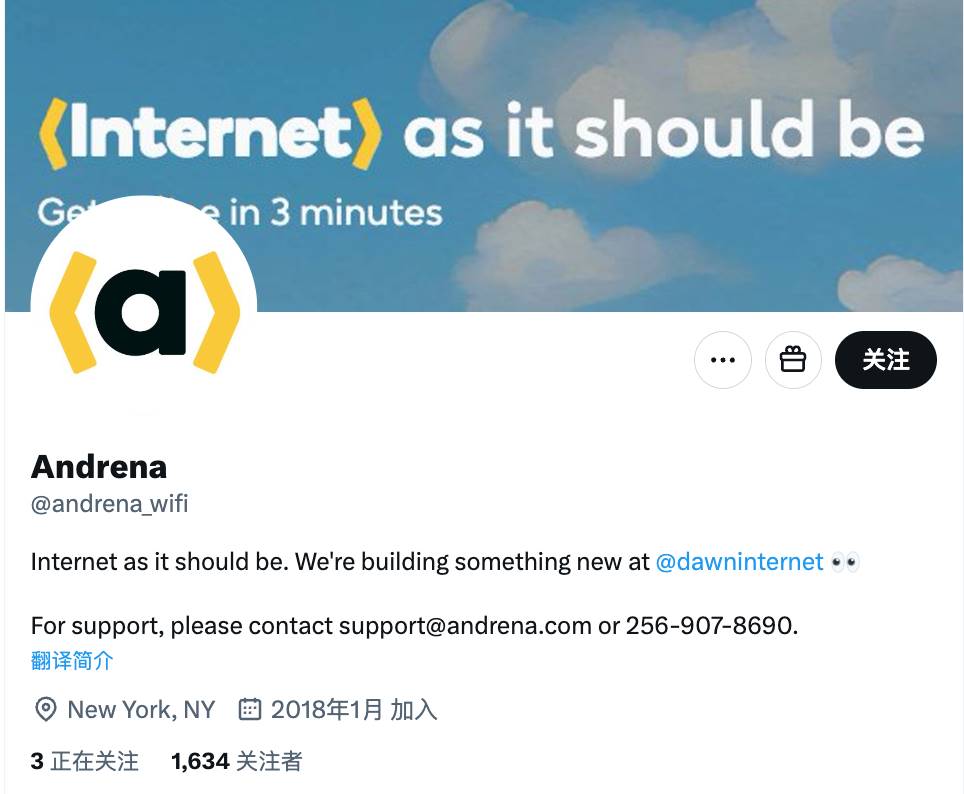
Andrena, the company behind the DAWN project, was founded by Neil himself.
Notably, another author of the DAWN whitepaper is Professor Pramod Viswanath from Princeton University, who is also a core member of Sentient, another prominent crypto-AI project that raised $85 million in a Seed round in July 2024.
DePIN Congestion: Uncertain Future Ahead?
Overall, DAWN aims to enable bandwidth sharing—more precisely, using DePIN hardware to solve the “last mile” problem in wireless connectivity.
In the same niche sector, projects like IO.NET, Grass, and Menson offer similar services. Although their implementations differ slightly, investors often struggle to distinguish between them.
An intuitive observation is that DePIN projects are piling up. In the previous cycle, many well-funded projects saw varying degrees of decline post-TGE. Whether the secondary market will become immune to such projects or enter another round of speculative frenzy after the dust settles will depend heavily on overall market sentiment and conditions at the time of TGE.
Join TechFlow official community to stay tuned
Telegram:https://t.me/TechFlowDaily
X (Twitter):https://x.com/TechFlowPost
X (Twitter) EN:https://x.com/BlockFlow_News
 深潮TechFlow






